PT Burnout Isn’t What You Think
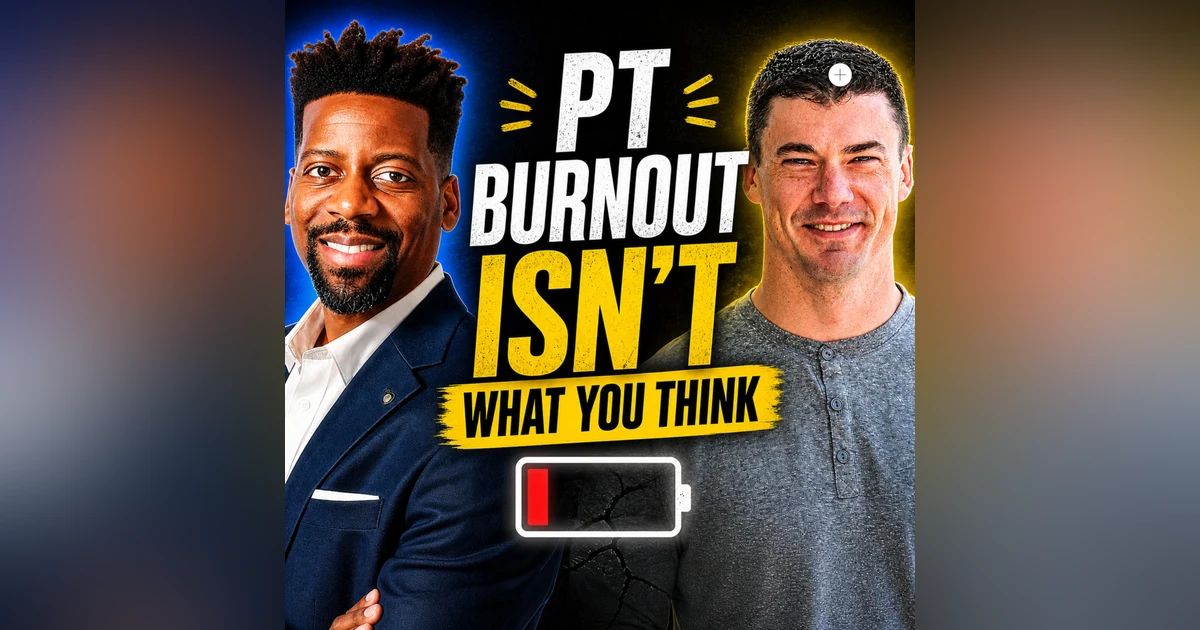


Burnout in physical therapy isn’t just about workload—it’s about how clinicians process stress over time.
In this episode, Jimmy talks with Charles Inniss about why optimism is not a personality trait, but a trainable skill. They break down how burnout develops in PT careers, why cynicism follows exhaustion, and what clinicians and clinic owners can actually do about it.
If you run a clinic, this matters because burnout directly impacts retention, patient outcomes, and culture. If you’re a clinician, this gives you a practical framework to regain control of your career experience.
What you’ll learn:
• Why PT burnout happens even in “good” jobs
• The difference between exhaustion and cynicism
• How optimism works like a muscle
• Simple daily habits to improve mental resilience
• How clinic culture contributes to burnout (or prevents it)
Get His Book: https://www.amazon.com/Your-Optimism-Game-Depression-Happiness/dp/1967115281
Sponsors:
SaRA Health – helping clinics increase revenue without adding staff
EMPOWER EMR – faster documentation and better workflows
U.S. Physical Therapy – clinician-led growth and career support
<p>This episode is part of the <a href="/physical-therapy-business-podcast">Physical Therapy Business Podcast</a>, where physical therapists and clinic owners learn how to get more patients, improve operations, and grow their clinic without relying only on referrals.</p>
<p>Looking for more episodes? Explore the full <a href="/physical-therapy-business-podcast">Physical Therapy Business Podcast</a> for real-world strategies on physical therapy marketing, patient acquisition, and clinic growth.</p>
0:00 You're listening to the P.T. Pinecast, where smart people in healthcare come to make noise. Here's your host, Jimmy McKay. Welcome back to the show. Do you want to say thanks to Sarah Health? They help clinics increase revenue without adding staff. Their remote care platform automates patient check-ins by text, improves follow-through, and supports RTM billing between visits. You don't have to download an app or memorize a password. Learn more at SarahHealth.com. It's S-A-R-A, health.com. Today's conversation, I'm looking forward to this. Our guest started in a world that physical therapists and healthcare providers know well, rehab, movement, helping people recover.
0:41 But along the way, he noticed something a little bit bigger. Many professionals knew how to care for everybody else. but had no idea how to care for themselves. Since then, he's coached hundreds of professionals, spoken nationally, and built a mission around emotional resilience. Today we talk about why optimism may be one of the most overlooked performance skills in healthcare. Ladies and gentlemen, welcome to the show, Charles Ennis. Charles, welcome to the program, man. Yeah, it's great to be on. Thanks for having me, Jimmy. This is my go-to line. Whenever I have someone on that's written a book, which is getting to be pretty often, which I like, I always tell them, I pat myself on the back when I read a book.
1:24 I'm like, look at that. Look at all these pages I read. How great am I? But you sat down to actually read a book. So sort of my go-to when I talk to an author is... Why? What did you see lacking in the world to actually not only want to talk about something like this, but really put time, effort, thought, and energy into writing all and organizing these ideas down? Yeah, absolutely. You know, I think anyone who's in health care or in an educational type of service realizes that they say the same thing over and over again. And not that we mind every time we have a new patient saying the same thing. But I got to this point, I'm like, oh, maybe I can magnify my impact if I can write it once and then hundreds or thousands of people can benefit from that wisdom.
2:19 So let's go back to the start. You started out your background as a PT and a trainer. What did you see early on that made you realize clinician wellness needed more attention? We've heard this phrase, right? Put your oxygen mask on first. But what made you see what did you see and made you realize that clinicians really needed some attention? Yeah. And of course, some of it just came from my own experience. Sure. Like a lot of clinicians, I felt like I was burning a candle on both ends. In the beginning, I was working as a trainer, so I'd be at the gym in the morning training people at six and seven and running off to the clinic and then sometimes running back to the gym and then Saturdays and Sundays. And so it was part of my own lived experience as a new grad, just feeling like I was stressed, overwhelmed and burnt out.
3:04 And of course, I was trying to find some balance in my own life. And hopefully if we all grow, we get a little wisdom and we start figuring out how to navigate our careers. But what I realized is when I got into corporate wellness, that it's not just clinicians, it's really most people in their work settings that we can get into a pattern where we're just stressed and overwhelmed and burned out and in school they teach us about how to be good at our jobs but they don't always teach us how to deal with actually working in the ups and downs of life and so for me i felt that was a gap in the market that yes we're bringing clinicians we're smart professionals we're accomplished but what are we doing to try to make sure that we feel just as good as the people that we're serving Yeah.
3:49 And for the people watching the live stream, there it is. I mean, when you see your cover, what sort of emotion does it bring about? I'll make sure people know. Up Your Optimism Game, How to Turn Stress, Depression, and Anxiety into Joy, Happiness, and Peace of Mind. That's your book. When you see the cover finally, how does it make you feel? You got a big old smile on your face. Yeah, yeah. It does make me feel good. It's been a journey. I actually it took me about four years to go from first putting sitting down, putting pen to paper or letters to keyboard and and getting it out there. And one of the things that I love about my book, like In the beginning, it sounded so differently than it does now. I feel like in the beginning, I wrote it more for my critics.
4:31 And I was trying to figure out, how do I write a book that no one's going to argue with? This Stanford person says this, and this Harvard person says that. And then about the fourth draft, I found my voice. And I'm like, yeah, this is how I would say it. And it really is, to me, a beautiful combination of all my health care experience just pulled over into the emotional world to try to help people to be their best and shine emotionally. Yep. You said PT school teaches us to care for others, but not ourselves, right? So where does that gap show up in most real careers, both chronologically? Like, I'm sure in the beginning, we all have shiny object syndrome, right? You work and you go through school.
5:12 So when you get there, you got a lot of energy. So when does it show up? And where or how can we spot this? If someone's listening, it goes, you know what, that might sound like me. Yeah, yeah. There are a couple of different things that I feel are common that I went through that probably other people went through. And you're right. Initially, that initial burst of joy is connected to our vision about what we see for our career. And so when you have a compelling vision, that's just the coaching principle. You're going to feel motivated and excited. But then somewhere along the path, the vision doesn't turn into the exact vision that we thought. We thought, wait, this is not what I signed up for. And so what I find is that people either get burnt out, they're living the dream, but they're just exhausted, or they get cynical and they're like, what the heck am I doing with my life?
6:00 And so I feel like the exhaustion and the cynicism are two things that sometimes happen at the same time, but they can happen individually. I know for me, I feel like the burnout happened first And then the cynicism kind of came like right behind it. And I feel like that's one of the hardest things I think for people now who are navigating work is how do you contribute, give your best, but not get to that point to where you're just exhausted and cynical? Because that's not a good spot for us and it's not a good spot for the people we're trying to help beat them. This is something I never heard of or thought about in a particular way, which to me is always a compliment. Whenever someone can say, I listened to something that either you or the guest said on your podcast, and there's two compliments.
6:44 One is I never thought about that before. In a world of the internet where you could look at billions of ideas, that's a compliment. Or I never thought about that topic that way, which means they had thought about it, but they never thought about it that way. You made them look at it differently. And you made me look at something differently. Yeah. I've looked at optimism, but you say optimism is a skill. I've never thought about it as a skill. I've always thought about it as sort of amorphous, an emotion, something you might have, hopefully more often than not. What does optimism as a skill actually mean for someone who feels burned out right now? Yeah, absolutely. And so I know most people define optimism as just like a positive outlook.
7:26 But what I would say is that optimism is any thinking pattern that generates positive emotions. And so I'll say it this way to kind of bring the PT kind of part of it, because when most people think about mental health, actually I'll say this, it's two buckets for me. It's cognitive function, and then it's positive emotion. So if someone says, oh, I'm worried about my mental health, if we think about something like Alzheimer's, in Alzheimer's, our mental health deteriorates, but it's a cognitive function problem. And that is more associated with our brain health. And so if we think about the other challenge though, the positive emotions, sometimes a lot of us, our brain functions really well, but we use it in ways that make us angry, cynical, stress, fearful.
8:18 And so what I would say is that just like we have physical muscles, we also have mental muscles. Our physical muscles generate movement and our mental muscles generate emotions. And then from a mental muscle perspective, we have two categories. Pessimism muscles generate negative emotions like anger, stress, worry, anxiety, and then optimism muscles generate positive emotions like joy, happiness, and peace. If we want to take care of our mental health and feel more joy, happiness, and peace, we have to strengthen the mental muscles that lead there. Actually, the way I wrote it in a book, there's three core optimism muscles and gratitude is one of them.
8:59 If we just take this as connected to work, When we're new grads, we get into our job and we're so grateful. We got a new job. We got a salary. We're making money. We're growing. We're learning. We feel good because we're in that spirit of gratitude. And then we start taking everything for granted. Our salary is not enough. We don't like our boss. We're not happy with anything. And we're just living in that more ungrateful mindset towards work. And it's so easy to think about the things we don't like about work. And one simple way we might, if we're just thinking about optimism in connection to work-related emotions, if we start bringing a little gratitude for our work, then that's gonna change our experience of our work.
9:41 And so again, how we think influences how we feel. And if we start practicing the patterns that lead to the positive emotions, then that's the way we can up our optimism game and get the benefits. I've heard about people practicing gratitude, saying things publicly, right? And I don't think anybody has a problem with that, either expressing someone who actually you're grateful for or being expressed gratefulness. If that's one of the muscles, what else would be on your home exercise program for those three muscles? What else can we do? Because again, I've looked at optimism like something I have sometimes and sometimes I don't.
10:22 But you're saying it's a muscle. I like that. What else would be on your HEP? Something that someone does every day or every week or something to check off? Exactly. It's perfect. And so the way I think about working out our optimism muscles, and of course, I think we can do like a five minute optimism workout. Good. I consider breathing as the warm up. thinking as strength training, speaking as cardio, and writing as stretching. And so simple example, if we wanted to strengthen our gratitude muscles, we could start with three or four deep breaths, try to ground ourselves, get ourselves in a state of mindfulness so that our brain is ready to learn.
11:02 And then we can use positive questions as our weights. Anytime we ask ourselves a positive question, we're gonna strengthen the pattern of thinking connected to that question. So if we wake up and say, what do I hate about work? What is missing? Then that's gonna strengthen that thinking pattern. If we ask, what am I grateful for at work? what's present in my life, what's working, then that's going to strengthen that. So positive questions are our weights. And it can be a thirty second to two minute just thinking about the answer as a way to strengthen that pattern. Then from a cardio perspective, we can do cardio in two ways.
11:43 We can talk to other people or we can talk to ourselves. And so when we have a positive conversation about a topic, that strengthens that thinking pattern. And we all know this. What we say out loud carries a lot of weight in our brain. And so we can talk to ourselves. There are good things in my life. I'm grateful for all the good. I'm truly blessed. I'm grateful for my family. I'm grateful for my health. I'm grateful for my job or whatever it is that we say. But using our voice is simply a way to magnify. And I always think about cardio with affirmations because I feel like, you know, you can just keep walking through those phrases. There are good things in my life.
12:23 I'm grateful for the good. There are good things in my life. I'm grateful for the good. And so just simply repeating and practicing is one way you can strengthen that pattern. And then lastly, if we think about stretching, we can go a little deeper and train our brain. We can have a gratitude journal where we write one to three things that we're grateful for. We could write a story about something that we feel gratitude towards. And from a learning perspective, when we're incorporating all those processes, the auditory, the kinesthetic, the cognitive, it just really deepens the pattern. And we can do it in less than five minutes. But of course, if we don't even have five minutes, we could choose any one of those elements.
13:05 Strength training, think about the answer to a positive question. Speaking, say something positive out loud or to someone else. And then writing, writing down some positive thought or intention. That's a good HEP. Five minutes, that's all you need. Five minutes a daily. And this is the beautiful thing I love about mental training is I feel like we can get a big bang for our buck in a lot less time. If you wanna get in shape physically, all right, you gotta do your hundred and fifty minutes of minimum activity to meet the non-sedentary standard. In one study on gratitude, they took people who were depressed and they asked them to simply do one intervention. At the end of the day, write three daily blessings.
13:47 Three things that went well. And what they found is that after six weeks, people had a significant decrease in their stress and anxiety and a significant improvement in their happiness and life satisfaction. And it didn't take a long time. It's three to five minutes to just do your journaling. And the beautiful thing about our mental habits is once we ingrain a positive mental habit, it follows us. And so we just start naturally walking outside and looking for what we're grateful for. We naturally start interacting with people differently. We naturally just show up at work differently. And so once we it's a snowball that can feed on itself and build an upward spiral of positive emotions and positive.
14:29 I didn't see it, but this book screams to have a partner podcast. Like I feel like you walk five minute episodes a day, walking everybody through a different HEP each and every day. I don't know. It feels like a QR code on the back of the book that leads to your YouTube channel. Your podcast would be a layup. You know, I appreciate that thought and I've been thinking about it and like being on your podcast is inspiring for me because I know to take those skills that we might have in one setting and then to use it in somewhere else. Yeah. And so you've been an inspiration and maybe the podcast will happen one of these days. Tell us about the moment you treated one person in clinic and coached another in the gym with the same back pain, but two very different mindsets.
15:13 Yeah, that's such a beautiful question. And it's actually one of the reasons why I leaned away from rehab and into wellness as a trainer. Really early on, I was working in a spine clinic in Quincy, Massachusetts, just south of Boston. And a forty year old guy came in with back pain. He was like, Charles, my back hurts. Can you rub it? Can you work on it? Oh, I just I had a long day. And I'm like, this is physical therapy. You're going to do physical stuff. You bring the physical. Not that I mind doing manual therapy, because that's one thing that I miss about being in the clinic is doing the manual therapy. And then later that week, I was in the gym with a new personal training client, a prospective client.
15:57 And he came and he's like, Charles, you know, I sit all day at work. I never stretch. I know I'm overweight. I got a weak core and my back hurts. What do I do? and i was like oh shoot i'm like this is the same person but in the fitness environment they're coming in a little bit more proactively and so i was like you know as a professional i'm like i want to try the demo on that proactive side where i'm trying to encourage people to do something proactively and have hope And and what else is not everyone in the clinic comes in with that more victim defeatist mindset. But I realized that when I saw that difference in the clinic, I needed to help inspire people to take some ownership and feel some hope that they could actually make progress.
16:45 And so I feel like being in both of those worlds definitely shaped my perspective. And when I became a coach, this is one of the first reason why I actually got into optimism was in its ability to support people and feeling motivated to reach their goals. So I'm sitting in the office. I'm talking to someone about their health and wellness goals. And this is so simple. Everyone already knows this. if someone has zero hope that they can be successful, they won't try. And so for me, I'm like, okay, how can I support someone in developing a mindset that's conducive to motivation and going after their goals? And of course, optimism and hope is a key.
17:28 There's a chapter in my book called The Anatomy of Motivation, chapter three. And of course, this was inspired by my coach training. But from a behavior perspective, we're motivated by one of two forces, approach and avoid. And negativity is the underlying mindset of avoidance. And if we are focusing on the challenges, the problems that come with changing our behavior, we're gonna avoid changing the behavior. So someone might think, oh yeah, I really wanna go to the gym, but the gym's gonna cost money, and it's gonna take time, and I'm gonna be sore, and I'm gonna have to miss out on this.
18:11 Whenever they're thinking about the negative aspects of making the change, they're gonna avoid the change. Sure. But on the flip side, if we can tap into the positive aspects of making the change, my knees might feel better. I might lose some weight. My blood pressure might come down. I have more energy. I'll sleep better. I'll be able to run around with my kids. Then when they're focusing on the positive aspects, they're going to be more likely to approach the change. And so that was one place where optimism was important for me to help people get healthy. If I take it a step further and how we think about ourselves influences our motivation. And when people focus on the negative aspects of themselves, their weaknesses, their past mistakes, their feelings, they're going to feel less confident and less up for the task.
18:59 Oh, I tried to go to the gym in the past and I never stick to it. And last time I did, I messed up my shoulder and versus if they think about the positive aspects of themselves, their strengths, their abilities, their past wins, their past successes, they're gonna feel more confident and more ready to go for it again. And so again, it's a simple way that optimism shows up in success, in growth, We need to think about our hopes, our dreams, our vision, what we can gain. And we need to think about our resources, our abilities, our strengths. And so as a coach, that was really one of the things I loved about optimism. How can I support people in getting ready to charge up that mountain and live their best life?
19:42 It sounds like when you say you're talking to the same person in two different settings, how they see the goal and the process and how you see the goal and the process, I mean, it matters, right? What are my expectations here? Let's go back to physical therapists. We're smart people, but what do most PTs get wrong about stress management? Where do we go right? We're smart if we read something and we love research, but what do we typically get wrong about it? Yeah. One of the things that pops into my mind is, and this was like for me, when I think about stress, I think about both body and mind.
20:23 And because we're such educated body professionals, we tend to lean on body care. So someone was sitting in front of me and I would think, OK, you're stressed. How's your exercise? How's your sleep? Are you meditating? Get an Epsom salt bath, get some magnesium, do all these things for your body. And what I'll say is that body care strategies are great for stress when the stress is being driven by our body. But what I notice is working with clients is someone would take care of their body on Saturday, go for a run, eat a good meal, get a good night's sleep. And then on Sunday night, they still feel anxious and stressed thinking about work. And I'd be like, oh, shoot.
21:04 And so if the stress is being driven by the mind, then we need some type of mental strategy or mind care strategies, as I refer to it, in order to overcome the stress. One simple mind care, which I think for people is worst case scenario. Many people, when something happens mentally, they go to worst case scenario and it adds stress and anxiety overwhelm. And so I could go for a run, but if I come back and I go to worst case scenario, I'm still going to feel stressed. I can meditate, but if I go to worst case scenario, I'm still going to feel anxious. And so one simple mind technique or mind exercise is called decatastrophizing.
21:47 And it simply involves thinking about the best case scenario and then thinking about the likely scenarios. And even if thinking about the best case scenario doesn't eliminate the possibility of the worst case, it just makes the overall picture more positive. And so it tends to serve to decrease our anxiety. And if we're thinking about how we're going to navigate the stressful situation, when we do it from a more grounded perspective, our cognitive function and our judgment is going to be better. And so if we're in that worst case scenario, sure we can do deep breathing, but we also need to mentally think best case scenario, likely scenario, and then from that place.
22:30 our judgment is usually heightened. So I would say that not just PTs, but a lot of people, but especially PTs, because we're so good at the body. Like that's just, that's our world. Right. When you, when all you have is a hammer, the world is full of nails. Right. So we go body first. Yeah. It's in the name. Absolutely. Absolutely. Let's go tactical because if someone is doing this on their own, that's great. But if where you work helps to facilitate this, how great would that be? So if you owned a clinic or you were brought in to help run a clinic, what would you do to improve staff emotional health without just throwing money at the problem? Because throwing money at the problem most of the time doesn't work and you're not going to get the money anyway.
23:11 So if you owned a clinic today, what would you do to improve staff emotional health? Yeah, yeah. I think that clinicians and clinic owners have lots of options. And I think that from a coaching perspective, I'll say this, collaboration is always, I think, a little bit more beneficial than pure directive. And so if there is a way to collaborate with the people that you're trying to uplift and support, then that can go a long way. And so I think that Actually, I'll say it this way when I think about stress. And you know it because you got a copy of my book. The anatomy of stress. Stress is going to be driven by four things, our situation, our behavior, our body, and our mind.
23:56 And so if we can change the situation through behavior, that's a great place to start. And so there may be a clinic practice will look and say, OK, what can we change structurally? What can we do something from a behavioral perspective that just naturally leads to more enjoyment? I've had a bunch of friends here in Massachusetts who have gone to a more one PT one client model. And I know that a lot of PTs tend to like that model more. So I have a buddy who has a big practice and like they started to expand like the amount of time that a PT could have with a patient.
24:38 And so again, like in every practice on this knows their business better than me. But what I'll simply say is that there can be potentially things that we do to just make the overall environment just a little more supportive. Beyond that, we can think about how do we support people physically. And I'll also say this, I feel like culture is one of the words that gets thrown around a lot. It does. And I do feel that optimism is a part of the culture that can just really revolutionize how we interact. Simple example, I refer to connection as a mental skill.
25:21 And we know that when people feel connection in an environment that they thrive and they feel less burnt out, less stressed. And so a couple of thoughts about connection muscles. When we relate to people in a negative way, it weakens connection. When we relate to people in a positive way, it strengthens connection. And so, simple thing, gratitude and appreciation. I know those are two different things, so gratitude. If we are creating a culture where we're expressing gratitude and appreciation for each other, then that goes a long way. I'm thinking about something, you know, I'm in Boston and there was this study on teams.
26:01 And it was, they actually used the, I think it was the, the, I think it was the, I think it was the, I think it was the, I think it was the, I think it was the, I think it was the, I think it was the, I think it was the, I think it was the, I think it was the, I think it was the, I think it was the, I think it was the, I think it was the, I think it was the, I think it was the, I think it was the, I think it was the, I think it was the, I think it was the, I think it was the, I think it was the, I think it was the, I think it And they wanted to see how many times did the players touch each other? Oh, I saw this. This is interesting. Yeah. You know, high five, pats on the butt. And what they found is that the Boston Celtics in that year, they had the highest touch percentage of any team. They just were congratulating people and living in this spirit of service and support. And they went on to win a championship that year. and so what i'd say is that when we're in a company if we can start and i feel like the leaders can can be the ones if the leaders are leading with gratitude and appreciation more so than criticism and blaming and i know it's hard because like sometimes as a leader you're like i want people to do the job And so what I'd say is criticism, I would consider a pessimism muscle.
27:05 What are your flaws? What are your mistakes? What are your weaknesses? What are you doing wrong? What do I not like? And the optimism muscle would be appreciation. What are your strengths? What are you good at? What are you doing well? What do I like about what you're doing? And so simply if we start shifting and start being more appreciative, then that can just go a long way to make people feel empowered. And when we're connected to something that's meaningful, the hard work actually uplifts us. When we feel like we're doing something that's meaningless and we're not getting any appreciation, that beats us down. And so again, I know we could probably talk about it for a lot, but what I'd say is that a culture that is more optimistic and appreciative will always be the culture that is more cynical and negative and critical.
27:56 Yeah. You ready for a quick rapid fire game? I didn't prepare you for this, but we're in a rapid fire. Sure. Best sixty second stress reset. What would you suggest? Yeah. For me, I'm thinking going outside and sitting outside for sixty minutes and just breathing. Touch grass. Yeah. No technology. Just in nature. Breathe for thirty seconds, sixty seconds and go back inside. Besides yours, a book every rehab professional should read. What do you like? Actually, one of the books that really informed my book, and I write about it in chapter four, is The Upside of Stress by Kelly McGonigal.
28:39 It was a beautiful book that completely changed my perspective on stress. Actually, there was a study in nineteen ninety eight where they interviewed thirty thousand people and they asked them, do you have a positive view of stress or action? What they asked them was, do you think stress is harmful for your health? Yes or no. Actually, I'm messing up the study, and that's funny because it's what I've talked about. They actually asked them if they had a lot, if they experienced a lot of stress in the previous year. And then the second question was, do they think stress is harmful for their health?
29:20 And what they found years later when they looked at the death records is that people who had a lot of stress and thought it was harmful were forty three percent more likely to have died. Wow. But the weird thing is the group with the lowest mortality were people who had a lot of stress but didn't think it was harmful for their health. And it led the researchers to conclude that the perception that stress is harmful is likely causing excess deaths. And so we know this from a, if we think about placebo effect, most clinicians are aware of the placebo effect. But what we don't often think about is the nocebo effect.
30:04 which is our thoughts can actually cause harm. And so how we think influences how our body physically responds. And so the way she collected the researches on expectation theory and nocebo effect, and it was just such a beautiful way to just change how I talked about stress because I used to tell people, stress is gonna kill you, avoid it, it's toxic. And by me making stress out to be such a villain, especially because it's something that people cannot escape, I was actually adding to the anxiety and probably the negative effects of stress. And so that book really did change how I thought about stress and played a large role in how I talk about it in my book.
30:47 So yeah, The Upside of Stress by Kelly McGonigal. It's a beautiful book. Good one. Most underrated daily habit. What's underrated that you'd say, hey, listen, if you add this, best juice versus squeeze ratio? Yeah. The first one I'll say is optimism, but I know that's just like a layup. But if I have to choose another one besides optimism, I feel like optimism can go in so many different ways. Actually, I'll stay with optimism. And what I'll say is that I think if we appreciate ourselves and practice self-appreciation, it's something that can just change our experience.
31:29 Most of us are our own worst critics. And we go through life beating ourselves up. And it makes us feel inadequate, depressed, frustrated, less than. And if we just spend a little bit of time appreciating our goodness, man, we're just going to shine so much brighter. So, yeah, self-appreciation is something that I'll say that it's it goes under the radar, but it just shows up in everything that we do. All right. We have a tradition on the show. It is called the parting shot. This is the parting shot. One last mic drop moment. No pressure. Just your legacy on the line. I want to thank US Physical Therapy for supporting the show and keeping this thing on the air.
32:11 They're a national network of clinics focused on developing clinicians through mentorship, leadership tracks, and long-term career growth. Learn more at USPH.com, plus our friends at Empower EMR. If your clinic is stuck in an EMR that slows you down, it's not very optimistic. Empower gives you faster workflows, cleaner documentation, and support PTs actually appreciate. Upgrade your clinic's brain at EmpowerEMR.com. So, Charles. Parting shot. You can give us your own mic drop moment, quote, idea, anything, or I can hit you with a parting shot question. It's completely your call. Yeah, if you've got a question for me, yeah, go for it.
32:51 So if every person listening today could build just one stronger inner muscle over the next year, gratitude, resilience, optimism, discipline, which one would you choose and why? Hmm. Oh, man, that's a really great question. I'm going to choose faith. And what I'll say is I know that in a world where sometimes people want to run away from religion, they also run away from faith. But there's a quote that has been my guiding principle as a person and as a coach that comes from Dr. Martin Luther King. And it says, faith is taking the first step even when you can't see the whole staircase.
33:37 And I think a lot of times, especially for highly educated adults, we've learned to master certain areas of our lives and we want to act with certainty. And so we just naturally want to research and know before we try. But sometimes that keeps us stuck. And if we can embrace the idea that life is never a hundred percent certain and develop faith in ourselves, develop faith in other people, develop faith in a higher power, and just take that first step, then I think that that's going to be something that really will lead to our growth and success. That's a great quote. It's a good one. Not the first time it's been used on this show.
34:17 Up your optimism game, how to turn stress, depression, and anxiety to joy, happiness, and peace of mind. I don't know. Could the world use a little more joy, happiness, and peace of mind? I think it could. Best way for the people to pick up the book. I know it's on Amazon, but is it anywhere else? Amazon's probably the best place. You can get it in Kindle version, paperback, or even hardback. Yeah. I say pick it up in paperback. You want to pick this thing up and you want to hold it. It's a great read. Kudos for you on caring about this topic enough to not only research it for yourself, but put the thoughts in order and sharing it. So kudos to you, man. Congratulations on writing this book. Yeah, it's been a labor of love. I'm glad that it's out in the world.
34:58 And I appreciate you for allowing me to talk about it. And hopefully, you know, with this exposure, we can help one clinician, one person, one somebody to find a path so that they can have more joy and peace, allowing them to make the biggest positive impact at home, at work and in the world. Sounds great. Charles, thanks for the time. I appreciate it. Yes, very welcome. I appreciate you. That's it for this one, but we're just getting warmed up. Smash follow, send it to a friend, or crank up the next episode. Want to go deeper? Hit us at pgpiecast.com or find us on YouTube and socials at pgpiecast.
35:38 And legally, none of this was advice. It's for entertainment purposes only. Bulls**t! See, Keith? We read the script. Happy now?