Why Doing Less Makes Your PT Clinic More Profitable

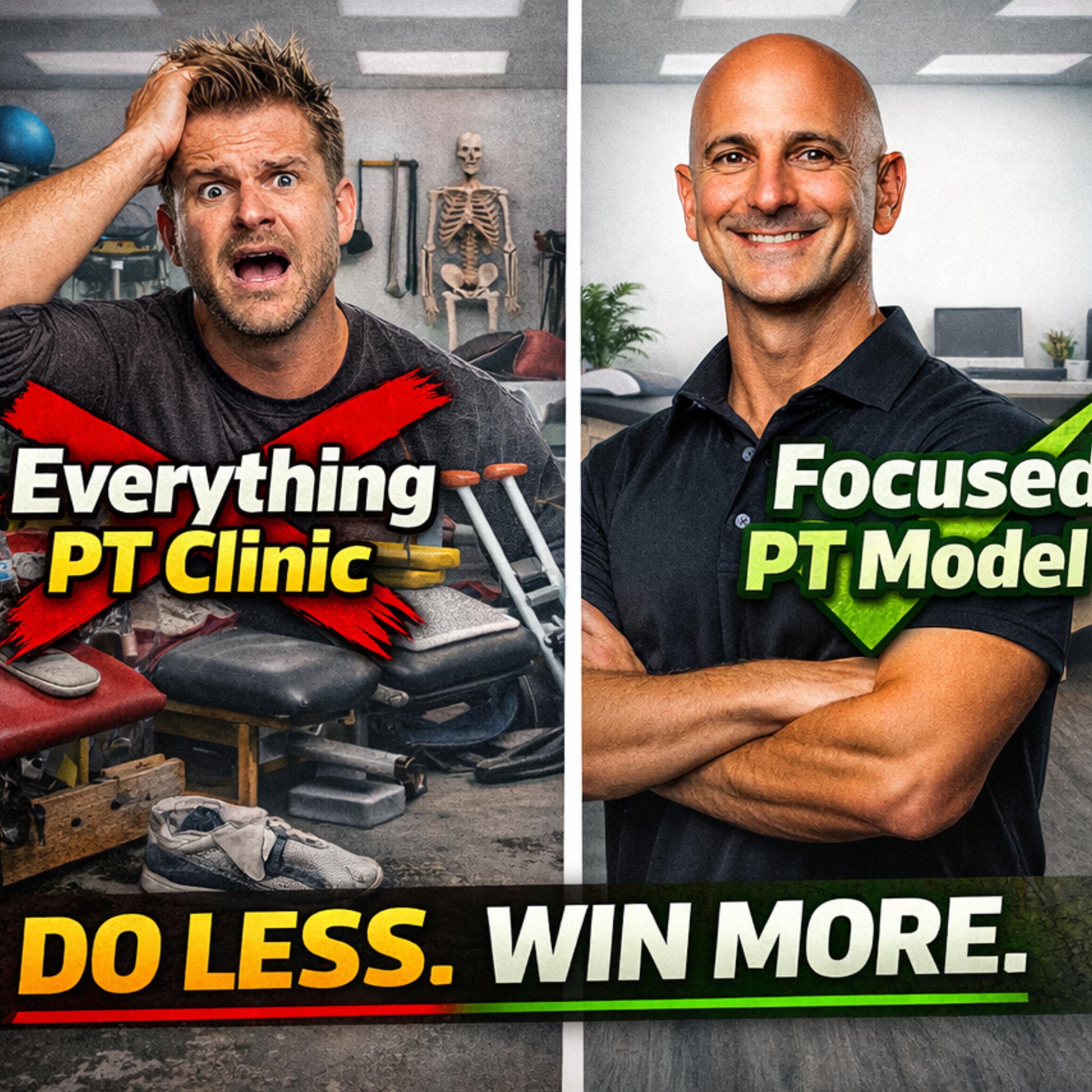


This episode challenges one of the biggest assumptions in physical therapy: that offering more services leads to better outcomes and business growth. Instead, the conversation explores how narrowing your focus can improve efficiency, hiring, patient experience, and long-term profitability.
Key Insights:
• Clinics trying to serve everyone end up differentiating to no one
• Simplifying services improves operational efficiency and staff clarity
• Hiring becomes easier when your model is clearly defined
• EMR and technology can create defensible business advantages
• Most PT clinics blend together—clear positioning is rare and valuable
• The biggest missed opportunity in PT is saying “no” to the wrong patients
• Business skills—not clinical skills—often determine clinic success
Why This Matters To PT Owners:
If your clinic feels chaotic, hard to staff, or difficult to grow, the issue may not be effort—it may be lack of focus. A clear model reduces friction across hiring, operations, and marketing.
Guest Links & Resources:
Tony Maritato – Total Therapy Solutions (YouTube)
<p>This episode is part of the <a href="/physical-therapy-business-podcast">Physical Therapy Business Podcast</a>, where physical therapists and clinic owners learn how to get more patients, improve operations, and grow their clinic without relying only on referrals.</p>
<p>Looking for more episodes? Explore the full <a href="/physical-therapy-business-podcast">Physical Therapy Business Podcast</a> for real-world strategies on physical therapy marketing, patient acquisition, and clinic growth.</p>
0:02 Broadcasting way too early from three separate Wi-Fi connections. It's PT Breakfast Club with Tony Meritato, Dave Kittle, and Jimmy McKay. I almost said happy Monday, but it's Tuesday. Happy Tuesday to you, Tony Meritato, Jimmy McKay. Dave Kittle is out this morning. What do you want to lead off with first? We got to hang out in Hawaii. I almost said Hawaii. Wow. Maybe I should have more coffee. Ohio. Great state of Ohio. They're virtually the same. I want to talk about that, but Dave said he's got a call-in question. Yeah, I wonder what that is. We'll get a call-in question from him as well. It was good to see you in person.
0:44 APTA Ohio turned, uh, seventy-five years young. And they threw a conference and a party. I don't know if I told you, I haven't gone to any events like that other than PPS because I came to meet you last year. And then that was the second live event that I've been to in probably fifteen years. And both times, both times I've walked away with realizations that we can discuss. But is Dave on the phone yet? No, not yet. Okay, when he is just jumping, yeah, I think the big takeaway, like, and this probably applies across all aspects of life, you know, politics, religion.
1:33 I get there, I talk to the people that I would have been mauling. And they've got great ideas. You know, you introduced me to Drew. You introduced me to a couple other people from APTA. If I stay in my silo, if I stay in my bubble, I feel like those guys don't know what they're talking about. Those guys have terrible ideas. They're, you know... Out of their minds. But once I talk to them and I ask them a couple of questions, I'm like, holy shit, these guys are normal people. They have great ideas. They understand the same problems that I'm dealing with every day in the clinic. It just doesn't come across until you're face to face with another human being.
2:16 Yeah, I mean, my ultimate hostage negotiation diffusion moment is when people are like, APTA sucks, or APT this, or APT that. I say, which person? Right. Show me. It's just a collection of people. It's just a bunch of people. And the people that work at APTA, run APTA, or are part of APTA, no one is saying that they're perfect. In fact, they're blatantly aware that there are piles of imperfection everywhere. It's just when you boil everything down, when you reduce the fractions, you have two choices. It's like come together or stay apart. And this is not a plug to join APTA. I always, I did this at a student event a couple of weeks ago, maybe like two months ago.
2:57 And you would have thought like, it was like saying God didn't exist at a church. A student raised its hand and said, in front of a panel, there was a bunch of speakers who had already spoken, some about APTA, some about other stuff, and said, why as a student should I join? And someone, Ben Aguila, gave a great answer. And then I said, may I answer? And they said, sure. And everybody in the room assumed I was going to bang the drum and say, join. And I didn't. And I said, you shouldn't join. And the room was like, and I said, until you understand what you're looking for, then look around APTA and see if that's there. If it is, then join. If you're looking for something that isn't there, don't join. You're going to be upset.
3:38 You're going to be rightfully upset. Here's the thing though. You can probably find some of what you're looking for. Maybe not the complete answer because it might not exist yet. It's just a pile of people who really want to solve this thing, but they're imperfect. I get so bullish on it. Because when you get a room, I mean, Ohio had, you know, four hundred and fifty something people for a one and a half day conference. Then they had a big old fancy party to celebrate their seventy fifth anniversary. I get excited about piles of people because I'm a joiner and I and I recognize that. But I get excited about things like that because I'm a joiner. I don't think it's perfect.
4:19 I still think it's untapped because the answer, the call is always coming from inside the house. The answer is always inside the room. Dave's on the phone. Dave, what's up, man? Good morning. Good morning. I am a first-time caller, long-time co-host. Where are you right now? Are you home? Are you on the road? No, I'm at home. I'm about to leave, though. Gotcha. All right. What's your call-in question? question is there is a new website. I think it's mostly around New York City, but it might be in other cities. damnlines.com D-A-M-N lines dot com. So this is a bunch of security cameras that someone put up across the street from busy pizza places in New York City.
5:06 So basically you could track, you could look at damlines.com. Before we go to Lendistry Pizza, I want to see how long the line is because I don't want to have to wait too long and we want to go in there. It's not a big line. And so it's just a new... website out there the thing i wanted to ask you guys is let's say if i hypothetically screenshotted it or i screen grabbed the videos from one of these locations obviously this these locations are brick and mortar they they do not look like my outpatient physical therapy office but if i posted it and you know made a joke but i don't know said like this is the demand that we have a concierge pain relief like we have a line out the you know out the front door My question would be, is there any potential blowback or negative Will I need to say it's a joke or something like that in the post?
5:57 Is it in good humor? Is it bad? Sometimes I have these questions when I'm going to post something. Is there any negative blowback, negative sentiment that I could incur because of it? I'm trying to communicate that we have demand and all that, but not to the level of popular pizza place demand, if that makes sense. Yeah. I think the website's interesting. I think your question's interesting, too. It's like we... That's a transaction. You already decided you want pizza. Now you're deciding, where do I want the pizza? And then you're picking, which place do I have to wait the least amount of time to have the pizza?
6:39 Are people going for pizza having that same conversation? That's decided way in advance, right? Definitely not. Definitely not. But it looks like there was some of the images of like the videos of some of these security cameras where it didn't show like the pizza place's name, right? So I was going to, if I had posted something like that on our Instagram about our practice and say something like, you know, concierge, we've got to line out the door. I mean... obviously it's not our office but people might not know that it's our office so my point is like if i posted it how much of the unknown public although not that we have reached like tony's uh account like total therapy solutions but if i posted it would it have some, you know, negative because it's comparing us to pizza or maybe people don't even know that the whole website is made for these pizza places.
7:30 Yeah. I think it's, I think it's so early in this thing. I've never heard of it. I think it's so early in the thing. I think people could figure it out. Like it's a webcam. Um, you know, I've seen, go ahead. Let me come in. I think the best, the best way I've seen this done kind of to what you want to do, Dave, are the people, and this has been a trend for different little like service providers, I think gyms, and I've seen PT clinics do this where they, they do a couple cuts on the video. Maybe they push somebody out the door or they steal something from somebody. Then they slam the door shut, lock it.
8:11 And the person's like banging on the door from the outside. Like, let me in, let me in. They show you taking somebody's possessions, their wallet, pushing them outside, then locking the door, then banging on it. And you're like, look, you know, people are dying to get into concert pain relief. So there are some funny ways you can do it. But I think if you just wanted to show something like that and kind of, if you keep it funny and, you know, not too serious, I think you can get away with it. Almost like a satire kind of thing saying, hey, look at the line around the block for pain relief, you know, or whatever.
8:52 It can be done. I just think it should be done in a comedic way. I mean, I'm guessing it's using some sort of AI technology because there's no way someone's watching these things, but it's showing data of the wait time and how many people were in line based on... I think we're talking about two different things. I think Dave just wants to use the image and say, hey, look at all the people waiting to get into my business. I think totally. I think what you're asking or what you should be asking is what Tony's saying, which is like there's a trend going on. Jump on the trend. I've seen a version of the trend that Tony's talking about.
9:32 I've seen a version where a guy's just walking towards the camera and a group of girls are walking away. And then as soon as the girls get next to him, he just screams something ridiculous and they all sort of spin around and he's just like putting his sunglasses on. Like, yeah, everyone's paying attention to me. Like, I get it. And like the whole, the whole video is the joke. Like, it's like, yeah, I have to do something ridiculous. No, I think playing off a current trend like that would be great. I don't think you face any blowback. Love it. Yeah. And Tony is helpful to kind of mix it in with some of the other things. It could be, a video where I chop it and the beginning is one of these lines and then a second video would be my therapist and I, we do something at our office where like they're trying to, you know, bust in the door or fake patients trying to, you know, get in or something and it's like the front of our office, right?
10:23 So it's that cut of like you take someone else's digital asset or, you know, the beginning hook of a viral video and then you splice in like your own person. Sure. Judy. Judy. exactly exactly yeah i when i saw the website that you just mentioned damn lines i thought you were gonna um pitch an idea of like waiting in line like if you were smart you'd be like hey do you want to go to this because the line's i'll wait in line for you for this upsell because now you have the now you know which restaurant to stand in front of because you can see the line If you really wanted to be enterprising, you get a bunch of your little brother's friends and you create the line.
11:07 You create the demand and then you create the supply if you wanted to. i think why i asked you guys is because in new york city and jimmy i know you know this and tony probably knows it's just for any other city that anytime in new york city that there's a line outside of a place people will like that are walking by they'll like they'll ask like like what are you guys waiting for and like people sometimes for better or for worse will get in a line like that and not not even know what they're waiting for but people will walk by and what do you guys believe like what is it is it like you know a celebrity is it like a shoe drop is it like yeah PT, the world's most famous PT, PT Barnum.
11:49 Nothing attracts a crowd like a crowd. I mean, there were moves back in the, I don't know, early two thousands where, before everybody had a camera and a phone where people would pull this move where they'd hire like three security dudes or their buddies to dress up like security dudes, somebody with a clipboard and then four or five photographers. And then all you gotta do is go out into the crowd and be like, it's that guy from that show. And people like, oh, that. Oh, yeah. Yeah. Yeah. Yeah. And next thing you know, I mean, I hate to say it, but like you need something laminated in the clipboard and you can get to most you can get into most places. It's harder and harder as it goes along because there's more nitwits trying it. But gosh, I got into so many places I probably shouldn't have been.
12:32 I just been I mean, I was supposed to be there, but they never asked me first. You walk in like you own the place. Dave has the swagger and the style to totally do that. He's got the hair. He's got the look, the clothes. He can totally be the celebrity. Ironically, looking like you work there, I know they'll get something laminated and a clipboard and you can get in, but also there's this group of guys who shoot, I don't know if they're still shooting these videos, but they bring a ladder place. Yeah. yeah and the ladder so doesn't make sense it's bulky it doesn't fit you can't hide it which is why it works of course um uh dave hung up i think he's just busy uh Real quick, real quick.
13:14 There is literally right now a Geico commercial where the Geico gecko is walking down the street, sees a line, asks somebody, what's the line for? And the woman's like, doesn't even know what the line's about and just gets in the line. I love the business model of those cameras because I've said it a thousand times. I'm like, I kind of want to go somewhere, but I don't want to go if it's crowded. Why can't I log on? Planet Fitness has it. Planet Fitness has the number system, one through five. How busy is it? Why wouldn't there be something similar in my clinic? to say, hey, you want to come down?
13:54 It's ten o'clock on a Wednesday morning. We're a five out of five. We are packed to the gills. Right now is not a good time, but if you want to come down at two, it's a one out of five. Come on down. We can handle it. It's the best way to manage capacity and put that in the patient's hands. Give them the opportunity to self-regulate your schedule so you're not packed at Monday, Wednesday, Friday at ten a.m. They can self-select out of those times if they don't want a crowd. Agreed. Why wouldn't you? And you could do it in a HIPAA compliant way with that simple one to five. You don't have to have a camera, but I do love the idea of a camera.
14:36 You could, I mean, if you wanted to operationalize it, you could build it into your EHR if you had rooms or just checked in. How many people are checked in and how many people are checked out and what's the net result? And obviously all the data is de-identified, but that would be a great little system. So let's take this into some of today's topics. We'll come back to the Ohio APTA meeting, but I was just watching a video about Domino's, Little Caesars, and Papa John's. And so these three chains, Domino's went the tech route. When I order a Domino's pizza, the app makes it super easy, eliminates all the friction.
15:18 I get notified when the pizza's in the oven. I get notified when the pizza's ready to be picked up. I know everything that's going on with the pizza through the app. It is amazingly smooth. Papa John's said, we're not gonna go that direction. We're gonna go better ingredients. We're gonna make a better pizza. People don't like our sauce. People don't like our dough. And there's a bunch of videos about that. So they don't have as smooth or frictionless of an ordering system. but arguably maybe they have a better quality pizza little caesar's one of my favorites like i could literally just drive through and pick up a pizza i don't have to order it i don't have to think ahead i don't have to plan like you literally pull up the pieces they're ready for you to buy and it's pizza like who cares it's it's you know it's always good enough um I don't understand why we don't have more clinics going in these different directions.
16:15 Like, let's get a tech-heavy clinic that says we don't care about the other stuff, the, the twenty certifications after your name. You, you just need good enough and you want fast. want to be in and out. You want frictionless. You want a smooth payment system. You want a smooth scheduling system. You just want to get in there, do your fifteen minutes, get back to work, get back to life, get back to the other. You could leave like literally we have patients who leave their dog in the car because they can get in and get out as quickly as you know they need to without worrying about their dog overheating. Yeah, this goes back to are you trying to sell someone what they want or are you trying to sell someone what you want them to buy?
16:58 Yeah, we know the answer to that. And we're doing the second one. This is interesting. I'm going to talk to Larry Benz today, and he's a no BS guy, and he'll see right through exactly what you're saying and be like, yes, this, this, this. So I'll definitely ask Larry that sort of off the air, but I'll probably record it too to see if I can get sort of his reaction on that. Why don't companies do that? All right. Well, you brought up a video this morning that you wanted me to watch about. I don't know these chains, but checkers and something else. I guess they're two rallies. Yeah. Same brand. So it's fat. I've never been to one. I think I've heard of checkers. So fast food brand was getting smoked by the big dogs, right? The ones with more footprint, the more budget.
17:40 McDonald's, Burger King, Wendy's, and they decided to go the opposite route. We're not going to outbid Goliath. So what do we do? And all the advisors, of course, with the spreadsheets say, we go bigger, we have to push all the chips in the middle, but that's just pouring water in a leaky bucket. So they did what? They went in the opposite direction, it sounds like. Yeah. And it's the same thing. So rallies slash checkers, they're kind of the same fast food store. They looked at McDonald's. They're like, all right, McDonald's has all of the seating. McDonald's, it costs about two to three million to open a new McDonald's restaurant. They have this capital expenditure.
18:20 That's just rallies didn't have the budget to spend all this money on the facility. looked at burger king right burger king went flame broil have it your way like customize your burger plus they have the facility rallies was like we're gonna go opposite and and this is where the value almost always is it's what how do you go against the trend how do you go opposite of what everyone else is doing they said hey we're not going to have any dine-in seats or booths or anything just going to be drive-through. They set up, this was the first like burger place that had two lanes that I know of, and they had lanes on both sides.
19:01 So if you had the passenger who wanted to pay the bill, you could go in on the left and the passenger would be at the window to pay the bill. If you want them to pay the bill as the driver, you go in on the right. They optimized everything for speed. You know, no matter how much I love McDonald's coffee and this other stuff, I know that it's still gonna be three or four cars before I could get through the line. Back when Raleigh's was in the area, just go right through. And so they cut away all the fat, they cut away all the stuff that wasn't necessary. They knew the customer was there for speed, not quality. And just something that killed the hunger pang.
19:44 That's what they were selling. Take that into the clinic. And basically what we've got is we've got a situation where you say, okay, I believe based on clinical research that exercise is just as effective as manual therapy for the conditions I'm treating, for the clientele I'm attracting. I'm going to wipe out all manual therapy. There's no need for me to deliver manual therapy. There's no need for me to get my therapist certified as manual therapist, to do any coneds for manual therapy. I don't want to do dry needling. I don't want to do instrument assisted anything. I can base that decision on clinical research that says therapeutic activity and exercise are just as effective of an intervention.
20:28 I believe my clientele doesn't need sixty minutes. I think ten to fifteen minutes of direct one-on-one time is enough. And you build a brand around that efficiency. You're never going to get the patient that wants sixty minutes of your undivided attention, but you don't want that patient. Braly's doesn't want the dine-in patient because it costs too much to serve the dine-in patient. Historically, my therapists If they were good manual therapists, I couldn't run them through forty hours a week of manual therapy, right? I'd run them into the ground. They just wanted a little manual therapy to be delivered so that they could stay fresh and they could stay into it, you know?
21:15 I just think we could look at what we do best as an individual, not we the profession, we as in Tony Meritato. where do i optimize my efficiency how do i deliver the value who is the sliver of the demographic that i can serve best make my business around that as opposed to saying hey i'm a physical therapist i do it all let's see where you know where the future takes me Do you know where the great manual therapist would set up shop right next to Tony's clinic and Tony would love it. Right. Great. You do that. You win. If you like that, you're going to hate me. And if you hate me, you're going to love that.
21:57 And you just say, this is what it is, but you can't really. So then the, the, the, the, I'm using air quotes here. The smart business man says, I'm going to, again, I'm going to put both of them together and then you lose again. This is a lot like Rory Sutherland's flat white or fuck off. which is a type of coffee, I guess, flat white or fuck off. It's a type of coffee over in England. And their whole business model is non-customization, the non-customization of coffee orders, because they're built on you drink this, this is all we make, but we make this the best. And if you want anything else, go away. I was trying to flip my camera around.
22:38 I know you can't see it, but straight across the street, there's a plaza. Anytime Fitness is there, NovaCare is there. A mile up the road, the hospital-based outpatient clinic is there. Somebody comes to me with an order for dry needling. I've got just the place. Go straight across the street. They will take care of you. I don't do dry needling. You know, I don't do a lot of that. I don't do high velocity manipulations. We have a chiropractor two doors down. Go see him. We optimize for efficiency and we optimize the intake for patients who want efficiency. All right, let's play the three hundred and sixty degree game then, because now I'm starting to go.
23:22 There's two sides to the health care coin. What does that do to your operations, though? Because you don't need to hire a person who can do thirty two things. That person doesn't need to do thirty two things. That person knows what to expect when they walk in the door. And as much as we want variety, I ran a radio station. We played two hundred songs. When we played five hundred songs, we got complaints. I don't like those extra three hundred. So. So is this also a cure for hiring or is I wouldn't say a cure? Is this also something that helps with hiring? Because now you know who to hire. That's right. It's easier to find. Do you like this? Yes. Then you're going to love it here. Do you like this? No. And there's no fit here.
24:03 Does it help? It must help on the other end. I think it helps with buying equipment because I know exactly what equipment I need. When I open a new clinic, I plug in the same machines, I plug in the same equipment. It helps with hiring because I know the culture and the values of the person that I'm trying to hire. I'm not trying to hire an artist. I'm not trying to hire somebody who's creating a unique experience every single time. I want to hire somebody who's comfortable following a basic recipe that has been proven to be successful. Now, ironically, I am not that person. I would be a terrible new hire for my business because I'm not comfortable doing the same thing.
24:46 I'm not comfortable following a recipe. I would rather... But as the business owner, I can build the business and then bring in the people who say, yeah, I love the structure because that gives me the freedom as an employee, that gives me the freedom to connect with my patients. I don't have to think about what I'm doing clinically. I don't have to think about the systems and all the other stuff that's already been operationalized. I can just focus on my human to human relationship. So if you're a person that you realize it doesn't really matter whether you do three sets of this or ten sets of that or two sets of this, you just realize the soft skills, the communication, the connection, that patient-therapist alliance, that's what's important.
25:37 That's what you can focus on because everything else has been operationalized out. Gosh, I didn't think this would get this deep. Trying to figure out which direction to... Yeah, I think Thor only had one weapon. It was a hammer. And that's how he used it, right? We're trying to be... I mean, it even fits, right? Everything's another tool in my toolbox, right? Then someone would argue, well, eventually he had an axe. I go, yeah, and he stopped using the hammer. The hammer went to someone else. So let's take this into the Ohio Physical Therapy Association event this past weekend.
26:22 You know, I came up, connected with you. You introduced me to a couple people. They introduced me to ideas and concepts that they had had that I had never heard them share on social media. That I was like, yeah, we're actually closer on these ideas. You know, the profession fundamentally probably has to change. How is it going to change? Are you going to be part of that change? Like, do you want to still be in the profession if it goes this direction versus this direction? And these are voices in the organization that I never in a million years would have thought that they were thinking this way.
27:02 this is sort of what i'm screaming about which is why i'm like every chapter not having a podcast confuses me right now and he but here's why you and i know why they'll go into a meeting and sort of write i guess rightfully so i don't know maybe wrongfully so what are we gonna say we're just gonna hand a microphone to a bunch of people we don't have enough trust for that and somebody a long time ago taught me You give trust to strangers every day when you drive on the highway. You drive towards someone and you trust they're not going to swear. You don't know that guy. You don't know that girl. But you trust that they're not going to do that. But you're nervous that they're going to say something. And then I say, you put a disclaimer at the beginning and the end.
27:44 And you say, the thoughts and ideas from this do not represent the organization. It's the views of the speaker. Because I think the answers are in the room. Um, interesting that I'm glad you got to meet Drew Contreras. He's a VP of something. I can't remember what his title is. Former military PT. I would have loved for you to see his story, but you can figure it out in ten minutes. Drew's a no bull guy. He's going to tell you exactly how it is. His ninety minute presentation or hour long presentation before that you met him that day essentially said adapt or die. And I know that a lot of people in this room are holding on emotionally to what PT was or what they want it to be.
28:27 And those people are going to be really pissed, not in twenty years, not in ten years, in three years, in a year and a half, because change is coming quickly. Yeah. Now, wasn't he I thought I saw an interview with him, you and he that he was like the innovation. Yeah, that's like his he's like, oh, I'll look it up. But yeah, he's essentially the guy that they need. looking, thinking, and talking about the thing that's just over the horizon, the thing that's going to get you. It's not the thing in front of you. It's the thing behind the thing in front of you that you're not expecting. So that's sort of what, yeah, that's Drew's purview. His purview is the future.
29:08 It's like, good luck, Drew. Make sure everybody knows about the future of what's coming next. He's got to look at all of it. Yeah, so it was a great event. What was your takeaway? Because I know you did stuff with students. Obviously, students are the future. What was your perspective? You know, what were questions the students may have been asking? Yeah, not not a lot of questions. So I did like a mixer where the goal was get students to sit at a table based on their interest, orthopedics, geriatrics, pediatrics. And then we bring in clinicians to sort of sit with them and say, what do you got for me? The ironic part is they don't know what to ask yet. They're students.
29:50 Most of them at that point hadn't even done a clinical experience. So they're the worst person to ask. You can't ask the drowning person what they need. They want a great career. I want to not drown. I want to make enough money to survive and like what I do. All right, let me know how to help you. I think it's the... I think it's two different people. It's people before they come to PT school. What do you think this is gonna be like? Don't shadow to win. Don't shadow to get hours. Shadow to not wanna come into the profession in a good way. Like let's weed you out in a good way. And then the people who need the most help, dude, the new car smell gets off of you in about eight months.
30:32 I think, after graduation. So the people eight months to two years, will we see a drop-off? Three years, that magic three years. Eight months to three years. Those are the people in the room, but most of the time they're not in the room because they're too busy doing, don't have enough money to go to an APTA event, but they're going to cost the company's money because you're going to hire them and lose them in less than a year and a half. And the profession's going to be net negative because you're going to keep bleeding PTs. So I think students might be the worst room to talk to. Absolutely. Or you're not going to get what you think it is. They don't know what to ask you. I remember they want to make you a bunch of man on the street interviews. It was my idea. I was like, let's interview students. And then I realized like five questions in, they didn't have any good answers.
31:14 They didn't have anything to answer yet. They're just, you know, what do you like about school? I love learning. I love my classmates. Okay. That's nothing. No one's going to win on that. But so I couldn't get anything great out of them. Uh, Bo's here. Steven Dunn's here. Ben Galen's here. Welcome guys. Um, have you guys done an episode? What would you advise someone considering applying to PT school or PA? So can I jump, let me jump in on this. Really? All right. So, so, The idea here is I see a lot of Facebook group interactions. Someone comes in, my mother's, neighbor's, sister's, brother's, cousin's, boyfriend's kid wants to be a PT.
31:55 Where would you want them to go? What schools are good? And then a flood of people say, go be a PA, go be a nurse, go be an architect, go be a train conductor, do anything except be a PT, except that person wants to do like be a be a pa i get it it's like well i want to be a medical it's like my man me with a scalpel and blood not going to happen that's one thing that i liked about pt the skin's usually closed so i think this like what would i advise someone considering applying to pt school versus other careers do it just like you talked about with dominoes i know i need a career it means i need a pizza or i need to eat something what do i value A Wagyu steak, that might be medical school.
32:38 It's going to be super expensive, but you're going to get exactly what you think you're getting. I think it goes back to the person because many people would not be a good PA who are great PTs. And it's not that you're not smart or can't do or that. So I think there's some sort of logical fallacy here. I just don't know what it is. Yeah, I've always found myself saying, you know, I have to understand your personality. Like a PA effectively is kind of the technician. They're the ones in there doing it, that you have to be the person who wants a job, who wants to go in, who wants to clock in, clock out, do the job, do the best job you can do. But be comfortable in that role.
33:20 I would never be a good PA. I would never be a good physical therapist assistant. I would never be good at a lot of those positions. You can make plenty of money, but I wouldn't feel good not controlling more aspects of my life. Right. There are plenty of people. I look at my four boys and I can see two of them who would be very comfortable with some sort of occupation where you go, you clock in, you do your job to the best of your ability, you clock out and you enjoy the rest of the time off. My other two boys are more kind of in line with me where they have to be creating and changing and influencing and affecting, and they don't care about the nine to five.
34:02 They don't mind working at two and three in the morning and thinking about new things and, you know, That's where they get their fulfillment. I'm not saying follow your passion. I'm not suggesting that, but I am suggesting understand your strengths and weaknesses, understand your personality and your desires and, you know, structure what you're going to do based on that. Last thing, my thirteen year old loves to cook. We had a chef in here the other day. We were talking about it, and I've said this a bunch. I tell him, look, cook because you want to cook. Don't cook because you have to cook. When you have to cook, when you have to show up, when you have to do the things that maybe that day you don't want to do, you quickly hate that thing that you used to love.
34:49 If I had to come in and treat people and put on a smile no matter what every single day, it becomes something you don't enjoy as much anymore. This is a deeper comment than it might appear. Do you know the book, Who Moved My Cheese? Yeah, yeah. Yeah, so this is a good comment, as always, from Ben, which is, and I read Who Moved My Cheese a long time ago, I think in undergrad. But the idea there is like, what avatar are you? Are you someone who changes quickly, bitches and moans and does nothing, or bitches and moans and eventually does the thing? This is a reason why I left radio is radio is very traditional.
35:29 We said we lied. and said, we're very edgy. Look on the air, we do crazy things. We did the same stuff, but we just, we coded it with paint. I was in radio to do different stuff every day. That's why I was there. And I was in the perfect position to do it. My boss loved me playing first base in radio. My job was to do the weird stuff every day. I was comfortable with the uncomfortable. The problem was as an industry, when the smartphone showed up, radio hawed hemmed and hawed or maybe they hemmed they just they just sat still they were like i'm done like we're we're just gonna triple we're gonna we're gonna quadruple down i'm a thing we're known for and now a lot of those dudes don't have jobs i'm i'm thinking of big large pt practices because my in my mind i either go work for a technology company that touches health care hopefully pt because i love you guys or a practice that touches patients but I probably need to look for one of them that is like, we will, the role for me is we will give you a task and give you latitude to do weird stuff and poke and prod and test until we find an answer.
36:37 Or do you just need me to make funny videos? Cause that I'm going to be bored. I can do that for three months, but then I'm going to be bored. Yeah. One conversation, I don't know if you're up for saying who kind of the main headline sponsor was there. Yeah. Can we say it? Who, Spry? Yeah. Yeah. So I met Alex and do you remember the other gentleman? Lester. Lester. Lester from Spry. Great conversation. We talked nonstop for a long time. One of the ideas that Lester brought up that I thought was really innovative in the sense that I never really considered it this way.
37:18 A lot of private practice owners are very concerned about somebody coming in, stealing their intellectual property, leaving and either going, starting their own business or going to a competitor's clinic and bringing all this information. And, you know, I have always thought of that since two thousand one when we started down in Florida. And I've always said that. Look, you're here. You can learn all of our systems. We're a completely open book. You can take all of our systems. You can go start your own business and people have. And if you can do it better than us, go do it. Like, awesome. More power to you. I'm going to be pissed because I'm going to lose money, but I'm not going to try to stop you.
37:59 Like, that's just the way it is. He brought up a really interesting perspective on this with electronic medical records and technology. He's like, look, it's one thing for somebody to come in, learn your systems, but, The technology you choose to use will stay with you. So even if somebody comes in and learns how you do something and then goes somewhere else, you have your technology. And that technology, to a certain degree, is going to protect a lot of those systems. So we're not a SPRI customer. But with our EMR, as we automate more and more steps in the process, that automation creates a moat around our business that somebody, a new employee who comes in, learns how to work for us, go somewhere else, they can't take the automation with them.
38:53 That's unique to us. You can't steal it, even if you know about it, you have to rebuild it and recreate it. So I was like, oh, I never really considered the EMR as protection against that kind of, twenty years ago, everything was on paper, You could absolutely come in, take our systems, bring them somewhere else and roll them out the next day. Now you can't really do that. I never considered EMR companies and I don't hear them talking about that enough to say, hey, this is a level of protection for your business that somebody can't walk away with tomorrow. I, you know, I know I go back to comparing things to radio, but I think you if when you do that, it sort of makes it easier to look at.
39:34 Like when we compare like health care to fast food, it's not fast food, but you're looking for the elements. What was to stop a new radio station from coming into Scranton, Pennsylvania and playing every playing the exact playlist I played one hour later? Nothing. Nothing. They could just, hey, intern, write down every song they play and then run into the room an hour later and hand it to the person on the air and they're going to play the songs. So it can't be the music. It can't be the music. It couldn't be that. So what's the differentiation? My boss was like, you, you dumb idiot. I remember being twenty four years old. Then what are we better at? We just hear longer. He's like, you, you dumb idiot. I was like, wait, me. He's like, you're the thing between the thing, the thing everybody can copy.
40:17 Right. Go to everybody's Web site. Go to go to ninety eight percent of PT clinics Web sites. They're all copying each other. Go to ninety nine point nine percent of all APTA state chapter websites. They're all just when they need a new website. They just go look at these ten and pick the best elements from those ten and then smash them together. Does it mimic your style? Doesn't matter. We just don't want to be worse than the other ten. I think you need to triple down on what you're good at. Is there anybody that's doing that? I feel like physical. said they were going to do that. Like we are balance and falls. We are vestibular. But then when you sort of double click, they're like, that's what they like sort of dangle, but then they do everything.
40:58 So like they took a half a step towards it, but do they actually deliver? Do they say no to people if they're not right? I don't know if they do. Cause you, that's the thing you need to, you need to say pissed off the flat white or fuck off from Rory Sutherland. Do you want a two, a two ingredient coffee? Yeah. Kick rocks. The movie Coyote Ugly, when someone asked for water in the bar, they shot them with a garden hose, right? It was like, no. Dick's Last Resort, you're not here for the service or the food. You're here for the anti-service. I feel like everybody else is in the middle, and I always call the middle mayonnaise-flavored ice cream.
41:39 That's sort of what it is. So you're confused why people don't want a ton of mayonnaise-flavored ice cream, and I'm not confused by that. You're not different. You say you are, but you're not. Unless it is screaming at you in a billboard or you walk in and when someone drops a weight, the lunk alarm goes off, you're not different. different. Forty five pound plate weighs forty five pounds in a in a Planet Fitness or in a Gold's Gym or an Equinox. You're not buying the gym. You're not buying the weights. You're buying the story and the vibe that you walk into or don't walk into when you're a member. And I don't think health care has done that. Health care is a big old pile of mayonnaise flavors ice cream. So you're saying health care.
42:21 Let's go back down into physical therapy specifically. Do you think that's because, you know, we have so many therapists who moved into business with no business background, no business education, no real understanding of business. They spent seven years learning how to be a therapist, another ten years being a therapist, and then they were like, I'm just going to turn on my business switch and become a business owner tomorrow. I know private equity gets a bad rap. They get a lot of negative attention, but the reality is these guys know how to run a business. And if it's crappy business, if it's a bad business model, they're going to run up the lending, get all that money, suck it out of that bad business model and let it die.
43:13 But do we need more real business people in the business of physical therapy? A thousand percent, yes. It's a business. You would not let... your buddy who has an MBA trade a post-op knee replacement, then why is the opposite not glaringly obvious, right? That's brilliant, yes. Why is the opposite not like, you would let your accountant touch your books, but not your surgically repaired shoulder, but you're doing your finances. Will Boyd has been putting out very simple content recently. And he just sort of lays it out like that. And he does it in such a great way. He's like, we have a roofing company that we work with because he's also in finance outside of health care. We have a roofing company doing seven million dollars.
43:55 But the CEO is taking home, you know, eighty grand. Why? It's because he was great at roofing and getting roofing gigs and working with the crew and doing this. And when he was making six hundred thousand dollars, he had he could do the books and it wasn't that big of a variation. But now that they're doing seven million, they're bleeding money. So, yes, look, our payment is let's just pretend no matter what you do, you get the same amount of money. then you have to do more or you offer more services, right? Hormozy breaks it down, but it's not his idea. You either find more people to get to buy your service, you sell that service more times to those people, or you sell them multiple services.
44:39 That's it. And we're confused by this. So Ben said, yes, our payment model, the main one, the traditional one forces practices into a specific type of practice. And unless you get around the main payment model, you'll look pretty similar. Difference will be the people, the culture. This is this is why. uh smaller clinics have better marketing it looks better it just uh snow beast performance in vermont was a guy that i had on a couple years ago i interviewed him because i was like that model looks cool do you know how i knew his model tony i looked at his instagram page he could explain his model in in in half of his instagram bio we treat snowboarders and skiers in vermont He doesn't need to do what Ben just said.
45:28 He doesn't need to work with a model. If you have insurance, I don't know. They might take it, but they're like, you come here if you are this. If a housewife rolls in who doesn't ski or snowboard or an accountant who doesn't ski or snowboard, I don't know if they kick them out, but they're like, are you in the right place? Like, well, take your money, I guess. Maybe, but maybe you want to be a snowboarder and they take them. So I think it's, you hit a point. Larry Benz has been talking about this. You hit a point where Centralization actually hurts you. He talked about it in a hospital and he's got the math and the receipts. He goes, a three hundred bed hospital, you can centralize everything. Above that, the curve bends the other way. Things get too big. It costs too much.
46:10 So there is a right size and a too big. There's a too small as well. for what you're trying to build. But you have to understand what game you're playing first. Checkers under, was it Checkers? Is that the French? Checkers understood. No play place, no sit down. We're built on speed, not for comfort. And that we can beat you on that game. But clinics keep getting bigger and they try to beat you at every game. You can't out beat everybody at every game. That when I say it sounds obvious, except people keep trying to do it. How would you document a told patient to kick rocks?
46:52 What would you write down in your EMR for that? I don't know. I don't know. Told patient progress was not expected in the future within their current state and our practice model. I don't, I mean, I haven't documented it a couple of years, but yeah, you got to fire a client. All right. What else? What else do we got as we kind of come around? I was going to ask you this earlier. Does this make you want to double click on APTA Ohio? If Tony found enough value, I also think that you have to work for the value, too. It's not you don't pay and get. It's the same thing. Uh, yes. You know, the immediate response is yes.
47:33 Now there's a meme floating around where it says like extrovert, extroverted me on Monday, committed to going out on Friday. Now introverted me is trying to figure out how to get out of it. That was my lived experience last week. I was like, yeah, all right. Also, I'm going to see Jimmy. I'm going to do all this stuff. And Friday morning I'm treating patients. I'm like, oh, I got to go up to Columbus and I don't want to do it. And I don't know what, you know, is going to happen. Once you're there, you make the connections. Extroverted me at the event was like, yes, September fifth, they're doing a tailgate at the Ohio State game against Ball State. I text my wife and I'm like, hey, let's come up here.
48:14 We'll meet our nephews. We'll connect. I'm sure that day introverted me as like, no, forget it. It's not worth it. Nobody's even going to know you're not going. I don't know. I mean, yes, the internal desire is, yeah, let's go out. Let's connect. You know, I saw Rick Wickstrom. Rick is literally down the street from me. We've known each other for years. It's great to hear what he's doing and kind of see what's going through his mind, make these connections, connect to the profession, right? But then you get back into the real world and you're like, hey, I got a full caseload today. I've got patients tomorrow. We've got a baseball game tonight, a volleyball game with the kids like it's going to get forgotten.
48:57 And also their seventy fifth anniversary or annual conference once a year. Right. And there are district events. Right. But this is hard. It's hard to scale up. feelings like that, right? That's effort, right? And I always say volunteer efforts get volunteer results. APTA Ohio is a massive organization. It's got three full-time staff people, three. Like, trust me, they're a capacity. So then the question is, what are they, I think a good exercise to APTA chapters or clinics is always, all right, what do we sell here? are we selling too many things do exactly what checkers did they went down to burger fries hot dog soda that's it not mccafe not salads not you know the fourteen different flavors of anything it was like we do this that was the roots of mcdonald's right it was burger fry drink mate and oh and shakes that's how that's how they got brought into it's like we can't make as many shakes more isn't better but i understand it feels good i'll tell you something that uh i on my way home i was thinking about that night but real quick brenda's here hey brenda um i was thinking about and correct me on the letters u p a w or what what's the the other united physical eta okay I was thinking about that, and then I was like, all right, we got APTA.
50:20 These guys came along. I'm like, I wonder why they would go that direction. I don't know anything about any of them. I understand they're frustrated. They're not getting the political changes that they want. They think that they can fight it better. I'm like, it would seem like if somebody is going to put the work in to create an organization like that, they would have just created a union. Now, I'm not a union guy. I'm not pro-union. I don't see value in union. I think there was a time for unions when coal miners were dying underground. Potentially, I could see unions coming into formation. I think we've outlived that life.
51:00 But aside from my biases, I'm like, why wouldn't they just go the union route? There are a lot of people in the profession that think that a union is going to be their savior. There's tons of money, ungodly amounts of money in unions. Unions have huge political capital. I think they could get the political stuff they wanted done. If they first became the union of physical therapy, start unionizing all these hospitals and all these places, pull in all that revenue, all that money from unionized workers, then put that into the political engine to make the changes that they want to make.
51:42 I'm just surprised they chose not to go that direction. decided to be a blue version of coke they were like we're pepsi so if you don't like coke like they're like most of their angle this is from a marketing perspective hey guys this is free marketing advice you just tried to be like don't you hate apta yes then come on over for what we're all going to hate apta together Okay, I don't know what my hundred and fifty bucks gets me for that, but you're right. It's like, what do you deliver then? Is it an in-person experience? Not with a hundred members. It's not unless you have a once a year rally or you connect all the time, but they're looking to create everybody. This is where I think the strength of APTA actually or other associations also shows back up. You're an APTA member, but now there are eighteen components.
52:25 Oh, you're in Peds? Yeah. So you're a PT. Got it. Now there's people in Peds. Now, how well Peds delivers culture and community is on them. But PPS is a thing that they get it. They're like, together, we are actually not in competition. We share ideas. But just being a member isn't enough. People from any association. Well, just being a member of your gym isn't enough. You got to go and do the work. That's what you're actually in buying. If you wanted to actually document how to kick rocks, Ben has written it out. Patient instructed to flex knee, extend knee, and dorsiflex into hard object whilst ambulating. That is a very succinct and accurate way of doing that. Let's say that that is a sign of an experienced clinician who understands I can't document what's really happening.
53:10 I have to use documentation language to get it covered. That would get covered. Kicking rocks would not be covered by Medicare. Yep. Agreed. All right. This went in a couple of different directions, but I liked it this morning. What's your parting shot? Um, you know, I, I, again, human interaction, as much as I tend to shy away from it, I think this was a lesson that I learned once again, when you have a disagreement with somebody, a fundamental disagreement that, you know, you, you and I have very different ideas on certain things. I see certain posts. I'm sure you see the same my way. I But once you see each other face to face, once you connect, a lot of that stuff kind of disappears.
53:57 And I think too much time spent behind the screen with this in between us or just completely dissociated altogether. That is what's harmful. That's what's harmful for the profession. That's what's harmful for us individually. I do think there's huge value in getting back out pre-COVID levels, connect, meet up, have a drink, get to know each other. That's the stuff we're losing out of the profession. Big time, right? How many times have I had disagreements with people? And I've just said, I'd love to have you on the podcast and explain to me. And as soon as that person gets on, lovely human being, likely our disagreement was two degrees off, not ninety degrees off, right? Oh, and you learned something.
54:39 It doesn't mean when you talk to that person, you have to immediately agree and start doing what they said. It doesn't. That's not the point and doesn't happen often. The point was see it from their perspective and take a few things away from it. That is value in APTA. That's hard to write down. That's hard to measure. That's hard to calculate. I always tell people test it out. I say when you become a member, all those special interest groups within a chapter or they're free. I say join all of them. And then start to uncheck. Like, okay, that was nice, but not really my thing. Until you're left with one or two or three. But join all of them. Do a quick little test drive. That's the way to do it. You have to find your own value. That's it.
55:20 APTA is not selling that they solve everything because they don't. All right, we're back on Thursday. I think it's something spicy to talk on Thursday. Have a good day in the great state of Ohio, Tony. I will. That's it. We're out. Boys, what the hell are you doing? Follow Tony Meritato on YouTube at Total Therapy Solution. Find Dave Kittle at conciergepainrelief.com and on YouTube at The Dave Kittle Show. And follow Jimmy McKay at PT Podcasts on YouTube, the socials, and wherever you binge podcasts you pretend are for CEUs. And hey, just a reminder, none of this was for advice. This was for entertainment only. Our lawyers say that counts. Thanks, Keith.