You’re Either Rowing Or You’re The Anchor

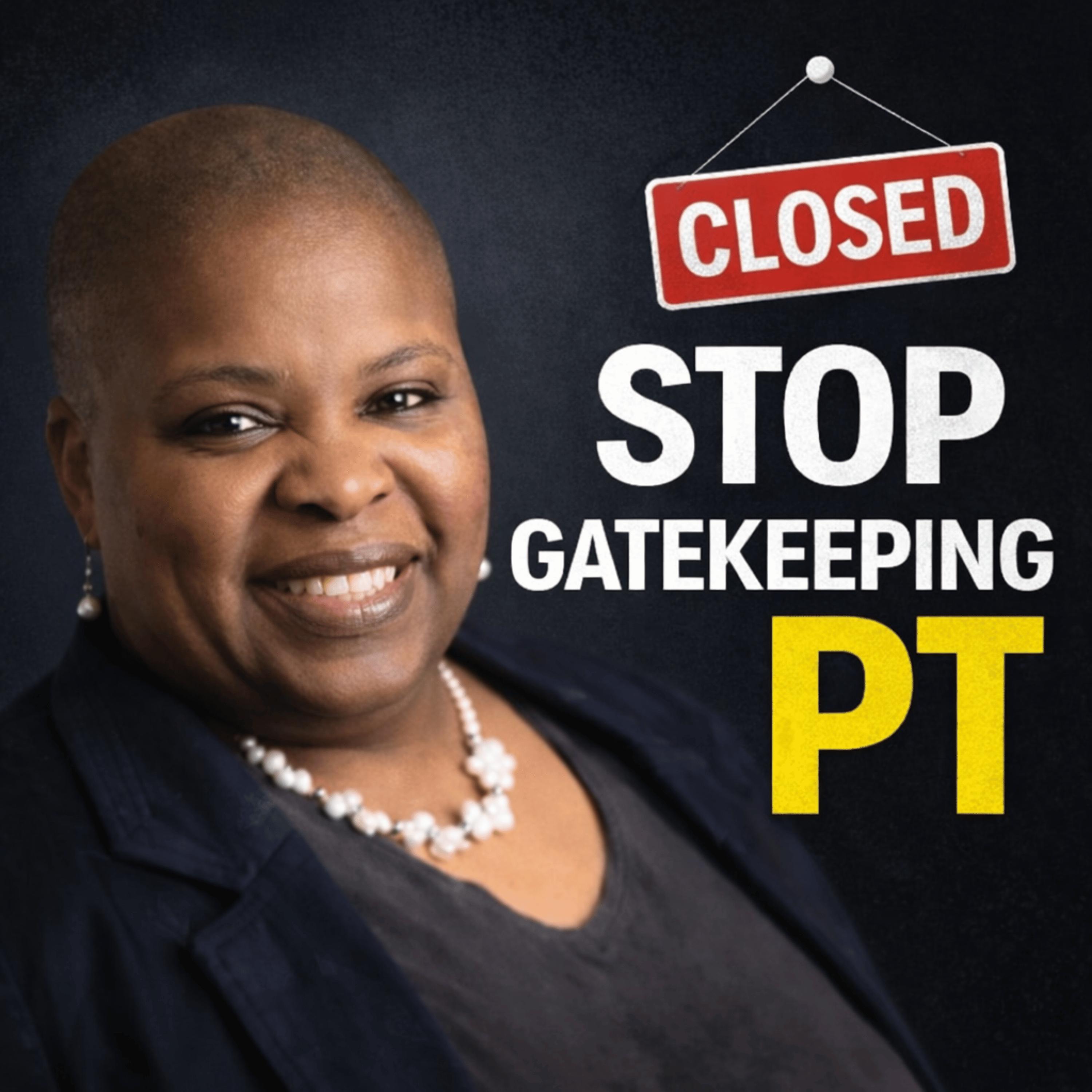


Physical therapy can’t survive on “me, me, me” messaging. Dr. Lisa VanHoose breaks down why rehabilitation deserts are growing, why gatekeeping admissions is fueling the PT workforce shortage, and what it looks like to rebuild the profession around community, access, and relational capacity—not just credentials and productivity.
We talk rural retention, community-based rehab, why “bootstraps” is a myth in healthcare design, and how the Ujima Institute is building real-world mobility support through food access, youth training, health literacy, and neighbor-to-neighbor infrastructure.
Chapters
00:00 Neighbors Shape Health
07:55 Admissions Beyond GPA
13:40 Rehab Desert Reality
22:35 Systems Over Bootstraps
30:20 Keep PTs In Practice
43:20 Ujima In Action
Guest + Resources
Dr. Lisa VanHoose (she/her)
Ujima Institute (community-rooted health + education)
Mentions: Ikigai, Blue Zones research, PCORI (patient-centered research model), community-based rehab, telehealth/remote monitoring, “Nothing About Us Without Us”
Ujima Institute: https://www.ujimainstitute.com/
<p>This episode is part of the <a href="/physical-therapy-business-podcast">Physical Therapy Business Podcast</a>, where physical therapists and clinic owners learn how to get more patients, improve operations, and grow their clinic without relying only on referrals.</p>
<p>Looking for more episodes? Explore the full <a href="/physical-therapy-business-podcast">Physical Therapy Business Podcast</a> for real-world strategies on physical therapy marketing, patient acquisition, and clinic growth.</p>
0:00 You're listening to the PT Pinecast, where smart people in healthcare come to make noise. Here's your host, Jimmy McKay. All right, some people build careers. Some people build programs. Some people build platforms. Some people build podcasts. Tonight's guest builds communities, and that's different. She's a physical therapist by trade, but she refuses to accept that access to care is accidental. She believes neighborhoods actually shape health. She believes education shapes workforce. And she believes we cannot complain about workforce shortages while gatekeeping Who gets into the profession?
0:43 She talks about rehabilitation deserts, about isolation, about the cost of forgetting that we belong to each other. And she designs education the way urban planners design cities. And that's with intentionality, I just screwed up. I'll edit this out. Intentionality and with the future in mind. She's the founder of the Ujima Institute and she's here to both inspire and irritate you in the best ways. Let's welcome to the show Lisa Van Hoose. Lisa, welcome to the show. Did you like that one? I did like that one. I was like, I want to meet her. I was like, who is that?
1:24 I want to go have a cup of coffee with her. Wouldn't that be a cool exercise to do with like a seventeen-year-old and be like write a bio of a man or a woman that you would love to meet in twenty years and then see what they describe and then go, why did you describe that? Well, that's because that's what we kind of do. Right. I'm sure psychologists would psychologize what I just did and be like, well, yeah, we will become the thing you needed. Right. That's what we hopefully we become. Right. And then and then the exercise is how do you go from here to there? Now that you have the end, how do you where you're not going to do it overnight? That person did not become that person overnight.
2:04 What are the three things you need to do in the next three years? What are the things you need to do in the next twenty years? Yes. And what is the delayed gratification that has to happen right for you to be able to become that thing? Because we're so consumed with I want to feel good right now. And so then when things get hard, people get a little nervous when you get to the messy middle. But that's where the development happens. Seth Godin calls it the dip. Some other writer calls it the suck. They're like, it's going to suck. I worked in a radio station. My job was hang out, play music, be fun, give away concert tickets. And there were still hard parts of the job, parts that other people didn't see all the time.
2:48 But I'll tell you, because we liked it, we got through the suck. You're able to show up. put on a happy face, and continue to do the things that needed to be done when things aren't going right. And that's sort of when you know you found the thing that you're aligned with or good at is it's always a job. It's always difficult. But when you're like, okay, what do I need? I need a big inhale. I need a big exhale. And I'll just keep doing it. That's it. All right. So we lost you for a second.
3:28 Do we have you back? Hold on just for a second. That's so crazy. So we lost you for a second. But what I was saying was... You know you're in a good spot or you're doing a job that you're aligned to do or good to do or want to do when the suck shows up or the dip shows up and you're still like, this is hard, but there's a reason for it. I was having a call with a guy yesterday. He's a career coach. Do you know Lucas Van Etten? He's cool. He's from Michigan. He's a PT. He does wild things. He was just asking me questions. He was motivational interviewing me. And he was like, well, what are you willing to like?
4:09 What if it was really heavy, would you still lift it? And he asked me this question because I'm looking for like, what do I do with my next twenty years? What job do I do? And he was like, if I checked like four out of five boxes for you in terms of like how much do you make, what your day to day, whatever. But you work for Samsung. And I'm like, the TV company goes, yeah. Would you take that job? And I was like, no. And he's like, why? I'm like, there's no fight there. Like there's no heart there. There's nothing more. I don't know. Does the world need more TVs? I don't care. Like me. I don't know. No, I don't think so. Like I have a TV, but that's it. So it's like, I need, I need there to be a thing. I'm sure someone out there is like, I love selling TVs and that's good for that person.
4:54 That is not enough for me. Yeah. And I think like in Eastern cultures, they talk about that, right? That for longevity, you have to have a purpose, right? And sometimes in America, we try to make purpose into like this huge, big thing. Right. But they're like, no, just what is it that brings you joy every day? And like you said, it might be selling TVs. But for you, it's this, you know, connecting with people and being able to spread messages. But everybody's got to do the self-work to figure out what their why is. Why do they get out of bed? I shared a post and this wasn't the direction of what we were going to talk about. I didn't know it was, but I have this slide always haltered.
5:36 You've heard about this, right? The Aiki guy? Yeah. The reason for being, right? And so it's three interlocking circles. And let me see if I can do it without looking at it. It's what you're good at. what the world needs, what you can get paid for. We'll get back to that one. And then what you're good at, what you love. So being good at something doesn't mean you love it. Like I might be the world's best bartender, but if I'm like, whatever. So those two things are different. And some people might poo-poo to get paid for. And I'm like, well, you have to be able to support yourself. Like good vibes doesn't pay the mortgage and put food on the table. So like, are you providing something of value?
6:18 to get value out so you can support yourself. And the idea of the ikigai, which anybody can Google it, four interlocking circles, those four things I just said, where it crosses. I don't even know if I'm saying this right. I need to talk to a Japanese person because I keep calling it ikigai. Ikigai, ikigai. it's reason for being it's like when you find the center of all four of those that's your jam and that is a very simple equation to say but it's not necessarily easy to do because the world is always the world is just changing like a rubik's cube all the time and finding where that spot is for you was always different very true very true because i mean like you know and simon sinek talks about asking your friends right Ask the people around you what you're good at, because we often most of us have been conditioned through our trauma stories to always think negative about ourselves.
7:08 So he's like, ask some other people like, why are you my friend? Why are you my neighbor? Yeah. Why are you my therapist? Yeah. I brought this up on LinkedIn for a while, sort of like pointing out to healthcare providers, because that's usually who I talk to or I like to talk to on the internet. And the pitch or the angle was like, I see you talking about features of what you bring. And I want to not nitpick, but I want to show you the difference between features and benefits. Nobody hangs out with Jimmy because he has brown hair and he's five foot nine and drives a Toyota. I don't think so anyway.
7:48 That doesn't really bring my friends who choose or not choose to hang out with me. That's not why. But in healthcare, we're like, I have a doctoral degree and I have twelve years of experience and this. I'm like, that is valid and logical, but that's not why people come to you. You are exactly correct, right? Exactly correct. I hang out with you because of your shirt. Like that is true. I do love the shirt. I do love the shirt. But I think we forget that we are relational beings. Yes. And some of that I think is because of the way in which we gate people into health care professions where we only allow you in if you have certain features.
8:30 Correct. Correct. But then we know that those features don't translate to bedside manner. which is what the consumers are looking for, right? And that's what patients are looking at. Exactly. So it dictates outcomes more than anything, your relational capacity. Yeah, it's wild. But I'm not in education. You've been in education. How would you include that in the process? How would you do that? So, Jimmy, let me tell you how. Here we go. I think that academic metrics are important, right? Because there is a correlation between those and passing the MPTE.
9:11 But I really think a third of that admissions has got to be what service opportunities have you done? Like, I'm like... Admit every waitress, every busboy, every porter that you know, childcare workers, like the people that have had to serve others. So if you've had to be a formal or an informal caregiver, like we need to value that commitment to service. Because that actually might be what turns the tide between a good clinician and an excellent clinician. It's that ability to recognize and attend to the needs of others.
9:51 And you're not always going to see that in a GPA. I did the things. I brought the meal. Why was that not a good service? It's like, if you were a waiter, you know. I never made eye contact. I never said anything. My mood sucked. You learn that. quickly or you get beaten you get thrown out like you're not i don't want you here because that's really what you're selling i can get a bowl of ziti kind of anywhere Um, I forget who was talking about that. Oh, John Taffer. He runs that show bar rescue. So he's like a food and beverage guy in Vegas. And he's just, he's like understanding the science. And he's like the difference between good food and great food is, is so small.
10:32 Right. In terms of, of overall, like what people view as a restaurant and they go, but the different, if you have great food with shitty service, I'm never coming back. Exactly. Great service with like crappy food. I'll give you another chance, right? So I'm not discounting the quality of a chef, but like even the chefs know, if I put out this great meal and you act like a jerk, I got nothing. Why do we treat healthcare differently? Is it because it's formal? Because it's science-y? Because it's more, I don't know. Why? Why is that? Well, I think somewhere during history, we tied healthcare with mobility, right? It kind of became this artificial royalty to, you know, this person is the doctor.
11:16 It doesn't matter how they treat me because I'm just getting seen by the doctor. It's kind of like I'm getting to go to the king, right? And unfortunately, right now, health care, just like education, you get paid regardless. Yeah. If it's crappy care or not, you get paid regardless. Uh-huh. I had an article about that not long ago on LinkedIn, and I got a lot of I agrees, and I got a few like, well, that's not the case because... And they were going one level deeper. They were like, well, if I give good care or quality care or good experience, people will come back more often. Yes, agreed. But then the person giving... mediocre care will just be like, I'll just spend a little more on ads and I'll just keep giving mediocre care.
11:58 And I understand I'm going to put nothing into it. So my margins are going to be better. And it sucks. I was trying, I wasn't trying to dunk on anybody. I was trying to show you like, this sucks. Like I can do a crap, a C minus job and you could do an A plus job. We get paid the same. And that, that isn't okay. We should be mad about this. Not trying to find the fault in my arguments. And we should be mad about it because where those mediocre and sometimes not even mediocre, just subpar clinicians end up is in rural and underserved areas where, you know, if you were to just think about, you know, just basic things, You know, equity. If you've got an area that has higher complexity and acuity, you would want the best practitioners to be there because they're going to be more effective and it's going to ultimately end up costing us less.
12:49 But if you keep sending mediocre and subpar clinicians and practitioners to those areas, then, yeah, health care is going to be trillions of dollars in debt because those people aren't incentivized to be effective and efficient. They get paid regardless. Right. So if you are out here in Joe Schmo, you know, Louisiana and there's one cardiologist, it doesn't matter. Because that one cardiologist is still going to have a full caseload and they're still going to bend over their back to make sure that that cardiologist is taken care of. Because they're going to say some service is better than no service. And I am of the belief that no, it is not. No, it is not.
13:31 You've talked about something that I don't even think I learned about this term until after I graduated. I think it was Patrick Berner who taught me a couple of these terms. And the term was, he used food desert. We're going to talk about rehabilitation desert. First of all, define it because I don't want to act like everybody knows what it means because I had never heard those two words put together for a long time. So what is a rehabilitation desert? What does it mean? And how are we or how is the system contributing to it right now? Right. So deserts basically are and you can use it with any adjective on the front end. Right. So you'll hear people talk about medical deserts.
14:12 You'll hear food deserts. You'll hear transportation deserts, rehab deserts. But any time there is an area where access is either limited or not available. And so the individual has an unusual burden to be able to try to access care. And we know that there's a sweet spot. So people will normally tolerate about twenty minutes of commute. So if I want to go see a PT, if they're within a twenty minute drive, I will go. But if it gets to twenty five, thirty minutes, my brain starts to think this is too much. And so we know that there are areas where people, they may have to travel hours to see a PT.
14:58 Or if you start talking about PTs with specialty or advanced practice, I know that there were times I would have clients that would drive four hours one way to see me because I was an oncologist specialist. And like here in Louisiana, I think there are two of us for the entire state. Why? When I'm thinking about where we're putting future PT programs, they need to be in areas where we can address rehab deserts. Or even if they're hybrid programs, then programs need to be able to say, how are you intentionally admitting people that are going to help us address these rehab deserts?
15:38 Well, they need to be able to stay, right? You've obviously thought about this, so I can ask you questions left, right, and up and down. Let's say you put a rehab, a PT program somewhere where they need PTs. Right. And then you get people from that community to go to that program and pass. What's to stop them from going, hey, I just got out. I have now the ability to leave. Would I not take it? How do you get them? How do you incentivize them to stay? Exactly. Yeah. So what we've learned from medicine and what they're doing with rural health is, is number one, from your admissions, you need to admit people from those areas because they've already got an anchor, a root in those areas.
16:24 And then their clinical education needs to be back in that area. Right. So if you can recruit from that area, educate them in that area, they are eighty three times more likely to stay in that area. Right. Eighty three times more likely to stay in that area. And then what we know from neighborhood science is that what most people want, right, is they want decent education for them and their children. They want a grocery store. They want a bank. They want health care access. So that's where PTs and PT educators, when we're thinking about where we're placing our programs and placing our clinics, we're just like we just got to.
17:07 think about us. No, you've got to think about the environment as well, right? And what it is that you need to do as an educator or a clinician to make sure that there are things in that neighborhood or in that community that will make those graduates want to stay. So it's hard for us as PTs to talk about mobilizing society if we don't think about a bigger society than what we do as PTs. That's talking a lot about who feels welcome in PT. We talked about this years ago. If you don't see someone who looks like you, walks like you, talks like you, why would you ever think that that's a place for you to be?
17:47 Putting a program there probably opens that door. But there's a lot that goes into that. Money. Who's going to be the people who you now move to that area to teach the program? If it's truly rural and care is scattered, where are they going to do their clinical rotations, right? Are they going to have to travel two hours one way or are they going to have to move to do a clinical? And then you've sort of defeated the purpose. So this feels simple but not easy. Yeah, it's not easy. So it takes a lot of planning on the front end. But that also is part of the experience of those clinicians that are providing care to rural and underserved areas is you'll hear many of them say that a lot of their job duty is traveling, right?
18:33 to the next county over, to the next city over. And so there's a part of training, right, this workforce that's gonna take care of the underserved to understand that that's gonna be part of the burden until we can get enough people interested in rural and underserved so that you don't have to travel more than twenty minutes as the practitioner or as the consumer. But I also think that we're not leveraging technology. Because like telehealth, remote monitoring, there are all these other ways in which PTs are providing care and also community-based rehab, right?
19:14 So all PT doesn't have to occur within a clinic. It can occur in a patient's home. It can occur within a community center. So I think we've got to get ourselves out of a box because a lot of this we've created ourselves. Where do we steal the innovative ideas? Like when you're mentioning some of that, I've done some, you know, interviews with people who work in Alaska or, you know, in the Pacific Northwest where being rural is just way of life. It's like, you know, necessity is the mother of invention. It's like, well, if you want to figure out how to solve a problem, go watch people who've had to solve it as a way of life. So are we able to steal some ideas from those types of practitioners?
19:57 Oh, yeah. I think if we were to have conversations with nurses, I think nurses have been really innovative in how to deliver care. I think your old school rural health primary care providers, they know you got to be boots on the ground. But ultimately, I think having conversations with the community members, with the neighbors, because community knows what it needs. What happens is, is we will go have a conversation with them and then we go, oh no, they just don't understand how we do what we do, right? But a community member will tell you, why can't the PT be in the barbershop? Right. Right. Because I'm going to go get my hair cut and I'm probably going to have to sit there and wait thirty, forty minutes.
20:40 Guess what? I could be doing my I could be doing my treatment while I'm waiting. Right. Yeah. Why? Why do I got to go down the street to you and then come back and sit in the barbershop? I mean, like community will tell you how to improve access. It's just whether or not if we'll be humble enough to listen. If you pay attention and if you're willing to change to it versus asking or demanding that it changed to you. I remember learning this lesson about a bicycle when I was in PT school. I bought a bike on Craigslist because I couldn't afford a new bike. So I bought someone else's old bike. I was like, I'll buy your mistake. Like, no problem. I'll get a three thousand dollar bike for nine hundred bucks.
21:20 I'm not an idiot. And I rode that bike for two years in races. And then someone watched me on the bike and they were like, why do you, you know, it's one of those like where you lay down triathlon bike. Like, why do you, why are you like this? And your wrists are like this. And I'm like, cause I have to touch the controllers and they go, there's a screw right there that would make those arms longer. And I was like, I've been doing this for two years. I adapted. I got smaller for the bike and, without knowing the bike was already designed to adapt to me. And I remember I was going through, I think neuro and PT school. And they were like, you don't ask someone to adapt to the power wheelchair.
22:01 You adapt the wheelchair to them. It works for you. You don't work for it. I remember like as dumb as a bike metaphor being like, Oh, you should look at this for everything. Like, This should work for the person. The person should not have to bend or shrink or twist or turn for the system, for the bike, for the wheelchair, for the curb cut, for those things. Is medicine or is healthcare, are we just this big establishment that we're just like, this is how we provide it and you will be glad how we give it and you will say thank you and you will go on your way? I mean, is that it? So I think that is it. And I go back and forth because I feel like some of that is rooted in this philosophy of what it means to be a great American, right?
22:49 because we tell people that the American dream is all about individualism and you pulling yourself up by the bootstraps, right? So yeah, you've got this healthcare system, guess what? If you're a good enough American, if you're a good enough individual, you'll figure out how to make it work for you, right? But in my learning more about Blue Zones and the research around it, what they are talking about is that that is such a fallacy. It's not the fact that these people are uniquely different than the rest of us, and that's why they're living to be a hundred years. It's because their environment is different. Right. So they're like, why can we not learn how to adapt environments so that then we make healthy lifestyles easy for people?
23:37 And it's the same thing with education. Why can we not adapt the educational environment? to make learning easier for the learning. Why can we not adapt the healthcare system so that it works better for the individual? But we have this fragmented healthcare system that we go, this is great. You go figure it out. And if you can't figure it out, then you get to die or you get to be sick or you get to not have your quality of life. It's your fault. I remember when someone pointed out that phrase, because like cliches, become cliches because they get repeated so much right doesn't mean they're necessarily true but the fact that like can you show me how you could sit on the floor and elevate yourself by pulling your own bootstraps up that doesn't work give me the best Cirque du Soleil athlete and that does not work you cannot do that like that does not work I get the sentiment I'm not trying to nitpick the cliche but People, if everything you're saying is true, which I also agree with, design the community where they don't have to pull themselves up, that there's a path to walk that's simple that also benefits themselves and others.
24:54 That seems like an easier way to do it. It makes sense to me because I'm like, if we're all out here pulling ourselves up, then why are there country clubs? Why is there golfing? Right. Why are there cigar bars? Because what those things signify is that there are places where people come into community and then they network and they help each other out. Right. So I'm like, so just normalize the fact that no one really is doing this on their own. Right. So but if we can keep telling people that they just need to keep you just keep doing more, then, you know, people will keep striving to do that and then they'll pay for all of these services or processes that don't really work.
25:38 So I'm just like, we just need to be honest about the fact that our health care system is fragmented. It does not work for most of us. It costs us way too much money and it's ineffective. And we do need to have an honest conversation about that. Because we created it. And if we created it, we could fix it if we wanted to. It's one of my new favorite quotes I got from a guest, Rob Pinarello. He said, it might not be our fault, but it sure is our problem. Which is like, you might not have created it, but you still have to deal with it. Which also means, but if you can deal with it, If enough of us decide to change it, that's the only time that something actually gets changed is when enough of us decide that it gets changed.
26:24 Yeah. And see, and I kind of see it as binary. And this might be way too simplistic because I kind of see it like life, right? So either you're living, you're either actively living or you're actively dying. Shawshank Redemption. And so to me, you're either actively creating it, even if it's bystander creation, or you're actively changing it. Which one are you doing? You're going to let it continue to exist as it is and you're like, that works, or you're going to change it. Yep. This also works against clinicians in the healthcare profession, right?
27:09 Like this lack of connectivity or isolation or individualism, like staff culture or like, so, I mean, we have, I forget what the statistic was, but a large number of our colleagues come into this profession and I think it's seven years later they last seven years. It's like, you just went to school for essentially seven years to hang out for seven years and then leave. And that's a lot of wasted effort and, and skill and insight. And that feels like we could, we should fix that. Yeah. And it's interesting, like why people are leaving and that number may even get lower based on what we're seeing in, in, these last two youngest generations of PTs, that number may continue to drop.
28:02 But it's like people are leaving, right? Sometimes it's, you know, family obligations, right? They're at a different season in their life. But a lot of times it's pay. A lot of times it's the workplace environment, productivity, insurance burdens, administrative burden. But all of those things we could change because at the end of the day, There is a PT manager. A lot of times there is a PT owner. And then even in these larger companies, there still are PTs in the C-suite, right? So once again, I keep coming back to the fact that I'm not going to say that everything's easy, but I'm going to say, but we still are in change agent seats where we could change it if we so wanted to.
28:51 Is it going to be painful? Yes. Are some people going to have lower margins? Yes, for a little while. But it's like, are you willing to have some short-term discomfort to protect the profession? And also to just be kinder to that fellow human, right? So you've had a graduate work seven years to be part of the profession. They get out, they graduate, and then they only work seven years. I'm like, come on, right? Like we're missing out on so much potential because we're losing these amazing humans that might be our future leaders. They might innovate something for the profession, but we end up losing them because we want them to see sixteen patients in one day.
29:40 I'm just like, That instant gratification. I'm just like, could we not be reasonable with productivity expectations? Could we not be flexible with work hours? Because it's going to cost you more to replace them. I was going to say, if you don't, what is the cost? You've said this, we're gatekeeping the profession while complaining about the shortage. Yeah. That feels like we're talking in circles, right? It's talking out of both sides of your mouth. There's not enough people, but we're gatekeeping. So what do we... Well, and then there's the middle part, which is how do we keep people in the profession longer? So you have input, you have throughput, you have output, right?
30:21 In terms of someone's career span. You're focused on input because you're in education. Well, I shouldn't say just focused on input, but you're like, how do we get more right people into the profession? Because more right people is better than more not right people. Because if those people aren't right, they might not stick around and prevent them from leaving the profession. Yeah. And I am of the belief now, and this is where people will get irritable with me, every four point O student is not the right person. Right. I think there is some beauty in having conversations about those people that represent the three point three point three because their drive is different.
31:07 Right. Their passion about the profession is different because. There's just a gratefulness to being allowed access. That then they're like, you know what, I'm going to stay in this because I am grateful to have been able to be here. I, you know, I know what I've had to do to be able to get to this point where we tend to only think about the three point eights and the three point and the four point O's is on my, you know, think about all they've done. Yeah, they've done a lot from an academic standpoint, but that that drive, right, that I don't even know what to call it, but that grittiness, I tend to see that more in the three point O's to the three point threes.
31:54 And I also tend to see them stay longer within the profession because they feel a commitment to the profession. They feel like the profession took, you know, they, they took one for them. What, what would be a better word for Jimmy? But I'm not saying that something was given to them, but they just, there's a different sense about being accepted into the professions. Well, for a second there, I was going to say it's an effect called the IKEA effect. Have you ever heard of the IKEA effect? Lego effect? Because I had more... I had to construct this coffee table. I actually valued the coffee table.
32:35 It was in Betty Crocker cake mix. All you used to have to do was add water and people said, it didn't feel like I was doing enough. They literally said, you have to add water and egg and adoption went up. So it was like, if you have to do a little more, if you had to sort of sweat a little more or put a little more work into it, you might feel like it's worth more to you. Right. Personally. That's a great way to put it. Because I do want humans to feel like they are the gift, right? We all have been called into existence for a reason.
33:17 But I also think that your profession, and especially professions that have selective admission, recognizing the gift that has been given to you. And I do sometimes find that those candidates with the higher GPAs, they feel like they're the gift. And if things don't go a particular way, then they're ready to go. And granted, many of them do have options. So yes, utilize your options. That's not what I'm saying. But I just find that the persistence and the perseverance is not the same. And I realize I'm speaking in generalizations. Right, right, right, right. But I just hear so many educational programs talking about they want the qualified student.
33:59 And in their mind, the qualified student is three point five or greater. I'm like, no, the qualified student, if your document says it is three point oh, then it's the three point oh student as well. So you need to wrap your arms around them. And what I have just found is that they come with a different set of attributes that actually ends up. being better for the profession. There's just a resilience there. There's just a hunger there that's slightly different. What would it look like if PT education truly centered community instead of competition, instead of a four is better than a three five?
34:41 Oh, you know, I would love for it to get to the point where if you've got the academic metrics, then Good we're done with that part right that's your screening, then the rest of the admissions process is really looking at those attributes that you have towards the ability to build community right. So even I would love to see community members participating in the admissions process. Right. What would that look like to have patients sitting on the admissions process to be like, oh, yeah, that person could be my therapist or oh, no. Did you notice the way in which they spoke to us? Right.
35:21 I think I would love to see the end users helping us select the future clinicians. Yeah. I mean, I learned that in a different way when I worked for Mount Sinai Hospital and David Petrino was in charge of a research lab and he used to use this phrase, which he didn't coin, but he said, nothing about us without us. And that was from the disability movement back in the sixties and seventies, which is you have people making decisions about other people and no one in that decision-making process has the disability that we are deciding on. And that doesn't make any sense. Right, it doesn't. And that kind of comes from community-based research.
36:01 Some people call it community empowerment research. You're now hearing terms like asset-based models. But this concept of if the end product is a practitioner, then I think there needs to be some changes in our processes to say, and be it education or clinical, at every time point, Where is community part of this decision-making? And so there is an organization called PCORI, which is Patient-Centered Outcome Research Institute. What I love about that organization is if you are designing a research project, community's got to be involved from conceptualization all the way to dissemination.
36:45 And I think that PCORI model, we need to embrace that in healthcare and clinical services. We also need to embrace it in education where if you're designing this and communities who it's going to impact at every timestamp, where's your community member? Where's your public member? I saw it in practice when I said at Mount Sinai, we'd have technology companies come and say, we've solved insert disability here, or we've solved this problem for this subset of the population here. And David, he was also Australian. So whenever he talked, it just sounded cooler.
37:25 He'd just be like, he would ask just like stunningly simple questions. Who from that community is on your board who's actively been in the process of this? And a lot of times, these were David's words, not mine. He was like, it's a bunch of tech bros going, we figured it out. And the answer is nobody. Right. And then he, David would then just simply turn to people who had that disability and say, is this in your top twenty five problems that you face every day? And they'd be like, not even in my top fifty. And they're like, what are we doing here? You've solved nothing. And from and from like psychology and sociology research, we call that saviorism.
38:06 Right. Where it's totally you thought there was a problem. and you were like, I'm gonna come up with a solution. And then you take it back to community and you're like, I'm the best. I fixed this for you, right? And we also do that in education where faculty will get together and be like, this is what's wrong with this course or this curriculum. and very seldom do we get feedback from the students like really good feedback not just the student eval at the end of the year but sitting with students to talk about curriculum and then we go we fixed it and the students are like no it still sucks right and then when you think about like clinics and patient care like often you'll hear people say we have community advisory meetings yes but they meet once a quarter Right.
38:56 How often do you invite community members into your staff meetings to talk about, hey, how is this really going? Like, sit down and have conversations. But a lot of times we're doing things because it feels good for us, not that it really helps the situation. Yeah. Because I have a use case where I think it happens. I don't think it's on purpose. A lot of times. APTA state chapters and academies. I see you. I love you. I want you to succeed. It might seem I'm harsh on you online. That's because I'm trying to push you. Some of them will do town halls. And I'm like, I don't know if that's the greatest way to get feedback because a person has to stand up in front of a group of peers and say something that might be super personal.
39:45 The funny part is... It's probably more than that person thinking it, but is that the best way to get feedback? Probably not. And here's my non-scientific way. We've all been to presentations. We just came back from CSM. Someone talks for sixty minutes. Everyone says, clap, clap, clap. Any questions? Maybe one or two. Clap, clap, clap. Thank you. I'm done. And then twelve people rush the stage to ask a question. Where was that? Forty eight seconds ago. Why? I know why. Because they didn't want the spotlight. But that's where really interesting things happen. So, yes, asking for a survey at work or at school isn't the best way to get the right feedback.
40:30 No, no. It's that one-on-one small group. I mean, and people are like, but do we have time for that? If you want to know the, if you want the answers, you have time for it. Right. And do you have time to not do it? That part. And nowadays, even with technology, right? So there's so many audience engagement systems that you can still protect someone's need to feel safe and allow them to still give you feedback. I'm just like, but we often design things in a rush or either we're just thinking about how we've always done them. We're not really thinking about universal design of, okay, how can I engage as many people as possible?
41:13 Because if you want as many perspectives as possible, you've got to be much more intentional in every aspect of the human condition. I would say these are communication principles, right? And I love stealing that fit VP model. Everybody's like, oh, frequency, intensity, time, type, volume, progression. I go, those are exercise principles. Those are also communication principles. Those are relationship principles. Those are all the principles. Those are the only levers you can pull. Oh, that's good. I had not thought about that in that way, but that's really good. You would say low frequency, but high intensity.
41:54 That's a town hall. So that might be good. It might be good. But would you need small groups quarterly? That's more frequency, but less intensity. What about a one-on-one that meets every three weeks or monthly? That's higher frequency, less stakes, right? Yeah. And... I come from the land of frequency, like quite literally radio frequency, but like, that's not what it, that's not the frequency has to do with wavelength, but how frequently do you show up and ask? Yeah. If it's once a year, are you shocked when you don't get good responses? And when you put it like that, you're like, well, obviously my door is always open.
42:37 That might check a box, but, But if I don't know, if I feel weird about walking through the door, I don't know how to start that conversation. Hi, I'm here to complain. Like, no, I don't want to do it. But if you're asking, I don't know. Like frequency is always the lever in my mind that I like to pull on first. No, that's a great point. That's a really great point. Really? I didn't think that was, but I'll take it. No, it was fabulous. And I teach electrofizz, so it so made sense to me, right? Because I'm like, I can have the electrodes on you, but if there's not enough beats coming in or enough hertz, I'm not going to get, yeah, it's not going to do anything.
43:19 So I felt that. Great job. You said we will not survive if we focus only on self. So let's look to the future. There's no good story unless there's tension. What happens if we don't change? For the profession, I'll frame it that way. As the profession, if we continue down the path we're doing and we don't take any of these things, heat of any of the things that we just talked about, what is the fallout? What does it look like when we fall off a cliff? So here's the world according to Lisa Van Hoose. So this is just my opinion. I do recognize that I represent other organizations, but this is my opinion.
43:59 From an education standpoint, PT programs are going to close. There's just not going to be enough interest. If we cannot figure out a way to lower costs, lower the cognitive load, I'm not saying decrease your credit hours, but You've got to make sure that instruction is delivered in such a way that it reduces cognitive load and reduces the trauma during the learning process. If we cannot figure out a way, students just aren't going to come to our classes, right? And I feel very strongly about that because there's too many options now, right?
44:40 This is not the nineteen fifties. It's not the sixties. It's not that, you know, there's only Fifty disciplines in health care. There's over two hundred disciplines in health care. So if somebody wanted to be in health care, there's all different kind of ways they can participate. So we've got to get more attractive from an educational standpoint. From a clinical standpoint, I think we are saying the wrong message because right now the message is about our features. So I'm going to use what you said earlier, right? We are a doctoring profession. We have done seven years of training. We are in the community, right? It's a lot of we messaging.
45:22 People do not, like, even if you're in a room with another individual and all you hear them saying is I, I, I, like, we don't like talking to that person. It gets creepy, right? So if the message was, you know what? Here's how PT is changing lives. Every state has a state health improvement plan. If we made sure that every clinic was addressing at least one measure from the state health improvement plan, then we can say back to states, you know what, we see you. We heard that this was a priority. This is how we're contributing.
46:03 That's a different message than we've done all these things. And for that reason, you need to take care of us. It's like, no, we are an asset. You said this was your problem. Here's the assets we're bringing to the table. And then naturally people will want to partner with you and people will want to make sure that they take care of you because you brought value. I think sometimes our doubling down on self-advocacy makes us come off as really selfish. And it's hard to sell a selfish message. So I really would love to see us focus more on public health community messaging.
46:45 And I think that would do us better. so i am afraid that within the next five years if we don't do some things quickly we're going to see pt programs closed down some people are excited about that because they're like supply and demand i also think that if our messaging does not change then what we're going to see is we're going to see other disciplines that have better messaging they're going to get to move into spaces. And we're going to be like, why is the athletic trainers there? Why is the exercise business there? Well, because they had a community facing message. The other thing that makes me really concerned is there's this big push to create PTs faster.
47:32 We're not making widgets. We're not making, I don't know, Something production wise we're not making tires right you're making humans who have to have a certain amount of relational capacity. And we already are taking them from bachelor's degree right to doctoral degree, we know from neuroscience that there are parts of their brains that control empathy and compassion are not fully developed until they're somewhere between. To. So why are we moving so fast, right? If the issue is that we need to get practitioners out into the clinic earlier, then let's talk about that, right?
48:18 So maybe it is time that we start talking about, you know, some type of tiered licensure setup so that They get their bachelor's degree. Maybe they do their first year PT school. Then after that, they go to work or maybe they, while they're getting their bachelor's degree, they become a PTA so they can go work. Right. And then once they've been in the field for a while, then they come back and work on their DPT. But this fact that we're going to take an eighteen year old and in five years at the age of twenty three, turn them into a doctor or PT. and they're going to be a safe clinician, and safe clinicians is not just about technical skills, it's also about relational skills.
49:00 I'm not sure if that's true. We just are not respecting the social, what they call socio-emotional literature, that there has to be time for development. We know that from a rehabilitation standpoint, right? Where we will respect some six and twelve weeks of healing time, But then we don't want to respect that from a brain development and a cognitive learning time. So I think there are other ways we could address the practitioner need question without Russian half-baked clinicians to the clinic. But that's my take on it. Like, I once want to hit a gavel and be like, Lisa has spoken.
49:42 If I had a microphone, I'd drop it. I don't want to drop it. I'm like, nobody likes half-baked anything. So stop it. Um, we were together at CSM in, uh, just a couple of weeks ago and you, uh, got an award and I like talking about awards. I like talking about awards for what we did to get, like, what was the thing? What was the purpose? Share what you did to get, because you didn't do the thing to get the award. You did the thing to do the thing. And then the Academy of Leadership and Innovation was nice enough to recognize that. And here's why. Number one, you deserve some accolades for doing that. But also, we want other people in the audience to be like, oh, look at that.
50:24 How do I do that in my way? So talk about what you did. Yeah, so I was super honored to be recognized by my peers for helping to build an environment that supports mobility, right? From all the domains of mobility, physical mobility, emotional mobility, social mobility, financial mobility. So what the Ujima Institute does is we partner with communities to say, hey, what are the problems, right? What is keeping you from being able to live your best life? And what we found in our neighborhood was it was childcare, youth services, food insecurity, and then just basic health literacy.
51:07 And so we went about doing those things. So we offered a childcare service. We had youth programmings. We trained young teenagers how to take vital signs and how to serve as healthcare workers so that they could go to appointments with their loved ones. and be able to be like, this is what these words mean, right? Because we, ooh, this is finna get political for a minute. So we know that when people have improved health literacy and they go into a clinical appointment and they say hypertension, Right. Not high blood pressure. Health care workers pay attention.
51:48 It's just like with your children. What we know is that if your children knows the word vagina, penis, vulva, they are less likely to be sexually assaulted because the predator knows that. Wait a minute. That child is talking to somebody who's talking to them about their body parts. Right. So it was really important to us that community members knew the words. so that then they would get the attention of the healthcare worker because then at that point they got better care. And what was crazy about it was that community members would come back and go, I've gone to that doctor for ten years. That was the first time that person sat down and listened to me.
52:29 So we created a healthcare worker system where Someone could call. They could say, hey, I'm going to go meet with my cardiologist. This is what's going on. What questions should I ask? And we would help them come up with the questions and help them come up with the words or find the guidelines, right? That's the other thing. We were like, start asking your health care workers, what guidelines are you using, right? So your mom's had a stroke. Ask them which stroke guidelines they're going to follow, right? That gets the attention of health care workers. And so These were things that the typical person would say, but that's not PT service, but it is, it falls underneath self-care, right?
53:10 So if people can't live in environments that support their life, then it's hard to have a conversation about, yeah, come see me in the clinic two to three times a week for your low back pain. And they're like, I'm trying to, you know, have enough food and make sure my kids are safe and everything else. So Is maslow's law, you know you got to deal with those basic needs first before you can start talking about tertiary care and so. we've been able to work with Community to do those things and so like now we've got a Community garden we're trying to figure out our summer youth programming and we just finished. because we just had a pretty bad ice storm here.
53:51 And so Ujima was able to mobilize with three other organizations. And over the course of four days, we were able to deliver four thousand meals to people when they were without power. And that like if you want to talk about bringing value to the profession, people are like that physical therapist over there, like that's Lisa. And if you have a need, she can help you. Right. So it's not just about you just come see me if your knee hurts. It's like, if you got a need, that's a healthcare person that can help. And that, that is you, that's invaluable. That's invaluable. So, yeah. I can't let you leave without giving a nod to Ujima.
54:34 Just give a quick mention about what is it. And then we'll put the website in the show notes. yeah so ujima is basically the third principle of kwanzaa um it means collective work and responsibility so in layman's terms my brother's problems are my problems my sister's problems are my problems that humans problems are my problems um so don't turn a blind eye to people so and then and do what you can every little bit helps i'll share the uh the website there well hey congratulations on your award I knew you wouldn't want to come on the podcast to talk about an award, but we'll talk about other things and then the work that went into the award.
55:16 Yes. Now, here is where Ujima needs help. So let me tell y'all where we need help. So as I said... one of the things that community has said that they needed is childcare services. So what we did in the past is we actually did like your traditional childcare set up, right? So when you think about childcare, you know, you take them to a center, they're with you from seven to five, you've got childcare work, um, childcare workers. Margins in childcare centers are very small, right? They're anywhere between five to fifteen percent. Um, And that is not manageable because what we tried to do different in Ujima was we knew that the household, the median household income.
56:02 So typically your child care should be between five to ten percent of your disposable income. That meant that weekly child care roughly needed to be between one hundred and twenty five to one hundred and fifty dollars a week. Right. That is half the price of what other child care centers. Yeah. So that was not a sustainable model. So you have a group of amazing, brilliant people that follow your show. What would be a model where we could still provide all day services for families, but it not be child care? So like some of the things we've thought about is could we offer it as a wellness model, right?
56:47 That you drop your child off at seven o'clock in the morning and you can pick them up at five and we're going to work with them on their wellness and physical activity, right? Something where it's not child care. um because the child care industry is so over regulated so that's the other part of it is that there's so many fees and everything else associated with that that that's part of the reason why it has to be so expensive um so we're trying to figure out is there another way to do that some people have talked about you know could we do a parent co-op right where parents then become the co-workers but if y'all got ideas about how we could provide all-day child care services for that pre-K through four-year-old group or even infants to four-year-old groups.
57:35 That would be greatly appreciated. What's some innovative ideas out there? I'll get on it. I'll call you back soon. I'll be on it. I got faith in you. Yeah. Last thing we do, Lisa, is called the parting shot. What's the thing you'd want to leave as your mic drop moment or your soapbox statement as we wrap? Yeah, if you're not part of the solution, you're part of the problem. Either you're in the boat and you're rowing or you're an anchor. Lisa Van Hoose, thanks for doing what you do. Thank you. Thank you always for your time. That's it for this one, but we're just getting warmed up. Smash follow, send it to a friend, or crank up the next episode.
58:19 Want to go deeper? Hit us at pgpinecast.com or find us on YouTube and socials at pgpinecast. And legally, none of this was advice. It's for entertainment purposes only. Bulls**t! See, Keith? We read the script. Happy now?