Understand What Game You’re Playing: Barnes & Noble, AI and the Future of PT
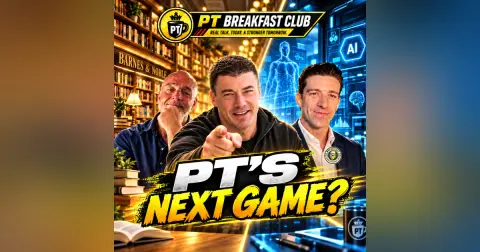


What does Barnes & Noble have to do with the future of physical therapy?
More than you might think.
Barnes & Noble couldn't compete with Amazon by simply offering more books. So the company changed what a bookstore could be: experience, discovery, community, events, gifts, toys, coffee, and local relevance.
That launches Jimmy McKay, Tony Meritato, and Dave Kittle into a much bigger PT Breakfast Club conversation:
What game is physical therapy actually playing?
The guys explore what PT clinics might learn from businesses forced to adapt, including whether clinics need revenue beyond traditional reimbursement, why “selling” remains such an uncomfortable word in physical therapy, and why simply making more people aware of PT may not solve the profession’s problems.
Then things get bigger.
What exactly will a physical therapist be ten years from now?
Tony makes the case that AI and digital healthcare could absorb much of the simpler end of physical therapy. Dave pushes back on how quickly the profession's identity and title will change. Jimmy questions whether our current professional labels, licenses, and marketing strategies help clinicians compete or sometimes constrain them.
The conversation also explores the distinction between PT as a license and DPT as a degree, digital versus human care, AI-assisted clinicians, healthcare consumer behavior, and whether the future belongs not to AI or humans, but to humans who learn how to use AI well.
And underneath all of it is one question:
What game are you actually playing?
KEY THEMES
• Barnes & Noble as a model for adapting instead of competing head-on
• Experience, community and alternative revenue
• Cash-pay physical therapy
• Why PTs struggle with the idea of selling
• Marketing through repetition and useful communication
• Whether physical therapy really has an awareness problem
• The future value of the PT license
• PT versus DPT
• Digital physical therapy and AI
• Hinge Health and Sword Health
• Human clinicians handling increasingly complex cases
• AI as a clinical tool rather than a replacement
• Cory Doctorow’s “reverse centaur” concept
• Understanding the business you're actually in
FEATURED VOICES
Jimmy McKay
Tony Meritato
Dave Kittle
WATCH TONY:
https://www.youtube.com/c/MedicareBilling
WATCH DAVE:
https://www.youtube.com/@thedavekittleshow/featured
FOLLOW PT PINTCAST:
Apple Podcasts:
https://podcasts.apple.com/us/podcast/pt-pintcast-physical-therapy/id1000443325
Spotify:
https://open.spotify.com/show/3LmMUT64yrUc2iGo9Emafc
YouTube:
https://www.youtube.com/@PTPintcast
Instagram:
https://www.instagram.com/ptpintcast
LinkedIn:
https://www.linkedin.com/in/jimmy-mckay-pt-dpt-a4207659/
Website:
X:
<p>This episode is part of the <a href="/physical-therapy-business-podcast">Physical Therapy Business Podcast</a>, where physical therapists and clinic owners learn how to get more patients, improve operations, and grow their clinic without relying only on referrals.</p>
<p>Looking for more episodes? Explore the full <a href="/physical-therapy-business-podcast">Physical Therapy Business Podcast</a> for real-world strategies on physical therapy marketing, patient acquisition, and clinic growth.</p>
0:02 Broadcasting way too early from three separate Wi-Fi connections. It's PT Breakfast Club with Tony Meritato, Dave Kittle, and Jimmy McKay. Good Tuesday morning to you. It feels like a Monday. Does it feel like a Monday to you? It's a Tuesday. Every day feels like a weird day. I don't even keep track anymore. Tony Meritato, I'm Jimmy McKay. Dave Kittle's coming in hot at some point. I was on the road. I was at the Breakthrough Market. Chad Madden. Chad Madden's event.
0:43 They did, they call it Titans Live. Again, why were none of, neither, none of us, none of the three of us, that doesn't sound grammatically correct. How did we not have a seat at that table? I do not understand. They put a hundred and one people in the book. I filled out the thing. We were a hundred and two. I filled out the thing and was like, okay, they asked me to fill out a thing. I guess I'm in the book. I opened the book. Uh, Didn't make cutting room floor, Tony cutting the floor. That's all right. We can take it. It's all right. Yeah. So I mean, like, good idea, right? Good premise. Have you are you a big reader? I don't know if this has ever come up before. You read some stuff, right?
1:23 I mean, I read every day. I haven't read a book in a long time, but ironically, I'm reading less books, but And I've got two of them. Tim Ferriss did Tools of Titans and Tribe of Mentors. Best way to write a book, guys, here's how you do it. You get a Google sheet. You pick thirteen or fourteen questions. You send those questions to a hundred people. They answer them. You publish the results, put your name on the cover, and you wrote a book. Tim Ferriss did it twice. Landed himself on the bestseller list. That's what this was. And it was a brick, man. It's a brick. It's a Bible. How have you not done that for physical therapy?
2:03 So five years ago, six years ago, and I've got people that worked with me, Bridget and Juliet, I saw that and went, let's do it. And you know me, I'm onto the next thing. And now you're not writing a book, now you're herding cats. Now you're like, can you fill this out? Or that, you know, that answer's too short. So I went to do that idea. And then by the time I ran into like all the parts about that idea that I don't like, I went, this idea, whatever, I'm onto the next thing. I wonder the new format would be, you have the questions, Dave's here, you have the questions, you give them a number, they call and answer the questions by voice, transcribe AI, turn it into the Kindle version.
2:50 would have no problem doing doing the work be like okay we're going to do an episode and your responses are going to be the book yeah and then you get a video out of it you get the audio out of it you get the transcription of it so maybe we do a hundred and two people tony maybe we do a hundred and three people because have you heard about six minute abs And that joke will land with some people. Go Google. I get it. I remember. Eight-minute abs, seven-minute abs, six-minute abs. Yeah, I mean, there was a lot of people that you know from LinkedIn at this event. It was in Nashville. I got to be honest, by the time I traveled there and traveled back, everybody's like, you're going to Nashville. I was in bed by ten o'clock.
3:31 I was like, I'm done, man. Because when you're standing there talking to people all day, you're exhausted. so but good to see a lot of faces that i've people have some people i've never even met before but i feel like i've interacted with for years uh on linkedin and whatnot but i don't know man i think events i'm i'm into events like that but i know not everybody is All right, so a lot going on in the group chat while I was gone too. There was a lot of stuff. Where do we want to start? If anything, if you shared something and you want to get into it, there's a lot of funny things that were floating around in our group chat for this. Dave, why don't you kick it off since you just jumped in? What was funny? What do you call that? There was a video, hot yoga.
4:13 That was the one that made me go, what the hell? I was like reading it on my phone. I was like, what is this? That was the hot yoga. All right, so I shared that with these guys just because, you know, there are definitely people who were made, what is it, a voice? Face for radio, voice for newspaper. So this woman, I mean, I don't know if you guys see this. I'm one of those sickos. I get all these, like, Kensington Street live videos of junkies on the side of the road. I don't know what your algorithm is saying. I don't know what your algorithm is saying. Okay, fast forward. This woman is like promoting. I think it's real promoting her yoga studio, hot body yoga or hot something yoga.
4:57 And I mean, the woman is scary. The woman is full on scary. And I'm like, you're not the person to be promoting this if it's a real yoga studio and you want real customers to come to this yoga studio. Was it a gag? Like, I watched it and it was over the top. It reminded me of Wanda from In Living Color when Jamie Foxx would do Wanda. And he would do like this and it was over the top, right? That was a lifetime ago. That is not something that you would create today. I guarantee there isn't anyone on popular media that would create that character today and not get canceled, not get run out of the city, whatever.
5:39 So anyway, I go back to. Even if you feel like, like for me, still hate my voice, can't stand watching my own videos, still feel self-conscious. We talked about this the other day. it's a great it's a great voice and everyone knows it but when i saw that video i had to share it with you guys because i was like all right maybe she's not the best one to be on video i don't i can't find my link right now just because my computer's being weird but like what were the what was the attention on there what were the are they doing it to gain attention are they doing it to be an outlier so weird that people like us go check this check this crazy lady out like now we have to stack weird on top of anything else to get any attention it might be like there are tons of accounts on tick tock that i think are just you know rage bait accounts they're they're not real accounts they're saying things to just inflame the viewer so the viewer keeps watching right i fall for it a ton um and i think you know they make plenty of money with it they monetize it whether it's ai or a real person i can't even tell that anymore like the technology has gotten so good but let's let's briefly talk about something else that i share that i think is a better topic i i saw the article from barnes and noble this is an interesting evolution and i want to hear what you guys think about it so before amazon you know you wanted a book you go to the bookstore you browse the shelves there were times where you go to
7:09 the library imagine that going so there were times where i remember like going to barnes noble i was always that person who would fall asleep in the comfy chair like think that i was going to read a book or something rarely bought anything but you know it was the experience but there was no other choice if you needed a book then amazon comes along they get every book title ever you know imaginable it's available now we're at the point where i can get a book in two hours barnes noble languished for like a decade i didn't realize i did tell you guys i don't know if you remember the only reason why barnes noble stayed in business where books a million went out of business walden books went out of business all of these other bookstores borders went out of business Barnes & Noble stuck around because of the real estate.
8:00 They owned most of the real estate. And as real estate appreciated and interest rates were so low, they were able to manage their balance sheet. Now, Barnes & Noble is back on the scene. They've reemerged. They've opened more new bookstores. I think it was in the year of twenty twenty four than they did in the entire decade of two thousand nine to two thousand nineteen. They are booming now. They're different bookstores. They're smaller bookstores, smaller footprint. It's not the superstore that it used to be the new CEO. is trying to bring books local. So if my Barnes & Noble here in Cincinnati is going to have a different selection than where Jimmy is or where Dave is, And when you look at that evolution, you know, Amazon started selling books.
8:50 Now, books is probably one of the smallest money makers that Amazon has, like their their ad business, their server business, like storage, all that. There's so many other ways that Amazon makes money today than they did when they started. Barnes & Noble is a completely different business. If I want Catcher in the Rye, I go to Amazon. If I wanna find a new book to read, I go to Barnes & Noble. So the question is, how do we bring that evolution into PT? I've been surviving like Barnes & Noble, not because the PT business is so great, but I had real estate, I have social media, I have other ways to make money.
9:32 I think a lot of practices have been in that boat. Now, do they follow Dave's lead? Do they go all self-pay? Do they go high-end concierge? Do they sell the experience like Barnes & Noble now is selling the experience of being a bookstore? Or do they just continue to languish and continue to battle for pennies on the dollar? I have to comment locally because I did send you guys something brick and mortar that's near me that closed down, which is unrelated to the bookstore. But it was a this place called Soul Detox. They did like cupping and massage and stretch and whatever.
10:13 And long story short, it's closed down. It used to be around and now it's not anymore. Whereas the bookmark shop bookstore in my neighborhood has been there forever. They have authors come and do readings and kids books. There's always a section of any market, I think, that will always thrive no matter what. I mean, my son's two and a half years old. We have like two hundred books. And any time that any other family has a kid moving forward, a child moving forward, they will always mostly buy books. physical books so all the bookstores will never be obliterated there will always be paperback books um but in terms of in terms of going up market down market that's obviously another conversation i'm curious for you what are some of the book or book titles that you read you've probably read a hundred times to your son Well, there's three that Sturdy McKee, my partner business coach, told me to get that actually help manage people, manage employees, but they're actually kids' books.
11:18 Like who, not who moved my cheese. If you give a mouse a cookie, there's like the little red hen. If you give a mouse a cookie and there's like a third one. And Sturdy used to give these books to his therapist when they came to him and said, hey, I want to make more money. I want to be a manager. I want to be a clinic director. And he would give them three kids books. He would have dozens on hand and he would give these. So those are a few books. My son, I mean, he's reading anything about Dora. or Sesame Street. But those are some of the titles that, you know, pop into the top of my head. Yeah. Some of the things that make me what you're talking about, Barnes and Noble is I mean, if there was going to be a theme among all these live streams that I typically feel like I say because I like to look at this is like understand what game you're playing.
12:06 So like Barnes and Noble, was it going to out book or out selection? Amazon wasn't going to be able to do that as hard as it would try. Right. So it under it now is understanding that I would love to see their Balance sheet. Are they public? Can we see them? I would love to see puzzles and games and calendars. Like what percentage? That's where they can out experience Amazon, which is the tactile touch in person with the cafe, with the smell of coffee, grab a book. There's a Starbucks in every one. So like, all right, what doesn't Amazon have? It's like people, experience, vibe, right? I'm actually, you know, I mean, if you work in New York, you live in New York and you go to a coffee shop, Twenty percent of the people are there to buy a coffee and leave.
12:54 And the other eighty percent are there with a laptop looking for an outlet to hang out. But as long I mean, my first my I was just taught, like, go buy a coffee. And if you're there for more than an hour, you buy another thing because you're sucking off the Wi-Fi, but you're there for other things. And I feel like Barnes and Noble understands that in terms of local bookshops. Dave, you made me think authors and local bookshops were the. original micro influencers with micro niches like I saw this great like like Twitter thread or threads thread who said like you know I did a book signing and you know thirty eight people showed up and they're like yeah but those thirty eight people are like raving fans and they're just in person like they came in person and they're going to tell five people each and is that a way to do it Yeah, I've used this term before.
13:44 I think we've over we've been over Kardashian, even though I think Kardashians are out of the zeitgeist. I haven't seen them in a while, but like we got a little jaded on like a million this and a million shares and a million likes where it's like, well, it's just thirty eight. I'm like, my man, thirty eight people doing something in person at the same time in the same place in a random town. It's kind of a big deal, especially when you understand your total addressable market and who's ever gonna buy your book. So I think Barnes & Noble understood what game they were playing and they're playing it. Well, I think they changed the game. They've adapted. Now, the question is, so like in Davestown, that little bookstore. Yeah, like Amazon can't bring in an author to sit down across the aisle from you.
14:28 You know, Amazon or Barnes & Noble used to bring in authors to do book signings and things like that. You'd go meet them. But the question is, just like us. How scalable is it? Maybe it doesn't need to be. How is that local bookstore still making money? How am I still making money? Twenty five years into business because I had the real estate. I have equipment that I'm not having to buy again. I'm not buying new equipment. I haven't bought new equipment in twenty years. You know, like is that bookstore? And I'm genuinely asking Dave based on, you know, your best guess. How is that bookstore affording to say in business?
15:09 Or is it just because the owners are like, you know what? I've got enough. I don't need more. I love what I'm doing. I'm willing to sacrifice and lose because I would be sitting at home. So I'm just going to sit in my bookstore. Like, what do you think? There's no way for me to know. But this this bookmark shop that's near me has been there for, I would say, at least ten or more years. I've been I've been coming to this neighborhood in Bay Ridge since two thousand summer, two thousand nine. So fifteen, twenty years, the book, the bookstore has been there. it's covered from floor to ceiling with books and tables for other books or child's toys, which I think probably have pretty good margins, some of the stuff.
15:51 And when we, by the way, this is timely because when we just went to this bookshop two weekends ago, there was a local author who read one of his books and did some drawing, coloring on an easel with some of the kids that were there watching and allowed the kids to engage and participate. So that allows the parents to take the kids to somewhere, like a play date, basically. We can kind of turn our brains off. The kid gets to interact with the author. Then the author, obviously, we feel compelled to buy the guy's book. Twenty dollars. I mean, it's a great book and it's designed well and all that. But it's like a twenty dollar.
16:32 By the way, it's CDs used to be twenty. I don't know. I don't know how we used to be OK buying CDs for twenty dollars back in nineteen ninety nine. Some of those CDs were twenty to twenty five bucks then, which is crazy to think about. So to Tony's point, there's a lot of toys there. So it's not just it's not just a. Books only. And which is funny, right? Because it's like is a bookstore. But then there's like complimentary toys for these kids and obviously adult books as well. Like just just normal like fiction, nonfiction novels and stuff. So I don't know the answer, Tony. Could it be that they're just staying in business because they're so obsessed with books and the smell of books and flipping through a book and reading and the hobby of reading?
17:12 Totally could be. However, they bring in authors in all the time. Those authors bring in customers and foot traffic. They promote it on their Instagram. The authors promote it on their social media. It seems like, I'm not saying it's a great business, but I always judge to go back to the place locally where I sent you guys the screenshots yesterday. place that closed down that was doing massage and cupping and stretching and all that type of stuff and they were only there for four or five years probably one one lease only another another gone and the whole website url is gone meaning they're they didn't downsize or change locations like they're done but this bookshop is still there so i feel like you cannot tony tony you can only bleed money for so long you're not going to have multiple multiple leases Unless you're crazy, which as a business owner, you could be where you are going into more leases, but you're paying out of pocket for the lease or the payroll and the labor and all that, which is possible.
18:07 I've seen it. But I don't know. Any other thoughts there from that? I would say the best day of owning a boat is the day you buy it and the day you sell it, right? You just lose money the entire time. I do think there are enough of us around that stay in the small business world, especially after ten years, who are willing to sacrifice. Now, even for me, as many clinics as we've owned over the years, i've never closed my clinic the clinic that i work at because i am willing to do the job of ten people um i'm willing to do the marketing i'm willing to do the admin i'm willing to do the billing i'm willing to do the janitorial and clean the toilet like i am willing to do all of those things for the salary of a therapist other people aren't going to do that every every clinic that i i have closed over the years and i've closed many It's because it just wasn't financially viable anymore and it wasn't worth it.
19:06 So I think a lot of us in health care, the Peace Corps gene, we're willing to sacrifice as long as we can, as cut as deeply as we can, just because we love what we're doing and it fulfills us in other ways. Yep. Of course, at some point, yeah, the reality, you know, strikes and hey, I got to pay my kids tuition. I got to put food on the table. I got to do something. That's when you see somebody close the last door. Jimmy, what are you going to say? I was going to share, I found the statistics, the latest statistics where Barnes and Noble books are a fifty eight percent toys, eleven, a cafe, nine and then gifts and others, twelve percent.
19:49 So that's what makes up Barnes and Noble. But if it was just books, you're not going to outbook Amazon. So, I mean, of course, we're doing exactly what everybody should be doing, which is like, what's my version of that? You know, is it offering cash services, which is almost like, oh, man, let me wipe that off my tongue, that bad word. It's like, guys, it's all money on the way down. It's just you hand money to another company, then they decide. That's the crazier version, right? Like, if you honestly can make someone's dollar go further, help them get better and stay better, isn't that a better ROI? on their dollar is them giving it directly to you. And that feels, Oh, I don't want to touch that dollar. It's icky. That's okay. Dave will touch it.
20:29 He'll he hasn't been great. No problem. He'll watch that dollar off. Like they'll take that. And I, and I think I keep hearing this. The, the gifts break down there with, with Barnes and Noble. Do you think that's gift cards? Because toys toy. Okay. So toys would be obviously kids items. Gifts would be any adult, any adult product that's there. So, so the, so I'm like, not just kids stuff. They have like really expensive, like adult, like high Lego boxes, really expensive, a hundred, a hundred and fifty dollar Lego things and really expensive. High, high margin. Those are going to be high. Correct. Really expensive board games, adult games. So I think the gifts is probably just like, It could even be impulse buys at the front desk, right?
21:13 A pen, a bookmark. What do you think the margin on a bookmark is? Like, seven thousand percent? Costs me four tenths of a schmeckle and I sell it for seven dollars because it's got an inspirational quote from Maya Angelou on it. It's like, that thing's a markup machine, right? And it's that impulse buy. But if they've got you, they're doing similar to what Amazon does. I actually don't think Amazon does this well enough, which is, if I'm buying this, before you check out what do other people buy i know amazon does it i'm just surprised it's not more prominent it's a little bit lower if you're buying this other people who buy this also buy this i'm surprised they're not doing that a little more That actually was something that came up in one of the articles I read where they were talking about upsells and you get to the counter and you're like, oh, I need this or I need that.
22:05 For some reason, I can't say for certain, I thought they were saying that Barnes & Noble basically does a better job at that than Amazon does. I think so. Yeah, Will Boyd chiming in saying, yeah, but then you'd have to sell, Jimmy, which is a curse word in PT. You know, I agree with Will. I'm not disagreeing with him. But this is how I would say this to someone who said that to me. I don't like selling. My dad was a New York City fireman. They didn't have to sell stop, drop, and roll. They repeated it over and over and over and over again. I got to be honest, the amount of times I heard stop, drop, and roll, I thought I would be on fire more as an adult, but I've been on fire zero times. They didn't have to sell call nine one one, but they sure as hell repeated it. So the fire department didn't sell that stuff.
22:46 They repeated it. They got a line and they repeated it. So no one, you know, I think Will's right, but I don't think you had, it's not this dirty thing. If you honestly and truly believe it, as Kevin Hart would say, say it with your chest. So later today, I'm talking to Hinge Health. We're talking about the future of PT. And, you know, I share some experiences with them and talk about social media and just the impact that it's had. But it got me thinking, putting these two things together, do you guys know what this is a picture of? That is...
23:26 Something in a typewriter. Is that a typewriter on the right? And on the left, a magnifying glass? Microfiche? What's looking into the magnifying glass? A woman. Close. Close. That's actually a computer. She's looking into a computer. No, the woman is a computer. If you go back and I look this up this morning, nineteen thirty to nineteen seventy, NASA Langley called women. Oh, yeah, yeah, yeah. That was a computer. That woman, that human was a computer. And so they would sit around and compute. They'd calculate numbers and do all this kind of stuff. Um, fast forward to today, you know, what is a computer?
24:09 Well, it's not a woman, right? It's not a human. And so names, words, terminology, lexicon, it all changes. It evolves over time. And this is one of the things that I'm going to kind of discuss a little bit. And we've talked about this before we came out of, was it reconstruction age AIDS? Then we became physical therapists. The physical therapists of a hundred years ago are not the physical therapists of today. As things are accelerating and changing so quickly, what is a physical therapist ten years from now going to be? Great question. My expectation, it's going to be a significant, most of what we do is digital in ten years.
24:55 The people who still want to touch humans, they may not be physical therapists. That might not be physical therapy anymore, but that's fine. It doesn't mean they don't exist. That just means they find a new name, a new terminology, a new classification. Because again, As we continue to see reimbursement decline, why am I continuing to fight to preserve language that doesn't help me and doesn't help my patient anymore? Yeah, it's funny to watch other people walk into an idea that we've been talking about. I'm not even saying we're the first people to talk about this or realize that, but I forget what Facebook group I was in and watch someone in the comments section go.
25:38 Why don't I just give up my license and then I'd have less restrictions? And I just sort of commented, Yeah, feels like it's actually not helping you. It's preventing you from doing what you want or being able to even keep the doors open. And this was not me being overdramatic. This person was saying like, I can't, I can't keep the doors open. Like I'm losing ten dollars a visit on these certain insurances in these certain areas. But if I gave up my if I dropped my license, I would be not beholden to those rules. There are there are positives and negatives to most situations. And if the negatives outweigh the positives, don't do that game. Let's revisit this with Dave. I want to bring you in.
26:18 Hang on. I've asked you before. It's time to ask you again. I understand there are times where you do bill out of network for certain third party payers or you submit claims on behalf of the patient. But if you have somebody who is not going through insurance, What is the value of calling yourself or your service physical therapy and constraining it to that? You can't hire anyone you want. You have to hire a physical therapist. Eliminate that title and you can hire anyone who is available with the skills and the expertise that you want. you're not getting reimbursement so you don't have to worry about that it opens the door to doing so much more even beyond the the confines of the state of new york like i just don't see in more cases for you why the benefit of still being called a physical therapist and physical therapy I don't know.
27:20 I don't know if there is a benefit. I think on the front end, if we're saying or conveying Dr. So-and-so, Dr. Ethan, Dr. Chris, or whatever, maybe I am assuming that it will help with authority or credibility or whatever, which... uh once in a while over the years like if we had a uh we had a pta that we kind of tested with we had a a physical therapist that was from another country where they did not have the dpt and some patients did say they didn't say they didn't care about the they didn't care about the physical therapist part but they did say like oh well i see that this person is not a doctor like they don't have their their doctor degree or whatever and you know dr crystal does or dr ethan does or whatever so you some of our clients did say that, but I agree with you, Tony, none of them ever cared if they were a physical therapist or not.
28:08 But, but then again, we were not, we were not saying here's a, uh, I don't know, rehab personal trainer or someone that like, we, we never, we never had someone else with a different title or a different designation where then the client was like, yeah, okay, fine, whatever. So, um, I don't know if we've, you know, gone down that route enough. I would say, like, name recognition, right? Sounds legit. That's why people want to get the letters after the name, right? Like, that feels like the legitness of it. You know, physical therapist has some understanding to it. As much as people say, people have no idea what we do.
28:48 And I go, no idea at all. If you said, go to chat GPT and generate... They have some idea. They would go, I don't know, a human... standing maybe with clothes like okay where does this person work like no idea and i just think it's a giant cop out you know i sort of went back and held someone accountable when they said it's the apta's job to do a marketing campaign um to make sure people know what we do and i go no no They're a professional association. They're where professionals associate. No, they're not good at public. That's not what they're built for. And then I brought this in in front of a room full of PTs who were wagging there. It's always someone else's fault.
29:29 Well, we're this, but they should do that. And I said, Do you remember that? Remember Aaron Burr? Why do you think a lot of us know who Aaron Burr and the fact that he got into a duel, right? A shooting duel. Hamilton, the show. It was because of Got Milk. It was the Got Milk ad, brilliantly done campaign, and it was paid for by the American Dairy Farmers Association. And I don't even know. I could go to Wikipedia and see how long, but I feel like that ad campaign ran for... a bajillion years it was a bunch of different ones but it started with a radio they were asking a question and the guy was like i'm an aaron burr expert but he had eaten some cookies and he was like on the phone he couldn't get it if he'd only had some milk to wash down the cookies right so they paid millions of dollars to do the creative to put the ads everywhere it became almost like it was it was a campaign on billboards got milk it was a question And then someone brought this up, how much milk consumption went up during or after that campaign?
30:28 And the answer was zero percent. Do you think we had a milk awareness problem? No, but it felt good because look, I see, there's me, I milk cows, yay. So I'm out here. You were solving a problem that wasn't an issue. I say, okay, great, you do this big campaign and everyone's aware of physical therapists, except if you want a private practice that does this niche, is that campaign going to do anything for your business? I don't think it is. So I think if you want a private practice, you spend a dollar, Dave, correct me if I'm wrong, Tony, correct me if I'm wrong, you spend a dollar, you're in your brain, you're like, this has got to bring me a buck fifty or else I'm not going to keep doing it.
31:11 And I don't think that it will. I do not think PT has an awareness problem. And if it does, It's on the individual. Now, a final thing, where I think the APTA or its state chapters or academies could go ROI positive is they bring Dave, Tony, and Jimmy to their conference. They give us a two-hour session, pay the hell out of us to do it, and we teach them how to create content. Not going for free. Not going for free. And we'll teach a hundred of your people how to create a hundred pieces a month. And now suddenly your awareness problem goes away, but it's not going to be APTA state chapters or academies or APTA national. It just ain't.
31:53 I didn't see Aaron Burr on the bingo card for today. Random fact, after we got married in a church in Manhattan, we had our celebration at One If By Land, which was actually Aaron Burr's old carriage house in Manhattan. Didn't think we were going to ever come there, but I have to drop it real quick. Now, in terms of the... In terms of the designation, Tony, there's a lot of physicians going into concierge who are out of pocket. There's a lot of nurses or PAs, some of them going into like the med spas or the injectables or whatever, and they're keeping their licenses. Have you noticed any of those other providers or professionals changing their names, changing their designations, the way that you're proposing in ten years physical therapists might be a different title or a different name?
32:42 Jimmy. And I don't like bashing other professions, but you asked the question, so I'll give the answer. And maybe we're guilty, so I'm throwing a lot of asterisks before I start throwing shade. I see a lot of chiropractors using words that are not their words. I'm a functional neurologist. And I'm like, what is that? That is where I draw the line where I say, no, no, no, you don't get to call yourself a neurologist unless you are a neurologist. That is where I can say, Say whatever you want, but that's my line. And I forget the doctor's name. He does a great job on Instagram calling people out.
33:22 And I will say, he should call PTs out if we do anything egregious like this. But calling yourself a functional neurologist, and God forbid you have someone who needs a neurologist, and they wind up in your office, no offense, not the right place for you, and disrespectful that way. So I see people doing it in a shady way But Dave, good question. Is anybody doing it? Let me rephrase it. Let me ask Tony again. So Tony's saying in ten years, physical therapists, they can drop the physical therapist title and be a different title. Before I even weigh in on that, I'm saying, Tony, you've seen a lot of concierge physicians leave insurance. There are concierge memberships or monthly or yearly or annual, whatever.
34:04 And as well as the PAs or NPs or any of these other allied professionals. starting their own practices. Are they changing their names? Have you seen that they're changing their title or how they're calling themselves on social media? So if, and we've shared this before, no, I have not seen it in physical therapy. Well, yes, we just did. You just told me we started as reconstruction aids. So maybe it's a hundred year cycle, but yeah. Yeah, but no, but, but, but no, but recently you're not seeing. What I have seen and we've said it finance. So a lot of the finance guys, especially the ones on social media and Will Boyd can chime in on this. He's watching.
34:45 They gave up their finance licensing or whatever you call it so that they can produce more social media content. There is so much regulation in finance, they couldn't produce the content they're producing and keep their licenses in finance. So I've seen it in finance. I've seen a little bit in medicine, but what's really interesting is there are politicians out there right now today who are calling themselves a medical doctor, an MD. They never passed the boards. They went through medical school. They've never practiced as a medical doctor. They don't. they they never got whatever license as a medical doctor but they call themselves a doctor and they use that for their political benefit i think your people could still be they are they graduated as a doctor of physical therapy yeah you could still leverage that education without the licensure and without the restrictions There's five letters that you get when you graduate today or tomorrow.
35:48 It's PT, DPT, and it sounds redundant, and it kind of is, but you're right. PT is the license. DPT is the degree. So yes, I mean, there are people who... Let me figure out how you'd have to do this. If you... If you passed, if you graduated from school but didn't pass the boards, you'd be a DPT, no PT. So there's a way to be a DPT without PT. Someone check me on this, but I think I'm doing the math right. You can be a DPT without a PT, but you can't be a PT without the DPT. Right now, yes. Right now, correct. But yes, yeah, I mean, so technically that person's correct, but correct and clear, those are two different words.
36:29 Now, the other one more thing real quick. The other part I would bring into this is, you know, our state organizations or boards, I mean, they're not super effective or aggressive, right? So we have non-DPTs using the credentials DPT. i.e. lifetime family fitness. We've got chiropractors and all sorts of people doing all sorts of crazy stuff with the terminology, physiotherapy, physical therapy. What is it exactly? So it's like even going across state lines, like I don't think we should be limited by state boundaries and what we could do.
37:09 But I know lots of PTs who are doing PT across state lines without the compact or without licensure in other states. So, it's like if you're going to make a law and then not enforce the law, how effective is the law? What is the purpose of the law? So, that too, I think when you look at the lack of enforcement with other factors, I think most of us are still fearful, me included. I'm pointing at myself to give up what little bit of equity we still have in the license. I still have a license to bill insurance. I still have a license to bill Medicare. Like there's still some shred of value in that that I can build other things upon.
37:54 Hence, that's why I have not chosen to give it up. Ten years is it's kind of far away, but it's not that far away. So I have to nicely say that I strongly disagree with Tony because in ten years from now, Physical therapists will still be with the doctor of physical therapy degree. We will still call each other physical therapists. There's a little pocket that say I'm a physio or I'm a physiotherapist because that's what is used in Europe and all these other countries except for the United States. Maybe fifty years, Tony. Maybe I can agree with fifty years, but ten years is... Far enough away, but close enough where I don't think there's going to be a major change in our actual title. Maybe we'll see more therapists dropping their license and just being like self-pay and having less restrictions so that they don't have to write notes, right?
38:44 I guess that would be one benefit. I don't know. What else? I wonder how long it took, and I was just trying to look it up, how long it took horse-drawn carriages in New York to disappear, mostly, because there are still horse-drawn carriages today. There's a few. How long did it take for the transition to happen from a hundred percent horse-drawn carriage in New York to mostly cars, Henry Ford? A hundred years. How long? Fifty to one hundred years. I don't think so. No. And I'll tell you why. I'll tell you why. I'll tell you why it wasn't that long. Horseshit.
39:24 The Industrial Revolution, the Industrial Revolution brought so many people to the city. And with city and people came horses and with horses came manure. They said in ten years, horseshit will be nine feet deep. then they had to pivot hard to cars because otherwise you were going to have disease. So they pivoted fast. This is like saying, like, how long did it take us to go from, like, bicycle commuting to city bus or car commuting? Like, there's still people commuting on bikes and walking to work because they got a DUI or whatever. There is, and they're still horse-drawn carriages.
40:05 So ChatGPT said, twenty-five to thirty-five years to go from all horses to predominantly cars. How long has AI been around? Like, we have to acknowledge the impact of AI relative to the impact of cars to replace the majority, not a hundred percent, but the majority of what we are doing right now as PTs. um and i just i think what's going to happen is it creates the vacuum that sucks out all of the bottom of the market i'm not saying a pt a human pt isn't going to be there for the more complicated more complex more involved individual who's going to take into account the psychosocial and and the economic and you know the history of the family and all of these other things But I'm saying the majority of simple outpatient orthopedics, the majority of simple neuro, the majority of simple pediatric, the majority of these simple things that I know you always say this and I love it and I respect it.
41:11 But this is the this is the people that already cancel no show and stop coming to physical therapy anyway. So you agree with that? So they're already sucked out of the market, Tony, because they come for one or two or three visits and they're like, this, my thing is not that bad, or I don't have the money or I'm not that, uh, I don't want to invest that much in my health time or money. So they already don't go to physical therapy. They come, they dabble and they're like, I'm out because they don't want to do it or they, whatever. There's so many reasons. I would love to see how much that exactly what you said, that dabble, that I've got patients right now that'll schedule three and four evaluations, keep canceling, keep no showing three and four times.
41:55 Because they're not serious and nothing with AI will change that. The impact of that on the profession at large is so massive that is what will disappear. Just like right now, I probably have four patients on caseload who are doing four to six physical therapy visits just so they can get an MRI, just so they can get a surgery. And it's nothing against them. That's what they need to do to get what they think that they need. that is gonna be gone. The cancellations, the no-shows, the repeat offenders, those are all gonna be gone. It is gonna clean all of that out. That is still there. If it wasn't there, you wouldn't be telling me about it.
42:37 And that has a bigger negative impact on my schedule, my profitability, my ability to operate a business. If I ran a business in the conventional way, I would be out of business twenty years ago. But these same people that we're talking about, they might also sign up for Hinge Health or Sword Health and never log into the app because that type of person, in my opinion, is not serious about their health and wellness. They're not going to invest the time or the money. Or if it's Hinge Health and Sword Health, I mean, it's basically free, right? You see these ads, it's free. So there's no barrier to entry. They just download an app and they've downloaded twenty five or fifty other apps on their phone. So they know how to do that process. They sign up. And then they don't log in ever to even do it because the person is not serious.
43:21 So it doesn't even matter about is a concierge out of pocket? Is it a network? Is it only a twenty dollar copay or is it free for my employer or however they access one of these AI? I don't think AI changes these people at all, ever. Yeah, it was this decision to change, right? It was not lack of information. We've not had a lack of information problem in a long, long time. The pain isn't great enough to overcome the effort required to change. Before we hit Dana's comment, I agree with Dave, a hundred percent. The difference is now the individual that would have cost me unreasonable amounts of resources and still dropped off, that person goes to a digital platform where it costs virtually nothing.
44:10 It doesn't matter if they drop off. Now, I'm not going to blame them. I'm not going to say they don't care about their health. They do. I'm not going to say they're not serious. They are. It's just this isn't the solution for them. And totally fine. You know, but the idea is when the doctor says go to therapy and they don't want to go to therapy, Now they have an option to still do what they would have done, but not take away from my resources. They could go digital and not do therapy. They don't have to come to me and not do therapy. I think it's a huge benefit. And I do think just like Dana, if you want to put that back up, you know, we're going to see this just like graphic design.
44:51 I don't use a graphic designer because the simple stuff has been wiped out by artificial intelligence. Thank you, Will. Love you. When Dave brings the Philly out of him, he gets all fired up. But Dana, always a great voice of not even just reason. I feel like she sees around corners, right? Because this is what she does. She says, the same is predicted for primary care physicians. AI will take over the simple to moderate primary care. And I'd love to hear what Dana has to think. I've heard some other smart people say that's actually going to be difficult for the people in healthcare. And this was their explanation. Every once in a while, if I can sort of turn my brain off, like someone walks in and when Tony sees a total knee replacement patient, he's like, great, I've run this play.
45:36 This is a bootleg, right? I've run this play for ten thousand times, right? I can sort of predict and he can sort of turn his brain off, which for humans, we sort of need to do that. So what these people were predicting is just what Dana is saying is, A, I will take over the simple to moderate primary care. If all you're seeing are the zebras, what does that do to you? And what does that do to a profession or people just entering the profession or people who've been in the profession? If you're not seeing any horses, you're only seeing zebras. I just, by the way, I already pay for insurance. We're paying like, I think it's like eighteen hundred a month, which is kind of ridiculous for no value, minimal to no value.
46:17 And then premium increases and they say, oh, we're going to increase your premiums. And we and we get no value. We get no additional value. We get nothing. Right. So two weeks ago or three weeks ago, I just signed up to pay a primary care physician in person. He also does telehealth and all that type of stuff. Two hundred fifty bucks a month to join his primary care membership. And we have nothing emergent. We have nothing serious. And so I also am going to disagree with that. I'm not saying I'm not disagreeing with Dana, but I'm saying she's saying the prediction is primary care physicians that I will help take over the simple to moderate. I think that that could in some situations, but also.
46:58 there's certain I don't know what percentage of consumers are like me in the market. But there's people that want a physician in person or telehealth. And maybe we'll say, Hey, maybe we could agree on this, a physician nowadays, who utilizes AI, but still the the humanistic It could be in person, it could be telehealth, whatever. I want a physician who uses AI, maybe for differential diagnosis or whatever, but I still want a human interaction. I don't want just like a, whatever the AI physician version is of Hinge Health or Sword Health. I don't want that. I could just chat you BT at Gemini, Claude, whatever. What benefit does that give me? What certainty or belief does that give me as a consumer or a patient who has something moderate to, maybe it's a little more moderate, maybe it's above moderate?
47:50 Yeah, I think that's consensus. At some point here, the physician who refuses to use AI, the health care provider who refuses to use AI now becomes negligent, now becomes liable. How could you possibly refuse to use this technology to support your own clinical decision making? I told my kids the other day, my twins are fifteen and a half. They're driving every day with me. I'm like, you guys are probably on the cusp pretty soon. It's insurance is going to be tenfold more expensive if you want to drive the car yourself because the car should drive itself, which will reduce the cost, reduce the liability, reduce the accident rates, all of these things.
48:37 Which again, we're moving into such a different world. Even if the person watching this doesn't agree, because I did hear a really good case to support why true AGI will never happen and the amount of technology needed for true artificial intelligence at the highest level is never going to arrive. Just where we are today, just where we are right now, even with the hallucinations, even with the mistakes, Jimmy and I were joking the other day, like we talk, the person who says AI makes mistakes has never met a human, has never met somebody who is up late the night before, went out drinking.
49:21 didn't have their coffee. Like, are you kidding me? Seriously? And if you're not sure, just go across social media. There is so much craziness all across social media of people doing crazy stuff far beyond any hallucination AI could ever have. Yeah, like we're already at that point. I do think Dave, Jimmy, the three of us agree, AI plus the human is the perfect scenario, at least for right now. Yeah, there's a great book. I just started it because I was flying back, and I usually buy books when I'm in the airport. That's when I actually buy books. There's a guy by the name of Cory Doctorow, who's a super smart dude. He's written for Wired Magazine, boing, boing.
50:02 He writes fiction and nonfiction, and he's got this book now. Well, his last book is called In Shitification. I figure if I'm gonna drop S bombs and stuff, I might as well do a couple in an episode. I'm not reading that one. I'm reading The Reverse Centaur's Guide to Life After AI. And you guys know what a centaur is, right? So a centaur is a good use of technology. It's the human brain on top of a horse's body. Horse, very strong, super efficient, yada, yada. He's saying, and again, I'm a chapter in, but my vibe is make sure you're not a reverse centaur. Make sure you're not a horse's brain centaur. strapped to a human body, right?
50:44 So make sure you're not just an idiot following as fast as a human can go, which is less than a horse. I said this to students yesterday at the College of Staten Island. Listen, because some students are pushing back about AI. And that's great. Question lots of things, right? And I said, you have a choice. You can say, I decide I don't want to work in a practice who uses AI documentation. That is your choice. It is a tool. But then understand what that tool requires. If we're a tree company and I say, your job is to work for eight hours and you'll be paid commiserate to how many trees you knock down, and I don't want to use gas power because carbon monoxide, that's okay.
51:25 Sharpen that ax and get to work. But understand we're in the number of trees cut down game. Understand what game you're playing. So you can live however you want, but... the universe and the world is moving in a different direction and if you're not on it i'm just worried that you're going to be left behind and that if you're okay with that that's okay because as my dad always said one day we're all going to be dirt so make a decision what do you want to be doing i'll let you guys know tony you're muted we'll do parting shots yeah yeah go ahead let's do parting shots I'll go first.
52:09 Go ahead. I was going to say, understand what game you're playing. We started with Barnes and Noble. We shifted that to what, of course, what our audience of PT, clinic owners, clinicians, anything is going to be doing with it. Just try to zoom out and see what the game is. And then I would say, zoom in, not even on the game, on yourself. This is where that stuff that we had to do in PT school that I hated, reflection. Oh, I hated it when I was in PT school. But I do it a lot more now and I find out I make better decisions when I stop for a half a second and actually think, what am I going to fit in well with? What's going to work for me? Not next Tuesday, but fifteen Tuesdays from now. So understand what game you're playing and what game you like to play and are equipped to play and want to be playing fifteen Tuesdays from now.
52:52 All right, parting shot real quick, Dave, my two favorites. I'll teach my dog one hundred words. And then The Napping House. I don't know either one. I got to get them. Oh, man, you got to do it. They're still on my head. Parting shots for us in this conversation, like it doesn't really matter. The only thing that matters is serving your customer, right? So your client, your patient, talk about Barnes and Noble and the split of how much books they sell versus the cafe versus the gift cards versus toys or whatever, or the bookshop that I was talking about, how much they sell books versus toys or whatever. As long as you just stay in business, And if you have problems staying in business, you got to contact Will Boyd who is here live.
53:37 If you have some issues with finances and cashflow, check out Will Boyd. But the most important thing is your team and your customer and your client. So it doesn't matter. All that matters is serving that client and that customer. It doesn't matter what your title is. It doesn't matter what's the split between home visits versus clinic visits or telehealth or whatever. Like all that matters is serving your client and keeping your team. And if you do that, then you can, you know, you could... sail through your, you know, your duration of business, however long that might be without having to pay out of pocket for it. The business of business is business, right? Stay in business. If you don't pivot, you're in trouble. All right, gentlemen, we'll see you guys on Thursday.
54:19 That's it. We're out. Boys, what the hell are you doing? Follow Tony Meritato on YouTube at Total Therapy Solution. Find Dave Kittle at conciergepainrelief.com and on YouTube at The Dave Kittle Show. And follow Jimmy McKay at PT Podcasts on YouTube, the socials, and wherever you binge podcasts you pretend are for CEUs. And hey, just a reminder, none of this was for advice. This was for entertainment only. Our lawyers say that counts. Thanks, Keith.