Your PT Job Ad Is Probably Selling the Wrong Thing
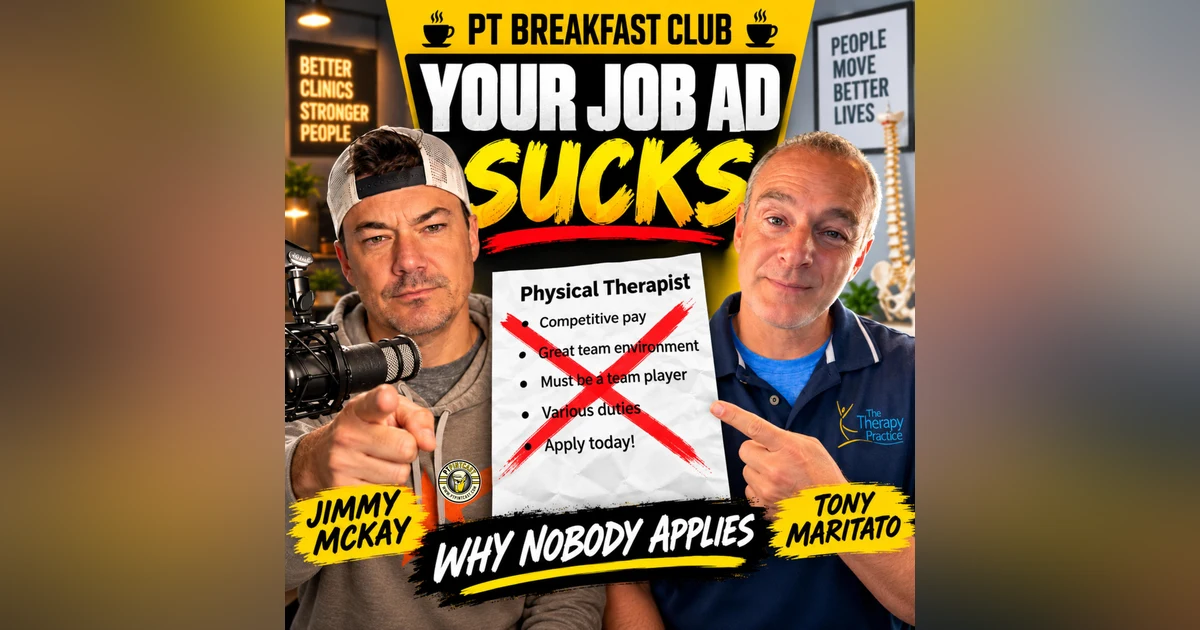


What if the goal of your next physical therapy job ad wasn’t to attract more people?
What if it was to repel almost everyone except the few clinicians who would actually love working for you?
Jimmy McKay and Tony Maritato dig into recruiting, advertising, AI and psychology after Tony asks a fascinating question:
What would advertising legend David Ogilvy want to know before writing a job ad for a physical therapist?
That question produces a 12-part framework clinic owners can use to evaluate their own recruiting.
The conversation starts with the basics: Who exactly are you trying to hire? What does the employment model look like? How much control does the therapist have over their schedule? What does compensation actually look like?
Then it gets more interesting.
Jimmy and Tony argue that employers should explain not only what clinicians GET to do, but also what they DON'T have to do.
Scheduling.
Insurance verification.
Marketing.
Faxing plans of care.
Administrative work.
Whatever creates friction in that particular clinic.
They also make the case for showing candidates the imperfect parts of the job instead of hiding them.
The goal isn’t hundreds of applicants.
The goal is a handful of people who understand the offer and think:
“That sounds exactly like me.”
The episode also explores how Josh Funk and Rehab 2 Perform use media as a recruiting tool, why simply spending more money on traditional job boards may not fix a hiring problem, and why short-form video could be an underused recruiting strategy in physical therapy.
Later, the conversation expands into communication and content creation.
How do you take one useful idea and package it as video, audio, images and text?
Why do some pieces of content explode on one platform and disappear on another?
And why do healthcare professionals spend years creating valuable information only to publish it as an unreadable screenshot?
Finally, Jimmy and Tony tackle another uncomfortable idea: information has become incredibly cheap.
People often aren’t paying coaches, consultants, courses or even clinicians purely for information.
They may be paying for guidance, accountability, confidence and someone to help them take the next step.
That leads to Jimmy’s warning about a $9,000 YouTube growth course and Tony’s story about spending roughly $33,000 on business education years ago.
The episode closes with perhaps the simplest idea of the entire conversation:
Before adding another form, another question, another feature or another step…
Ask what you can remove.
KEY TAKEAWAYS:
• Recruit a specific person, not “everybody”
• Transparency filters candidates instead of scaring them away
• Explain the negatives before applicants discover them themselves
• Sell what clinicians DON’T have to do
• Make the next step conversational instead of bureaucratic
• Great recruiting media can show what working somewhere feels like
• One idea can become multiple kinds of media
• Information and implementation are different products
• Better experiences often come from subtraction
FEATURED:
Tony Maritato
Tony on YouTube:
https://www.youtube.com/c/MedicareBilling
FOLLOW PT PINTCAST:
Apple Podcasts:
https://podcasts.apple.com/us/podcast/pt-pintcast-physical-therapy/id1000443325
Spotify:
https://open.spotify.com/show/3LmMUT64yrUc2iGo9Emafc
YouTube:
https://www.youtube.com/@PTPintcast
LinkedIn:
https://www.linkedin.com/in/jimmy-mckay-pt-dpt-a4207659/
Instagram:
https://www.instagram.com/ptpintcast
Website:
Twitter/X:
<p>This episode is part of the <a href="/physical-therapy-business-podcast">Physical Therapy Business Podcast</a>, where physical therapists and clinic owners learn how to get more patients, improve operations, and grow their clinic without relying only on referrals.</p>
<p>Looking for more episodes? Explore the full <a href="/physical-therapy-business-podcast">Physical Therapy Business Podcast</a> for real-world strategies on physical therapy marketing, patient acquisition, and clinic growth.</p>
0:02 Broadcasting way too early from three separate Wi-Fi connections. It's PT Breakfast Club with Tony Meritato, Dave Kittle, and Jimmy McKay. Tony Meritato, I'm Jimmy McKay. Dave Kittle is off today. Tony, how's it going, man? What do you want to talk about first? I feel like we shared a lot of ideas. I just got here. What do you want to talk about first? I got a sec. Yeah, I shared a whole bunch of pictures. So which one? Let's, let's let's do the last the most recent, which is using AI.
0:48 The David Ogilvy GPT, you know, because this is something you've been talking about a lot. Um, Give me your initial thoughts while I've got my mic. Well, David Ogilvie, if people don't know and they should, is the person who and I haven't read the book, but apparently he wrote like the first book on advertising and he was the guy to sort of make it. from an he combined sort of art and science like he understood you're trying to change human behavior and i think even a million years after david ogilvy people still like to just post we're hiring or we opened a clinic come to it and that is telling a story not storytelling so david ogilvy understood that like there needs to be an element of psychology to get someone to to understand or to want to come closer or hopefully to eventually want to do something again i'm giving a talk at apta florida not to spoil it but i've been showing the slide forever and i'm probably never going to change this slide but for the podcast audience attention leads to trust, trust leads to action.
1:57 Ogilvy was very, very good at the first two. And then he said, it's up to the person viewing this, reading this, hearing this, if they want to take that action. But it's his job to gain attention to hopefully earn trust. So you're saying, did you train up a GPT to act like David Ogilvy? Kind of, not totally. Basically, you know, every Tuesday, Thursday on the way to work, I'm brainstorming ideas for the podcast. I shared a whole bunch of, this was the train of thought that got me here. So I was like, hey, you know, there are some real benefits to insurance. Everybody hates insurance. Everybody hates paying premiums.
2:37 But there are a few people who make boatloads of money having paid for insurance and a bunch of people who lost money. So I was like, oh, that's an interesting topic. We could talk about that. And then I was like, well, let's define the different terms between price, cost, worth and value. Yeah. Went through that conversation. Then it got me to Jimmy. Yeah. jimmy's been talking about recruiting and hiring and everybody you know is short staff so so what are some cool ideas going back twenty years ago when i was hiring the the thing that got me my best employees was never putting a vanilla and i saw one of your videos um job posting up it was like let's get to the meat what is the pain we're trying to solve for Therapists are frustrated.
3:26 Therapists aren't making enough money. They feel cheated. They feel overworked. They're not getting to do what they want to do. So when I was recruiting, like those are the pain points I could talk to flexibility and hours and value and all of these things. And I was like, well, who's the best at conveying that? It's the copywriters. Who's the best copywriter? David Ogilvie, Gary Halpert, like all of Alex Hermosi, all of these names. So I just threw this thread on the chat. I said, okay, all these conversations now, let's go through. And if you were David Ogilvie writing an ad for me to hire and recruit a physical therapist, like what are the questions you would ask me before you created the ad?
4:11 and then what would an ad like this look like sound like feel like uh and that's how we got to this point so you know i don't even think people realize like i don't think they're thinking about the actual questions you should be able to answer before even starting the app nope where does your head go because I had a series of posts a couple months ago where I said, nutrition information is standardized in this country, right? You have to tell me how much sugar and how much this and recommended daily allowances. And I actually said, standardization would be a superpower here. Because exactly how the nutrition label is written, you know exactly where your eyes go.
4:56 If you don't like sugar, your eye darts to sugar. If you're like, I need to make more money, salary is the only thing I'm caring about, you're going to go right to the salary line if they were all written sort of the same way. I like that from a back of the â this is why I like using the baseball card analogy. the back of the baseball card is always the freaking same, right? It's what year, batting average, runs, hits, home runs, single, double, triple. The front is where you get to be fun, right? That's where the player... It's an action shot. I'm not saying be super boring and just do a nutrition label, but I'm saying... The reason I like the nutrition label is it's open, honest, and clear, and you don't wonder or worry.
5:36 Someone had a post a while ago. I don't think this was in healthcare, but they're like, no one wants to take a day of PTO off, do research, do a bunch of effort only to get to a job interview to find out that place is offering thirty thousand dollars less than I'm making now. I was never going to consider that most likely. So why aren't we being more transparent? So what are the questions? Do you want me to ask the questions or you were saying what Ogilvy would ask? No, no, let me back up here. So it was twelve questions. Let's kind of run through them just because I think the listening audience deserves. So, okay, question number one, who exactly are you trying to recruit?
6:17 Is it a new grad, an experienced therapist, someone already working full time, a parent wanting a few hours, a burnout corporate PT who wants to change? Um, you know, so starting with that, go ahead. Here's what not to do. Can I give it what not to do? I'll be the devil on the shoulder. Don't write it. Don't say the answer to this question is everybody. Because if you say everybody, your thing is going to be a pile of mayonnaise. It's going to be, it's not going to have any, there's going to be no edges, no threads to pull. If you truly want a couple of those, they need to be different messages. Yeah. Because if you want to, I'm not a fisherman, but if you want to fish for different fish, different fish like different bait. That's as fisherman-y as I can get.
6:58 So yes, I think question one always for me goes, who are you trying to talk to? If I don't know who I'm talking to, I don't know what to write. Well, the part that I thought was interesting, I saw one of Dave's recent videos. Two of his therapists are sitting in a room, looks like an exam room, talking to each other. The female therapist asked the male therapist, what's your favorite quad exercise? And I heard that interaction, too bad Dave's not here, but like, that's a great example. I look at, the girl therapist i look at the boy therapist and i'm like these are very different personalities yeah um so for me when i'm thinking about this one of the things i want i want somebody who wants to to learn i want somebody who wants to understand what i do what i've created that's an important aspect to somebody that i would want to bring on the team i would not want to bring somebody who's already an air quote expert in whatever their field is i am not looking to hire somebody that i want to learn from some people are i'm looking for somebody that wants to learn from me from us from what we've built here so like that's an important element because that is a very different personality that you're looking to bring on to the team so first was a who question what's number two What is the actual employment model?
8:21 Is it a W-two, a contractor, full-time, part-time, PRN per visit, on demand? What are the minimum hours, maximum hours? Can they work somewhere else simultaneously? Just lay it out. These are all the things that they're thinking. And if you don't answer the question clearly and concisely and plainly, they're going to wonder. And our brains, we're big, dumb animals. Our brains are wired for the worst. Your boss messages you, can we talk tomorrow? What is our first impulse most of the time? What did I do wrong? I did something wrong and this is going to be horrible, right? So by you not mentioning or at least, yeah, you got to mention it, right?
9:01 At least somewhere. Now keep in mind what Tony is saying, it doesn't necessarily need to be all in the picture. Let's understand, like I said, baseball card. The nitty gritty or some of them can be in on the back of the baseball card, but they got to be there somewhere because that's where my eye is going to dart. So we got a who question and a what question. It's providing context. This is all about context to then allow the GPT to create the offer that we want. I mean, this is marketing one-on-one. Whether I'm marketing to a patient to come to my clinic or I'm marketing to a therapist to come work for me, we're just marketing. That's all it is. So for me, and what I'm doing is I'm going to answer all of these.
9:44 We'll have it in the video transcript, then we'll use that video transcript to actually create a job offer. Okay, so for me. it's basically i would be looking for a part-time w-to maximum flexibility i would want somebody who doesn't want full-time hours i want the best of the hours that they're willing to give me not forty hours no matter what you know and so for me it might be fifteen to twenty hours um And I would pay a W-two so they don't have to worry about taxes. They don't have to worry about Medicare and Social Security and FICA and all that kind of stuff. I want to keep it super simple. Number three, how much control do they really have over their time?
10:25 This may be their biggest, your biggest selling point. Who chooses the days? Who chooses the hours? Can they say no? to a patient offer? Can they charge or change availability from week to week? Are evenings, weekends optional? So like when I was recruiting, this was probably my biggest value proposition because I could say, look, you want a four day week? No problem. Weekend? No problem. Work Monday through Thursday. Then, you know, Tuesday through Friday, you are in control of your schedule. You manage your patients. Your patients, no one like you. They trust you. You have that autonomy.
11:05 You want to change the plan of care from three days a week to one day this week and three days next week? Go ahead and do it. I don't care. Get good outcomes, get good patient reviews, make the patient happy, and you can do whatever you want. You just advertised autonomy, but you did it in words that don't appear on the SAT. You're an individual who knows how to get results? Great. Get them. Right. That's what Jobs said, right? You don't hire smart people and tell them what to do. You hire smart people. You let them tell you what to do. And we love to jam people. We say we're smart or we hire them and say, we're going to take the smart person and we're going to shove them through our system.
11:50 That works until it doesn't. Yeah, yeah. Number four, exactly how does the compensation work? Hourly, salary per visit percentage. What are the rates? What are the ranges? Does documentation get paid separately from patient care? What happens if there's a cancellation or no-show? Raises, bonuses, CEU money, retirement. I remember the biggest challenge we ran into was still managing like, okay, somebody we used to, we don't anymore, give a thousand dollar stipend for CEUs. Well, what happens if the CEU happens to be on a Wednesday or a Thursday? Do they have to take PTO?
12:32 Do they not? Do they get paid for that time? Does it come out of their budget? Like what happens to their patients? There are blind spots that newer employers, newer businesses haven't lived through yet. And going through an AI like this will help you identify those things. So for us, You know, yeah, we have typically found now we're salary in the past when we were hourly, we basically said, look, I guarantee you this block of time, I'm going to pay you no matter what, whether the patient shows or no shows, whether this or that happens, you can count on this time and this money for this exchange.
13:15 And that gave peace of mind to the clinician to know, Okay, I'm safe. Even if I'm going to make a little less, I'm going to have the security in that exchange of knowing that I'm going to get paid something. And if that's how you're operating, you want to use the right bait. I hate using bait because it sounds like we're trying to trick someone, but you want to use the right words that convey security. what the advantages are there. Ironically, I think we get in the wrong mindset of, I want to get as many people as possible. And I would argue you want as few people as possible. You want three really great candidates who none of them are confused.
13:57 None of the things you're going to say in the interview or if they ask a question is going to immediately be like, no. You don't want that person. You want to weed that person out as quickly as possible. But on the internet... In social media, it's get as many as possible and hope for one. I would say go the opposite, right? Like, you know, make small big, make big small. Those are the immutable... Two of the twenty-eight immutable laws of marketing. I say make the hidden visible, right? Bust open the... i told you guys the story before how we would hire for weekend djs and we'd be like you're gonna make state minimum wage you're gonna work nights weekends and holidays you want a free ticket to that concert you can't because you're gonna be in the studio and we're all at the concert i only wanted the one person right i wanted the right person so i think this mindset is better clarity that's what someone really wants in this part of the exchange is clarity yeah So question number five, what does a clinical hour actually look like one patient at a time?
15:02 How long are the visits? What's the expectation? Is there double booking? Do you use tax productivity? Again, we're developing context because the prospective employee, has never been in your clinic, has no idea what's going on. The most, if they do any research, the most they're gonna get is what you say on the website, which everybody's gonna say the same stuff, yeah. So it's like, they have no idea. So like you just said, give them the honest truth, give them worst case scenario, let them know, look, there are gonna be times where six people walk in the door at the same time, even though they're scheduled every thirty minutes or an hour.
15:44 There are going to be times where you're going to miss lunch because somebody is running late, but they still want to come to therapy and somebody else comes early. There are going to be times where you're going to be bored out of your mind because three people cancel and now you're sitting there with you don't know what to do. This is the reality of the clinic. And this is the reality of the person who you're working with, right? I work with people who are kind of high anxiety, not now, but in the past. High anxiety, high achievers. They're constantly moving. They say a lot of words. I don't, I'm not going to be that person.
16:24 So if you need a lot of words, I'm not the best person for you to work with. If you need affirmation, if you need uplifting motivation, I am not the best person for you to work with. Yep. The, uh, the, the, one of the clinics, and we mentioned this guy a lot because frankly, I don't see anybody else doing it. I hope people steal his methods and I think he's hopes people steal his methods. But Josh Funk at Rehab to Perform, their media is not for patients. But they're not sitting there reading a job description. They're showing you exactly what a day or an hour or the vibe looks like. All of their media, which is really well done, is for hiring, and if I had to guess, Josh doesn't have a, I'm gonna guess Josh doesn't have a hiring problem, because Josh decided to start solving it five years ago, and it wasn't let's double down on boosting posts on Indeed, which, spoiler alert, does not work.
17:25 I was talking to a practice owner recently who said we three X'd our spend on Indeed this year versus last year, and we're in September, And I said, how's it going? So you three extra spent. I go, how's your results? He goes, a third. And I'm like, that math? Don't math. You three X'd it and you're getting thirty three percent of the results. And then I looked back at them and, you know, this is a practice owner that I just met. So I have to understand how much credit I have as the guy sitting across the screen at a Zoom call. And I go. so you keep doing the same thing as everybody else you're competing with and getting worse results would you be open to trying something different and they were like what's the difference and i go i just need to i just need to know if you'd be open to trying something different right but this is this is what it comes to which is you understand your brand and your day and your hour and your payment models really well the person on the other side of those words they don't be clear Yeah.
18:20 Number six, what work does the therapist not have to do? And this was another, so my big selling points were never going to be salary. It is never going to be benefits. It was never going to be CEU reimbursement. It was going to be flexibility, independence, and it was going to be, what do you not have to do? So like it says, you know, removing under undesirable work, who handles the scheduling, insurance verification, authorization, billing. We used to. Tell our therapist, look, you will never fax a plan of care. You will never schedule. You're never going to schedule a patient. You're never going to sell somebody. I even used to say, look, you're never going to have to shadow a surgeon because when you went to work for the hospital, one of the obligations was you had to go market.
19:07 You had to go spend a day with the surgeon. None of the therapists wanted to do that. They were intimidated. They were scared. So I was like, if you want to, you can, but that is not something I'm going to force you to do. I don't force anybody to do social media. Social media is a huge part of our current business. It's not something I force people to do. And so helping them see, because usually they're working somewhere where they're doing stuff they don't want to do, helping them see, okay, I'm not going to have to do that. Again, much more appealing than like the promise of what you're going to get to do. But if you don't tell me that that isn't part of my job, I'm just going to flat out assume it because I've done this before.
19:50 Either I'm a student or a seasoned clinician. So you mean I'm getting all that bad stuff and no extra money? Like this doesn't... But what if I took away all the bad stuff that you don't like? And again, bad is going to be subjective. Some people don't mind doing certain things and some people get some people really hate doing it. If someone turned to me and said, you never touch a spreadsheet for the rest of your life, I would just be like, where do I sign? Like, where where where do I sign? Right. So understanding that's the opposite of what does this job include? It sounds like it's not important, but what does this job not come with? That's terribly important. I still I agree with Mr. Ogilvie on that one. I'm going to lump a couple together. What patients would they treat?
20:32 So in other words, outpatient ortho, neuro, you know, we are adult geriatric outpatient ortho. I try to avoid low back pain referrals. I don't do any like prosthetic. I don't do any neuro. So obviously that's going to be a huge element. Number seven, I'm sorry, number eight, what resources are available? Yeah. So like all the normal stuff, what equipment? We have old equipment. Don't come here thinking you're going to get like a thirty thousand dollar treadmill. We used to have it. We don't have it anymore. You're going to get bare bones, basic stuff, heavy things that you can lift and push and pull and carry. This is not a state of the art gym.
21:14 It is a basic, low cost physical therapy clinic. What are the negatives? This is very Ogilvy and Halbert. That's what it says. What are the reasons someone wouldn't take the job? For example, we don't have group health insurance. I said we do guarantee hours, but if you didn't, that's something you'd want to make known. We're a small organization, right? We have a variable caseload. Now we do, but in the past, we didn't necessarily have a full caseload for a brand new therapist on day number one. So like convey the negatives, which we've mentioned multiple times, is item number nine.
21:58 Real quick, item number ten, eleven, twelve, What does the therapist have to give you in return? Right? So beyond providing competent treatment, what are the non-negotiables? What are the documentation standards, reliability, communication? What are the minimums you need to have? What makes your offer structurally different from other offers that are available in the Cincinnati area? What's the easiest possible next step? This is an important one. This is the last of the twelve. A traditional application may create too much friction. Direct response might instead say, if you're interested but not ready to apply, text Tony.
22:43 Let's talk for ten minutes. We need to decide what action you actually want the person to take now. Yeah. My journalism degree brain for many years ago would envision these twelve questions as what we call the inverted pyramid, where you start with the big information, right? The who, the what, the what, the why, and you get down to the how, where, and the when. So it's inverted pyramid because you're becoming You're very general, big picture, and you're getting more detailed as you get down the further you read. That's how news is written with that inverted pyramid, which is broad, big strokes up top, and then you go down to the detail, but not including it somewhere.
23:32 And again, please don't go to Canva. Take everything Tony just said and put it on one image. The human brain will not process that. But you can do a combination of lots of things. This is where understanding the physics of platforms is important. This would work well as an Instagram carousel. Maybe that'd be an engaging way to do that, where each big point was its own image. You could also include a lot of the detail in the comment on Instagram. It would be completely different on LinkedIn or could be. In fact, LinkedIn is going to more of more carousel posts that I see anyway. Big, big companies are doing that. But this is understanding you're answering who, what, why, where, when, how.
24:15 Those are the six questions that everybody's asking, a bunch of different variations. But if you follow these twelve, even do an audit with these twelve, right? Take the last couple things you've tried to use a clinician, to use to hire a clinician and go, don't even do the work. Let AI do the work, right? Where am I lacking? And also, which order do I have it in? Maybe you're burying the lead. Maybe the biggest thing that's valuable is the ninth thing on your list. My friend, bring that up above the fold. Bring that to the top. Yeah, you know, real quick, talking about different modes of delivery, that's been something that I've been working on quite a bit. I'm like, how do I take a single idea and deliver it in multiple ways that different viewers, consumers of media want to accept?
25:03 There are people who watch reels. There are people who don't watch reels. There are people who want images, who want text, who want audio. And this goes way back. I remember twenty five years ago listening to direct response guys. They're like, look, get an eight hundred toll free number, have a recording. Why a recording? Because people don't want to risk calling a number and getting a human on the phone that's going to try to sell them something. Right. So if you give them an audio recording, They can call the number, listen to the recording, hang up anytime they want, right? And you take that into today's world and it's like, all right, I have the idea. Now I could do a video just like this, talking to the camera.
25:48 I can strip out the audio and do just an audio only version of that. I can create an image that conveys the content and the idea of what you just said. I can do a text only post. I can do an image of a text only post. So like there is this five to eight mode stack that really just takes the same idea, gives it to social media and allows the algorithm to put the appropriate delivery method in front of the appropriate person. I did a presentation at CSM a couple years ago, was asked to do the presentation. It was for researchers, and I love me some researchers.
26:31 I just think they have so much information, but they maybe weren't trained on how to share it. So I came up with a cute version of sharing it, and I called it The Wheels of Content, where essentially... I just said, listen, it's a what, a how, and a where. Like, that's all this is. It's a what, a how, and a where. So what do you want to share? What part of your research? That's your what. How might that be transmitted? Sounds, videos, pictures, words, a quiz, a story. And then where are you going to put it? If you say, I want to make a video, and you put it on a platform that doesn't really optimize for video, you're putting it in the wrong spot. So either abandon that place or when I make it on this platform, I'm going to optimize for the type of media that it was consuming.
27:19 And I think it got easier for me to do when people saw this because I'm like, just what, where, how? What, where, how? Can you run through what, where, how multiple times? Yes. Should you? Yes. Because here's what I see. Researchers work for months or a year or multiple years to get something published. And what do they do, Tony? They've learned how to take a screenshot of the journal, and they post that. And not with binoculars could I read a single word on that. It is not optimized to be read. It's not optimized for any of those wares. But there's so many gems in there that you could have created a what, a where, and a how, or a what, a how, and a where.
28:02 But they don't. They don't. They work for years. And the finish line is, I'm going to share a screen. I'm going to share. Here's what I'll do, Jimmy. I'll share multiple screenshots. That'll show them. No, it's just more piles of, I call them walls of text. So I think it doesn't really matter what kind of information. If you tell me it's honestly valuable for someone out there in the world, and you're like, the algorithms are working against me. Are they? Or do you just share bad media and if you do the algorithm is actually doing its job it's making sure the bad media doesn't get shown now the thing with that is in the past you used to have to pay for every opportunity to put a piece of media in front of a media consumer correct now it is virtually free free so so i knowingly share media on all the platforms, knowing that it's probably going to do well on one of the platforms.
28:59 Right now today on Instagram, I've got seven and a half million views in the last thirty days, mostly because of two pictures. Those two pictures, those two images did terrible on Facebook, but they did amazing on Instagram. You know, but I still shared them to all the platforms because somewhere it's probably going to get in front of the person that needs to see it. Correct. The cost to do it is pretty much zero. If you've already created the information and the, the best thing, and I wrote about this the other day, you just don't know. Yeah. Like the New York state Lotto's, uh, uh, uh, you know, motto was all you need is a dollar and a dream.
29:41 You don't even need the dollar anymore. And you really don't know. I mean, two of my best performing videos, more than a hundred something thousand views a pop. You can tell I did it on a whim because my hair looks like I combed it with a firecracker. But if I was working for a big company, I would have, you know, I would have professional light and professional sound. It's me sitting on my step. Like, I just had coffee and I was like, I'll just fling it. I'll just give this a shot. Here's some great advice from a former boss. If you do something that's a terribly bad idea and no one liked it, no one heard you suck. So you have to get over the psychology of this needs to be perfect or I need to optimize or reduce the... No.
30:26 Maybe. Maybe try that. Again, the experimentation is almost zero. I do want to talk about that woman that... I won't say who it was because I didn't ask for permission, but she DMed me and was like, what do you think about this YouTube growth program? Somebody was selling a YouTube growth program for nine... thousand dollars i don't know tony maybe we should get into this gag right let's let's go scam some people now i'm not saying that there aren't people who can show you how to grow things that's not what i'm saying but i asked this person who said i'm about to buy this program and i could not type with my thumbs fast enough in all caps under no circumstances should you a physical therapist be investing nine thousand dollars in a youtube growth program Don't do it.
31:12 Tony's giving one away for free right now. Like we could do an episode that would be more value than nine thousand dollars, in my opinion, to this woman. And she wouldn't be take that nine thousand dollars. Do something with eight thousand dollars and buy yourself a microphone and a decent camera. We wouldn't even need a thousand dollars for that. That ain't the way. But I get it. Just push purchase and your problems are solved. That person sold you well. Do not buy that package. Don't do it. You won't get enough results. to ever make it worth it, right? Generally, yes. Generally, yes. And I share this story plenty. Going back to two thousand and three, I started the business with my wife in two thousand one, two thousand three.
31:58 We're booming. We're so busy. We don't know what to do. We've got tons of money and no time. But we knew we had to do something different to to grow the business into a business. So we did we went we paid a thousand dollars for a marketing seminar that marketing seminar then led to a thirty thousand thirty three thousand dollars spend at that time in two thousand three on like consulting and management education and learn how to turn your business into a real business not just a job um there was nothing we learned for thirty three thousand dollars that we couldn't get from a thirty three dollar book But there was value in, and maybe this is just self-justification, rationalizing it.
32:46 We took a week. We went to the place. We were there with other business owners. We studied, we read, we tested. There was a person in the room answering questions if we needed. It was all self-paced. It was all self-directed. And so it's like, all right, so I don't feel like a total moron. My rationalization is... the price and the fact that we went off site made us do it. We knew this is what we needed to do. If it was less, we would have just wasted, you know, the time and the money we wouldn't have done it. So I agree all the information she would get from that investment is readily available for free.
33:30 Correct. You're never paying for that. You're paying for the commitment and the accountability and that kind of stuff. And you know, so what happens in the clinic? I just told a woman yesterday, she wanted to know, what are my cash rates? I said, look, you could pay, but what are you paying me to do? I can tell you right now, everything you're doing is great. There is nothing you need me to tell you for another two hundred dollars that I'm not telling you right now. You told me your history. You told me your situation. I'm telling you you're doing the right stuff. There is nothing more I could tell you. But if you need to pay me the money to believe what I'm telling you right now for free, Okay, go ahead and do it.
34:16 I don't feel good about it, but go ahead and do it because this is what you need to do. But there is absolutely nothing new I'm going to tell you after you give me the two hundred dollars that I'm not telling you right now. You are good. Keep doing what you're doing. Don't worry about changing anything. But but what she wanted was. guidance. She wanted a Sherpa, right? That's what people sort of want. It's why you hire a coach, right? It's why you hire a physical therapist. But PTs would get real gun-shy about that. Well, no, no, no. You hired me because of my clinical excellence and my pattern recognition. I'm like, yeah, those are table stakes though, right? That's what everybody's supposed to have.
34:57 You're supposed to be able to diagnose and treat. What else do you do? Because right now, Pieces of technology are getting real good at some of the other things we like to hang our hat on. But I think they were never the thing that people were buying in the first place. But that's challenging someone's professional identity, which sometimes is not a smart thing to do. But push back pretty hard. Even this conversation back to the employment offer, these are important conversations. You know, like somebody coming to work for me needs to understand. I am basically going to assume Everything out there is bullshit. Everything out there is no better than sham.
35:38 You want a dry needle, you want a shockwave, you want to do this, you want to do that. That's awesome. Do whatever you want to do. Do what you have to do to convince yourself that this is something of value so that you can charge the rate you want to charge. But understand at my core, Nothing you were doing is any better than lifting some heavy weights and exercising more consistently, reducing your stress, improving your sleep, eating better food. And so don't come to me looking for affirmation to say, wow, this fancy new gadget is gonna revolutionize physical therapy. come to me if you agree with the mindset that none of that stuff matters.
36:19 It's all theater. It's all about the experience and convincing somebody that they're getting something worth three hundred dollars versus, you know, the simplistic look, lifestyle affected you in this way. We got to reverse thirty years of lifestyle choices with hopefully five years of better choices. Correct. Yeah. All right. I'm definitely going to pull that transcript because part of my job right now is solving this big, giant problem. And everybody I've run into, I like to ask them, what are you doing now that's worked? What have you done that hasn't worked? Let's rule out things. And where do you think your biggest opportunity might be?
37:02 And we love to triple down on the things that we did five years ago. We're human. We're human. Big, dumb animals. We're human beings. We will triple down the thing that used to work because this is why casinos make money on. Well, I won once when I put the quarter in and pulled the handle down. I know what that feeling feels like. So I'm going to do that for six hours until I get that dopamine hit. That ain't it. It's not it. So I'm going to operate. So my goal is, or one of my strategies is short form video for jobs. I don't, I have not seen anybody do it. Have you seen anybody do it? Like a straight up job, just a straight up job sell. My twist is a little Ryan Reynolds, a little mint mobile, a little tongue in cheek, a little break the fourth wall.
37:46 But I don't want a hundred people to like it. If I show it to a hundred people, I do not a hundred people liking that job or wanting that job is a failure on my part. I want three. I want to piss ninety seven people off or push them away because I want three people to go. That is what I want. And it sounds like he's being truthful. So I'll take one step forward. And I always say fifteen minute conversation, not a job interview next, because I think you're right. I think if I have to formally apply, if the next step is and I swear to God, If you run a company and your job application process requires me to upload my resume, and then fill in the blanks of all the things my resume just told you?
38:29 No. Don't do it. It's twenty twenty-six. Push back on your applicant tracking system. That is sacrilegious in my book. But I would rather just say, if this sounds like it's for you, I like text Tony. I like text, don't text us, don't text company name. I like text Sandra. And just ask her. Fifteen minutes. That's it, lower the stakes because that could be, the wall's too high, it's too formal, I don't understand this. And the funny part is all the business owners are like, we're super chill here, and we're super, it's just whatever. And I'm like, yeah, but your ad makes it look like I'm applying for the FBI. And that puts distance between us.
39:10 It doesn't bring us closer. So I like, hey, listen, if this even sounds moderately like something you might want to do, dude, text Sandra. She's just chilling in the back. She'd love to talk to you. Like, make it a human. I don't know. I haven't seen anybody do this yet, but I'm going to triple down on it. And that, you know, look at the new patient admission process for some clinics versus others, right? You look, I'm going to swing this around. When you walk into my door, there's one page and one signature. That's it. There's no health questionnaire. There's no five pages, twenty pages of past medical history. There's none of that stuff.
39:51 Yes, I don't value that stuff. I don't think any of that stuff helps me in any way because I'm going to have that conversation with the human during the treatment, during the evaluation anyway. But there are providers listening to this show right now who send packets of forms, electronic or paper, and they expect their potential client to do a college essay for a PhD before they even get scheduled. And, and obviously that's not the kind of employer who's going to use you to create those videos because like you, somebody I've never talked to on the phone calls me and they're like, Hey, my shoulder's bugging me. What do I need to do?
40:32 Come on in. We'll figure it out. You know, Hey, I'm, I'm bored at my job. I want to do something different. Come on in. Let's chat or let's, let's just talk right now. You know, I think it doesn't have to be that complicated. It doesn't. I was watching a video about something psychology, and they gave groups of adults and groups of children the same prompt. And the prompt was, it's either build a Lego tower or change a Lego tower. And I think the distinction was important, but I'll find the video. And to prevent a Lego figurine from getting crushed, you had to put a weight on top And you had to make sure that the platform prevented the thing from getting crushed.
41:19 And they were like, most of the adults added stuff. They added crap. And most of the children took stuff away. And there's a whole Japanese theory around this. I can't remember what it's called. But it's like, our first reaction for some reason is, let's add some stuff to it. But we've seen most of the success is when, what does it need to be here? And I feel like I have an edge on this. Because for fifteen years when I worked in radio stations, I only had one dimension. Until websites really came along from, you know, nineteen ninety-seven to whenever websites were not just around but enough that we were consistently updating them. Because remember, the first couple years of a website for a business, you built it and let it sit there.
42:00 You didn't change stuff, right? We only had one dimension. You play too many sounds at once, you know that's gonna be unsuccessful. The brain's not gonna be able to process that. So we practiced whatever this Japanese theory was. What do I need to remove? What has to be there? What's need to have and what's nice to have? No offense, nice to have is actually not nice. There's the quote of the episode. What does not need to be there? Out. It's out. Pretend you're one of those bomber pilots over Japan when they run out of gas. Throw everything out. It's a gun. We need guns. We're going to crash. Guns are important. Not crashing is more important. So we have to start to act like that because I think our first response for some reason is, by the course...
42:46 add to the app if it's ten questions make it twenty because it'll be better and i actually think the opposite is true i think it's what doesn't need to be there get it the hell out yeah yeah you know you mentioned the course again uh i i right now i'm trying to continue to build my facebook there's a guy he he's in the financial space he's uh mike what no the one i'm thinking about I don't know. He's funny and a good guy. He teaches a course. I want to buy the course so badly. Everything in me physiologically is like, buy this, buy this, because I want to solve the pain problem.
43:31 The pain is I'm not where I want to be. I want more views and more money. This guy is where I want to be. I want him to bring me there. But there's a little bit of logic left in my brain that's like, listen to what he says. He doesn't have the answer. None of us have the answer. The YouTube guy doesn't have the answer. We have an educated guess based on experience. We know that past performance doesn't predict future performance. And so I'm like, I want to buy it. I want to give them the money. But I know that once I do, I'm not going to get what I think I want.
44:11 Because he can't deliver it. He just can't. It's physically impossible. And so for weeks now, I'm struggling with this. I can feel myself looking for reasons to justify the purchase. And I've done this my whole life. I've got a I've got a six thousand dollar fourth plate sitting in storage that I use twice. I've got a eight thousand dollar Harley sitting in storage that I use for a year. Like, I've got all this crap that I haven't, you know, that I've totally wasted money on. And so it's like, when do we as humans learn the lesson? We keep repeating the mistake and it seems so hard for us to finally learn the lesson.
44:55 And I've said this before, and I think people take it an attack on their own personality when I say we make emotional decisions and then we try to back them up with logic. Just what you said. You already made the emotional decision. I want it. Now you're trying to make the logical argument to yourself, ironically, to say, this is why if I give three hundred dollars or a thousand dollars, it will be worth fifteen hundred. It'll be worth more than I paid. The juice is worth a squeeze. Let's wrap the show. I've got somebody waiting on me. Parting shot. Come back on Thursday. We'll have your version and my version of the job ad, and let's see what they look like.
45:38 Yep. I think this would be helpful for Dave, too, because that's his clinic. I would say challenge yourself to walk around today, whenever you're listening to this, and ask, what can I remove from this process to make it better or easier? All right, Tony, I'll see you on Thursday. That's it. We're out. Boys, what the hell are you doing? Follow Tony Maritato on YouTube at Total Therapy Solution. Find Dave Kittle at conciergepainrelief.com and on YouTube at The Dave Kittle Show. And follow Jimmy McKay at PT Podcasts on YouTube, the socials, and wherever you binge podcasts you pretend are for CEUs. And hey, just a reminder, none of this was for advice. This was for entertainment only. Our lawyers say that counts.
46:19 Thanks, Keith.