Your One-Star Review Is Content
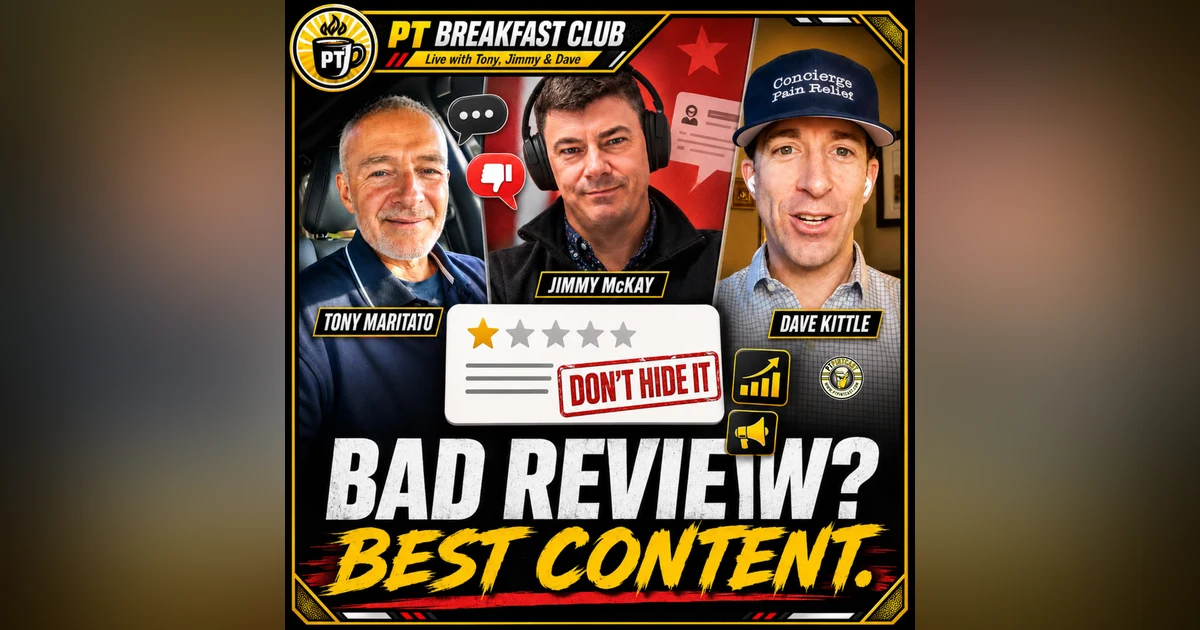



What if your one-star review is not a disaster?
What if it is actually one of the clearest ways to show people what your clinic stands for?
In this episode of PT Breakfast Club, Jimmy McKay, Dave Kittle, and Tony Maritato talk about content, clinic storytelling, virtual assistants, outsourcing, moonlighting, AI, and referral relationships.
Jimmy and Dave start by talking about why PT Breakfast Club seems to be connecting with people: it is loose, unscripted, opinionated, and willing to say the parts that usually get sanded off professional healthcare conversations.
Then Dave shares why he made a video about a one-star Google review for Concierge Pain Relief. Instead of hiding the bad review or trying to delete it, he used it to explain how the practice works, why the model is different, and what type of patient may or may not be the right fit.
Jimmy breaks down the difference between telling a story and storytelling, then shares how he borrowed Dave’s idea for a wedding DJ marketing carousel built around fake one-star reviews from people whose weddings were too much fun.
The conversation then shifts into operations. Dave explains his experiment with virtual assistants in Costa Rica who are helping handle phone calls, lead follow-up, scheduling, EMR entry, and front desk workflows. The challenge is not just answering the phone. It is teaching the system: geography, home visit scheduling, Google Maps, commute buffers, conversion rates, and all the tiny decisions that live inside a clinic owner’s head.
From there, the crew gets into AI, employee identity, outsourcing, moonlighting, no-solicitation agreements, and whether therapists should be allowed to work elsewhere while employed full-time.
The episode closes with a setup for Thursday: a referral-source draft board. Who are the people in your neighborhood that PT clinics should build relationships with besides the obvious physician offices?
<p>This episode is part of the <a href="/physical-therapy-business-podcast">Physical Therapy Business Podcast</a>, where physical therapists and clinic owners learn how to get more patients, improve operations, and grow their clinic without relying only on referrals.</p>
<p>Looking for more episodes? Explore the full <a href="/physical-therapy-business-podcast">Physical Therapy Business Podcast</a> for real-world strategies on physical therapy marketing, patient acquisition, and clinic growth.</p>
0:00 That's the attitude, you know what I mean? Broadcasting way too early from three separate Wi-Fi connections. It's PT Breakfast Club with Tony Meritato, Dave Kittle, and Jimmy McKay. Happy Tuesday morning. Welcome to PT Breakfast Club. Hey, new graphics. Who dis? Got some new images if you're watching the livestream. And apparently, people are watching the livestream. Have you seen some of the stories I've been sharing in the group chat? Like, people are like, hey, man, like, love the show. Like, unsolicited. I haven't been sharing anything, just the content.
0:40 But we had several people be like, hey, man, love the show. Listen to it on Ride to Work and been listening for a while. And that's cool. But isn't it also a little weird? Because we talk. We know we're sharing it. But also when people are like, hey, I listened to that enough that they write. It's cool, but it's also I forget people hear us. It's weird. Well, whether someone's just tuning in for the first time or they've known of any one of us, you and I or Jimmy, I'm sorry, or Tony over the years, we've been doing it for a long time. Tony's here watching live while he's waiting and maybe he'll be jumping in. He'll jump. He's busy, but we're going to try to push through.
1:21 I got a little horse, you know, a little horse throat. But when Tony's out, sometimes you got to play injured, right? You got to step up. So there's no excuse. I'm here. One hundred sixty two games in the year, man. You got to there's got to be some grind innings as well. Um, let me, let me, let me go back. Let me go back real quick. So the people that write to you that say that they like to show and they kind of mention you or all three of us by name. Oh yeah. Um, yeah. Um, At least, I mean, I have so much fun doing this, by the way, and I think, this is my hunch, is that because I don't usually, and I think we all kind of speak in a real, genuine way, and it's not We don't really script this.
2:11 We don't have a paid sponsor where we have to be politically correct or PC or watch our lips. So I think the reason why we get people reaching out a lot is because there's not a lot of podcasts or shows like this Uh, because a lot of them are trying to sell something and, uh, believe it or not, we, we all want to sell stuff outside of the show and maybe this kind of show kind of, it kind of, it kind of, this, this show could help in certain ways. Um, you know because like i remix it sometimes to the dave kiddell show and we try to get that in front of owners and then owners reach out to us to potentially partner or sell but like i just got to the point of doing this now with you guys for i don't know a couple of years or something that like yeah two three years like it's just like it's it's it's more fun to me to just like let it rip and not worry about like offending i don't know physical therapists or physicians or or whoever like whatever we're talking about or the apta or whatever and so there's not a lot of because you mentioned pat mcafee at the top of the show there's not a lot of health care or definitely not physical therapy shows or podcasts that are this uh real and genuine and uh there's some better adjectives to describe like um definitely authentic uh almost like sometimes i think either either my take or tony's take sometimes i think either like
3:41 contrarian or against the grain or surprising where some of the audience reaches out to me I get texts sometimes and it's, and it's like buddies or colleagues in the industry. And they're like, they're like, I, they're like, I really disagree with Tony. Uh, I really just, I really agree with you or whatever, or, you know, it's funny, you know, whatever this thing Jimmy said or whatever. So people reach out to me all the time, but it just, we just like let it rip. Like we don't have to watch what we say and there is no filter. So I think that's, I don't know, in my opinion, I think that's one of the big reasons. Obviously it also helps that we've all done video for so long. I think also like I â the vibe I get from you and Tony and I think myself is I don't â if I'm proven wrong, great.
4:24 Like I'm not here â like you said, to sell anything. I'm not here to take an angle, and there's very few hills I'm going to die on. Like if I have an opinion and then six months later I've been shown other evidence of why that isn't true, I'm like, you know what? I disagree with that now, or my worldview has changed. The funny part is though, and maybe you've run into this, I'll meet people at conferences or anywhere online, and they'll say, hey, I got a great topic. And I'm like, why don't you come on? I'll interview for that. And they go, oh, I could never. I can't say that. And that's the thing I think you were getting at in the beginning is because we don't have a sponsor. But we could if you want to call Woody Hunt. No, we could have a sponsor. But I think if we had a sponsor and they asked us to do this, not that, it completely deflates everything.
5:11 Because if we have to think twice about what we're saying, and I don't even think we have that many hot takes. I think the reason things land is because people are like, I sort of thought that too. You either put words to what I was thinking or feeling, or I love this compliment. Do you know, Mike, did I ever share this, my two favorite compliments? And they're in order. This is the second favorite compliment. I never thought about that before. And I love that because in a world where you have access to infinite information, you've never thought about that. That's so cool that we presented something that you hadn't thought about that. And the only better compliment is I've never thought about that that way, which means you have spent time thinking of it.
5:54 You're looking at this thing and you're like, you made me think about looking at it from the other side or whatever. And I think the value in this show or this format, again, start your own. We're verbal processing. Like as I have an opinion, you say something, Tony says something, and then all of a sudden I'm like, I never thought â no, I never thought about it that way. Again, in a world of infinite information to give new ideas because, I mean, as soon as AI showed up, right, no more new ideas. AI has everything except we know that's not true. Like you still need the human to sort of spin that or look at it. Oh, Tony agrees. I never thought about it. Never thought of it.
6:34 And since we're riffing on it, it's like the Pat McAfee show in a way where we and him, he's way more irreverent. And I think when we started, we were probably a little similar to the shows and stuff and all that that we used to kind of do. professional like when you when you interview someone from apta like let's be honest yeah yeah the interaction is not the way tony and i are like disagreeing with each other and saying like that sounds like a horrible idea and that is ridiculous and i disagree or whatever like so i think as i've had more fun with it i think i've leaned into that a little bit more i think tony's not here but i think he would agree uh and and he and i i think have gotten even more comfortable with conveying and you too i mean conveying our opinions and not necessarily like playing like like the referee or the middle ground but like actually taking a side which that's another refreshing that's another refreshing thing that like you don't usually see or hear on like normal like professional industry podcaster shows that's sort of why i liked radio again when i went to school you know for journalism it was radio tv newspaper Like there was no, so that's how old Jimmy is that there wasn't social, but I remember looking and like radio had to be, or sorry, TV had to be super polished and scripted newspaper, deep, deep.
7:53 And the process was slow and neither of those things are bad. I just looked at it. I was like, you mean to tell me I pushed this button. I say something, people hear it at the same time. Sign me up. I was like, let's, let's do that. Um, all right, so let's get into a topic. Did you guys talk about this last week, the video you made about your one-star review? Do you remember what we talked about? I thought we all talked about it before, but let's do it. Let's do it again. Let's talk about it again. I loved it. I thought, so you did, I can play it, but you did a video about a one-star review that you got. Doing a video about a one-star review, great idea.
8:35 Why? Because everybody, all they want to do is show their five-star review. So instantly, it's like, this guy is going to like, ooh, what happened? Ooh, there's intrigue, right? And then you went into it, and then you paralleled, and the back end of the video was a five-star review. Go ahead. I just want to tease another topic, if we have time, that I'm currently, like yesterday, I was almost on Zoom for eight hours teaching and mentoring my two, potential two new virtual assistants to answer our phone calls at Concierge Pain Relief. There's a lot of pros and cons. why we took like an hour break for lunch. I didn't need a break, but they, they need a break. And I'm trying to be nice. I'm trying to, I'm trying to, you know, I can power through, but I'm a maniac.
9:16 So that's a whole other topic because I've done the phone calls for concerts primarily for so long. I've had so much ego and pride around being responsive and texting back and calling back and all that. And I'm, yeah, I'm delegating and let it go. Oh, oh my gosh. uh really some good positives some also some wow shocking challenges uh that's just another teaser for later today later today or next episode yeah yeah so i love the video i'll share it in the comments you essentially were like we got a one even the hook that you had i don't remember what it was that made me go oh i wonder what's gonna happen here and even i know you and i think i knew the story but you had it on screen you had the image of the one star review and I loved it.
9:59 Why'd you do it? And then I didn't look at the stats, but how, how was the reaction? Did it, did it drive, did it do what you thought it would? I mean, I think so in general, our, we only have twelve hundred followers on the concierge pain relief account. Our average views per reel is anywhere from, it's usually like a thousand to like three thousand, four thousand. It's more views than followers, which like doesn't always make sense. so um i have to find the video because it was maybe uh two months ago or something so i'm looking back um so why'd you do it the the reason why so we only have we have like seventy plus google reviews and i think there's two of them that are one star reviews and they're both around uh ones are ones about payment and insurance and ones around uh a twenty-five-hour cancellation policy for somebody who scheduled four visits and no-show two of them.
11:00 We have some people we see for two years, Jimmy, by the way, who never late cancel. See someone for two years, they never late cancel. See this other younger person, they schedule four visits and they miss two. They're only coming fifty percent of the time. But somehow it's our fault, right? So I still wrote a nice response on Google because you want to write a good response to for potential patients to also see how you react and respond. Right. So, so, so it is, you know, the chat GPT professional version of how I would respond, not how, not how I would respond verbally on this podcast, obviously. But you, you asked, why did I make a video reel showing a screenshot of our one-star Google review?
11:43 Why did I do that? The reason is because there's so much boring, normal content out there. And my ideas around content now is almost like, how could I surprise, I mean, it's a small audience, but even Jimmy, Tony, how can I post stuff? And when I post stuff, it's like, it's meant to be surprising or different or a different angle or a curve ball. What I mean by that is sometimes I've posted videos where I'm driving and it's like, I have a phone kind of, i have the the video recording me and i have the lapel mic that you helped me get and i'm talking about physical therapy manual therapy what like just industry topics like that's different and then uh dr ethan berger and i'm one of my new hires having a catch in central park and you can hear the glove pop as we're having a catch and one of us is closer to the camera one of us is further away from the camera like that is so different um walking and talking on a on a new york city street like we had we had thai food and i was like joking like i was like ah it's like so hot spicy we're leaving the restaurant i was like oh my god it was great but it was really spicy oh my god right so i i hanged it up a little bit and we're walking and talking and i'm giving by the way i don't know if you've seen this so i gave like a like a dave portnoy like a like a like a food review a few like i forget like like eight or nine out of whatever I gave it.
13:12 And then I did like last week I did like a coffee review. So Capital One Bank Capital One now has these Capital One cafes and they serve and they serve coffee. And I made a video. We actually should have done it at Capital One. We left and we did it back in our clinic. um but i did a post where ethan was filming me and i was talking about the cappuccino and i was basically saying like starbucks is in trouble dunkin donuts might be in trouble uh this cappuccino from capital one cafe is really good with a blind taste test i don't know if i would tell the difference between a capital one cappuccino versus a starbucks cappuccino and it's just like it literally has nothing to do with physical therapy but it's just like trying to like widen the net of like the top of the funnel and so the point of posting the video about the one-star google review is one, it's very different.
14:00 two no one i've never seen it so some of the stuff i post it's like i'm not modeling it elsewhere i'm trying to model what i don't see that i think would be unique um sometimes the stuff that like is a random video uh gets more views and some of the things were like that particular like the one-star google review i was thinking like this might get some legs and like maybe got a couple thousand so it's still good but it wasn't like viral by any means but it's like no practices post a video about their one star Google reviews. They don't own it. They don't they don't describe it. So I knew that just that regardless of how many views it gets, I know that's going to be different.
14:41 And I kind of want to teach my audience that they're never going to know what's coming next, if that makes sense from us, like they're never going to know what type of video. Sometimes it's clinical exercise videos or manual therapy, but sometimes it's like joking and having fun with one of our therapists. And we're talking about olympics we're talking about like with the olympics and with um with the world cup we were doing like like score predictions which is like sports and it's kind of tied to physical therapy but not really like it's totally like it's more like current event type stuff but the point is anyone who's following i don't want them to be like oh it's going it's always it's going to be this type of video again this type of video again i want it to be new and different the funny part is i don't know if people think that way i know i don't i look at what's next I mean, social media is designed like a deck of cards, right?
15:29 You even swipe and you're like, I don't know what's next. What's this? What's this? So I think an organization or an account having more than one type and pillar and conversation and topic is fine. I liked your video because it was the opposite of what most people try to do. Most people try to tell you a story about how great they are. And you did not tell a story. You did storytelling, which there's a difference. It sounds like I'm just playing with words. Like telling a story is like I went to the conference. There were four hundred fifty people there. The topics were ABC. I had fun. Storytelling is let me tell you about this person that I met that had the most amazing spin on their career. This woman does this and this and this.
16:10 That's storytelling. You took a thing that most people sweep under the rug. under the rug. I've been in Facebook groups where people go, hey, how do you get rid of, how do you delete one star reviews? And you didn't do that. You showed it. But what you actually showed was how you think, how you act, not just your response, like your actual text response. Like, hey, listen, We got a one-star review because this wasn't clear that we do this, everybody else does that. Instead of just saying we're different because we're one-on-one and we're concierge, you're like, we're a little different and that didn't come off and this person sort of didn't get that and that's why we got the one-star review and that was right. I took your idea out of physical therapy.
16:53 I helped my brother market his professional sound company, weddings, corporate events, whatever, anything. And I created a carousel That lists our first review. There we go. Look at the influence. I love it. So this first one says, one-star review. Amanda, these guys were terrible. We spent six hundred dollars on a wedding cake and almost nobody touched it. Apparently our guests were too busy dancing. This is what we do. You're the wrong customer for us if you want boring, formal harp classical music in the background. One-star review. Jacob, Would not recommend. Dance floor was completely overcrowded.
17:34 At one point, my eighty two year old grandmother was out there. Make the invisible visible. Make your bed. Love it. Good. Kelsey, one star. People wouldn't leave the venue. Turn the lights on. People kept dancing. Whoops. But what is this community? So I saw your thing and I'm like, make the ugly pretty. Right. Or like if you hate because no, no one likes the middle. The only way you're going to get popular in the middle is if you're Amazon or Walmart or Corn Flakes. This is the last one I'll show. Mike. Oh, no, sorry. Kelly. My one-star review for my wedding. My husband disappeared for almost two hours at our wedding.
18:14 Found him on the dance floor with all his college roommates. That's what you want. I know you think it's all about centerpieces and what appetizers you do, but it's not. And I was trying to communicate that in the same style as you did. So that was the campaign, the Instagram carousel. My brother looked at it. He's like, why would you... He saw the first slide. I go, why would we show off one-star reviews? Do I have one-star reviews? I go, scroll to the second one. And he's like, ah, got it. It's telling you who we're not for. It's like the steakhouse who did the one-star review and put it on all their employees, the t-shirts on the back of the t-shirts. And it said something like, You know, the fish here was terrible.
18:55 It's like, we're a steakhouse. You want fish, go down the street. Like, you have to have a stand. Goes back to, like, why people, I think, connect with our show is you got to have a stand. People, you got to make, I don't care what your opinion is, but you got to have one. And I think that's why, I think that's why your, that's why your content and particular reels stood out to me and why I think things cut through noise. That's right. Tony, how we doing? Tony, join. Tony Mogul. Tony on the road. Tony on the go. That's right. Good. I was listening to you guys before I got called back for my blood work. All right. Somehow, the microphone is buttery smooth with Tony as he's driving, so just really impressed with the technology this morning.
19:36 Oh, wow. It's the iPhone XV Pro or iPhone XVII Pro. Love it. You got to have the air conditioning turned off, like no lapel mic, nothing? Nothing. The doctor's office is across the street from my clinic, so... I literally, I literally just got in the car when you guys started and I'm here already. I like it. All right. So Dave, you, uh, sort of, um, uh, did like a forward tease to you spent eight hours on a zoom call with some assistance and virtual assistance. You know, what's the goal? What do you want these people to do?
20:16 You talked about sort of an emotional connection, like maybe Dave was white knuckling some things. Maybe we're getting some blood back in the knuckles. You're letting some things go, which I think usually leads to good things. It's simple to do. It's not easy. What's going on there? Yeah, so using this US based company that finds folks in Costa Rica that vets them and interviews them to place them virtually as the virtual front desk for healthcare practices across the US. And what they do is they would send three video three different email videos of like candidates and the candidate talking into the camera uh so they sent three um i like two of them i scheduled two different calls with each of them we did like an hour and a half this was this was like a month ago or something we did like an hour and a half interview talk you know just like talking and hanging out and like obviously interviewing and like going through some scripts they would read some stuff and all that so it was two of these guys and um and they live in costa rica and i couldn't like i was like i don't like they're both great like i for i'm really impressed because english is their second language they don't have a they don't have a significant accent um there's pros and cons and these are some things i think we'll have to do like another uh maybe in three months or six months we'll do like another talk or or video about it but there's pros and cons around like It's less cost for me up front.
21:42 And I am also delegating this. And I want to practice and get reps of this whole process because I haven't fully done it. So in the future, if these guys don't crush it, then maybe we'll just pay more to have someone who's Northeast or New York based. And maybe they work from home, but they're nearby. And they know the geography of Manhattan and New York City a little bit better. So what I'm facing, the thing with that is like the starkest reality is with trying to teach them they have access to go high level. So where the leads come in and they can do calls out of it and they can do text and emails out of it through our six four six New York City local area code number.
22:24 So it looks like a local person. uh local office and they have access to our medical records so they're learning that like how to schedule a patient and how to input all the pieces of like the contact information that we need like date of birth street address phone number um email address patient's first and last name obviously all that type of stuff the the biggest thing that i uh knew about recently but i it's like until you're really in it you don't realize it is the logistical challenge of not just scheduling uh you're on the phone with a new patient and it's like hey is this for our midtown manhattan office or a home visit and then it's like if they won't they say home visit where we're still mostly home visits um Then the person who's in Costa Rica also has to pull up Google Maps and say, okay, let's see.
23:14 There's a patient, Marie, at two p.m. And what's her street address? And then if you want a time before two p.m., it needs to be twelve thirty to one thirty so that there's like a twenty three to thirty minute gap with commuting or walking, depending on location. Right. not only do they have to use go high level for the phone call and to capture the lead and it records the phone call for quality assurance and training, all that type of stuff, which is cool. They're in our medical record as well. And then they also will need just traditional Google maps. And that's a lot of what we covered yesterday. And to say it out loud, doesn't sound that it's like, yeah, okay. That makes sense. Like I think most people, if they use Google maps or whatever, like Apple maps, like it makes sense.
23:57 Um, But if you're trying to teach that logistically over a video call, it's challenging. And I'll kick it back over to you guys. But the one thing what happened was I used someone from my network. So they knew it was a mock call yesterday. One of them did like a mock call to call this number. And it was, you know, it's like it's like a call. like a family member so i was like it's a mock call but they were still kind of like nervous and it was good because it was one virtual assistant was doing the call the other virtual assistant was watching and i'm watching so i'm watching and listening how this goes and the virtual assistant that was doing the call did a pretty good job with the call then booked like here's a slot that was already taken and then booked this patient right on top and both of these were home visits in two different areas so it's like so then we had to like that was one of the things we reviewed after the call which was like hey like check this person's street address in google maps okay now map it with the street address and and he's like oh there's i didn't give like a commute time or whatever sorry so it's like it's like oh my gosh like um again pros and cons it would be easier if it was someone local um but We're getting through it and it's a process.
25:10 And right after this, I'm going to be back on Zoom with them as much support and coaching and mentoring that they need. And then we're going to be measuring the conversion rates of both of them. And I'll probably just take whoever has the way better conversion rate. And then if they are similar in the next two three weeks or whatever then um maybe i just say to the company like i want to use both of them and like they alternate days or um it pushes me to get more marketing and leads and phone calls coming in um to maybe hire both of them or keep both of them so that's kind of where i'm at that's that's the stuff that i get excited about like i love doing that drill I love taking the opportunity to like see the system, figure out where the gaps are in the system.
26:03 So like you said, maybe it's something you're not thinking about that like, oh yeah, I need to work in the time differential for commute time between appointments. I feel like when a therapist is sitting there working for somebody else treating patients and they're like, oh, I'm so pissed. I got to start my own business. They're not excited about that stuff, you know, and that's the difference between somebody who embraces business versus somebody who's resentful when they go into business for themselves. Like, I love the logistics of figuring out how to make things more efficient. I probably like it more than treating patients.
26:43 I could sit and work through that drill, then figure out how do I operationalize it, proceduralize it so that I can then teach it more consistently to future new hires. You know, like those to me are the exciting parts of business, but I still think too many therapists are like, no, I'm going into business so I can treat patients the way I want to treat patients. It's not about that. Yeah. Jimmy, you're muted. Sorry. Oh, maybe I'm muted. Keep going. I'm going to reset mine. Hey, can you hear me?
27:29 Am I good? All right. Paul chiming in saying learning the art of scheduling based on geography and buffer time is definitely difficult. It is simple to do. Simple does not mean easy. It's simple because you have a ton of context, right? I took classes in high school, actually, in technical writing. And I did it because I was like, this looks easy. This is a layup course. Turned out, the first assignment was type out how to make a peanut butter and jelly sandwich. Something, I don't know, five, six-year-old can do. And obviously, if you've ever done this exercise, it's a great exercise. The teacher in high school, Mr. Mooney, was awesome. He took all of our papers and had a jar of peanut butter and jelly and bread and did exactly what we said.
28:16 He's like, take the knife. And he grabbed the knife and walked out of the room. I didn't know where to take it. You said take the knife. So the example there is what you say, what someone hears, and what you say, what someone understands are wildly different. And you're highlighting, listen, this is someone from a different culture who is speaking in their different language. And the thing that you're asking them to do is sort of complicated. You know, it's not like to Dave, again, this is a leg is fairly easy to lock it in. You know, the reason you're spending hours doing this, if you lock this in and you figure it out, it could be a complete lever, you know, gigantic leverage to not have to do this.
28:56 If you know what's being done, right. You can move on to higher level tasks, whatever those might be in your business. So simple, but not easy. you know what i wonder i i know i kind of missed some of that conversation but talking about virtual assistants and outsourcing could somebody is there a world where somebody like jimmy and i don't know jimmy's exact position right now at prompt but like we always you and i and the three of us think about outsourcing like i'm going to hire a person to be my virtual reception could jimmy hire a virtual assistant to do part of his prompt work so that he could then you know multiply himself to potentially do other things more things we know during during covid there are people that had two and three virtual jobs that nobody knew about like it just makes sense did you hear about there was like a guy this is years ago this is this is more than six seven eight years ago before virtual this and virtual that some accountant hired some guy from asia to do his job and he just paid him a percentage of his salary and the guy was like so the guy essentially promoted himself hired someone under from underneath him for a portion of his salary and then his job is quality control check the guy's work so could i do that i mean well you've ruined it for me now tony because you know people from work and now i can't do it they're gonna be looking for that but could you uh yeah i mean i guess totally But aren't you always trying to do that?
30:27 You're always trying to figure out how to make your job so optimized that hopefully you get promoted. You never want to get stuck where No, you do? I don't know. I think we do. We've said this before. As an entrepreneur, I am constantly on the search to put myself out of a job because I want to replace myself. But what we've seen with AI more than ever before is the fear of replacement. There are people who are viciously fighting to protect the job they have, to stay in the place they have, not to improve, not to move on, not to develop. and it's it's hard for i think us to understand but there's a threat to that this is the identity of a lot of people and they're like well what do i do if i don't do this that's the word is identity that's the word if this i've seen people over complicate a process and i don't know if they're consciously or subconsciously doing it defensively well only i can do this and i'm like if i watch you do it for eight hours, you're telling me I couldn't figure, you are, what are you, a rocket scientist?
31:34 I mean, even rocket scientists follow formulas, so like, right, it's identity and fear, and if you're clinging to that, guys, I got toll booth operators, and I've got, you know, town criers, elevator operators, there used to be someone who stood in an elevator with a handle going up and down, and you said, third floor, children's toys, automotive, and they went up, that was their job, they knew where stuff was, they brought you there, That has been replaced by a sign and a button. Don't be the elevator operator. Luckily for my physical therapist, obviously when they're treating patients, they can't outsource that. They can't have some virtual assistant helping with that, which is a good reminder because probably the start of this year, maybe last year, at the end of last year, I started having my therapist, obviously if they're full-time, with us.
32:26 that they sign a no moonlighting, basically like it spells out every possible, you know, virtual and in-person and consulting and coaching and counseling and every type of word, PT, wellness, health and wellness, personal training, you know, any type of, treatment or anything adjacent or alternative to what we do, uh, that they cannot do it. So it's, I want them all. I want them. I want them because I want them to be all in with me. And because the base salary and the weekly performance pay allows them to make a lot of money with us so much so that they shouldn't need a second job or a third job. I don't want them to go work for Luna or Kins or any other part-time job or whatever. I want them to be during the during the work hours all in on us and then sometimes there is still some things that they do outside of uh the work hours like whether even if even they're not responding to emails but we're sending them emails or we're sending them updates on what's going on with the next couple patients that we're booking for them Or if there's any issues with current patients or whatever it might be.
33:28 So that's maybe not for everyone. I could see some owners not wanting to do that. But we've done it. And I think it only makes sense for us. Just, I don't know, maybe it's my style. Maybe it's what we offer. But if you want to make more and treat less, the only catch is no moonlighting elsewhere. Tony, what do you think about that? I don't think you can legislate that. I think it has to be something they want to do. And we've always taken the opposite end of that bargain. We've always said, If you find something better, go do it. If you wanna pick up PRN because it's paying twenty bucks an hour more, go do it.
34:08 I will work around that if whenever you're ready to leave. And I've shared the story with you guys that one of my, the guy that was running my main clinic, my biggest, most profitable, most successful clinic, he opened his own clinic half a mile down the street. He, you know, and more power to him like that. I knew that he didn't have the advantages that I had. So it was going to be an uphill battle for him. I was not concerned. We went through a blip on the radar in regards to lost a bunch of referrals, but then built it back up, obviously lost our lead clinician, but then found a replacement. So I mean, I just can't imagine somebody signing a document that says, I won't do these other things.
34:58 I can see somebody who doesn't want to do those other things working for you. I just don't think you can force them into it. And then you go through, okay, so then what? If they don't follow the rules, am I going to sue them? Am I going to pursue this? Who's going to win in that situation other than the lawyers? uh to me it just not something in my nature let me let me let me ask this question back to dave in dave's native language dave you run you run the philadelphia phillies you got a stud are they allowed to play in the olympics can they go play in the world baseball classic why can't and why can't they wouldn't that be isn't your job to make them better and and make sure that with you they understand is the place that they get get better in all the ways that Your value is not just you know how to run Google ads or you know how to run Facebook ads and you hand them good patients, right?
35:54 Your job is to make them better. And wouldn't doing stuff outside of this, if they wanted to, I don't have to, wouldn't that, couldn't that open up possibilities? I'll give you a final example. Every job I've ever gotten, including this one, has come from doing this stuff. And my one stipulation is I don't have to give up the podcast or a live stream. when I take a full-time job. I love you, Jimmy. It's a great comparison or analogy, but it's actually terrible because the GM and the owners of the Philadelphia Phillies don't want Bryce Harper to go play All-Star.
36:34 They don't want him to play in the Olympics or the World Baseball Classic or anything because the risk of him being hurt outside of wearing a Phillies uniform. Same thing. The Yankees don't want Aaron Judge to play in the World Baseball Classic. Would it be good for that star and their own brand? Yes, of course. Will they make more brand deals because of playing in the World Baseball Classic, in the Olympics, or anything else? Or any other new tournament that they ever make? Yes, that's best. That is better for the... individual star athlete but the decision makers that are in so i'm in this analogy that you proposed like i'm either the gm or the owner of like the sports team and you're saying wouldn't i want my star player to go play for somewhere else okay so what were you saying what i'm saying is they do it because the because the players are like the players are in charge you work for them right but the player Yeah, but the player signs a contract and it's like a bunch of things of like, if you get hurt while riding a quad or, you know, flying a hang glider, like your contract could be null and void.
37:38 So there's conditions around it. And one of the conditions for us is you can't worry. Are you worried they're going to get injured? No. No, I'm worried. I'm worried. I'm worried that when we get a new patient like yesterday, this happened. We got a new patient from from Atria, which is like the most expensive concierge practice. And we tried to fit them in. Actually, we had a time either three thirty p.m. with with Ethan or six p.m.. Turns out they chose one thirty. p.m today but we would not have been able to fit someone in with a part-time therapist or someone who was also moonlighting elsewhere that therapist dr ethan berger who's full-time with us would not have the he had someone else at like four thirty or something but in terms of a home visit he was open and willing to see this new person because he knows how important it is to me and the practice to Accept an onboard, a new referral, especially when it's from Atria because it's one hundred twenty thousand dollars to join.
38:36 And these people are our ideal clients. Yeah, totally. So he he agreed verbally. He's like, I could do now like three, three thirty or I have this other guy and then I could come back and see them at six p.m. And so if someone was working last night, last evening, somewhere else part time, that slot would not have been open. But it was open because he's all in and committed with us. So to me, I agree with you now. There's a hierarchy. It's nine thirteen a.m. Technically, the workday has started. So Jimmy's full time job is now. But I said, listen, on days we do live streams, I start early and they know I work late anyway. And they see an alignment between what I do here for prom to being in front of people.
39:18 So I agree with you. If you if you say I'm going to play one hundred and sixty two games a year and you're like, I'm going to dip out in the middle to go play in this other thing. No, no good. Red flag. But if there's things that fit outside, would that be okay? Like what Tony's saying, if I don't work Saturdays normally or Sundays, would that be okay or is that not? And if so or not, why? They're not working elsewhere on the weekends. We have weekend opportunities. all the time and that a lot of the therapists are either out of the city at that time when the when the when the request comes in like saturday morning or sunday morning and the request comes in and then i'll text it to my therapist or email it to them or whatever and they're like out of the city or they're already busy and that's fine or they're you know a couple there are a couple mimosas deep and obviously they're not gonna they're not gonna go and treat a friend right so sometimes sometimes logistically it just doesn't work out um historically i was the one that would go obviously and do the weekend visits and i don't want to do that anymore and so sometimes the weekend visits just don't occur but they don't occur because they're already busy and they didn't have it on their schedule and it's like a all of a sudden it's like a a prompt request for this new patient uh on a weekend but And if they do it, they get a little bit more of a bonus, and that's totally up to them.
40:46 It's voluntary for them to say yes or no for weekends to work with any of these weekend patients. But no, it's no moonlighting, early mornings, late evenings, or weekends. Now, full disclosure, I'm not the saint that I portray. I'm not paying as much as Dave is paying. I don't have, you know, to me, it's an advantage for somebody to go do something else because I save on the payroll and I'll book them up when they're working for me. So I can get a lower cost employee, give them the freedom to go work at PRN or something like that for forty percent more. They make more money.
41:27 I save more money and we're going to see the same volume of patients. Plus, again, I have the competitive advantage of you know there's a fear of okay this person's going to build up a caseload go take them go do their own business and i just lost all of those patients no because they can't like i have the competitive advantage that i've got the equipment i've got the space i've got the geography i've got the referrals somebody even working for me for ten years can't just take all of that and go do it on their own they're starting back from zero even if they have the patients who want to work with them they don't have the infrastructure that i have even if they build it they can't build it for what i am paying for it because i built mine twenty years ago it's so cheap in today's dollars so like Dave, one of his people could absolutely walk away tomorrow with his best clients and you know, he's lost everything.
42:27 They can't do that to me. So I could look like the hero and be like, Oh, I would never make you sign a non-compete. I can't believe the owners who would make you do that. Yeah. Because I know that I know that there is nothing you could do about it. Here we go. I don't make people sign a non-compete either. Okay. So what is the conversation around? the guardrails, what's on? So, I mean, there's obviously like a no solicitation of patients or referral sources or whatever, although those are like, obviously the referral sources can kind of be fair game or whatever, right? In the public domain. But in terms of patients or clients that are introduced to them through our practice, that's part of like, I forget if it's three years or five years or one year or whatever after leaving, but there is a non-solicitation.
43:18 Sometimes therapists have brought patients to us through their network. Right. And then, so then when they leave, we have, I don't think it's in any agreement, but we have like a handshake and a gentleman's agreement that, If they brought patients in and we charge their credit card, we handle the receipts and all that, then when they leave, you take, please, you take your patients that you originally brought onto our platform and that we build. And that's fine. I'm not going to fight that. Those patients love that therapist and they only want to be with that therapist anyway. So I don't have any leverage there anyway. So it's like, yeah, cool, totally fine. But then all the... Because also, by the way, we're going through this right now because I mentioned...
43:59 One of my therapists is had resigned and he's finishing up this week, this Friday, the twenty eighth. And so last week and this week, Ethan is doing some shadowing with that therapist so that that way next week. Ethan will just continue with some of these patients or Crystal, who starts hopefully on Monday, as we talked about and agreed to, that those patients will have continuity of care and continue with us, even though that therapist is gone. So those are all the patients that obviously came through our network, relationships, our marketing, all that. All right, we've got about ten minutes left. I think I kicked this to you guys in the group chat.
44:40 I don't know if you guys responded, because I usually just fling things in the group chat, and then they just go away. But the idea was, we've done this before, a six-pack format or a twelve-pack format. One sort of idea, and then we separately, privately, will bring answers to answer that question. And the one that I came up with was, who are the people in your neighborhood. I can almost hear that children's song. Who are the people in your neighborhood? In your neighborhood. Who are the people in your network, in your neighborhood, in your community that you should be building relationships for referral sources? And I almost wanted to do it in that sort of Instagram real style of like a draft board.
45:22 Now that we're getting into football season. If one of us says physicians, that's great. That's off the board because I took them. Now you've got to go deep. Fantasy football is... rarely won by first or second round draft picks. It's won by like the twelfth round. You pick the right kicker or something weird. Because I want people to think nontraditionally. Like why would you, you know, why would you reach out to this type of person? It's so nontraditional. Everybody's competing for the physicians. Everybody's sending over Chipotle or Panera Bread, right, to win over the front desk person in the physician's office. Okay, great. What happens when you open a clinic and that physician's office already has referral sources set up?
46:05 I'm not saying don't try. I'm saying we need to go deeper. So the pitch to you guys is either next week or on Thursday, let's talk about some of those weird places. And what I want the listeners to walk away with and us is like, oh, I never thought about it. Never thought about it that way. Or never thought about to approach this type of person. check uh check facebook dm that i just sent in our group chat i totally forgot i totally forgot about this also this friday uh we're having a providers uh providers collab and referrals drinks totally totally totally forgot to mention it uh and this is this is a test because i it's the end of august and there's going to be people that are still away and there's a bunch of physicians that we invited and most of them are what did i mess something up No, I love the fact that you're like, it's cocktails and mocktails.
46:58 Dave and we've all been talking how alcohol doesn't necessarily drive people who are twenty-five today. These days, people aren't drinking, right? So, yeah, mocktails and cocktails on us. First round on us. Everybody show up. Run up the credit card, everybody. That's right. That's sponsored by Terrence Payne, really. So, that'll maybe be one of my six-pack thing that we talk about, but... We're testing this now because, again, people are away. It's in August. There's a bunch of people that are like, oh, I'm in the Hamptons or I'm going to be out at the shore or away or whatever. So this is a test. And then we're going to just do more of these happy hour drinks and also sponsored dinners into the fall.
47:40 But this approach of this physician and PT night out kind of thing, we're going to do... two approaches and it's it's inviting physicians and it's also going to be obviously invite bringing our pts so physicians our pts and also candidates and potential pts that we might hire in the future to have another touch point of how do they interact in the wild how do they you know how do they jive with our other therapists how do they kind of you know act when they think no one's looking or whatever like that whole thing so it's like not all it'll be not only it'll be a two for one our staff therapist can meet some physicians and referral sources um we can try to get patients referred to those referrals referral sources or physicians and pts can get to meet each other as well as we get to hopefully invite and meet potential candidates that either we've interviewed in the past or they're like in our interview process right now um so i don't have any sponsor for it so hopefully uh Hopefully the tab isn't too bad.
48:43 I mean, you can see it's it's four fifteen p.m., which is like super early. So people are some people are working. It's not going to be a big turnout compared to seven p.m. Free drinks for fifteen to four nineteen p.m. Everything is free. Put it like an asterisk. You're like, what is the recent social media trend where people will do a photo of this? their finger and then you've got to zoom in on Instagram to see the little text between their fingers. And that increases engagement. It's like I've got I've got a secret. And then like the person's fingers like this and you've got a zoo. You're on the post longer. So it shows engagement. Yes.
49:24 Yeah, it's a way to hack it. I'm sure Instagram will devalue that eventually. But like for now, that's the trend of the week. But that'd be great free drinks and you zoom in and you're like it's four o'clock at four fifteen at Battery Park. All right, guys, let's wrap it up. I'm just going to say I missed half the show, but you guys are awesome. I heard the beginning. If anybody's still watching, subscribe. Go check out P.T. Pinecast. Go check out Dave Kittle's show. And, you know, I appreciate all the time and effort all three of us put in to making this happen twice a week. We can't top that. That's it.
50:04 That's the part I'm saying. simple yeah parting shot all right we'll see do you want to do that thing on thursday yeah yeah what do you think bring four bring as many as you want and if someone pulls yours you can't say it but i don't want you to invent ones on the fly i want them to be on your board so force us to think early we'll see on thursday we'll solve all of all of your referral problems all of them will be solved in less than an hour That's it. We're out. Boys, what the hell are you doing? Follow Tony Meritato on YouTube at Total Therapy Solution. Find Dave Kittle at conciergepainrelief.com and on YouTube at The Dave Kittle Show. And follow Jimmy McKay at PG Podcasts on YouTube, the socials, and wherever you binge podcasts you pretend are for CEUs.
50:50 And hey, just a reminder, none of this was for advice. This was for entertainment only. Our lawyers say that counts. Thanks, Keith.