Why So Many PT Leaders Feel Like Imposters
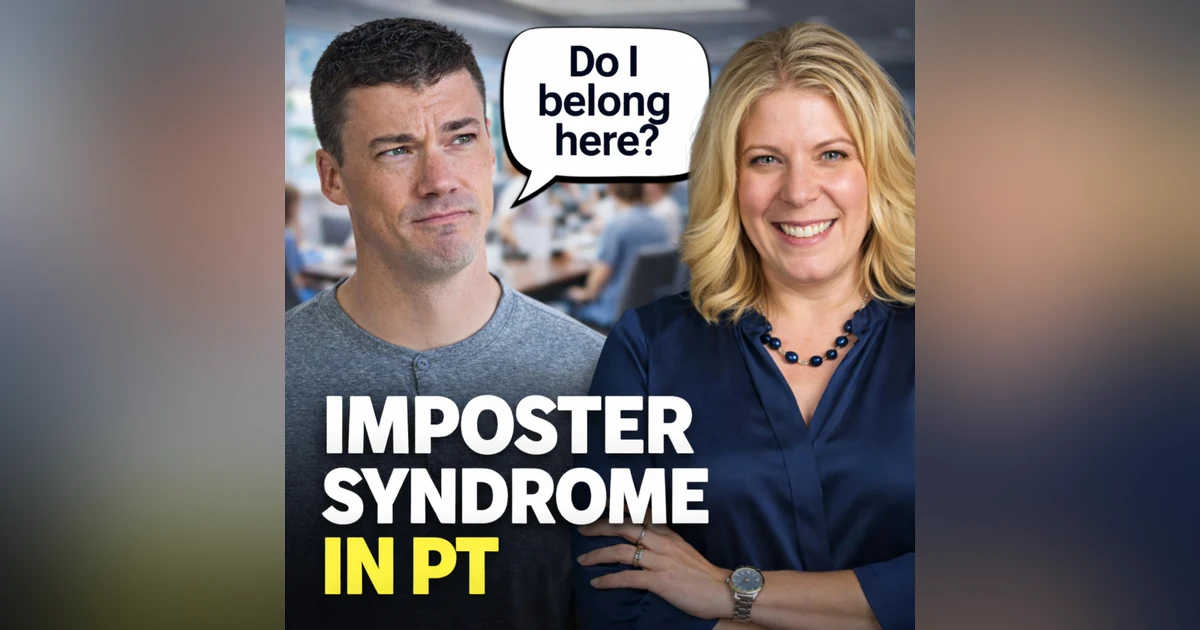



Most clinicians are trained to treat patients — not lead teams.
So when a physical therapist suddenly becomes a supervisor, director, or clinic leader, it’s common to feel unprepared. That feeling often shows up as imposter syndrome.
In this episode of PT Pintcast, Jimmy McKay talks with speech-language pathologist and leadership coach Katie Holterman about why imposter syndrome is so common in healthcare and what clinicians can do when it shows up.
They break down how leadership roles appear suddenly in clinical careers, how imposter syndrome affects decision-making inside clinics, and practical ways PTs can build confidence while leading teams.
If you’ve ever sat quietly in a leadership meeting wondering if you belong there — this episode is for you.
Key Insights
• Why clinicians often become leaders without leadership training
• The five profiles of imposter syndrome in healthcare professionals
• How imposter syndrome causes decision paralysis in clinics
• Why asking questions actually increases perceived leadership authority
• The “Actually Factually Good At” list for building leadership confidence
• How shifting from “Do I belong here?” to “What problem am I here to solve?” changes leadership mindset
Guest
Katie Holterman
Sponsors
SaRA Health
Remote care platform helping clinics automate patient check-ins and meet RTM requirements.
EMPOWER EMR
An EMR built specifically for rehab workflows with faster documentation and cleaner operations.
U.S. Physical Therapy
A national network supporting PT clinicians and clinic owners with mentorship and career development.
Subscribe & Follow
Apple Podcasts
https://podcasts.apple.com/us/podcast/pt-pintcast-physical-therapy/id1000443325
Spotify
https://open.spotify.com/show/3LmMUT64yrUc2iGo9Emafc
YouTube
https://www.youtube.com/@PTPintcast
https://www.linkedin.com/in/jimmy-mckay-pt-dpt-a4207659/
https://www.instagram.com/ptpintcast
X / Twitter
Website
<p>This episode is part of the <a href="/physical-therapy-business-podcast">Physical Therapy Business Podcast</a>, where physical therapists and clinic owners learn how to get more patients, improve operations, and grow their clinic without relying only on referrals.</p>
<p>Looking for more episodes? Explore the full <a href="/physical-therapy-business-podcast">Physical Therapy Business Podcast</a> for real-world strategies on physical therapy marketing, patient acquisition, and clinic growth.</p>
0:00 You're listening to the P.T. Pinecast, where smart people in healthcare come to make noise. Here's your host, Jimmy McKay. Welcome back to the show. I do want to say thanks to our friends at Empower EMR. If your clinic is stuck in an EMR, if it slows you down, that's not okay. Empower gives you faster documentation, cleaner workflows, and tools designed specifically for rehab teams. Better notes, faster documentation, smoother operations. Learn more at empoweremr.com. I do also want to thank our friends at Sarah Health. It goes right along with a great EMR. It's a remote care platform helping clinics boost revenue without having to add complexity. Sarah automates daily patient check-ins through simple text messages.
0:42 No apps, no logins. This is all about that stuff like RTM, remote therapeutic monitoring. Clinics improve patient follow-through and meet RTM requirements so you can get paid for the care you provide between visits. Learn more about that at SarahHealth.com. It's S-A-R-A, health.com. Now, in healthcare, most clinicians spend years learning how to treat patients, but almost no time learning how to lead people. Then one day, congratulations, you've been promoted. Now you're running a team, managing schedules, making operational decisions, and sitting in meetings with administrators who seem to speak completely different languages.
1:24 It's a moment many clinicians quietly wonder the same thing. Do I actually belong here? Or when are people going to figure out that I don't belong here? I've thought that. Today's guest has spent more than two decades helping healthcare professionals find their voice, both literally as a speech language pathologist and figuratively as someone who coaches leaders to step into their expertise. Let's welcome back to the show, Katie Holterman. Katie, welcome back. Thank you. It's been a while. Let's kick this off. Imposter syndrome was something I'd never heard of until I did. And it sort of put words to this feeling that I thought only I had, which I'm sure is somewhere in the definition of imposter syndrome.
2:07 Why does imposter syndrome show up so often in healthcare leadership, as I mentioned in the intro? Yeah, we are not trained in leadership. We don't have the training involved in this. We don't have the prep. So many times it's, you know, hey, you've done a good job. Would you like to lead this team? You know, you've done a good job in XYZ. I think you could lead this. I think you could be on this committee. And it doesn't necessarily even have to be a title of, you know, you are the director of rehab or you are an executive here. It could be, hey, I want you to lead this committee or I want you to, you know, mentor somebody.
2:50 And And as clinicians, we don't have training in this. We have training in clinical skills and that kind of where it stops. So you get placed in this and you kind of go, what the heck am I actually doing here? And do I belong? So someone might be spotting the raw materials in what would make a good leader. But if you're not shown how to apply those. you can now you'll now feel like a fish out of water and also you might not do a great job it's similar it's very clear when you say well i've spotted somebody who's a great college student they'll make a great clinician we still put them through school to get them there it's very obvious there and there's actually something called when i found this out i was able to spot more than a few people i know of the peter principle have you heard of the peter principle yeah rise to the level of your incompetence essentially you might be a great clinician now you're the degree you're you've been promoted to director you might be great at that then you get promoted to regional director and somewhere between that first uh sorry the first promotion the second promotion you actually don't have those skills or you just weren't taught them So you're bad at that regional job, that higher job, but you're never demoted.
4:03 So now you're in a job you don't have the skill set for, the training for, right? We don't know which one it is or both, but you don't get demoted. So now going forward, you're sort of stuck there. So we can spot this because we want to make sure we can do stuff with it. What are the common signs that someone might be dealing with with imposter syndrome? What are the things that we can either look for in ourselves or others to help spot these? What are the signs? What are the symptoms? Yeah. Well, the first thing is everybody has it. Everybody's dealing with it. So the sign is look to your left and look to your right. And there it is. In yourself, there's actually, so Valerie Young is somebody who I think everybody should follow.
4:52 She's a great leader in this field. And she's identified five or talks about five profiles of imposter syndrome. Oh, I like this. And that is where I think everybody can identify with at least one profile. If you're an overachiever like me, you identify with all five profiles depending on the day or the week or the position that you're in. But the five profiles are the soloist, right? I don't need anybody else. I should be able to do this alone. And if I can't do it alone, then I'm not good. The natural genius, which is if I struggle, I must not be good at this.
5:35 The expert, which is I need to be an expert in everything. And if I'm not an expert in everything or I need to be an expert in this, I can't not know everything about it. The superhuman, which is I must do it all. And if I can't do it all, then I'm doing something wrong. And then the perfectionist, which, you know, if I can't do it perfectly, then it's failure all before it even began, right? So identifying where you fit or where you're feeling in the profile at the given time.
6:15 helps to at least name it, which is a strategy, right? So name it, say it, this is what it is. And recognize that it's universal. Everybody's feeling it. Everybody's walking around feeling like an imposter. It's a universal issue. And so sometimes when you just say it out loud, it helps. Now, as you mentioned sort of those five types, A couple of them felt pretty close, but I'm guessing you might. I feel like I do some of those sometimes and not all the time. Absolutely. Is that common? Absolutely. Okay, got it. I'm not always this or that. Nope.
6:55 And it's going to be situational. And here's the thing with imposter syndrome. Imposter syndrome in and of itself is situational. And this is a common misconception. So I have a lot of people who will say to me, I'm a relatively confident person. So why do I feel like an imposter in this situation? And that's key for imposter syndrome in and of itself. Imposter syndrome is not a lack of confidence. It's a lack of confidence in a specific situation. Got it. So you may feel like a superhuman profile when you are managing your radio show, right?
7:36 Managing your podcast. Right. Because you need to do it all great all the time. But when you are XYZ, you know, in a different aspect of your world, you may feel like, well, I can do, you know, I don't have to do it all. I can take a step back. That's not the profile you're feeling in that moment. You know, I feel like a superhuman when I'm trying to manage work-life balance, when I'm trying to manage, you know, am I able to give enough at work and able to give enough at home? And am I able to, you know, I think a lot of, you know, Mothers feel like this at times. Right.
8:17 Family, you know, whatever. But at work, I don't necessarily feel like I have to take it on. That's not my imposter syndrome profile at work. The expert is, though, I need to know it exactly right. And if I don't know it exactly right, then I'm an imposter. So it depends on the situation. But the confidence is, again, situation and situationally specific. Yeah, yeah. How does imposter syndrome affect decisions though? Like leadership decisions inside of a clinic? Essentially knowing about this is one thing, right? Understanding the signs and symptoms, but then what does it do?
8:57 How does it now affect decision-making? Because if I, I'm able to speak confidently about this, not from an expert perspective, but this is me, right? Several times during a day. It does sort of affect decisions. So lay that out for me. Absolutely. So depending on the decision that you're making, you're either going to to overcompensate, you're going to not want to come off as being needing help. So you're going to put all of your effort in and you're going to make that decision on your own when in fact, probably could have been a better decision had you collaborated with somebody else.
9:37 But because you feel like an imposter, if you ask for help. That's it right there. Exactly. Or you become paralyzed with the decision making, right? So decision paralysis where you feel like, okay, I need to make it perfect. before I go and take that next step and the perfectionist profile comes in. So if it's not perfect, then I don't make the decision. I don't lead the team in the way it needs to be. So every profile has a different aspect of paralysis and decision making or leadership, halting leadership potential because you're limiting yourself.
10:21 Yeah. So you said imposter syndrome gets really, really dangerous when it goes unspoken, right? Because I've heard this before. And the first couple of times I heard it, I was like, I didn't understand it. No decision is still a decision. When I've decided not to do anything, and somebody gave it to me in a great example, which is if you're crossing a busy street, and all of a sudden you recognize a car's coming, well, I could run to the other side of the street, or I could run back to where I came from. Or do I stand still because that's no decision? And sometimes standing still in the middle of the street still gets me hit by the car, right? So no decision, indecision is a decision. So you've said it becomes dangerous when it goes unspoken. I feel like as soon as you start talking about it, you find you lead your way to an answer.
11:02 So why is it so dangerous then? I think it's dangerous because if you're if you are trying to internalize all of this and you are again, it kind of goes back to the fact that this is a universal issue that nobody talks about or doesn't talk about enough. So then you're feeling like, well, I'm all alone in this and I'm not asking for help or I'm I'm trying to do it all or I'm not forgiving of myself in this situation, And so it leads to being run over in the middle of the street.
11:43 That's essentially what that end result will be, rather than saying, you know, it's okay if I make a mistake. It's okay if I don't have the perfect answer for this situation. One of the things that I always like to tell people is borrow confidence. from the work that you're doing and don't switch it around. So don't wait to be confident to do the thing. Do the thing. Clock the wins and then that will grow the decision making and the confidence that comes behind it.
12:27 Is that sort of like motion creates emotion, but a little bit of action creates a little bit of confidence and then a little bit of constant confidence creates a little bit of action. Exactly. Exactly. Yeah. It's, you know, take the win, learn from the win and use the win. Right. Yeah. I mean, some of the best advice I was ever given is, you know, and I know this is probably a little gender based, right? Men never ask for directions. And I just sort of leaned into that. I was like, but I feel like if I ask for directions, I'll just get to where I'm going faster. And the person I'm going to ask for directions a lot of times is a stranger. I sort of don't care if they know that I don't know where I'm going at all. So I don't think it matters if I know I don't know where I'm going.
13:07 The point is to get there. Right, exactly. Which, again, is a simple but not easy explanation of what to do in that situation. But I get caught in that. You know, sort of know your superpowers, know your limitations, but also know your strengths. My strengths, or I like to think it is, is people, right? So when I'm in a situation where I don't know how to proceed, a lot of times I do try to figure out, listening to the five... sort of avatars where I'm sitting there going, well, I got hired to do this. Now I need to know how to do all of it myself or I'm no good. So it feels like soloists or perfectionists or whatever, mix of all those. And then I eventually come to a point on a project that I'm like, well, I could just ask someone how to do this one thing.
13:52 And most of the people that I know would just be like, they'll just tell me because they want to be helpful. And I wind up realizing that your superpower is actually the people around you. Absolutely. Not wanting to admit like I don't know, that's an internal barrier to me and others. Well, and that's exactly it. You're doing a disservice to yourself, but at the same time, you're also doing disservice to others to allow them to help you and allow them to grow as a leader, right? Because that's how we grow leadership is every question that is asked of us we give an answer we learn about ourselves and we learn about the thing that we're being asked about one of the best ways to overcome the expert profile or you know the expert profile or whatever yeah right exactly is teaching someone and proving to yourself how much you know.
14:56 Well, every time you, as a person feeling imposter syndrome who feels like they have to take it on themselves, doesn't ask for help, you're not allowing somebody else with imposter syndrome to overcome their own imposter syndrome by teaching and by helping themselves. So it's like this cycle where we all just have to borrow from each other's imposter syndromes. It's also been shown and I've seen examples where they've proved that someone in a room in a decision making, you know, in a team and a decision making, the person who asks the most questions actually winds up looking like they have more authority than they would if they only tried to answer things or if they kept their mouth shut the whole time.
15:42 Yeah. And it actually, the thing that I was reading said that the person asking the most basic questions actually winds up looking like they know the most or close to it because it shows that they're trying to make, they're not trying to come and exert their authority. They're trying to show that they're looking for understanding. Right. Exactly. This is my secret for trying to look like the most interesting person at a dinner party is I just ask questions. I don't answer any of them. He's really interesting. I was like, no, I just asked a bunch. I mean, that's the cheat code, right? But it works not as a trick, but as a method. Absolutely. You know, and then there's a whole other part of that, which is how do you ask the question, right?
16:30 The words matter and the way you ask the question, there's something to the effect of, you know, if I ask you, well, I'm not sure if I understood that versus here's what I hear and here's what I took from this. Let's make sure we're on the same page. That's a different way of communicating and acting confident even when you're not. Think until you make it. Chris Voss, are you familiar with Chris Voss? FBI hostage negotiator. I reference him often. I think his tactics are stunningly simple and very powerful.
17:11 He even just talks about mirroring. Where he'll just repeat the last two to four words that someone said. Because he's pointed out if you ask someone a question about what they just said, a lot of times they'll just repeat what they just said louder or faster. Right. Because they feel questioned. But if you don't question, if you go with... And he literally says, because again, as a former hostage negotiator, he didn't have a lot of leverage. Right. The hostage taker had people or whatever. And his job was to build rapport. And he would talk about that process of mirroring and how powerful it is. And it almost feels like a cheat code when you start using it, especially someone in my job as an interviewer.
17:55 But people in healthcare, you're professional interviewers too. Using these very basic but powerful tools can get you a lot of information. absolutely think about how many times you you know when you're talking with a patient and you're trying to get their his your their case history you know their their medical history and you have to phrase something a little bit different way to get them to talk about what they've you know what they've been doing so it's it's all communication factors and how we can phrase things suddenly me getting a degree in communications seems like Like it was a good idea, not just I wanted to play radio and make funny videos and things like that for a job.
18:36 Outside of knowing those avatars that you mentioned before, and I'll put the link to that guide I found online in the show notes, but what's a practical tool you'd suggest for leaders so they can use when imposter syndrome shows up in the moment? I think two main things that... actually three. Again, the avatar is one thing, right? Identifying that, but just naming it. That's the most important thing is this, this is showing up right now as an expert profile. Now, let me learn, you know, learn strategies to help overcome that.
19:18 So that's number one. One of the best things that I think helps people in different moments different scenarios is building what i call i'm really actually factually good at this um list whatever that list is so i'm really actually factually good at you know leading a meeting and here's how i know that and putting the proof the evidence list in front of you so all the certifications that you have, all the praise that you've gotten. And that can be any kind of praise.
19:59 It can be a thank you note you got from a patient. It can be a performance review where you kicked ass. It can be a LinkedIn message of, hey, I saw this that you posted and it really spoke to me. I liked it. Thank you. Print that out and post it somewhere, right? It can be a Teams message, a Slack message. It can be It can be, you know, a word on the street, write it down, but have that actually factually good at list in front of you so that you can refer back to it in that moment when you're starting to doubt. Because what happens is our mind always goes to the weakness. Our mind always goes to, you know, when put in that in that moment, you're going to think of the same or similar type of moment that you had where you messed up.
20:47 where you weren't at your best. It's what our mind does. It's a natural thing. So if you have the actually factually good at list in front of you, now you're countering your own mind to say, no, wait, I know that happened once. I know I walked into the room and tripped and fell and made a fool of myself in front of my team. And now nobody sees me as a leader. They see me as this fool. Okay, yeah, that happened once. You know, not saying that was from personal experience or anything, but, you know, maybe that happened one time. But actually, factually, I've led teams of twenty seven people and have gotten great buy in and have forged good relationships and promoted three of my team members up the ranks that actually factually happened.
21:37 Yeah. Yeah. The tripping and falling might have happened, too. But here's my actually factually list. Yeah. Yeah. What would you say to a clinician sitting quietly in leadership meetings right now? Because a meeting is an arena, right? You've made it to that and you're looking around. I've been in rooms where I'm like, not sure how I got here. I jokingly was in a very large meeting and I very clearly was background, age, all of it, like the sticking out like a sore thumb. And I jokingly, when we're introducing ourselves, like, This is how I alleviated some stress. I said, I won a contest in a supermarket to be on this board, which got some LOLs.
22:21 But at the same token, I was like, that feels more plausible than me being asked to be here because I'm not understanding. But how would you... What would you say to someone... earlier in their career when they've made it to a room that they maybe don't feel like they belong. And I feel like being quiet is the defense mechanism because I've used it. Right. But you're in the room because you were asked to be in that room. So what would you tell those people? Is there tactics or what advice or what would you do? Yeah. So switching the mindset from, do I belong here? Which is the question that everybody, you know, at one point in their life and you get in that room, you, you immediately, I don't belong here.
23:01 So you start to say, you know, do I belong here? Do I really belong here? So switching that phrase from, do I belong here too? Okay. What problem am I here to solve? And when you shift the attention from yourself, to the value that you can bring and you focus on the mission of that group, not your own self-evaluation, that helps the process along. So making it more external, what value am I here that can bring to this whole team or this whole group or this problem, it shifts that focus from internal. How can that be helpful?
23:45 Yeah. Yeah. Because we can all be helpful in some way, shape or form. One of the best things that happened to me years and years ago, I was sitting on a committee for ASHA, which I looked around and I went, oh, my God, there are. bigwigs here. There are names that I have only seen in journal articles, you know, and here I am, and I clearly got in the wrong room. I clearly took a wrong turn. And so I was quiet for most of the meeting, and it was a three-day meeting. And I spoke up one time, maybe two, and the co-leader of this meeting pulled me aside afterwards and said, that was the best comment out of the entire meeting.
24:38 It was the most valuable comment that we took away from it. And I looked at him and I went, oh, thanks, that was nice of you to say. And he said, no, I need you to say things more. And it was one of those things that I just went, my voice actually does have purpose. But I needed to just hear that that was one thing was okay and it helped me. But if I would have just been able to say it to myself rather than have somebody else say it to me, I would have said a lot more in that meeting from the get-go. Yeah. And the room might have lost because you were quiet for so much out of three days. Right. Exactly. A lot of times the person who speaks, this is coming from me who talks a lot.
25:20 A lot of times it's not the number of words. Most of the time, not the number of words. It's the right words at the right time for the right reason. Exactly. You ready for your parting shot? I am. This is the parting shot. One last mic drop moment. No pressure. Just your legacy on the line. right parting shot brought to you by our friends at us physical therapy we partnered with clinic owners who want to grow without losing their identity that's what they do at usph you stay local and in control while getting the resources and mentorship of a national network find them online at usph.com and that's usph.com so i'll throw you a question if a clinician listening right now feels like they don't belong in leadership but they're there that's the setting what would you want them to remember not do but remember to think of to hold on to what would you give them to to grab onto everybody has been at a starting point at some point nobody magically was birthed and then stepped into a leadership role so everyone has had a first moment a first you know, leadership position in a committee, a first leadership position in a company, a first time having a student, a first whatever, everybody's been there, everybody's been where you are right now, and nobody has died
26:55 So you will survive. You will get through it. And you just, you know, if you keep in mind the fact that you're not alone and you deserve to be where you are. Perfect. Katie, thanks for walking us through this. I think we could have the same conversation in six months and still be valuable because I think sometimes you, well, I don't know. Maybe we never outgrow this, but as long as you can understand that it's there and how to use it and how to lean into it, I think it just affects us less. Exactly. Katie Holterman, thanks for stopping by. I appreciate it. Thank you so much. That's it for this one, but we're just getting warmed up.
27:36 Smash follow, send it to a friend, or crank up the next episode. Want to go deeper? Hit us at pgpinecast.com or find us on YouTube and socials at pgpinecast. And legally, none of this was advice. It's for entertainment purposes only. Bullshit! See, Keith? We read the script. Happy now?