Why PT Clinics Need Metrics (And Clinicians Should Care)

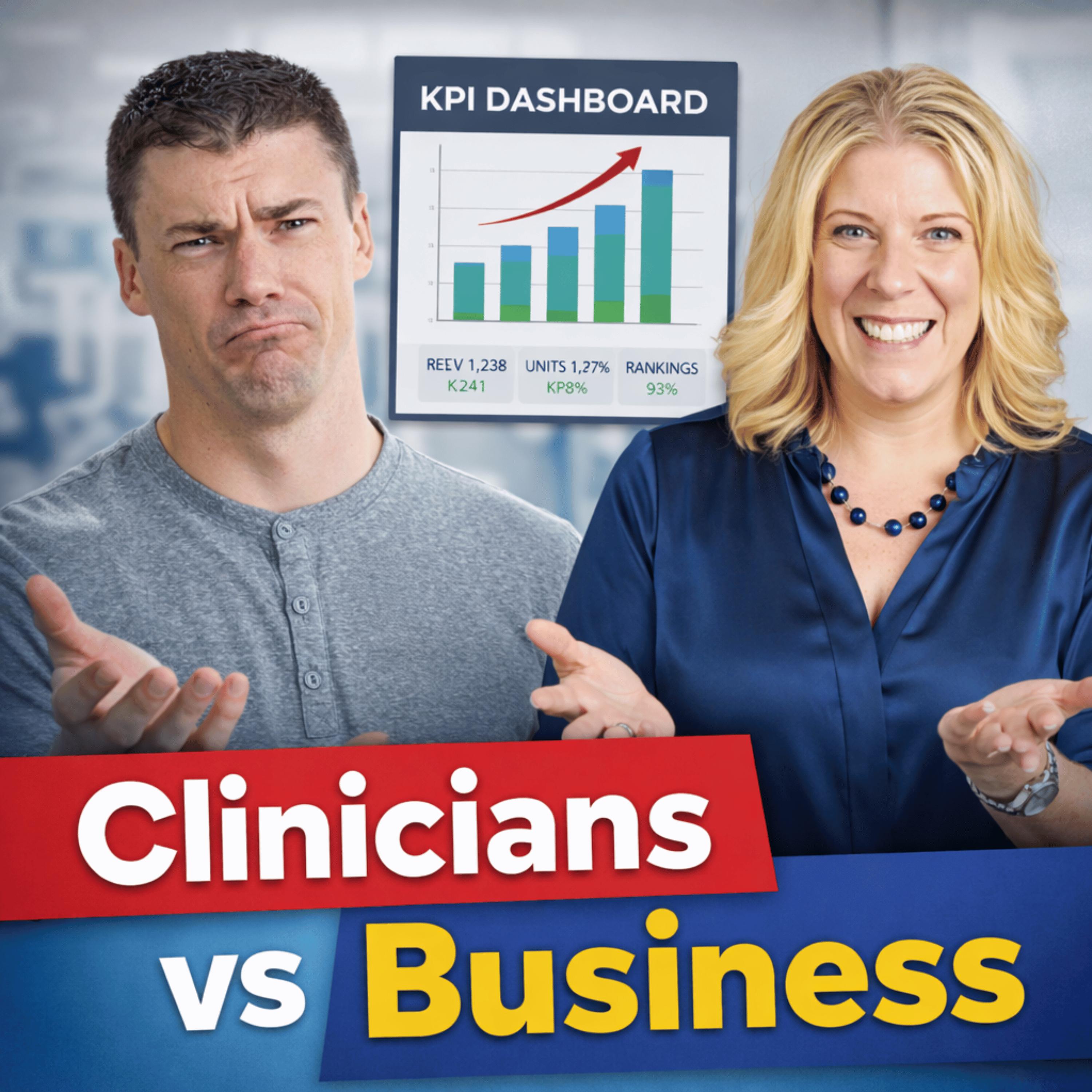


Many clinicians feel tension between patient care and productivity targets. In reality, that tension often exists because clinicians were never taught how the business side of healthcare works.
In this episode of PT Pintcast, Jimmy McKay talks with Katie Holterman about how clinics can bridge the gap between clinical excellence and operational performance.
The discussion focuses on practical ways clinic leaders can introduce metrics without alienating clinicians — and how transparency, standardization, and communication help teams work toward the same goal.
Key Insights From the Episode
• Why clinicians often resist productivity metrics
• The role of clinical guardrails in protecting care quality
• Why every clinic needs clear performance metrics
• How dashboards and scorecards improve clinician buy-in
• The leadership mistake that causes teams to reject metrics
• Why some clinical standardization actually improves autonomy
• How value-based care is changing rehab expectations
Practical Takeaways for Clinic Owners
• Explain metrics using clinical language, not just business terms
• Show clinicians how documentation protects their license and revenue
• Use scorecards to make performance expectations visible
• Limit KPIs to the few metrics that truly matter
• Connect metrics directly to patient outcomes and clinic sustainability
When clinicians understand why the numbers matter, the conflict between business and care becomes alignment instead of tension.
Sponsors
SaRA Health
The remote care platform helping clinics boost revenue through automated patient check-ins and RTM support.
EMPOWER EMR
An EMR designed for rehab clinics with faster documentation and cleaner workflows.
U.S. Physical Therapy
A national network supporting clinic owners and clinicians with growth opportunities and leadership development.
Subscribe & Follow
Apple Podcasts
https://podcasts.apple.com/us/podcast/pt-pintcast-physical-therapy/id1000443325
Spotify
https://open.spotify.com/show/3LmMUT64yrUc2iGo9Emafc
YouTube
https://www.youtube.com/@PTPintcast
https://www.linkedin.com/in/jimmy-mckay-pt-dpt-a4207659/
https://www.instagram.com/ptpintcast
X / Twitter
Website
<p>This episode is part of the <a href="/physical-therapy-business-podcast">Physical Therapy Business Podcast</a>, where physical therapists and clinic owners learn how to get more patients, improve operations, and grow their clinic without relying only on referrals.</p>
<p>Looking for more episodes? Explore the full <a href="/physical-therapy-business-podcast">Physical Therapy Business Podcast</a> for real-world strategies on physical therapy marketing, patient acquisition, and clinic growth.</p>
0:00 You're listening to the PG Pinecast, where smart people in healthcare come to make noise. Here's your host, Jimmy McKay. Big thanks to Sarah Health, the remote care platform helping clinics boost revenue without having to add staff or four thousand post-it notes. See, Sarah automates daily patient check ins through simple text message reminders, which means no app, no lost passwords, no logins. This way, clinics improve follow through. They meet RTM requirements and get reimbursed for the care they're already delivering between visits. Learn more at sarahealth.com. That's S-A-R-A health.com.
0:41 In healthcare, clinicians often feel like they're stuck in the middle. Call between doing the right thing for patients And hitting numbers, the business needs to survive. But what if those two goals were never supposed to compete? What if they weren't supposed to be separate? Today's guest has spent a career helping rehab teams and clinicians stop fighting the business side of healthcare and start understanding it. She's trained thousands of clinicians across the country to translate complicated clinical challenges... into practical systems that actually work in real clinics it's got to be real uh she's part speech language pathologist part pretend pt and ot but we're all cousins part educator and part strategy leader let's welcome back to the show katie holterman katie welcome back to the program thank you uh what's nice in theory may not be practical and what's practical may not feel nice so the tensions that clinicians feel between quality care and productivity expectations, they're real.
1:46 So clinicians often say they feel like business pressures conflict with patient care. Let's start with where. Where does that tension actually come from? I think the tension comes from clinicians not understanding that business is business and that it's okay to know that you are actually working for a business, that it's okay to know that money makes the world go round, right? And it has to be a component of the conversation, but that as long as that conversation is led with clinical eyes and clinical words, the fiscal piece will follow it and it just will be a good thing.
2:30 I mean, this is why nursery rhymes or fairy tales or fairy tales because it's a story that teaches a lesson. This is why schoolhouse rocks. This is how a bill becomes a bill. You can be mad when things aren't your way, but when you begin to understand, hey, there's a process. If you want the outcome, let's go back to the beginning and see how this thing changes. I think it's probably on the syllabus. In fact, I know it is. It must be mentioned somewhere, but it's probably different program to program in terms of, hey, you're going into healthcare. And then there's like seven subtitles layer. Healthcare is a business.
3:10 It's probably one of the businesses. There are others like it where it's driven by this mission, but it's still a business. If you'd like to get paid to do this, there needs to be some sort of financial exchange in order to keep the lights on and pay for the people involved. who actually provide the care. Larry Benz in a recent episode even said in a health care organization, your assets wear shoes. Your assets are the people. I know you might have machines or anything, but even if you're a hospital with MRI machines and helicopters and ambulances, really your most important asset, nothing, nothing moves unless you have people. Exactly. And here's the problem. I think the core of it before the person becomes the employee in PT, OT and speech, they're the student and the student isn't taught business.
4:03 They're not taught that their product is what they're selling or they're not taught the financial aspect of it. So we go into this business thinking, okay, well, everything else is going to make the money. We're just going to treat. Right. You are a service, right? Ritz-Carlton doesn't really sell beds. They sell the experience, everything from the moment you pull up to when you leave, if there's a mint on the pillow. And I've heard of healthcare organizations bringing in, quite literally, the Ritz-Carlton's sort of management or experience school to understand you're providing experience, right?
4:50 So your framework sort of starts with defining non-negotiables. And I like those because as creative or as free as we can be in how we treat, right? There should be some non-negotiables. In order to be really creative, to think outside the box, there's got to be a box. So your non-negotiables are a box. And I like those things. Exactly. What does that look like in a real clinic, your non-negotiables? Yeah, so I think of these as like clinical guardrails, right? What is that box that you're not going to go out of, but you can play within it? So what is the max number of patients or people per therapist?
5:34 What does that look like? And when it starts to go outside that box or outside that guardrail, then you know you're getting a little bit into more of that sticky place of is that really a business motivated decision versus your clinical guardrail of this is patient care. So that's an example of just I think staffing is a really good one. What does your staffing look like? And is it that you're trying to have X number of staff for, you know, this day versus this day? And does that make clinical sense because of the patient makeup that you have in that day?
6:17 So clinical guardrails, I think, are really important from a documentation standpoint. You know, what is your clinical guardrail there? And then obviously from a billing standpoint, you know, from CPT codes, you know, what does that look like? Of course, I come at everything from the lens of the guy who used to work at a radio station, but there's so many parallels, and we were taught the difference between policy and law. Now, first of all, you can't violate the law. You can't do it. I mean, you can, and people do, but you're going to get caught. Just pretend like you're going to get caught. Don't do it, right? So there was the FCC. Don't break any of their rules. I don't care what you're doing. Don't do it. Then there was policy and that's set by the company.
6:58 We don't do these things. And that's like, Hey, if you want to work here, you can't break these laws. We, these rules, sorry, not laws rules. Cause we'll fire you for that. That's outside of our bounds. And the funny part was in radio, it's much like it was so it's funny to come to healthcare and be like, Oh my gosh, this is, and I'm sure it's other, you know, professions too. Everybody on the air, we made the thing. We made the funny commercials and we made the whatever. We picked the music and we talked, right? We were the clinicians. We were the product. And we would look at sales and management as sort of always wanting to butt heads.
7:38 And the minute I sort of realized that without them, we can't do what we do. And without us, they can't do. We are in the same boat. We are tied together. So instead, I sort of pulled a Bruce Lee move and it was only because I had smart bosses around me. be water. The goal is to get along, to go along, but I made sure to sort of hold fast to, well, I understand why you're trying to do that, but that's asking me to violate some of the things that keep our brand a brand. Which if we do an exception now, what's the stop of six months from now for doing that? If we eventually do it now, no one's listening and now you can't sell anything. And I feel like it's the same for clinicians. It's like, well, if we make exceptions, I understand why you're telling me that, but I can't do it because I've also got a license.
8:24 I didn't have a license in broadcasting. You didn't have to have one. You lose that in healthcare, you're done. So that should be also be your guiding light. Yeah. And also, you know, the, when you start making the exceptions, it's easy to lose sight of when that exception then becomes the norm, right? The slippery slope idea, right? Yeah. You make that exception once, then you make it again. And then it's, well, was it really, was that really within our clinical guardrail? Right, right, right. Did I make that up? So it's important to really keep and take hold of that. Right. So this, I think everything I just sort of heard or a lot of what I just heard sounds like, understanding what you do and where you fit.
9:12 And this is understanding the physics of the environment. Yes. Given a blank check and all the time in the world, you would treat people differently. But we do not have a blank check and unlimited time in this environment. That just is not. So we have to understanding the other side, management, if you're a clinician or clinicians, if you're management, because sometimes management are former clinicians like yourself. Sometimes you're not. So sometimes more understanding is typically always better, right? Like understanding is either confirming what you already knew or teaching you something new. Exactly. Exactly. And you, you, I think that that understanding and it goes a long way because then you can speak the language for the other person too.
9:59 Like when you're all on the same page, it just makes the, the, it makes everything easier. And so that starts with communication, clear, clear communication. Yep. You, you say if something matters clinically, it should be measured. Yes. What are the most important metrics then that clinics should actually track? Because in twenty twenty six and beyond, believe me, we could track the list of things we can track is only listen. You can actually hear it getting longer as we speak. But what are the most important metrics? Because we can't have a million KPIs. It makes them not key. That's what K and KPI means, right? So what are what are the most important metrics that you think clinics should actually track?
10:41 Yeah, well, before I answer that, I think what you just said is so important that it deserves to be kind of said again. Everything can't be important. Can't be. And if you're measuring it, for goodness sake, ensure that there's like a compelling and real story behind it, right? It has to matter. So what matters for clinical care and why? And the why part is the important part. because then that will help you figure out, is it really important to measure? So for example, frequency, right? How frequent are we seeing patients per week? That's a metric that everybody seems to want to measure.
11:22 Are we seeing them three times a week? Is that appropriate? Well, why? Why is that appropriate? It may be appropriate for one type of patient and not for another. So it really doesn't make sense and we can kind of throw that away if we don't have the why behind it. Number of visits, right? That's gonna be something that people are going to measure. But again, why? What's the magic number and do we have a story behind that that gives us reason as to why we need to measure that? And then outcomes. Right. In this day and age, we're moving towards value based care. Actually, scratch that. We are in value based care.
12:04 And so outcomes are of utmost importance. But if we don't if we're just measuring outcomes because we think we're supposed to measure this assessment, this this this measure that CMS says we have to measure. Okay, that does make sense because it fits into the value-based care model. But at the heart of it, what's going to say that your clinic is the best clinic out there? Is it, you know, I come from the geriatric world. So a lot of times we would measure, you know, something around falls. We would measure, you know, is the patient at risk for falling?
12:48 Okay. What's the number of times they've fallen in the year? That's one measure that we can, you know, that that might matter. And then insurance companies may pay us more if their patient is not falling as much, if their patient is not at risk for falling. But wouldn't it be great if we had a better measure of, well, what's the number of times that they engaged in something or didn't engage in something because they had a fear of falling or didn't have a fear of falling? And it's because I had PT and it made a difference. Well, now we have a domino effect of all of the things that that can potentially impact.
13:32 including, again, payment from insurance companies. So I think there's a number of things that we need to look at measuring. But more importantly, why are we measuring it? What is the story behind it? What is the purpose? And I was taught that early in my career. It doesn't really matter what my career is. The advice was still good. Number one, a great boss said, she said, figure, understand at least the basics of every job in this company. even if you're not going to do it. So go out, ask, volunteer. I came in as a broadcaster, but I was going out when I didn't have to to help set up events because I was like, I'm going to need to send these people out. I want to know what I'm sending them to when it's raining or snowing or when I give them no notice.
14:15 When someone turns to me and says, well, it takes four hours to do that. I'm like, oh, we can do that in an hour and a half. Or I know I'm sending you to something awful. I'm going to give you more help. But understanding what the actual job entails why you're doing it. And then at some point that why might have changed and now you don't need to do that anymore. So why are we doing it? There seems to be no reason. I guess we can discontinue that. So understanding the why is everything I've heard so far. Yes, a hundred percent. Yeah. I do want to thank Empower EMR. If your clinic is stuck in an EMR, it slows you down. Empower gives you speed, cleaner workflows, and documentation tools built specifically for rehab. Better notes, faster documentation, smoother clinic operations.
14:57 Learn more at empoweremr.com. That is empoweremr.com. I mean, even EMRs, they have access to so many things. So you can measure. But if you're not asking upstream what you're looking for or what you want to measure, you're not going to get that good data downstream. So let's move forward in this timeline. Once metrics exist, the real challenge now is getting clinicians to care about them. This just feels like it's a feedback loop. How do you suggest we create buy-in or what have you seen work, not only in theory, but in practice, in reality? make it visible, make the frontline clinician be able to see what those metrics are.
15:42 Again, they know the metric and they know the why behind it. Once you get past that, it's kind of an easy slope to kind of glide down. But if they don't see it, then they're not going to have it constantly in their workflow, in their reminder, in their daily life. But making it visible is one thing. How are they interpreting it and are they interpreting the metric correctly? So make it visible, make it a part of conversation so that they understand what the metric is telling them and again, what that story is.
16:25 I think who who talks about the metrics and what they say about them are as important as the metrics themselves. So in other words, clinic owner talks about a metric that they're, you know, let's just say it's, you know, revenue per day. A clinic owner talking about that and just saying, okay, our revenue per day is this, and here's the number and walks away. Frontline clinician does not care about that. It's tone deaf. But if you talk about it in the way of here's our revenue per day, and here's how we got to that number. And it was X number of units. And this is the CPT code that you used.
17:07 And let's talk about your documentation. And does your documentation reflect what you did? Is that the right CPT code for what you did? And if it is, great, perfect. If it's not, maybe we need to change that. That's a clinical discussion. That turns that whole clinician's mind frame, mindset from here's a number and walk away. Here's what you did. I'd love to know more about it. Let's have a conversation about that. But the more they see that in front of their face and hear that information, at least that's a conversation they're willing to have them i think yeah clinicians are not stupid i mean they can understand this the thing is if but but you can't understand something that hasn't been put in front of you or you're not discussed or it's it's it's been hidden from you this is why revenue per day in your clinic matters and you're like why so you can buy another boat it's like no because if we if this stays low for too long we close And then we provide no care to anyone.
18:10 Or if we can figure out a way to clinically improve care or find more people to help, we raise that number. We can hire another clinician or we can expand to another thing or we can give you a raise. I don't think clinicians want, for the most part, to produce more just to get a raise, and I don't think you should. But if you understand that doing a few more butterfly, you know, the butterfly flaps its wings, right? The butterfly effect, what that does, the tail shouldn't wag the dog, but the dog should wag the tail. Like, that's why we got into this. It's really funny, especially in healthcare. I say we have the Peace Corps gene.
18:52 Many people, and rightfully so, would like to be paid more. But they would also like to give a lot of things away for free or included. And those two things don't math. Those two things, they don't work together. I'd love to see how that works. But you've said dashboards and scorecards matter. I sort of like that second one too. Only if people actually see them, right? An invisible scorecard that I'm getting graded on. Even in higher education, there's a rubric. I know how much percent of my grade or anything. A lot of times I think you're right where it's not visible. So what is good visibility look like in the clinic?
19:34 Because I imagine too much might be paralyzing. Absolutely. Yeah. I think it's this balance, right? Where you don't want so many numbers coming at people and so many different scorecards and different dashboards and, you know, different numbers that mean different things in different ways because then it becomes white noise. But invisible metrics die quick, make the actual metric die even quicker. So it's a balance. I think that scorecards are important from how the clinician is doing themselves.
20:16 Everybody wants to do well. Nobody gets into this field to say, I want to be a really can I swear on here? Sure. I want to be a really shitty clinician. No one says that. People want to take pride in the work that they do. So a scorecard is a great way to do that. And this goes back to outcomes. Nobody wants to go in and being like, I'm gonna give mediocre therapy today. And maybe this knee injury is gonna get better by itself. Maybe I'm gonna help it a little bit. No, people want their patients to walk out the door and go, oh my gosh, Katie did a fantastic job. I'm gonna refer her to all of my friends.
20:57 that makes us feel good. And so that kind of a scorecard and visibility from our outcomes perspective and our cash business perspective, that all paints the picture of how good of a clinician you are at the end of the day. With a good scorecard, imagine we both understand what the number means and how it changes. If you're giving me a C and I'm like, but I don't know how I make the C a B, that's not fair. And then understanding how it lines up with the big picture. How does this move the entire boat forward? So this is just an alignment of good expectations. I mean, most things that... you know, devolve into stress or disagreement.
21:40 If you rewind, it's because of missed. I said that, but that's not what I meant. Or I you said that, but I heard this or I don't understand. Sometimes it is as simple as a simple but not easy as understanding what those expectations really are and making sure they're aligned. Yeah, absolutely. And words matter. The way you say things and explain things do matter. And I'm a big believer in that. I think because I'm an SLP, I definitely always go with the, you know, choose your words carefully on how you explain things. Correct. Yeah. I said that, but this is what I heard or I thought that. Right. Is what this meant. Right. Katie, your hot take is that it's okay to give up a little clinical autonomy.
22:24 What do you mean by that? I like that. Sounds scandalous. Gosh, you people hate to hear this usually. If I had a dime for every time I heard, you can't tell me I can only do this assessment. My clinical judgment is this. I'd be a very rich person. Yeah. And I don't mean this that, you know, yes, we're taking away all clinical autonomy. No one should think for themselves. That's not what I mean. But standardization is what makes things flow easily. It's what helps produce these numbers that we can actually measure.
23:07 and produces scorecards that we can talk about. So it is okay to have some standardization in place, whether that is everybody has to use this assessment so that we level the playing field on measurement. You can use other assessments and that's where your clinical autonomy comes in. But if you want to set a standard for your clinic to say, OK, but everybody has to at least at a minimum use X, Y, Z, that's OK. It's not taking away anybody's clinical judgment. It's not saying you're going to be a cookie cutter PT. It's saying I'm going to make sure that at the very minimum, this is the standardization of workflow.
23:54 And it produces a better product. Understood. Yeah. All right. I can see that. Last thing I'll ask before we do a parting shot is where do leaders usually lose their team in this sort of discussion? Right. So we just I feel like we just talked about. metrics, but brought it back to words and understanding. So where in this process do leaders usually lose their team in this? Two places. When they don't talk about the why and when they only have that business hat on and forget that that frontline clinician doesn't give a rat's ass about the business and i don't mean that that they you know we've talked about they need to give them you know they need to care about the business they need to understand it But at the end of the day, they want to know what is in it for them as a clinician and why we are doing what we're doing.
24:53 So like, for example, good documentation protects revenue. That's just a fact. But talking to the clinician about how good documentation protects their license and keeps them out of jail is actually going to help. It's going to do the but what about me factor. And remembering that clinicians aren't taught about business. So, you know, we need to talk about it frequently because they aren't, it's not in their daily routine. thought process. But if we talk to them again as a clinician and how it relates to clinical care, it's going to take that clinician and that business a long way.
25:36 Yeah, words matter from an SLP. Parting Shot is brought to you by our friends at US Physical Therapy. Today's show is brought to you by USPH, partners with clinic owners who want to grow without losing their identity. You stay local and in control while getting the support and resources of a national network. Learn more at usphpartnership.com or find out at usph.com. I'm going to pitch you a question for the parting shot instead of letting you or making you sort of go from scratch. Here's your parting shot question. If rehabilitation is going to survive, right, as a whole, PTOT speech, whatever you want to call it, rehab is going to survive, the shift that we're already in to value-based care, what's one mindset the clinicians need to change right now?
26:29 Gosh, your parting shots always kill me. I would say that without good clinical care and without showing evidence of what that looks like, there's no point in actually even providing it. So making sure that you, you know, showing the evidence behind showing the work. Like I, I have a, a. Fifteen year old son who is complaining to me every day that he has to show his work and in his, you know, homework that he's doing for math and for LA and all that.
27:11 Mom, why do I have to show my work? Because at the end of the day, that's what you're getting graded on. It's not the output. It's actually the work that you've put in. And so outcomes are the same way. It's a great analogy. Uh, Katie Holderman, thanks for coming on here and talking about this. Much appreciated. Absolutely. Thanks for having me. That's it for this one. We're just getting warmed up. Smash follow, send it to a friend or crank up the next episode. Want to go deeper? Hit us at pgpiecast.com or find us on YouTube and socials at pgpiecast. And legally, none of this was advice. It's for entertainment purposes only. See, Keith, we read the script. Happy now.