Tuition, Burnout, and Board Failures: Inside the DPT Crisis
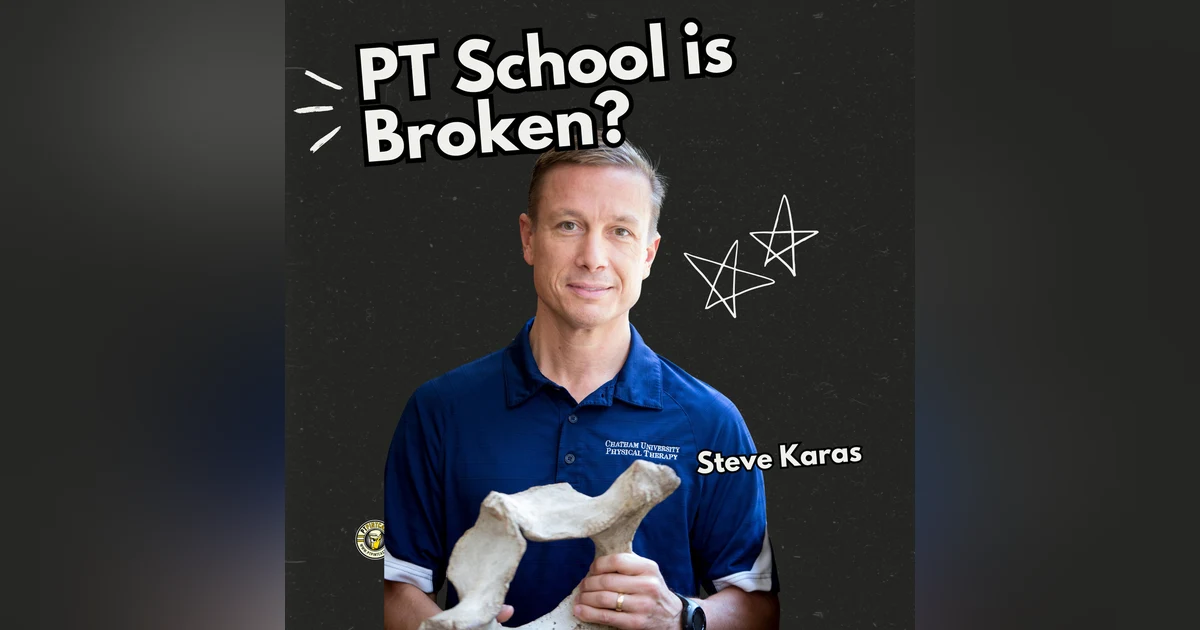


Dr. Steve Karas — PT, educator, researcher, and data-driven advocate for change in DPT education.
In this episode:
- Why tuition has skyrocketed — but outcomes haven’t
- The quiet epidemic of PT school dropouts
- How pass rate declines may signal deeper systemic cracks
- Are hybrid programs innovating… or racing to the bottom?
- What faculty, admissions teams, and CAPTE need to re-evaluate now
Steve’s message is clear:
Stop setting students up to survive school. Start setting them up to succeed in life.
Sponsor Shoutouts
- ????️ Pre-Roll: U.S. Physical Therapy — Career growth without burnout: usph.com
- ???? Mid-Roll: Empower EMR — Time-saving documentation that works for you: empoweremr.com
- ???? Pre-Parting Shot: Brooks IHL — Turn clinicians into leaders: brooksihl.org
<p>This episode is part of the <a href="/physical-therapy-business-podcast">Physical Therapy Business Podcast</a>, where physical therapists and clinic owners learn how to get more patients, improve operations, and grow their clinic without relying only on referrals.</p>
<p>Looking for more episodes? Explore the full <a href="/physical-therapy-business-podcast">Physical Therapy Business Podcast</a> for real-world strategies on physical therapy marketing, patient acquisition, and clinic growth.</p>
0:00 You're listening to the PT Pintcast, where smart people in healthcare come to make noise. Here's your host, Jimmy McKay. I want to say something to an organization helping us keep the lights on before we kick this episode off that I think you're going to learn a lot from. It's Brooks Institute of Higher Learning, brooksihl.org, residencies, fellowships down in Florida, orthopedics, pediatrics, geriatrics. If you want post-professional education, you want the support to get there, brooksihl.org is where you go. Just listen, if you're even thinking about it, Book a call with them and find out. Don't just stop at the website, but have a conversation.
0:41 That is the place that a lot of people have gone. And then I don't think I've heard anybody in my circle anyway speak negatively about the experience. So brooksihl.org. Thank you for those guys for supporting the show for more than two years. Today... We get to talk to someone who's a tenured professor, research director, manual therapy expert, and somebody who's lived and worked across seven countries. I don't even know if I could name seven countries. All right, I could name seven, but I don't know if I've been to seven countries. Our guest today has seen higher ed from every angle, and he's not afraid to say what others won't. Oh, did your ears just perk up? Good. As PT programs expand and student debt skyrockets, he's asking the tough questions about the future, sustainability, quality, and really the future of this entire profession and how it plays out.
1:36 Let's bring in our guest. Steve, welcome to the show. Thank you. Thanks for having me. You and I were just talking before I hit record about something that I think your daughter just exposed you to. We were talking about podcasts real quick. Smartless. And I love how they intro the guest where they give the movie trailer, then pop the guest on. How did I do with your intro? Did I miss any of the big beats? You can't summarize everybody's life, but how did I do? I think that's pretty good. I feel like I have a lot to live up to for the next however long we're here. You don't have to brag. I'm their hype guy. You just sit there and say, no, no, thank you, thank you, thank you. So we connected on LinkedIn.
2:16 Yes. I don't even remember. I was looking about a half hour before we record to find the actual interaction. And that's okay that we don't have it because the gist of it was what I sort of talked about in the intro. You've said, you think or you feel, listen, at this moment in time, in December, twenty twenty five, PT education is facing a perfect storm. So I'll start off by asking, what are the biggest warning signs that we're ignoring as a profession or an educational system? What are the flashing lights from your perspective? um okay so first before we start so so nobody jumps on me about conflicts of interest for some strange financial reason i am a tenured professor you can look up tenured professor salary um so i'm a chatham in pittsburgh i do a little bit of work at bowling green in their hybrid program I work for the North American Institute of Orthopedic Manual Therapy doing an online course and helping with their research.
3:22 Also help with some DSC students at Andrews, which is where I received my DSC. And not that this is relevant, but I work in assorted clinics whenever they'll have me around the Pittsburgh area. Good. I like how you're like, here's my conflict of interest. Boom. There's the first slide. Perfect. All right. Now we'll go back to the question. Right. And I shoveled snow for my neighbor, but that's not really a conflict. All right. Well, the first thing, you know, this is this has been going on since I think about twenty twenty two. I think there was an article storm clouds on the horizon and I don't know if we've turned our back on it. But I do know that whether it's state conference, national conferences, CSM, AOMT, you know, educators get together and we sort of talk about, we start talking about education and it ends up in the same sort of session, right, where we talk about things.
4:17 And the big thing is, you know, career regret. We see, I've been in academia for fifteen years. And while I have some stellar students and students that are doing great work and they own clinics and they're doing research, I have students that have left the profession. They have left for either online work to be a rep for pharmaceutical companies or medical companies, somebody that's working with real-time ultrasound, MRI clinics. You know, they're sort of all over the place. And I think that spans from You know, I'm not sure I'm well qualified to talk about the reimbursement part of it.
4:59 But, you know, just recently in the private practice section meeting down in Florida, you know, some guys I know that were there, same thing. We are seeing lower reimbursements where it's more difficult to get into some of these larger providers to even see patients. Even if you are fellowship trained and certified and have experience, they're not letting people into the system. So they're losing out on patients. So to try to coalesce all that, I think students are coming out with a high level of debt, which I'd like to talk about that. They're in the profession and they just can't make it work.
5:40 They're getting burned out. They're getting pushed to see more patients, to present more billable units. And it's difficult. And this is, I think, says more about the profession maybe than education and where maybe we're going to talk a little bit more. but there is a considerable amount of burnout in the profession and students becoming therapists and then leaving the profession. Just a recent, what was it, career regret with PTs. I have the numbers here. Forty-one point three percent of PTs regretted their career based on loans and costs.
6:25 And then they're leaving within ten years of graduation. Why does that? Why does that? So that's the hard data. That's the objective. But just for a second, before we move on to a different topic, why does that bother you so much? I mean, I'm going to assume it's because you're an educator and you care about this stuff and you're like, hey, I show up for the paycheck and because I like the job, but also I like the thing that we produce, which is people, not degrees. Right. So why does it bother you? How does it make you feel from a personal perspective to watch people leave the profession? you know i've i've if i've had fifteen classes that give or take six hundred students at least coming through our dpt program um and some of the better students that are forward thinking and are excellent clinicians and excellent managers um are leaving because they just they either have better opportunities they're more motivated or they can't make it work And, you know, in the end, this is going to sound like one of those platitudes that people say, but this is, you know, in the end, we're about patient care.
7:30 Right. And producing the best outcomes we can. And when we see really good therapists leaving the profession for this reason, you know, we think about. you know, what are we doing for those patients? If therapists are leaving when they have experience and they start to develop mechanisms for evaluation and treatment and patient-focused care and patient-centered care and they're up with the research and their knowledge is improving, know that doesn't bode well for us as a profession in terms of just frankly marketing right if every time somebody goes to a therapist there and nothing against new grads but they're seeing somebody with without the experience or without that level of knowledge um my my suspicion and i i don't have the hard data here is that um outcomes are probably not going to be what we would like them to let's talk about something that you're close to but professors don't set prices right it's not how it works and there's more than one factor in how much um something costs or how much debt someone comes into right you've got interest rates or there's a lot of factors multi-factorial as we love to say at big meetings right but with with dpt student debt exploding and salaries haven't changed much If you had a magic wand, what do you think needs to happen at the program level, professional level?
9:00 This almost feels like Sesame Street. These are the people in the neighborhood. What do those people in the neighborhood need to do if you had that magic wand to make this slow down or even get better? So let me just back up just a little bit. I would say that sometimes you have to dig deep for this data and for these numbers, and oftentimes it's different depending on what source you pull. Whether it's private practice, section, journal article, the APTA, the Bureau of Labor Statistics, it's all different, right? It doesn't seem to add up. But where I come down, it's let's just say an average starting salary of eighty five thousand.
9:43 Granted, different New York City, San Francisco, Pittsburgh, they're all going to change a bit. There is some financial advice where people say you don't take on your maximum student loan should not be more than one point five times your first year salary. Got it. I've seen that as well. Yeah. So and we have undergraduate debt. Right. And we're asking them to take on more. So let's just consider I pull like one hundred twenty seven thousand as that maximum number. Right. But we know about a third of students have over a hundred and fifty thousand dollars in debt and some programs cost more than a hundred and fifty thousand dollars.
10:25 My hope is that. Not sure I'm answering your question because that's that's a tough question, but. Well, you're not just saying, well, Jimmy, it's complicated. You're showing me some of the many different ways in which it's complicated, or it's not that simple. Simply by saying, how much does a DPT cost? Well, what is that person or the average person or most of those people carrying? It is undergraduate. They are going right from one to the other, or maybe they've had two or three years in between. So it's not simple. So one thing is just to get the information out. There is a tremendous variety of... costs when it comes to a DPT program.
11:06 Anywhere from an in-state somewhere around forty thousand dollars all the way up to the mid two hundreds. I mean, that's just insane variation. But I think trying to let students know what the numbers are and then hopefully they can be the consumers of of our programs and look and say, you know, if if if that honda and that um mercedes they're getting me to the same location right why am i choosing the merced like like let me take a look at this and really make an informed decision agreed let me throw one more wrinkle into that too though because if we're using honda analogies and mercedes one more wrinkle on that would be if i apply to three hondas three mercedes and a lamborghini And we know seats are limited because that's how seats are.
11:57 And I'm standing still with the world and time passing by. And I go, well, there's more people applying to Honda. So it's harder to get in there. Less people applying for Mercedes because they don't, they're smart and they're not even going to apply there. And very few to the Lamborghini. I have to make that decision on what's a year's worth of me standing still worth. And where'd I get in? Right? So there's one more wrinkle. And again, that's simple, but not easy. true and and you know i i would i would call linkedin the polite twitter or yeah yeah yeah for now for now it's not ruined steve and i do have some students reply to some of my posts saying you know i only got in here yeah and i really want to do this and they've taken what i think is a smart strategy and worked for a few years and banked some money and become a little bit more independent and then they get into a program that's you know And look, I am not saying that these programs are not good, that you don't get a good education, that the faculty isn't good.
13:02 It's just when you look at the numbers and you look at what we know about burnout and people leaving the profession, I don't think we can ignore that. We have to really kind of look at as an educator and say, well, what is happening to these tuition dollars? And invariably, what I see, again, I don't have hard data for you. There is somebody doing this right now, but it's just not done yet. So she didn't feel comfortable sharing incomplete data with me. A lot of the newer programs are basically to stabilize institutions that are not doing well. And there are a lot of institutions not doing well because of what we call the fiscal cliff or the enrollment cliff in higher ed, which is more students or less students, right?
13:56 A less population of college age students and people aren't seeing the return in investment or the value on undergrad or graduate education. That was predicted ten years ago to start in twenty twenty five. Well, guess what year it is? So I think we have to look at that. And as faculty members say, you know, look, where we have to do something proactively with our costs of tuition, what we offer students, Um, and where, where our money is going, if it all is going right back into a university system, that's concerning to me.
14:38 Right. Well, let me ask you this then, because there was a pivot. There was a, this is impossible moment. Uh, maybe ten years ago, maybe a little more. I remember it was when I was in PT school or just graduating. So we're talking twenty fifteen, twenty sixteen, which is weird to know that that says ten years ago. Uh, the idea there was hybrid education. Can't work in PT, everybody. We have to be in person. That's impossible. And of course, necessity being the mother of invention, hybrid was sort of on the way of being a thing. And then a little year of called twenty twenty happened. And that's when impossible became completely possible. So hybrid education, though, was designed to meant to reduce cost and increase access, maybe have to limit where someone would have to physically be from your seat where you sit.
15:23 Is it working? Is it doing those things? What do you think about the goal and then where it is? So let me preface by saying I am all for innovation, one hundred percent. I am for hybrid if that fits your learning style. I am for traditional. I am for modified. Whatever we can do to deliver succinct education to students in an affordable manner, I support. I do not see that hybrid education has lowered costs for students.
16:04 There are hybrid programs, and this is all public data. You can get on the APTA or CAPTI website and find this stuff. They are as expensive or more expensive than what people like to call traditional education. Now you can live at home. That's great, right? Hopefully save some money, but there's travel costs, right? You go anywhere from five to ten weeks, give or take per year. So you're traveling, you're staying there. Some people like to say shorter is better, right? If you can get in and out of a hybrid program in two years. However, in my brief experience with a few programs, students are, man, are they stressed, right?
16:51 Some of them, not all of them. They are in full-time education. They are working on their own with their hands-on skills, which we can have a conversation about whether that's the best way to go about that. And then they're working and they're also taking some online sort of evening courses. So they're fairly busy and doing a lot in that two-year period. Some people can do it. Some people are a bit stressed. But in answer to your question, has it lowered the cost? I do not see that it has. I do not see... hybrid programs being substantially less than traditional programs or the overall average of a DPT education coming down.
17:35 That has not happened. Okay. Staying in this sort of area and understanding there's, it's almost like the government, right? Federal, executive, there's always branches that lean on each other. You've got programs, you've got the industry, you've got insurance, multifactorial. But from education, as enrollment drops, But programs keep growing. Are we risking quality by admitting underprepared students? Because we've got to fill the seats because filling the seats keeps the boat floating moving forward. What levers are at play? What could be in the future if we do do this? Well, our first time pass rates within the profession have dropped since.
18:18 There's a KPI. Now, is that COVID? Is that a new learner? Is that social media? I mean, I don't know. It's again, multifactorial. You can't isolate, right? That's how the world works, right? So cohorts above seventy, from me just looking at the data and pulling things and looking, This is not published information. This is my going online and looking. Your lens, right. Okay. That's okay. A lot of these cohorts have more than seventy students. So that less than eighty percent first-time pass rate, right, these are programs with large cohorts.
19:01 Now, does that mean they are trying to fill seats of students that traditionally would not be admitted to a DPT program? Or because of this enrollment cliff, are there less students and we're pulling on less qualified students? Or is there grade inflation? We're not sure. But typically, these are newer programs, both traditional and hybrid, mainly hybrid, but also traditional. And that's just, I think, because hybrid is just the newer format. So we see more newer hybrid programs. But those modes, they don't seem to be related hybrid versus traditional in terms of first-time pass rates. Now, the good news is the ultimate pass rate is usually high, right?
19:41 High nineties. So eventually, but when you look at a, you know, at twenty percent of students starting to retake an exam, you know, that's a high number, I would argue. So anecdotally, again, just from talking to my colleagues and peers, We are starting to see unqualified or students who are challenged by a DPT curriculum. They're either failing out or they're dropping out or they're unable to pass the hardcore sciences like anatomy and physiology at a graduate or doctoral level.
20:22 We still see very good students. We still see sort of the middle of the road. But why that's happening? I mean, I think it's just basic math, though. Like you said, if there's fewer students and more programs where, you know, again, anecdotally talking to people, they are going through their accept list and their wait list and everybody's getting in. So there are some programs that don't flat out reject people. They put everybody on a wait list just in case. Um, and, and I, I hate to hold that against a student that wants to become a PT. Um, but we're seeing it in the numbers again, we're, we're seeing the first time pass rate drop.
21:06 Um, and we're seeing, we're seeing students leave the program, right. To leave their cohort before they're even there, they graduate. So let's go to the other end of this too. You've, you've got faculty with DPTs, PhDs, fellowship, EDDs, um, And it would be hard to argue that getting smarter people is bad, right? So I'm not arguing that, but I get to ask the questions and look smart and you got to answer it. You got the tougher job, man. So we got faculty with DPTs, PhDs, fellowships. Is that raising the bar or reacting to a broken system? Um, a little bit of both. It depends. I knew Steve, come on, we're PTs. We knew it and it depends would come out eventually.
21:48 You know, it's more fun when you just put a slogan on a T-shirt or threaten to sue somebody on Twitter and then, you know, people are, you know, think you have all the answers. But, you know, look, here's my experiential answer is... I think it's thirteen to fifteen per teaching assistant, right, in a lab scenario that CAPT requires. So I would argue that that number should be a little bit less, something like ten. But technically, I would be qualified to go help out in a pediatric lab.
22:30 I do not consider myself personally qualified to do that, but technically I could do that as a teaching assistant. And I think that needs to change. I think there needs to either through CAPTI or through schools need to say, look, if you're coming to help out in my spine lab, we need you to have at least three years of outpatient experience. We need you to be understanding of the way we teach, maybe the classification systems, manual therapy stuff before you come in. And that requires, right, a little bit of experience and a little bit of motivation on on the teaching assistance part.
23:11 So that would be one thing. Now, I do know there was a move to and I can't remember the number of maybe as fifty fifty at this point of PhDs to fellowship trained. Right. So yeah, can a fellowship trained therapist be an outstanding teacher? For sure, right? And can a PhD be not as good as that person? But we probably have to eventually get to a place where we're looking at terminal degree, years of experience, patient load, research, involvement in the profession, and look at all those things before we make a decision. Okay. So what would be your call to action, right?
23:52 We're going to go to CSM and we're going to put you on stage. We're going to live stream it. Three hundred thousand physical therapists, all the physical therapists just in the U.S. are going to be able to hear Steve for for ninety seconds. What would your call to action be? What do what do PT faculty, program leaders, clinicians? What is I mean, this is pretty much saying, Steve, you ask everybody one question, but what do they need to be doing right now? You can really only have one call to action. What would your charge be? And I know I'm asking a big question, right? And you're, you know, this is not an easy thing I'm asking you to do, but what would it be if it's a hypothetical? So in the end, we are where we are to serve patients, right?
24:33 PT is not a profession in general that or medicine shouldn't be where you go in thinking, you know, I'm in this for the money. So I think we have to look at where we are now and we can't ignore it. The first thing is for educators and academics, and I probably will need more than ninety seconds for this, but I'll try. That's all right. We need to really look within and say, look, we need to make tuition more affordable. We need to look at that one point five over first-year salary and think about what it is in Pittsburgh and Kansas City and Oklahoma City and Los Angeles and figure out what is possible.
25:17 And then I think we have to get a little bit confident as educators and say, hey, if we're bringing in a cohort of, let me just make this round numbers, right, of ten, and we charge them ten dollars, that's a hundred dollars. Where's that money going with the university? It's not all going to salaries. And if we're in a hybrid program and we don't need office space and we don't need the traditional lab space, I understand there are additional expenses. We need to price that accordingly to keep the profession going. Well, I'm not going to say you said this. I'll say sources have told me a lot of times PT programs are programs that can float other majors.
26:00 They essentially help the university stay afloat because it's so ROI positive. I think I said that. I would. Yeah, I mean, you just and that's why I say we need to be a little bit more confident in what we're doing and looking at the growth that is projected for physical therapists in the coming ten, twenty years. Again, depending on where you look. and not be the program that props up either the overall university or universities that are running into fiscal distress. It's not fair. I'm sympathetic and empathetic to that, but it is not sustainable for the profession.
26:40 not just to start a program because your university is having financial problems yeah um we're we're and and the data's out already right we're seeing people leave profession we're seeing people stressed um we can go over numbers of what this means for monthly payments for students but we have to look at affordable tuition we have to look at when we bring students in we have to advocate for students so that they can advocate for their patients Work study should be something that we give them. If they're going to help a professor with their research, there should be a stipend associated with that. Perhaps with graduate students in profit making or profitable programs, we ought to let them like, fifty percent off housing or even free housing.
27:25 Universities do not want to hear this. They do not want to hear somebody saying, Hey, you made one point two million off of our program last year. I have an idea. Let's make it eight hundred thousand. They're not going to be receptive to that. But if they're not, I think we're shooting ourselves in the foot for later because eventually the market forces are gonna pull students to places that are more affordable. And it's just not gonna work for some of these universities. You got smart people making smart decisions. And that's not to say, oh, I don't, don't be quoting me. That's not to say someone who stays as a clinician is not doing a smart thing.
28:07 But when someone leaves you, I left clinical practice because I said, this really isn't for me. But also that math wouldn't math even if it was smart. People are making decisions based on... I gave this analogy the other day. The coach always told us, you know, the logo on the front of the jersey is more important than the logo on the back, meaning the team is more important than the individual. And I push back on that now. The name on the back is my family name. I make decisions on that first, and then if it's okay, I play for the team. So I sort of reverse that. So I think you have people making decisions based on, unfortunately... being able to survive in twenty twenty five, twenty twenty six. And those people have signed up for. I'd love to be in a profession that does.
28:49 Yes. And it helps me survive. And I get to be the greater good. I think if I was going to sum up what you were saying is let's make sure we don't penalize for people doing that. Let's make sure we all can at least win. If we don't do that, we will feel repercussions five to ten years from now. We're now, we're already. And that would be what I would say to academia, to the APTA, or to our larger organization, and to CAPTI, say, you know, when you Approve a new hybrid program. You're approving an influx of therapists across the United States, and that needs to be a consideration, right?
29:30 Are we indeed going to flood the market with new PTs? Possibly. Again, depend on what data set you look at. And when you're looking at regional right programs just in the Pittsburgh area, I don't I don't want to mention schools, but there are a lot within nine miles. Pittsburgh, Boston, New York. I mean, obviously, the big metro centers have very large concentration of those programs. So we have to have somebody say, you know, there are enough there are enough programs in this area or there are enough programs that feed, you know, the whole country. And when there are programs that say, well, we're going to we're going to admit one hundred, but they only have sixty five.
30:16 Well, How far down their wait list are with their qualified students? And my fear is that are we setting some of these students up for failure? And is that why we're seeing the drop in first-time pass rates? Because they drop out of the program and they're figured in that overall rate. The final thing I would add is, okay, I agree with that. But then you do have this good movement. Connie Hauser was pretty instrumental in starting a program in a rural area. Could you reward students who wanted to go and stay for a predetermined amount of time? Reduced tuition if you stay in this underserved rural area. Like, wouldn't that be great if almost the ROTC version of PT?
30:59 So you... You know, you've hit on something that we haven't brought up yet, but that is very important. And that's the Department of Education reclassifying as master's level and not professional. So, you know, this may be forced upon us quicker than we think if students are only able to leverage twenty thousand five hundred dollars, I think is the number per year. So so just again, I sort of in prep for this, I looked at some numbers. So an average student. So let's just go one hundred thousand over twenty years just to make it round numbers. Right. And you can do this. Just Google loan repayment calculator comes up.
31:41 So, you know, it's not that these loans, these government backed loans, you know, they're coming in at somewhere around eight percent. Correct. Oh, that's eight hundred and thirty six dollars a month over twenty years. Just for the interest rate. right no no no to repay right so you're paying almost you're you're on a hundred thousand you're paying almost double that right when you're when you're finished um and then we have these variations so so i bank with citizens right which is around pittsburgh i think it used to be mellon but anyway i'm getting all these emails like hey would you like a student loan And then in the little asterisk, it says variable rate between three point two four.
32:23 That's pretty good, right? That's that same thing as five hundred fifty seven dollars a month. all the way up to thirteen point three seven. Twelve hundred a month or one hundred thousand dollars, two hundred and eighty seven thousand repaid. So you need it. You're going to need a cosigner. You're going to need to either have have your have something in savings or own a home or have some sort of collateral. And when we look at what we've been trying to do in terms of first-gen college students or socioeconomic data of students that we're really working to try to get into the PT profession, how is that going to be viable for this sect of students that are driven and motivated and intelligent and can make good physical therapists but don't have the financial means to qualify for these loans?
33:23 We're getting people dropping out of the profession now at a, you know, thirty percent rate in ten years. You know, what's going to happen? I mean, I know for a fact my mortgage wasn't twelve hundred dollars a month. I don't think I've ever owed twelve hundred dollars a month for anything. But, you know, what are first of all they might not be able to get a loan at a decent rate and then when they get it this these payments are just not sustainable it's a mortgage and more mortgage uh is french for death note there's a reason for that like look that up uh i feel like we can keep going on this and maybe we will But let's do a game right now.
34:07 Are you down with a game? I didn't prep you for this, but you want to play a quick game? All right, let's do it. All right. Thanks to U.S. Physical Therapy for supporting the show. A national network of clinics focused on developing clinicians, not burning them out. Leadership tracks, mentorship, career growth, and the stability to build your future in PT. If you want a place that supports how you want to practice, that's U.S. Physical Therapy. USPH. All right, Steve, the game we are going to play today is called Storm Clouds or Silver Lining. So we're talking about the storm clouds coming. You mentioned that. I'll throw out a trend or an issue in PT education.
34:48 You tell me if it's a brewing storm on the horizon or a silver lining and maybe give me like a couple words why. And am I allowed to choose both or just one or the other? It's PT. You can always choose both. You can always choose independent. It depends. First up, storm clouds or server lining? Hybrid education, storm cloud, server lining, or both? I think silver lining because I am hoping that the tuition rates will rebalance themselves. And I do know several... very good educators within the hybrid space at this time perfect uh pass rate declining storm cloud server lining that is a storm cloud exponential and if we don't look at that we're in trouble new doe rules you knew i was going to bring it up somewhere there it is new doe rules which was which had happy twitter linkedin in a tizzy for the last two weeks um The only silver lining is that it's going to force programs to do the things that I've sort of suggested.
35:57 Hope you're right. The rate at which we're looking is that that's a storm cloud and that's going to be a very difficult thing to navigate. AI in PT school. Is this a storm cloud or silver lining? Funny, I just met with somebody about this. Talk about an it depends answer. Yeah. How it's used. He has a silver linings. Can't wait. I'm just going to have to defer the answer to that question. I just don't know enough about it. That's a lot. If I see a Steve Karras avatar teaching.
36:40 That's when we know where it is. Final rehab somewhere. That's going to be a problem. All right, last one, last one. International student enrollment shifts. Is this a storm cloud or a silver lining? You know, it's a it's a it's a storm cloud starting. I think any time we deny an education to qualified students, we're really not fulfilling our mission and we're not producing therapists qualified to give good patient care. OK, you're off the hot seat. That was a storm cloud or server lining. Last thing we do on the show, Steve, is called the parting. This is The Parting Shot.
37:22 One last mic drop moment. No pressure. Just your legacy on the line. All right, just your legacy on the line. Parting Shot. I want to thank Empower EMR. They've supported the show for the last two, three years. That's the platform helping clinics simplify documentation, improve patient engagement, and get their time back. Your EMR doesn't have to be painful. That's a choice. As long as you pick the right one. Kick the tires for theirs now at empoweremr.com. That is empoweremr.com. So the mic is yours now, Steve. Parting shot, whatever you want. Your mic drop moment, soapbox statement as we wrap up. Go ahead. Students considering physical therapy, take a look at all your options.
38:04 Take a look at how much money you're going to be making, what your return on investment is, and really consider the type of education and the amount of tuition that you will be charged and what that looks like over long-term payback within what you think you're going to make and what kind of lifestyle you expect from this profession. Also understand that this is an amazing profession. The rewards that you get on a daily basis are outstanding and you're going to love it. To educators, you know, We need to really think about what we do and how we deliver our education.
38:53 And I think we're in the driver's seat now. There are students that we can really deliver a quality product to, an affordable product. And we have to, I think, advocate for our students who advocate for our patients one day. And think about how we best deliver this and where those tuition dollars are going. It's not going to be comfortable speaking to an administrator about why we need to do what we need to do to attract quality students. But it's something that we need to do, and we need to do it yesterday. You need to do it yesterday. Perfect. Steve, appreciate the time. And thanks for dropping by. We'll have you back soon. Yeah, I appreciate it. Thank you.
39:34 That's it for this one, but we're just getting warmed up. Smash follow, send it to a friend, or crank up the next episode. Want to go deeper? Hit us at pgpinecast.com or find us on YouTube and socials at pgpinecast. And legally, none of this was advice. It's for entertainment purposes only. Bullshit! See, Keith? We read the script. Happy now?