This Profession Belongs to All of Us
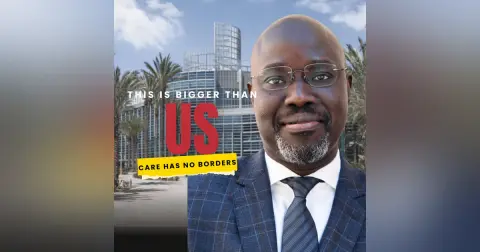


What does physical therapy look like beyond the U.S. healthcare system?
In this episode, Jimmy talks with Sidy Dieye, CEO of World Physiotherapy, about how the global PT profession is evolving — and why U.S. clinicians should care.
World Physiotherapy represents 129 member organizations and over 600,000 physiotherapists worldwide.
Sidy shares:
- Why global collaboration is the profession’s greatest strength
- The workforce crisis in countries with only one trained physio per 10 million people
- How AI should be regulated and used as a tool — not feared as a replacement
- What “direct access” means in different healthcare systems
- Why the 2027 Congress in Guadalajara is more than a conference
- The 75th anniversary celebration honoring 75 transformative physios
This episode reinforces a powerful idea:
World Physiotherapy doesn’t belong to leadership — it belongs to the profession.
<p>This episode is part of the <a href="/physical-therapy-business-podcast">Physical Therapy Business Podcast</a>, where physical therapists and clinic owners learn how to get more patients, improve operations, and grow their clinic without relying only on referrals.</p>
<p>Looking for more episodes? Explore the full <a href="/physical-therapy-business-podcast">Physical Therapy Business Podcast</a> for real-world strategies on physical therapy marketing, patient acquisition, and clinic growth.</p>
0:00 Come on, there we go. Doing another live broadcast here from APTA CSM in Anaheim, California. The CEO of World Physiotherapy. And we've got his entourage, his bodyguards. They're lurking around, making sure everything's taken care of. Representing the profession across more than a hundred and twenty countries and helping shape the future of physiotherapy worldwide. Joining us to share what's next for the profession on a global scale. Please welcome City J to the live stream. City, welcome to the show. Thank you very much, Jimmy.
0:41 Appreciate you having here. Have you come to CSM before? Is this your first? Funny enough, this is my first CSM. I explained it when I came to my first and went home. I explained it to my classmates because I was still a PT student. And I said it was like a circus with like eighteen different circuses in it. Are you getting that same vibe? And this is day one, but. Definitely. Yeah, definitely I am. And it's so impressive. It's unbelievable. Yeah. Even though I'm quite used to international congresses. But this is mind-blowing. Yeah, it's a lot. We tell people to pace themselves. It's a marathon, not a sprint. So how do we set up? Let's start with what is World Physio?
1:21 What is that? I mean, I saw the name while I was a PT student, but I didn't understand it until I was exposed to people who had been to a congress, and then they explained everything. To me, it felt like the UN of PT. It is indeed. Yeah. I like that one, but World Physiotherapy is, as the name says, is the World Confederation for Physical Therapy. World Physio is our brand name, but we are legally the World Confederation for Physical Therapy. And that's the global body that represents the profession. We are a confederation of hundred and twenty nine countries, member organization, and we represent over six hundred thousand physiotherapists around the world.
2:12 Wow. and uh city's now going to give us all hundred and twenty nine countries in alphabetical order whenever you're ready just go we're not gonna do that um so now we understand sort of what what things are on the radar what it would i mean you just have to pay attention to the entire world uh that can't be easy uh what are what are the things that are on your radar looking at the scope as wide as it goes the world well um I will respond in kind of two different aspects. The first one is for World Physiotherapy as an institution. As you know, I've been appointed as the CEO last April. So it's less than a year, even though I've been working for World Physio for the past ten years.
2:58 So we're going through lots of changes as an institution because we are putting back our membership at the heart of World Physio. And that means a lot. It's about integrating our membership's priorities, their vision, their aspiration across the globe. And as you know, it's not a one-size-fits-all. Yeah, it can't be. The reality in the United States is very much different from what we have, let's say, in Sudan or what we have in Senegal.
3:39 But yet, we are all part of the same global community. with a responsibility for World Physio to cater for every one of our members' needs. So for that, we need to be able to go through some strategic changes, redefining our global priorities. And it's good that we are about to embark again on another three-year cycle where we define our strategic objectives. And it's quite challenging because the world is changing. AI is knocking at the door, being perceived by some as a replacement for this profession, which it's not.
4:24 but also it's something that we need to embrace and make sure we customize it, we tailor it to our need, making sure that it is a supplement rather than a replacement. So also globally, the world is changing and other professions that work across the medical field We need to make sure that we are fit for purpose, we are trained for purpose, our competencies are well-defined, our scope of practice well-defined, and this across the globe. There are countries where it's far more advanced than what we're working on because they've been developing this profession over the past seventy-five years of World Physio's existence, where direct access is a reality.
5:18 where the title is protected, where there is a career development plan. You can enter as a clinician and end up being a seasoned academic or an advanced practitioner. But when you look across the globe, it's not the same reality. There are countries where you enter as a clinician, you retire as a clinician. There are countries where you have over ten million population, with one trained physio. So the dynamics are very different from one point to another. But yet, as a global community, everything we need is from within.
6:00 We don't have to reinvent everything. Whatever Senegal will be going through in the next fifty years, APTA or APA in Australia have gone through the same process. Years ago. And that level of expertise and knowledge is here. We just need to leverage it. We need to enhance the collaboration within World Physios member. act as the global community that we should be and if we do that we will look at the same direction together and be able to progress together and turn this institution is what those the founding members who sat together in that vision they have will be able to make it real i'm ready to go you got me hyped up that's the hype real that's what i need to hear You mentioned AI, workforce shortages as well, and changes in healthcare delivery.
6:59 What should clinicians focus on to stay relevant in the next five to ten years? And you mentioned there a second ago in terms of AI is, well first understand what it is, what it can do, what it can't do, and then where you fit, I imagine. And I think the starting point is, the education, because to be a physio with or without AI, you need to be properly trained. You need to get the set of competence that a professional needs to have to be a physio. AI is a tool. It's something that invited itself in our world and you got to deal with it.
7:39 it can make our life much easier. Access to information, processing huge amount of data, doing some of the critical kind of thinking piece on not the actual skills that we have, but in the management of the system in itself. So it has to be contained, it has to be controlled. The problem is not AI in my view, is the use we as human and professional rule have of AI. I don't see a world where AI will replace the physician or the clinician.
8:24 I would see a world where the clinician is able to pull out from AI, utilize AI as the fundamental tool to be able to deliver the services he was trained to do. Because at the end of the day, our primary role is to deliver those services. Any tools now we can use to improve that service delivery is welcome yeah we just need to regulate it understand it turn it into something that is trustworthy because nature by night uh is doesn't entertain vacuum right In the absence of regulation, it will self-regulate itself at your disadvantage.
9:06 In the absence of proactive decisions, you will have later on when you realize that you missed that opportunity to deal with what it has created and turn it into what it should have been. And we should not make that mistake. Now we have the opportunity to put the legal framework that comes with it, to redefine our use, to make it trustworthy and usable across the board. That's where our challenge is. We should not be led into thinking that AI is a competitor. No, it's not. It's definitely not. Now, what will make it good or bad is the user will have it, and that lies in our hands.
9:48 I got to ask you this, a hundred and twenty-nine member organizations, When you're gonna go in and do work, imagine you've gotta understand culture and language and history long before the first meeting. And that's simple, but that can't be easy. Well, that's the challenge we have as global leaders. Yeah. Because today, It's about togetherness. It's about being together because we are the architects in some way of our own challenges and our own failures. Quite often, instead of understanding what we're dealing with and address it head on, We prefer to create parallel alternative, not knowing that in doing that, we're not negating or eliminating this.
10:40 We only turning it into a threat we'll have to deal with in the future. Because today, if you look at each other, We're different. We're different from a cultural point of view. We're different from many angles or many ways we as humans have adapted in how we differentiate each other. But we're here sharing one passion, one profession, one vision. And we can choose to focus on what we have in common. or what we have in difference. And we should not make that because that difference, we should embrace it and turn it into a positive stimulator for what we have in common, which is this profession.
11:32 The strength, you'd turn it into a strength. Turn it into a strength because if today you have a Ghanaian physio, a Brazilian physio, An American physio, as long as they stay within the sphere of physiotherapy, they speak the same language, have the same issue, the same aspiration, and that's what brings us together. Now, our ability as a global organization is how we can transcend those differences that we're focusing on, turn them into strength. Because there is a saying somewhere around the world where they say three heads are better than one.
12:13 And we have hundred and twenty nine. Yes. Challenge is different. But hundred and twenty nine countries that share the same passion, the same share, the same profession and everything we need across the board is already is already within our own membership. It's about now adopting some principles around diversity, inclusion, recognizing the impact culture and background can have in the way in which we deliver those services. But the services will still be the same across the board.
12:53 An American patient doesn't have more need than the Brazilian one. A stroke patient is a stroke patient. And he doesn't make a difference between, you know. There's no border. No, not at all. And that is actually our strength as a global organization. Yeah, you said it. It is a daunting task at World Physio to try to understand what direct access could mean for an American physio and what it could mean for a South African physio.
13:34 Because the context is different, the realities are different, and the way in which it's going to be implemented also is different. And there is a learning for us to see how complex needs can be translated into something simple, understandable across the board. Yeah. I'm not going to put you on the spot. You travel around the world. Maybe just some favorite cultures that maybe you weren't exposed to before your work started a decade ago with World Physio. Where are some places that you've been that you've seen and just loved it?
14:15 Some highlights. Well, I will mention Tajikistan or Vietnam because we were invited by WHO to come and do a gap analysis in a country where with close to ten million population you have only one trained physio was trained in India at the bachelor degree level so and me when I got there I As an African, it was a cultural shock in a sense that for a week I was there, I was the only black guy walking around, which was quite funny because everyone was friendly, amazed in some way.
15:02 But when you get into a meeting, you're introduced as senior staff from a major organization, then immediately you got people's attention and you start talking about complex health policies how this if you compare it to the United Kingdom where we base how everything was shocking you know yeah we have direct access yeah yeah it's about explaining to somebody from the Ministry of Health what a scope of practice is for the physiotherapist but If I look back seven years after, I'm just so grateful for being part of that change because today, not only we have, we introduced the first entry-level program in that country, we've kind of moved people from the Ministry of Health to our different congresses, exposed them to the reality of the profession, the scope of practice, the level of education across the globe, and today, Those individuals are our champions in the system, making everything they want, everything they can to help advance the agenda of that profession.
16:26 And as a global organization, if you look back, knowing that Tadjiki Sen is not even yet a member of World Physio, But because of the work we're doing, we have introduced that profession in that country with a contemporary understanding of what the profession is. That's what we call making an impact and changing the future of the profession. Every few years, you have an event that brings together physios from member organizations from around the globe. One is coming up. It's not that far from where we are now. Looks like we're going to head to Mexico. Let's talk about that.
17:07 Well, twenty twenty seven World Physio Congress will be in Guadalajara. And as you rightly say, this next door. Yeah. And which gave me the opportunity to call on all American physios to prepare to attend that Congress because beyond what it offers from a scientific point of view or education point of view, but it's also about celebrating a profession. It's also about sharing. It's also about belonging to a global community. Because one thing about physio across the board is I've never seen people who love sharing, cherish sharing more than the physios.
18:00 Because like I said to you earlier, before being the CEO of World Physio, I was the head of development with World Physio. gave me the opportunity to go to Vietnam, work on upgrading the entry level program to West Africa, to Central Asia, to other South East Asian country. So that gives you like a global kind of view of what's happening in the profession. But everywhere we go, when other profession they will have to mobilize a lot of resources to develop teaching materials to to kind of assert something for us it always started at the voluntary level every time we needed something it's from within we will find individuals that will be ready to jump on the next flight to go and support the development of their profession in another country.
19:04 And that's remarkable. That's fabulous. And that's what characterizes physios across the board. Now, obviously, the state of the profession in Mexico or in South America is very different from what we have in the United States. But as a global profession, how good are we? if everything works in one country and in the neighboring country we still have a lot to do and that's the message that i'm carrying it's not about yes going to a scientific event where you can network it's about support. It's about togetherness.
19:46 And it's about building on the future of our profession, which is our future. You've got something a little different. I'll explain what I know and you correct me. But if someone's going to present on a topic at World Physio, they have to have somebody from other member organizations. They have to have people from other countries with them. So it can't just be a presentation of all Americans or people from France. Is that close and why? Not exactly, because for Focus Symposia, for example, it's a partnership you can have. Jimmy from the United States, somebody else from another country, they come together around specific topics. Now, when it comes to abstracts and other sessions, you can, you as an American, come in and present your own abstracts.
20:32 Somebody else can do that. But we... We at World Physio, we try to make sure that in the program, in the making of program, we enabling connections. We encouraging people to come together from different horizon to come and work together. And that's why a Congress program committee has been put together. It is led by Dr. Judy Dutch, who is American. But in that committee, we have representatives from all the five regions of world physio, from highly developed countries, from low- and middle-income countries. We've got academic clinicians. We've got seasoned practitioners and early career physios.
21:17 We're trying to bring everyone together to get that global perspective. And that's the same method that is being used for each one of these sessions. Yeah. So in one topic, you're going to have multicultural views in one presentation. So one won't dominate. So I love how you bake that into the programming to make sure that's never separated out in that event. Yeah, because it's about collaboration. Sure. it's about sharing knowledge it's about also being together it's about breaking those fictive barriers that we have we're coming together as a global community we're coming together demonstrating what diversity and inclusion means for world physio in in living example.
22:01 Exactly. And the simple fact that we are moving from one continent to another, from one country to another every two years tells you about how important that togetherness is for us. And if you look at World Physio as a global body, We scattered around the world, and it's United States, I live in South of France, some are in Germany, some others are in Kuala Lumpur, because that's the global community we are together. And today, technology has allowed us to do a lot more than we could have done probably a few years back. It's wild. All right. Last thing we do is on the it's called the parting shot. So what's a what's a sentiment, a thought, a quote, something you would want to leave the global audience of physio to think about?
22:49 Well, before that, if you allow me, I would like to just to say a few words about one major activities we have in this year, which is the celebration of our seventy fifth anniversary. Seventy five years anniversary. It's not a small feat. And today we have this open a call for nomination for our member organization and they will be responsible for nominating seventy five physiotherapists that have marked their time from nineteen fifty one to today we call them the seventy five not worthy physios so we will this year celebrate those who have contributed in this fantastic journey of world physiotherapy that started in nineteen fifty one to today now to come back to uh to your saying.
23:42 It's just like as an African, if you're asking me to tell you about what I'm saying, I'm like, one is just a bit too small. I mean, if you ask me to give you twenty, I would be very happy. But what I would say is just this belongs to us. World Physio is not my property, it's for all of us Physios around the world. And when you're managing something that belongs to everyone, there is a saying, they say, do not do it alone, do not understand it alone, and do not make it alone. No, sorry, do not do it alone, do not own it alone.
24:26 And why is that important? Because If we share that together and everything I do on the name of the institution is something that I talk to you about, we discuss it, we do it together. So it's stopping one person's business and become our business. And in being our business, because of the contributions of the three heads is smarter than one head. We will do it smartly. We will own it. And once we own it, we will sustain it.
25:06 Because if today I want to remove your beautiful bow tie, you will do everything in your power to keep it on your neck because it belongs to you. Let's make sure that World Physio is not our own property. It belongs to all of us. And if it belongs to all of us, We will all contribute and work towards sustaining it. And the best way to sustaining it is to make it fit for purpose so that our members will always cherish it, will always feel like this is something they need and this is something worth protecting. Love it. We'll share the link in the notes that go along with this episode for the Seventy-Five as well as the Congress coming up in Guadalajara next year.
25:53 Appreciate the time. Thank you for coming here and being part of this with us. Much appreciated. Thank you for having me, Jimmy. It was a pleasure. Thank you.