The Therapist Who Took the Interview While Driving
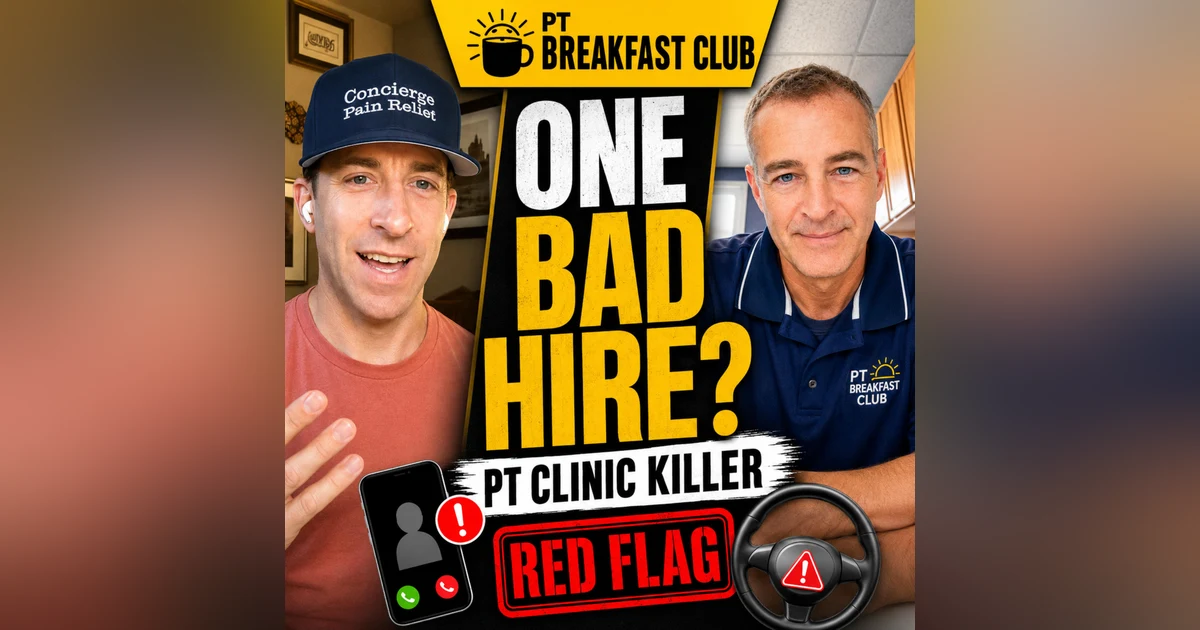


What matters more in a physical therapy hire: clinical skill, reliability, values, or fit?
In this episode of PT Breakfast Club, Dave Kittle and Tony Maritato talk through the uncomfortable parts of hiring that rarely make it into job descriptions.
Tony starts with a question every clinic owner eventually faces: what do you do with someone who is great with patients, but unreliable? Dave shares his interview process, including phone screens, Zoom calls, in-person skills assessments, reference checks, and the small behavioral details that can reveal whether a candidate is actually serious.
The conversation centers on one memorable example: a candidate who took a scheduled interview call while driving. For Dave, that was the end of the road. Not because the person was evil, but because the moment revealed something about attention, preparation, and how seriously they treated the opportunity.
Tony and Dave also explore whether employers should clearly spell out expectations or leave some things unsaid to see what a candidate does naturally. They talk about new grads versus experienced hires, hiring for core values, ambition alignment, long-term fit, and why one person can either elevate a clinic or quietly disrupt everything.
Then the episode turns toward outpatient ortho and the future of physical therapy. Dave brings up a LinkedIn post from an orthopedic surgeon who says he prescribes less formal PT than he did 10 years ago. Tony responds with a bigger question: what if some routine outpatient ortho care is not the best use of insurance dollars?
That leads to a spicy conversation about joint replacements, bundled payments, home exercise programs, AI, cash pay, private practice, premium models, scalable healthcare, Equinox, Planet Fitness, and where PT might be headed next.
This episode features Dave Kittle and Tony Maritato.
<p>This episode is part of the <a href="/physical-therapy-business-podcast">Physical Therapy Business Podcast</a>, where physical therapists and clinic owners learn how to get more patients, improve operations, and grow their clinic without relying only on referrals.</p>
<p>Looking for more episodes? Explore the full <a href="/physical-therapy-business-podcast">Physical Therapy Business Podcast</a> for real-world strategies on physical therapy marketing, patient acquisition, and clinic growth.</p>
0:02 Broadcasting way too early from three separate Wi-Fi connections. It's PT Breakfast Club with Tony Meritato, Dave Kittle, and Jimmy McKay. And we are live. Dave Kittle, Tony Meritato, Jimmy McKay. So before we went live, I said, we are never sick. And, you know, we've had this conversation before, but it's worth bringing up again. I've got a physical therapist assistant I work with, I told him a couple months ago, I actually got sick. I never get sick. I said, I don't think you've ever called out sick in like, fifteen years of working together.
0:47 Finding somebody like that is so impactful, not just from the perspective of having a stable employee, But also just in personal life, you know, when I think of my boys, I think of them meeting women that they're gonna maybe potentially marry. I think of the personality, I think of other things. But one of the things I think about is, you know, what's going to happen if you marry somebody who maybe has a different i'm going to use the word constitution i don't know if that's the right word but like somebody who gets sick a lot somebody has a weak immune system somebody who has personal issues and and disability and while i i empathize with individuals who are suffering and going through some of those challenges i also look at you know what are my boys going to be facing whether it be heaven forbid them dealing with it or them having feelings for somebody who's like that.
1:47 Have you been in situations business-wise where you hire somebody who's an amazing therapist, but they're just always sick, they're always out, they're always unable to perform? Not to that extent, luckily, so far. What about on a team? You're a sports guy. Uh, oh yeah, of course, of course. Um, by the way, just some of the things that you're talking about, like there's some things that are maybe out of our control and then some things that are controllable, but in terms of like showing up early, showing up on time, uh, not bringing your personal challenges into work, like not bringing your, you know, if your spouse, you and your spouse or your family have an argument or something and like, uh, that's the way I operate.
2:34 I don't know. Like, just like, I'm not going to bring in some fight or some, I don't know, like, even if it was like something like driving, like a, I don't know, like a, like a slow driver or something like that happened outside of work. I'm not going to bring that into work. And luckily we haven't had much of that in terms of hiring, in terms of being on teams whether it's work teams or even baseball teams absolutely um we're we're just where players just ghost a team for a while then they come back and they're like like they're expecting like to be all good literally just happened this summer with our baseball team where um our our ace pitcher uh was just gone for like two months Um, and there, there were some signs that there was an assistant coach that kind of said like, once it gets hot and once the, you know, once it's like the summer, this guy is out, like he's at the Jersey shore, uh, he's partying and turns out the assistant coach was completely correct.
3:40 Uh, and then he just came back yesterday to pitch the, the do the, uh, win or go home last uh championship game and we actually lost we were in the championship and we lost but this guy was he was he was good enough in terms of performance but you could you could tell that he was a little rusty and when he's on he's like really on like no one can touch a slider he's really on and so i don't know where we're gonna navigate this to like physical therapy business or healthcare but like for me with that Like, it's hard to respect someone who has talent, who has such great ability to contribute to a team, but then lets the team down in one or more ways, whether they're coming late, they ghost the team for a while, they're not answering text messages, they're saying that they got enough, so many little stories around that.
4:37 But yeah, there's some things that are in your control and some things that health-wise may be out of your control. it's the things that are in your control like like we talked about before like you know sleep and you know all the all the things that you could do to optimize your health uh to best participate with your team whether it's a sports team whether it's your job helping more patients helping helping the team with the mission of impacting more patients wherever you live so those are some things that come to mind Yeah, so you work with a business coach, you work with Sturdy, you've talked in the past about like interview processes, interview questions.
5:19 My question to you would be one, Do you address that? Do you have any, like some people will say, tell me about a time that, you know, you woke up, you were sick, you couldn't come to work. How did you handle that? Because they probably have a full caseload scheduled. They're gonna dump all of that responsibility onto somebody else at the organization, or they're gonna cancel all those people and you're gonna lose basically the entire profit margin for the week. So are there interview questions that come into play before you hire somebody? And then the other part of that is, and or do you plan do you build the system like i have in the past built a system for somebody who like your picture this guy in the clinic was amazing everybody loved him patients loved him but he had a weak constitution he was sick all the time so i had to build a business model that supported and allowed him to come in when he was feeling good call off when he was feeling sick without completely disrupting the entire organization so i did that because he was good enough that i'd rather have him at his best when he was available than not have him at all so question number one is on the interview process do you think about this do you do you look for this do you question any of this I don't know if I question it directly because it's usually like, you know, hey,
6:50 tell me about a time when you had a challenging patient. Tell me about a time when there was a miscommunication with a patient. Or tell me about a time when there was a challenge or issue that was confronted by your that where your manager or director or boss had to address address something with you, because like usually they'll be able to pull out something. You know, tell me about a time when you had a conflict with a coworker or conflict with a patient or conflict with your clinical instructor or your boss or your manager, someone who was kind of like managing you. And with our process, fifteen minute phone call, then a sixty minute Zoom call.
7:34 And then if they if we continue, then it's a one hour meeting in person skills assessment. They evaluate me on the mock patient. from those three touch points i think you can at least for me um it helps obviously with like interviewing more and more and more therapists um you can really get a good sense of someone i i believe in those three touch points sometimes in the past two years or so two three years um after the mock evaluation sometimes i will depending on multiple reasons we might go out like maybe i tell the therapist like hey there's this great place nearby or i'm hungry and hey like are you you know if it's around lunchtime or whatever um then i'll i'll say hey you want to like grab it you want to grab some food it's on me like we'll grab some lunch nearby i like this place nearby or whatever and then it's even more minutes of me observing how they just interact like do they try to hold the door for someone else do they say thank you or no thank you or yes please whatever just like simple little things to the the waiter or waitress um how how do they how do they navigate all that?
8:41 And then now if that's the potential fourth touch point, it's like a lot of minutes of how they just, how they interact. And you Tony know, and we all know that they're on their best behavior in the beginning of this whole interview process. So it's never, this is what sturdy helps me, helps me with. They are never going to be better than that first three or four touch points for us. Never. So it's like, Now, when you interview more and more therapists, it doesn't matter if it's therapists or anyone else, any other type of potential employee or team member, they're never going to be better than that. So it's like, it needs to be like a heck yes to hire them. And if it's on the fence, like it's probably not the right fit or it's probably like someone who... Yeah, like there could be challenges.
9:31 So in terms of finding out, do they call out a lot or... they're not going to be reliable. It is a little bit challenging, but that's when you triangulate, like, do they show up on time for the call? Do they answer right away? And here's an example really quick. So maybe a month ago, I had a fifteen minute phone screen, like the first step of our process, a fifteen minute phone screen with a candidate that I had DMed on LinkedIn. We scheduled the time. I called the individual at I don't know. It was eleven a.m. I called the individual at eleven a.m. They don't answer. I send the individual because I like to over communicate.
10:12 I send the individual a text and I think an email or a LinkedIn DM. I like two touch points. I like, hey, we had a call scheduled for eleven a.m. I just called you and left a voicemail. But then I'm over communicating by saying I'm putting this in text and or email form so that now there is a paper trail of that. Right. The individual calls me back, I think like six to eight minutes later, which is already too long, like already too many minutes beyond. So already I'm like this, this person is going to have to like really jump over the high bar here to like, wow me to even go to the next step, which would be a six minute zoom interview. The point of this first phone call, the fifteen minute phone call is to make sure and confirm.
10:55 Does it make sense for me to even invest for me and you to even invest more time the next one hour on a zoom call? The potential therapist calls me back at eleven oh six or eleven oh eight or whatever. Already, I'm like past four or five minutes like that's not a good sign. And guess what, Tony? I hear I hear them. I hear them driving. I hear I hear the windshield wipers going and I go. I go, I'm sorry, I'm a little, maybe I'm out of line here. Are you driving right now? And they're like, yeah. And then I go, yeah, hey, I'm sorry. I mean, I didn't have this in like the booking of when you booked this with my Calendly link.
11:38 because I didn't think I need to even say it. But, um, when I do these calls, I, myself and the candidate, I don't, I don't do these calls when one of us is driving, uh, or, or that, or a noisy background, not, not on a noisy New York city corner, not in a Starbucks. Um, and that sounds like green eggs and ham, not on a train, not on a plane. Yes. Yeah. And yeah. And so, um, So the, I said, yeah, I don't, I'm sorry. I don't, I don't do these calls. If the candidate is driving, like I'm distracted, maybe, maybe you could be distracted. I don't want you to be a distracted driver.
12:18 And the therapist, the therapist was like, oh no, no, no, it's all right. It's all right. And I go, oh no, that's fine that you're okay with it. I'm not okay with it because I don't think that it's, I think it's hard for you to be all in on this phone call because in this minute block, this is potentially the future of your career and you're not looking at it that way. And so we ended it and I said, hey, best of luck, take care. This is the end of the road for us. I wish you all the best and thanks for reaching out. Or I guess I reached out, but thank you for scheduling the call. But I don't think this is the right fit. be well and take care. And we ended the phone call. And so it's like, that is so wild.
12:59 Like these days, like, and even though my son's going to grow up around like all this technology and stuff, like I'm going to bake in, I'm going to hammer the importance of all of that, that if you are serious enough to interview with someone, why in the world would, Would you schedule it when you're like on the go? Like you obviously are not serious. And then the therapist is kind of saying like, no, no, it's all it's all good. Like basically they're saying that they are serious. But guess what? The rest of the world is not really going to judge that to be serious. Does that make sense? It makes sense. So now my question to you is, that was a lesson learned.
13:40 In your mind, you're like, I can't believe he even considered multitasking when we're doing this interview. In his mind, he was like, what's the big deal? I'm just going to answer a bunch of questions. We're going to talk. Who cares? For you, though, moving forward, lesson learned, Now do you communicate that to future candidates that, hey, this is an important meeting between us. I want you to be focused. I want you to be in on it. Don't drive. Don't do this. Don't watch kids in the background while you're talking to me. Or do you leave that information out that context to see what they would do naturally?
14:22 I think leaving it out is what a lot of employers would consider doing because they want to see what this person does naturally. But I think that's a bad strategy because you're setting them up for failure effectively. It's like, I'm not going to tell you what the expectation is. You need to meet the expectation or exceed it without even knowing. And the expectation is totally in my mind. I don't like that kind of interview, but I'm just curious what you're doing moving forward. so i'll have to check maybe i can check it as we're talking but my calendly link so right now i send someone a link and they grab a fifteen minute call slot and it should say some instructions i know for sure because the next step is a separate link through my calendly link or calendar where they can book a time for the sixty minute zoom call and that absolutely has instructions the the zoom call because it's like Um, please be in a quiet place with solid wifi.
15:20 Please check your wifi before the zoom call. I suggest, uh, earbuds, headphones, headset, although it's not required, but for audio purposes, that's optimal, uh, screen at eye level with a light or, you know, a light or window facing you. So it says it for the zoom call. Yeah. It might not for the intro phone call, but. maybe, you know what? I don't know. Like there's, there's pros and cons, but it's like the historically, like the right fit for us. Yeah. It's just, it's just not, they're just not going to ever consider taking this phone call. uh in the subway with a with a screeching train in the background to five feet away or whatever you know or um on a busy corner with cabs beeping and cars beeping and and people shouting um so i think there's pros and cons like i agree this again this this is the best that they will behave ever in the beginning of the interaction in the beginning of the interview process so with this therapist in the car and it was like kind of like it was not that it wasn't subtle it was like i hear the road i hear the windshield wipers i mean not that i have you know any significant type of levels of hearing like anything different than anyone else so um my opinion that therapist just was like ah
16:50 like whatever and not taking it seriously enough and so that's that's a huge flag and then but the ones that the ones that start with us and the ones that stay with us would never do that that's the thing so it's like if we put it as a heads up maybe some of the bad fits slip through maybe and then maybe that maybe that's not a good thing Well, and that's how my business evolved. You know, I go back to the first probably five or six years that we started the business. I was in the mindset of I don't want to taint the pool. I want to see what they do naturally. I want to see what their behavior is, what their core values are.
17:32 It was all about them kind of proving to us that they're a good fit for the organization. They're going to fit the culture. Then as things kind of migrated toward, wait a minute, I don't need these guys to be my best friend. We're not hanging out at happy hours anymore. I'm not going out with the crew anymore. The business was growing, locations were opening. Now it was like, no, I don't care about any of that stuff. This is what I want. This is the expectation. Now you make the decision candidate. Are you going to fit this or are you not? And I think it's interesting that you've said it a couple of times, the interview is the best they're ever gonna be. They're putting their best foot forward.
18:15 What's interesting to me about that, and I don't think I ever thought about this, I've been saying on the AI side of things, AI is never going to be worse than it is today. It's like the polar opposite of what we're looking at. It's like I buy a bar of gold, it's just going to be more expensive in the future. I run ads today, they're just going to be more expensive in the future. But when we're talking about staff, when we're talking about employees, it shouldn't be that way though. Don't you say you were a better therapist today than you were fifteen years ago? Yes, but we're not talking about clinical skills. We're talking about behavior and how you're handling yourself.
19:00 Theoretically, you would be a better person as you gain life experience, as you grow and mature. Yes. Theoretically. Theoretically, it sounds great and it makes sense. However, we're talking about behavior. And when people get comfortable six months in, twelve months in, whatever, to a job, they let their hair down. They get more comfortable. Maybe they say things that are off color or they like what you're describing, the guy that was chronically calling out for you, that was good and performed when they were there and patients probably love them.
19:43 but then calling out more and more and more, whether that's PTO or on their own time, but it's still someone who is not reliable. So we're talking about behavior and behavior is something that the interview process typically will prompt most people to behave above their average of when they get comfortable, they will default to their natural mechanisms or their natural behavior, which might be not what they're initially demonstrating. Now, on the positive side, the great therapist that we hire, they will be closer to their initial behavior demonstration.
20:29 They'll actually be able to maintain that. And it's like, that could be actually how they are. Maybe that's their ethos. That's actually their constitution. That is how they operate. And so that is the challenge. And that is why, ultimately, why we have so many steps in the process to make sure folks are the right fit. That would be an interesting trait or skill set to try to identify. I'm thinking back to experiences in my life. You always hear about marriage, obviously, divorce rates, things like that, and how as you get more comfortable with your spouse, you start to take them for granted. You start to not do the things that you did in the beginning.
21:12 um but i i like i spent a lot of time in martial arts i joined the martial arts academy i think my senior year in high school i had no idea i'd never been involved in martial arts And I think that going through that system, as I went through the ranks, there was more responsibility placed on me. I felt that I was setting the tone for new students coming in to the martial arts academy. I eventually became an instructor. And as I'm thinking about it, I believe I improved. I contributed more. I added more value. I held the standard to a higher level as I rose through the ranks.
21:52 And I just wonder if an employer now, say I'm going out looking for a job, if there was a way for them to identify the fact that I had had that experience, I understand the pitfall of, look, when you get too comfortable, you get lazy, you start cutting corners. Is there a question? Is there something in the interview process that that person, that hiring manager could tease out of me? whether i realize it or not to say i understand this this tends to be the the natural path people you know are on their best and then they decline because they get comfortable and they get lazy and but there are also situations where people start on their best and they just get better they actually get better as they commit more invest more build the organization with us uh it's an interesting idea i've never considered that when hiring but i i do think that there is an opportunity to find those individuals well and this is why also we do reference checks and But there's pros and cons, right?
23:01 The cons of reference checks is that I'm going to cherry pick my three best relationships and three best people who I know are going to sing my praises, right? So what I do is I will call each reference. Usually it's during the business day on purpose. Usually they don't answer because it's a different number. I don't always text them ahead of time because here's the thing. also taught from sturdy. I don't want them to answer on the first call. When I call the reference, I want to leave a voicemail and I want to say, Hey, Tony, John is interviewing with us. And he said that he was, you were his manager last year or two years ago, whatever at XYZ physical therapy.
23:45 He's interviewing with us to be, uh, he's a candidate for a potential job with us as a full-time W two physical therapist. And I'm calling you, uh, to ask you if you were going to interview him again, would you hire him? Right. And thank you very much. And I hang up and that's it. So now the call to action is they will only call me back if they would hire that person, that therapist again. If they don't call back, then we'd say to the candidate, well, you know, I called Tony and I left him a voicemail and I haven't heard back.
24:28 So now the candidate, John, needs to nudge Tony and say, hey, Tony, like, you know, I want to I want to move forward with this practice. And, you know, can you Can you call Dave Kittle back at this phone number? He said he left you a voicemail and that'll make you just it's trying to get more signals. It's trying to get more signals around this candidate. And so if you do that with two or three people, then if when I do get them on the phone, then of course, usually they're going to say like, oh, yeah, like Of course I would hire them again or whatever. And so I say on the phone, like, listen, like when we do these reference checks, like everyone is always like, you know, it's all good and easy peasy. And like, they were great. Everyone says the candidate is great.
25:09 There's got to be one thing where they can improve. What's the one thing that they can improve on? And if they go clinical, I always want to push them to, like, the behavioral, right? So, like, I leave it kind of open format, but I want them to say something like â and that's when â if they say something like your guy that you previously â or your therapist that you previously had that was, you know, kind of late or not taken seriously or â calling out a lot, whatever. I would want to try to get that pulled out of the reference check because the reference check might say like, oh yeah, they were great and they were, you know, patients love them and they were always about learning and blah, blah, blah, blah. So I always want to say like, you know, listen, On these calls, it's almost like a formality.
25:53 Come on, let's be honest here. I kind of make it like a joke. Listen, I get on these calls and obviously the candidate, I would do the same thing. And the candidate cherry picks the three best people, the three best relationships that they know it's gonna be a glowing reference. And so what's one or two things where you would believe that they have areas of needs improvement? It's just like very open-ended. So then they might say, maybe it's clinical. Maybe it's confidence with patients. Maybe it is showing up early or maybe it's being more efficient with the vows and visits and the visits are going over time, whatever. So whatever those things are, then you want to kind of triangulate that behavioral thing or that clinical, whatever that thing is.
26:38 And then you want to try to find it with those other two reference check calls. And then, you know, if you have the time and I think it's always worth it, can you can you find someone who's adjacent who's not on the reference list but someone who worked with that person but they but the candidate didn't give you that name and you use linkedin you use facebook whatever um if you can find someone who was even a co-worker like just another staff therapist you might be able to find out from them because now that person doesn't have like the onus to give like a glowing review because they might just be they might they might be a little bit more honest because they're not on the reference list so that that's another thing again it takes some time and effort depends on how much time and effort you have and how serious you are about the whole interview process but to answer your question it i don't know if there's like a direct question um again for the for the for the same type of thing So let me ask you one more aspect to this from your perspective as the business owner.
27:38 There are businesses that view themselves as a platform for growth for their clinicians. They put a ton of time in, effort in, they train their people, they bring everything they can resource-wise into helping that employee be the best possible professional they can be. There is the other aspect of the business where it's I am not hiring you to educate you and train you and teach you and improve you and do all of these things for you. I am hiring you to come with those things. I want you to be better than me so that I can put you into that role and you do the things that I can't do.
28:18 Where do you fall? And I'm going to call it a spectrum. Where do you fall on that spectrum? Because I see you putting a ton of time and effort and money into training and educating and improving, as opposed to maybe being the business who's looking to hire the professional who's better, smarter, faster, you know, better looking, younger, richer than you and putting them into that position. um i'm certainly open to and and i'm becoming more and more open to maybe hiring like newer grads and and kind of investing the time and effort uh for them on the like clinical improvement or the navigating like our whole model like out of network and demonstrating value and trying to get you know doing pre and post tests and trying to demonstrate like clinical um Like effectiveness, like getting more patient buy in to the plan of care and getting a therapist comfortable with our premium dollar amounts and visit like the eval visit and packages and programs and multi thousand dollar programs and all that.
29:31 But a lot of it is I'm looking for therapists that have a lot of that already. And then it's like, I just need to tweak them a little bit with like, Hey, like you're actually going to be where you worked usually is like in network typically, or like Medicare part B home visits where those therapists literally never had to talk about money. Money was never a thing. They never had any rejection because some patients would just stop coming and ghost them. But there were so many new patients all the time that like the therapist never really cared about it. And with us being like lower volume, because we're more premium, you maybe feel it a little bit more. Maybe you realize like, oh, wow, this is like a little bit more challenging.
30:12 This is definitely more unique. So in general, the therapists that we've kind of hired the past year or two have already had a lot of those things. They've already had the confidence, the clinical experience, they're well-behaved, they're professional, they're prompt, all that type of stuff. But I'm open to maybe having more of my time and effort in filling up their cup, like kind of coaching them more, mentoring them more if they're younger, if they're a little more like newer in the field and they, but the thing is they have to have, typically it helps in this situation.
30:54 Let's say someone's like three years out of school. So I haven't really hired someone that was just three years out of school, maybe ever. And so that I can recall. If someone's three years out of school, I need them though to have been frustrated with like an in-network model where they were treating fifteen to twenty five or thirty or whatever patients a day. I need them to have experienced that either on a rotation or at their first job. I need to hear from them that they don't like that, that they want more time, they want less notes, less patience, all that. So then it's really easy. It's like, well, here's what our model looks like.
31:35 And there's a safety net. there's a base salary and there's weekly performance pay and oh, and here's some pay stubs and here's some figures from some of our therapists and here's what they're making, you know, four, five, six, seven thousand dollars every two weeks. So it's pretty even pre-tax, you know, or after taxes, pretty good, really good. And so I'm open to it. But generally who we hire, it's like they're already bringing that to the table and they're kind of plugging that into our system because they want to unplug from the other systems like the network or all that. yeah makes sense i i think we historically had always been on the new grad side like right out of school i don't want you to have any clinical experience i don't have any baggage i don't want you to have any of that um and i was looking for people more And I've said this candidly to the person I'm hiring.
32:35 I'm like, look, you've got the personality that I'm looking for. You've got the core values that I'm looking for. You don't have the experience and the clinical skill. I would rather get you on the team for two years um help you develop the clinical skill because that stuff's easy take the benefit of your personality and your core values and then move on like then you go then you go to the next level you go to the bigger the newer the different organization I always kind of viewed myself as a residency, even though we weren't a formal residency. And I was totally fine with that because I enjoyed teaching.
33:18 I enjoyed the engagement, the interaction. It made me better. It kept me kind of on my toes and like them asking questions. But I think what happened for us was there is a gradual shift. And I don't know if this is a demographic, a generational thing. The candidates that we were interviewing and talking to, they didn't think they needed to learn anything. And so I was getting to the point where I was like, well, I can't force you to want to learn the stuff that I think is important. And if you think you already know everything, you're beyond what I can offer. So just go work somewhere else. You know, and I think for us, because we always say like, no, the business you're in, the delivery of service was not the business we were in when we were growing.
34:08 We were in the business of taking young, eager clinicians who wanted to learn and gain experience while getting paid and prepare them for their next big opportunity. And when that dried up for us and I felt like when I talked to a therapist, about an intervention and they were just blowing me off because they felt like they already knew it. I was like, that's it. I'm done. There's nothing of value that I could offer here. And that's when we basically stopped hiring. That's when we basically said that opportunity is no longer available to us. Let's just cash in on what we've got, the delivery of service and not even bother trying to hire new clinicians.
34:53 um and that fundamentally you know was the death of that business even though technically the llc and the name total therapy persisted we never really found an opportunity to grow the business anymore Interesting. Let me ask you. So you said, Jeremy, we have their PTA has been with you for fifteen years. So the way you were kind of approaching any of the hiring, even the therapist and the PTAs and other folks that have come and gone. Do you recall? I know it's fifteen years ago, a long time ago. Do you recall when you interviewed Jeremy, was there anything in the first several interactions in whatever your interview process was at the time?
35:39 If you can think back, which fifteen years is a very long time, was there any signal or anything with like behavior or confidence or anything that stuck out then where you look back now and you're like, oh, yeah, like, of course, that's why he they that's why he stayed here or that's why he patients love him. Is there anything there that maybe you can look at and say that's a potential signal for maybe other practice owners to try to notice or catch? Yeah, we basically had three people, two PTs and Jeremy at that time. Jeremy was a student doing his clinical rotation. Now he's a physical therapist assistant in case that detail got missed.
36:24 But he did his clinical rotation with us. So obviously that gives us a huge advantage to see over several weeks what his personality is, culture, what he's like. This is a second career opportunity. He came out of like... I don't know what they call it. I'm going to say youth corrections, you know, correctional institutes for kids, troubled teens, that kind of stuff. So already kind of knowing the environments that he had been in, seeing how much he enjoyed what he's doing now in outpatient therapy. He had an athletic background, played football like in college, did other things like that.
37:05 And just the general, the other two therapists, they were PTs who were also kind of new hires at that time. You could just see, you know, I never had a patient tell me they felt he was arrogant. Whereas with the other two DPTs, multiple patients were like, he's just so arrogant. They just think they know everything, you know, like. They came off with this era of like, well, I'm doctor so-and-so and this is what you're going to do. And this, you know, my way or the highway kind of thing. And they were good. They were good therapists. And they worked for me for a very long time. And we had great outcomes with them.
37:45 I fundamentally would never do the treatment they do. They would never do the treatment I do. I think both of us had a level, those DPTs and me, had a level of, I respect your independence and autonomy as a professional, But I don't think what you're doing actually does what you think it does. And I think they felt the same way about me. You know, that guy, he's too lazy. He's too like he doesn't care about anything. He doesn't think anything matters. But there was a mutual level of respect there. And so. i think the difference here is you know jeremy and i can look at the same condition and maybe it's because we've worked together for so long and we've been like yeah like this makes sense these are the things we want to do we kind of share the the culture of there is no hard and fast rule about it nobody knows what's going to work we'll try some things we'll work out a little bit we'll make the person feel good and functionally they're going to improve Whereas other clinicians other therapists are like no you got to do this special test and if this works this way and you got to do this and you got to do that and you know very very regimented and what they believe is evidence-based where I would say there is no evidence there's no evidence to support anything that we do we we can find evidence that sham is just as effective as any of the interventions you know so I think that's why it's worked out.
39:15 And we're basically the same age. We come from similar backgrounds. We have very similar values. He's basically like a brother that I get along with to that level. I trust him implicitly with everything. And I don't want to mess with that anymore. So you just hit on something values, right? That's another thing that I probably have overlooked in, or I'm not over, I haven't conveyed on these shows about the interview process. So when we have the zoom interview, I'm asking questions that are, that I can't say to them, like, Hey, our, one of our core values is like, respect is like a two way street. I'm not going to say like, tell me about a time when you, you know, you like, tell me like, what does that mean to you?
40:02 I have to pull out, I want to say, tell me about a time when a patient disrespected you. What happened and what did you do about it? Or tell me about a time when a coworker disrespected you or maybe a referring physician or a boss or manager or a clinical instructor, CI, whatever. So then whatever they tell me, the experience that they had would then relate to our core values. And in the Zoom interview, a lot of the questions are, Because they don't necessarily know. They probably don't know yet what our core values are. So I want to ask stories and life situations on how they navigated the world, what types of challenges they might have had.
40:44 And their responses will then tell us a lot of are are their core values close enough to our core values right and so that that what you're describing of like turns out jeremy like has kind of like similar values that you have and it's like then it's like no surprise that he stayed with you for so long right um because it's not necessarily just about communication or how much he's making or whatever but like he he just likes your vibe and you guys are like closer to the same page And even ambitions. It's one of those deals where, you know, you've known me long enough, like there are things I could do to make more money, but I'm in a comfortable place right now.
41:26 I prioritize time with family over more money. I prioritize ease of life over more money. And I think we share that as well. It's really hard to have somebody who's like, I want three million dollars a year and I'm going to do everything in my power to make it. And then put that person alongside somebody who's like, I'm good with sixty thousand. I'm comfortable. You know, like those two personalities clash because there's different ambitions within that. I think he and I are both very comfortable with a relatively modest life and we prioritize family and other things. Which again, when I bring somebody in who disrupts that relationship, it's not even just that I want to grow or not grow or whatever the business is.
42:17 I know that if I bring another personality into the mix, there is a chance that it disrupts everything, changes everything. And things are very comfortable right now. So, like, those are business decisions that I think we make as business owners that somebody from the outside looking in might not consider. I know we're kind of running low on time. Let's say ten more minutes. You shared something with me that I think is interesting. Do you want to talk about that, LinkedIn? Or do you have something else? I knew you would love it. I knew you would like this. Yeah. Yeah, so... I'm going to try to bring it up while you're talking.
42:57 Yeah, I'm gonna pull it up as well. So this was from LinkedIn. This was a surgeon who posted, I prescribe less formal physical therapy than I did ten years ago. and my patients move better. I'm just opening up the post now. So this is a hip and knee reconstruction specialist. So right up Tony's alley. This is a lot of stuff that we've already kind of talked about. I mean, I know for sure Tony has posted about it, but there was a big long post talking about an article, a perspective, randomized study at a Brown University published in the Journal of Orthopedics talking about knee replacements and then assess them at two weeks.
43:41 Then again, at six weeks, basically found no significant difference. The sample size, two hundred forty eight patients were randomized. And so that this physician was in this orthopedic surgeon physician was saying that he's not saying therapy doesn't work. He's saying that the routine prescription is not the therapy that the stratification is. That's a lot of little, little higher level, but nonetheless, we we've talked about this before where I think though, I think this is my take and you can push back on it. I think the change of specifically hip replacement, but maybe knee replacement as well. Definitely hip replacement has been referred less to physical therapy over the last, I don't know, last five or ten years, maybe longer, but definitely a progression of less and less patients who get a hip replacement get outpatient physical therapy.
44:35 Maybe they get some... home physical therapy for like just assessing walking or gait training, but not really like the manual therapy or, um, maybe they don't need it. I know Tony's going to have some, some, uh, some thoughts there, but, um, I think a lot of this was driven by the bundled payments. In my opinion, I could be wrong, but if, if a physician or health system is going to get a flat rate for the entire month, The entire situation, meaning surgery, post-op visits, and including the downstream outpatient physical therapy visits. And then once physicians heard that, or hospital systems maybe, or physician groups, they were like, well, why would we refer out?
45:17 And I'm not sure if that is the case. I could be wrong. Also, like... for uh rotator cuff repair maybe like maybe they still do need a lot more of the outpatient therapy that tony would do with them and that we would do with them um and so they still will prescribe and refer out for that and knowing that it cuts into their potential bundle payments um anyway that's a lot there but i'll kick it back to tony yeah i think you know medicare is growing or expanding the program where they basically say um we're going to expect this much money be spent on a total knee replacement.
45:59 If the hospital's in charge, the hospital is local leadership, the hospital makes the decisions on who's gonna see the patient for outpatient therapy, what other conditions are gonna be treated. But if this hospital, ends up spending more and this hospital ends up spending less and we've determined the median price is this, the hospital spends more is going to have to pay back some of that money. The hospital who spends less is going to get more of that money. Like, if you go two or three layers upstream though, We have to acknowledge the money is running out or already ran out.
46:40 Like we're borrowing money to pay for health care costs. You know, we're borrowing money for all of these things. So Medicare itself, there is there's less money going in than there is going out. Medicare is never going to look at increasing payments for anyone. And the same is true for all other third party payers. so how do we as one tiny sliver of the healthcare business the industry how do we show like look we're actually doing things to spend less to improve outcomes to make this more affordable this is where i think the research like i said earlier there's no good research anywhere saying physical therapy is the best thing right at best it's no worse than sham no worse than placebo um but now there's there's research that says look people who do a home exercise program at scale do just as as good as people who don't there are going to be cases i get cases in here where the person is so freaked out like they're so anxious they're so scared they're they are legitimately bleeding uh and you know they need that dressing change they need the dressing looked at maybe they have a dbt there there is really something going on but that's a very small percentage of the total population and when i share on my facebook feed how many physical therapy sessions did you do i get people that are doing years
48:12 of physical therapy two and three times a week after a typical knee replacement you know so like these abuses and i'm calling them for what they are of what insurance is supposed to be I think it's getting called out. There's going to be a reckoning. And so this is where I think we have a responsibility. Let's look at what AI is good at right now. If a home exercise program, unsupervised home exercise program has been shown to be just as effective as one-on-one physical therapy, AI is probably going to be better than that. So let's roll out some of these ideas, some of these innovations.
48:55 And I still get therapists who are like, I can't believe you want AI to take our jobs. I want AI to do the stuff AI is better than me at doing. There's a lot of things AI is better than me at doing. A calculator is better at me at doing complex math. I'm going to let the calculator do it. Um, but this, I think, I think this is going to impact outpatient ortho more than any other aspect of our profession. And I think it should, I think, eighty, ninety percent of what outpatient ortho does should be wiped out tomorrow. It is not something that insurance should be paying for. It should be out of pocket. Yeah. Yeah. It doesn't mean the patient can't do it.
49:38 And the people who have the argument to say, well, patients can't afford if you put the power back in the hands of the business owner they will build a business that patients can afford mcdonald's has built a business of feeding people at a price point they can afford like you just you've got to get it out of the government control right now i can't deliver a medicare visit for less than medicare pays even though technically i have the capacity to do it legally i can't do it So, like, get the government out of that regulation. Let the private practices do what they want to do.
50:20 A lot of them will go cash. A lot of them will go premium. That's awesome. But then they're going to be the big companies, the private equities that are going to bring an affordable solution out for pennies on the dollar. It's a lot, but... I feel like I want to be part of the private equity that does the consolidating or the grouping or the portfolio effect of the premium options. It makes sense for all the private equity to back all the big Ivy Rehab and Athletico and ATI and all the big guys, most of them are pe backed to catch the like to have the widest net right to take every insurance and all that but it's like you could have i mean it's it's a different investment uh and like the approach is different but knowing that you can hire almost any therapist potentially keep any therapist in terms of compensation have way more margin and then just reinvest profits back into paid media or other things like videos and stuff that you're putting out and all the other ways to attract more of those patients.
51:42 I mean, there's plenty of other private equity that does back more of like the premium restaurants and other brands. So certainly possible. That's what I was going to ask you. So what are examples outside of health care where private equity or just investor money in general comes in and supports a premium service based experience? Like I know they're rolling up plumbing businesses, they're rolling up roofing companies, they're rolling up some of those things. But like, are there examples where they're going to come in? And if the standard rate, I mean, standard rate for a roof, I'm making this up is twenty thousand dollars.
52:23 Is there a fifty thousand dollar roofing company that a private equity is going to come in and consolidate and roll up? I didn't think there was. I thought their sweet spot is kind of medium to low price point. Just get lots of those businesses. I'm going to have to get back to you on that. I know that there's definitely the investors that back maybe the middle range. I don't know if you've ever heard of the Darden Group, D-A-R-D-E-N, Darden. And they own a bunch of brands, like restaurant brands. And those brands are not McDonald's. Um, but I would say they're definitely like mid tier.
53:06 Um, I think they own bonefish grill. I think they own maybe, maybe Carrabba's like some of those types of brands. Um, because I remember getting some of those darting gift cards and then it's like, you flip it over and you see like, I could use that, you know, five or six of these different restaurants or brands nearby. And it's like multiple. So some of those brands are those restaurant brands are like the, maybe the two and three dollar, like what you see like online was like the dollar amount. So it's like mid- They do both. They have Olive Garden, Longhorn, Cheddar's, Yardhouse, Bahama Breeze, but then they also have Ruth's, Chris, Eddie's, V's Prime, Seafood.
53:51 So it looks like they're at both ends, but my hunch would be that the majority of it comes from that middle tier, like you said. majority of what majority of profitability and revenue like i i don't think a ruth's chris or anything in that price point hundred dollar plus meals individual meals i don't think that contributes as much of the profit maybe it's more profitable as an individual restaurant But over the umbrella of the organization, I've got to think, and we can look into it, Olive Garden, Longhorn, those things contribute more profit in absolute terms and more revenue in absolute.
54:35 McDonald's is more profit in absolute terms because it's so huge compared to even something like Chick-fil-A. Everybody wants to say, oh, Chick-fil-A does two million per location and McDonald's does less or whatever the number is. But in absolute terms, there is a whole lot more McDonald's than there are Chick-fil-A. almost forty or thirty eight thousand extra locations onto more than Chick-fil-A. In absolute terms, I can open thousands more average physical therapy clinics that deliver an average patient care experience that isn't bad compared to a high touch point, premium, amazing, you know, pro level athlete physical therapy clinic.
55:20 Because there's just way more opportunity in that pool. Okay. Yes. And as time goes by, every five years, every ten years, with inflation and cost of living, which one becomes easier to operate? McDonald's and Chick-fil-A. The average one. The middle of the road one. How? When your margins are getting squeezed. How? How does that become easier to operate? Because you have economies of scale. You have other opportunities within the opportunity. And again, I'm speculating. I'm thinking that's what happens because I see Coca-Cola versus some champagne company. I see McDonald's versus Ruth's Chris.
56:03 Yeah. Like in my mind, looking at the entire pie, there is far more opportunity for those big businesses that are highly scalable than there is for the premium level service. But we need both. Let's do parting shots. My parting shot is always going to be, we are still, anybody watching this, I guarantee we're all still at the minuscule level where the person you bring into your organization, even if you have a hundred employees already, One person can either be a cancer that kills the rest of the organization, or it can be a net benefit that elevates the organization.
56:48 You have to understand who it is that you're hiring. Yes. Oh, I know. So we got to wrap up. But one of the examples is Equinox, Equinox. I don't know what the investors are. We'll have to look it up and we don't have time right now. But we have talked about Equinox recently and they are the premium option close enough to physical therapy compared to the Planet Fitness, which is ten, twenty dollars a month. Equinox is what we've seen, two fifty, three fifty, four hundred dollars a month, depending on the location. That is the premium option. So we have to look at what are those investors? Who are those investors? And they're absolutely investing in way, way more like taking longer to get their money back.
57:28 And it's more of the premium option. But knowing that we recently discussed, I think it's Equinox that their average customer is paying like I forget what it was like, four thousand dollars a year. And they think in the next five years they can go to six thousand dollars per year in the next five years. So it's like they have the opportunity to continue to get more of like their customers wallet share if they're delivering value and Planet Fitness will not. They're going to sell five dollar T-shirts and they give away free pizza. Like how else will Planet Fitness have more share of their customers wallets? That is a good question.
58:10 But Planet Fitness has way less of an ability to have more of wallet share of their customers because they already chose the lower cost option. All right. I'll do the research. I'll bring it back. Guys, come back on Thursday, eight thirty in the morning. Dave, you have an amazing rest of your day. That's it. We're out. Boys, what the hell are you doing? Follow Tony Meritato on YouTube at Total Therapy Solution. Find Dave Kittle at conciergepainrelief.com and on YouTube at The Dave Kittle Show. And follow Jimmy McKay at PT Podcasts on YouTube, the socials, and wherever you binge podcasts you pretend are for CEUs. And hey, just a reminder, none of this was for advice.
58:52 This was for entertainment only. Our lawyers say that counts. Thanks, Keith.