The PT Profession Has a Math Problem
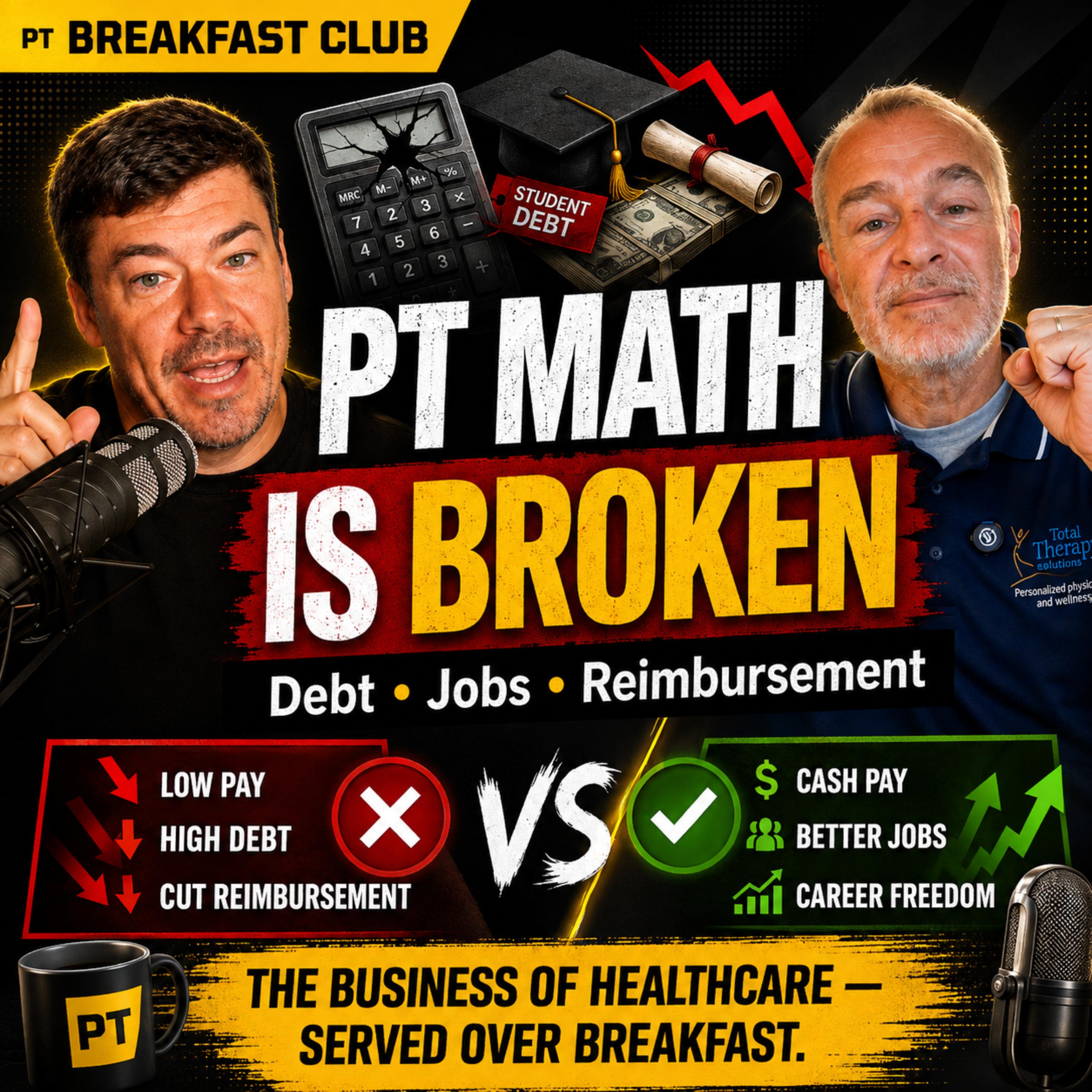


Physical therapy has always told students some version of the same story:
Work hard.
Get the degree.
Help people.
There will be a job waiting.
But what happens when the math starts to break?
In this episode of PT Breakfast Club, Jimmy McKay and Tony Maritato start with a post from Richard Severin about the financial viability of the physical therapy profession. The conversation quickly moves into PT school ROI, student debt, academic program pressure, and whether the next generation of students is more willing to ask the uncomfortable question:
Is this still worth it?
Tony argues that the profession may be facing a bigger identity problem than it wants to admit. If a patient’s desired outcome is less pain and better function, PT is only one possible delivery model. AI, tech-enabled MSK platforms, personal trainers, hospital systems, cash-pay clinics, PTAs, techs, and other professions may all compete to deliver parts of what PT has traditionally owned.
Jimmy pushes the business angle: if you own a private practice, you are not just in the physical therapy business. You are in the marketing business, the patient attraction business, the hiring business, the customer experience business, and the human resources business.
The second half of the episode turns into a practical marketing lab. Jimmy and Tony critique a listener’s marketing pitch about targeting new families moving into a clinic’s area, then break down why so much AI-generated healthcare marketing feels cheap, loud, and generic. They use classic advertising examples like Rolls-Royce, Grey Poupon, Holiday Inn, and Volkswagen to show how better strategy leads to better creative.
The episode closes with Prompt’s Career Connection program and the idea that maybe some clinicians do not need to leave physical therapy. Maybe they just need to leave the wrong job.
Key Ideas- PT has a financial viability problem, not just a morale problem.
- Students who really run the numbers may never enter the profession.
- “I just want to help people” is not enough if the career cannot support a life.
- The profession may need to separate outcomes from identity.
- Outpatient ortho under insurance may not be the future of private practice.
- If PT cannot scale the outcome, someone else will.
- Private practice owners are not only in the PT business.
- Marketing is not decoration. It is how the market understands your value.
- AI-generated design still requires strategy, taste, and iteration.
- Career matching may work better when it is human, specific, and trust-based.
<p>This episode is part of the <a href="/physical-therapy-business-podcast">Physical Therapy Business Podcast</a>, where physical therapists and clinic owners learn how to get more patients, improve operations, and grow their clinic without relying only on referrals.</p>
<p>Looking for more episodes? Explore the full <a href="/physical-therapy-business-podcast">Physical Therapy Business Podcast</a> for real-world strategies on physical therapy marketing, patient acquisition, and clinic growth.</p>
0:02 Broadcasting way too early from three separate Wi-Fi connections. It's PT Breakfast Club with Tony Meritato, Dave Kittle, and Jimmy McKay. how to be honest this one feels this feel i heard something i think tony maritato not even something you said before we went live just the vibe you said something about the profession not existing i mean if that isn't a cold open i don't know what is um do we want to start with someone else's post is that we want to start with are you trying to find that one yeah i've got it let me pull it up so richard severn which i think probably most people know I'm going to put it on the screen.
0:49 This was posted on his personal profile, the doctor of physical therapy students, a bunch of different places. And basically, he's talking about the financial viability of the profession, right? He's like, I don't want to talk, make it all about finances. And there have been multiple therapists and educators in the profession talking about finance. But he talks about challenges to the financial viability of the profession, clinical practice. This generation of students is more aware of their finances than ever before. Talking about return on the investment, putting academic PT programs under threat.
1:29 You talk to students. You kind of have your finger on the pulse. Before I keep going, what's been your experience? I don't truthfully think PT students in the programs are thinking about finances at all. but i think i think they're thinking about it more than they did ten years ago i do not do that is that funny because i'm right or funny because i'm wrong more more is relative right before it was zero now it's one percent well well all right let me it's it's hard to measure but i don't think there was much discussion there was zero ten years ago and now there's some so that's a thousand percent more right exactly uh Yeah, I think I've said this before, and this is not a knock on education, but after eighth grade is ninth grade and after ninth grade is tenth grade, there's always a thing.
2:22 So there was always a thing to land on. That's how it was for me now. the closer you got to the end of high school, the more your teachers were like, you know, you need to do some stuff, right? You can't just show up and sit there and then be moved along to the next number. Eventually, like you're going to get the boot, right? So I think that was sort of the debt, like the idea ten years ago when I graduated from PT school, and again, only ten years ago, was there's a job, like you're going to work for it, but there will be one. And now some of those jobs, you're underwater in terms of like whatever you owe versus whatever it's paying. And that should be a wake-up call that you need to do something different. It doesn't necessarily need to be more.
3:02 I mean, listen to a guy like Chris Corner and he's like, you don't need to necessarily just keep working more hours, right? There is that whole, I mean, if I heard it, if there's a cliche for the last ten years, it's trade time for money. Yeah, it's ability for money. It's time for money, right? But if you're in first gear and for every spin of the pedals, you're only getting one spin of the back wheel, that's not good. Figure out something else to do. Maybe don't bail out of the profession altogether before you look around and say, well, what else do I like to do? What am I good at? What is no one else doing that a bunch of people need to do? Again, still shocked that no one's also adding...
3:46 food service i thought your idea for like like meal prepping with people who were either homebound or just don't have the time or like me i have lots of time i don't like doing it and i would pay someone to do that right i'm not lazy i just i'd rather be outside mowing the lawn or weed whacking than i would cooking something and other people are vice versa So I think the fact that if you don't know who Rich Severn is, he might be one of the last people to go out of the way, in my opinion, to talk about finances. This guy's all about clinical excellence. He's in academia. And the fact that he's doing this, but he's also seeing this full circle moment, I think. Because at eleven fifty nine on the clock, you have students and at twelve oh one, you have academics and programs.
4:30 And now I think they're both Touching each other, right? I mean, somebody had a stat the other day of how many colleges there were in the country and how many of them were financially in trouble. And the number wasn't good. It was a significant amount. I think Rich is looking at it from the lens of like, well, if these schools are in trouble, who's going to be teaching the next generation of PTs? The answer might be no one. And then what happens? other professions absorb the things that we did i think that's the route that you were going and that's the route that's sort of what i i didn't even read rich's post i didn't see it but i've listened to rich enough to go i think i know where he's going rich isn't the guy trying to get loaded he ain't the guy trying to get rich rich ironically is trying to just teach people and be happy and be good so um i'm on a diatribe here so oh uh my thing i think students are more aware of it And one step further, I think the ones that are hyper aware of it aren't making the decision to go to PT school.
5:31 I think the ones that are actually crunching the numbers and looking at them and saying, this math, don't math. We never hear from, I never meet them. They never listened to this podcast because they never make the decision. They're gone. Right. Yeah. And that's what it is. You know, basically what I'm taking away from his post is if the financial situation in clinical practice improves, the value of the profession improves, we attract more people. And when I look at that, I mean, it goes back to chicken or the egg. Are we as a profession past the point where maybe back in the day, We were able to kind of bring people in, attract students who just want to help people, right?
6:17 That's what we did. Now it's not financially viable anymore to just want to help people because the people helping people need to buy a house, need to buy a car, need to raise their kids, like do all of this stuff. So all morning I was playing around with AI and I was talking to AI. I'm like, how do you differentiate between the healer physical therapist who wants hands on the patient, the therapist who wants an hour dedicated to each individual, make a fully customized treatment plan versus somebody more in my world where I'm like, look, we're all humans. We need to walk or locomote. We need to move through space, however we do that.
6:57 We need to lift and push and pull and carry. I can develop a plan that pretty much works everything. I haven't taken a student for probably almost ten years. Since before COVID, I haven't accepted any students. Yesterday, I talked to a local high school. They're like, I've got this young girl. She really wants to be a physical therapist. She's in her senior year of high school. Can we do this arrangement? I was like, yeah, we'll take her. Because now we're kind of in a better position to provide the student with what I believe they need. But with that, one of the main things I'm going to show this student is, look, here's ten humans that all walked in with different conditions, a back, a shoulder, a knee, a hip or whatever.
7:43 They all have different histories. They're all unique personalities. They're all kind of snowflakes in their own way. But at the end of the day, every single one of them will benefit from doing these five things, walking across the balance beam, carrying a weight, you know, resisting this motion, whatever it is. And that's where I go back to him. Like, first, we have the identity issue of am I the person who has to do the intervention or am I the person who who now analyzes the situation, determines the plan of care and then lets the technician deliver the intervention, not even a physical therapist assistant, but an actual unlicensed tech that's been trained by me.
8:31 And if we continue down the road as a profession, fostering the culture that nope everything has to be done by the pt or the pta nothing can be outsourced to the technician working under the pt or the pta i just think we we've passed that uh replacement population growth where now we're declining and at some point correct at some point we're going to be replaced and it's not so much that i'm going to replace it's what i deliver is going to be replaced okay this person walks in they have shoulder pain they want to reduce pain and improve function i don't i'm not the only option to do that i'm one option to do that and if i can't do it at scale somebody else is going to come in and do it because these individuals need that outcome Funny part is this last weekend, I was at like a prompt growth summit.
9:27 This brought a bunch of practice owners in. And my job for two of the sessions, and you're gonna love this, was poke. Ask a question until you got enough people talking and then shut up, which is harder for me to do, but I did it. And the only rule was we can talk about the ideas that were there, just like Graham sessions at that one conference, just don't say who said what. And the idea of PTAs or care extenders were brought up and all these practice owners, most of them were larger, footprints all of them most of them were in agreement that is a great idea in fact if you're not doing it that math don't math and these are the people who are paying attention to their own math they're not using hypothetical math they're using their math in with their payer mix in their state with their staff their overhead their costs and they're all saying yeah we we are doing this as much as we possibly can and if not we should be doing it more Yeah.
10:22 So is it ego? Is it I'm these these are the hands of a healer? Is it that is it we're taught that we're the one don't let someone else do the thing that's the magic. But you and I think both agree that these aren't magic. It's you know, it's supposed to be this and sort of this like, I don't know. I think it's a combination of, you know, I go back to listening on TikTok, this particular OT that I listen to a lot, who I completely disagree with all of her perspectives. I don't know her name, and I wouldn't say it even if I did. What are her perspectives? What is her stance? Well, it's just back to...
11:03 Each individual needs a customized, dedicated plan. And we've got all of this knowledge in our head, which we do. They basically want the patient to get a thousand dollar experience But they refuse to allow the patient to pay for it. They expect the taxpayer in the community to pay for it. And they refuse to provide the service for less money because they need to make money. So they want to get paid more. They want non-patients to pay the bill for them. It's like they want all of these things together. And then this is where I really struggle also.
11:44 i'm like where do you draw the line between personal responsibility versus this kind of victim mentality where she she's like hey i was burnt out i couldn't stay in the clinic i'm out of patient care but i'm still an ot and i want other ots to be more like me well if everybody's like you nobody's going to treat patients everybody's going to teach people how to treat patients and nobody's going to treat patients yeah Um, so again, that's not a sustainable profession. Like I can't hire somebody like that. That's why I've given up on hiring clinicians. I just can't do it. Who would be perfect for you? Like, how would you describe the person who you would love to have walk in and you'd hire?
12:27 What, what, what, what are their, what would their motive? Like, what would their vibe be? And what would they like? What would the, what would drive them? That's a great question. I think a big part of it is you don't have to do what I do. You don't have to do it the way I do it. You can do your own thing. But you have to have a passion for putting the numbers together, understanding the finances behind it, making conscious decisions of, hey, I'm willing to sacrifice more income because I'm going to do what I want to do versus I want to do what I want to do and I want to make a premium income. Like Dave's not here today, but Dave makes a premium income for what he does.
13:11 I'm okay taking less money. I take a lot less money for delivering what I still believe is an outstanding patient care experience, you know? And so what I would look for in an individual who potentially could join the team would be somebody who they're, they're a self-starter. They think independently, they know what they want to do. They know what they want to achieve. They understand the finances behind it. They can, they can find a middle ground between making enough money to be comfortable, achieving their financial goals, and still delivering an experience that the patient wants, even if it's nothing like the experience that I deliver.
13:51 But that person is doing it themselves, and there's no reason for them to come work for me. If I worked for you or Dave, I would have stayed in clinical practice longer. The reason I left was my brain don't brain like some people were like, oh, you're the angle of the force that you're using on the tibia. Jimmy, you're ten degrees off, buddy. Like, what do you do? And I just remember being like, I don't know, like I sort of felt like getting a move. Their leg was like more more. That was eighty five percent of it. So I felt like the places that I worked were way focused on the wrong thing. And I kept looking at myself in the mirror being like, you are round peg in square hole world.
14:33 You got to get the hell out of there. Like, I feel like more people need to talk about that. What you're talking about, which is... And, you know, my physical therapist assistant and I talk about this. We're like, it doesn't really matter. It doesn't have to be that technical. There are cases where it does need to be that technical. And that's where I think the value is. Those therapists are working for institutions where they're not being monitored. They're not, you know, productivity standards aren't at a hundred and twenty percent. you can have three patients walking working with a patient who had a stroke and and all of that resource going into that one individual because that institution is making all their money somewhere else yeah correct the overhead is covered you could do nothing and the overhead is covered right right but in my my situation it's more like hey we just need to move we need to work out like the individual just needs a little more fit now i will say real quick So yesterday I had two situations where I evaluated a patient, I expected a specific outcome.
15:40 During the treatment, I found new information that changed my perspective on what this person actually needed. Hence, I changed what we were doing. If I had delegated that out to a technician that is not a therapist, I don't think that would have been necessarily identified. It might have been identified two, three sessions later after some of that money had been wasted. So again, I'm still trying to find that balance point where, yeah, I can have a standardized protocol. Everybody comes in. They do the same ten things. They're all going to get some level of improvement, but they're going to be people who need more direct supervision, more direct analysis.
16:25 i don't know where that point is yeah but i go back to like all right there are therapists who who have to go and do legal depositions they've been documenting for twenty years preparing for the one time that they have to go do a deposition that is a whole lot of over documentation for the chance that one time in twenty years i'm gonna get called into a court of law And like, these are the kinds of things that I'm like, you don't over-treat everybody just because occasionally there's going to be one or two cases that do need more, you know, let's go the other direction, figure out a system where if there is something, a red flag that pops up, we can identify it.
17:10 Then that person goes to the specialist. Not everybody goes to the specialist. Right. Yeah. Horses, not zebras. When does this break? You brought something up very briefly that I think actually tips the scales. We don't have a problem right now, or everybody tells me at least, most of the time problem is not finding patients. Right. But when there are less humans, I imagine right now the biggest two problems, there's going to be three problems, right? The biggest of the two or the three right now are Well, I'm getting paid less for doing work. I've got to figure out how to take a hundred dollars, but provide something for sixty dollars so I can at least make forty.
17:54 Right. So it's the economics. We'll call it the number. And then it's I need more people who want to do the thing that brings in the revenue. It's not the patient's thing. What happens when we throw the third problem on there? And I'm sure AI could map this out with a bell curve of Where the population dip is, right? Because the end of the baby boom is in their seventies. I think my dad, the end of the baby boom, and he's seventy three. So like, yeah, in ten years, what's that kind of I mean, is that going to be the thing that really, really puts the pressure on all of the things that we're talking about now? uh that's a good question yeah i i think there's there's that but then you go deeper and you're like okay well how much is hinge and sword gonna take off our plate you know for the individuals like how are they gonna commoditize at scale simple orthopedic cases that would have come to a live physical therapist that don't really need a live physical therapist, they would have taken care of that.
18:57 How is AI and technology gonna develop new interventions? I mean, AI in healthcare, robotics in healthcare, like I do think this is gonna have a major impact where maybe we don't have as many people who are gonna need the services of human physical therapist. Are we going to advance technology quicker than the population of licensed PTs is going to decline? Who's going to get to the finish line first? I don't know. Or is the educational system going to change and adapt? You know, are they gonna change the culture of who are we putting out into the profession? Who are the students we're attracting?
19:39 Why is it that chiropractors tend to go into private practice more than physical therapists? Is it because the educational programs of chiropractic care are attracting more entrepreneurial people? Like they wanna help people, I wanna help people. They want to do it in different ways. Why are so many chiropractors in private practice where PTs, which is fine. I am totally a proponent of, look, just wipe out all outpatient orthopedic from insurance based care. If you want to do outpatient orthopedic, go work for a hospital, go work for an institution, go work for a place that you can focus on being the best therapist you can be without doing marketing, without answering calls, without scheduling patients and accepting copays.
20:26 Just go do that. And then let's change the face of outpatient private practice, which You weren't on the episode. Dave and I were talking, I think, with the PTs who are teaching personal trainers how to do PT. But yeah, you and I talked about it because you did Active Life interview. And yeah, like maybe that's the future of outpatient ortho. We just completely move away from insurance, completely move away from calling a PT. We're still providing the same outcome. And I think that's what's important. Yeah, that's the question that, you know, would a rose with any other name smell sweet, right? If I was licensed on Monday but dropped my license on Tuesday and still did the same thing on Wednesday, is it still the same?
21:12 And the only difference is I can't bill insurance, which is probably one of the reasons why people don't want to work for, I'm not just going to say a hospital system. I don't think they're the big bad wolf all the time anyway. I don't want to be told what to do. I am an independent, autonomous thinker, which I agree with. But if you want more flexibility, you got to take more risk, right? If you want to hang your own shingle, you have to be the one responsible for doing all the things. I had a post on LinkedIn that I think it's one of the few times that everybody agreed with me. I said, if you own a private practice, you are not in the physical therapy business. You are in the marketing and patient attraction business.
21:53 You're in the customer experience business. You're in the human resources business. When I got promoted in radio, my boss sat me down and was like, all right, today's your first day and you're officially in charge. And then he said, are you ready for someone on your staff to come in your office and cry? And I was like, no, why would that ever be a thing? And then three months later, someone's crying because they needed a weekend off because their grandma died. And I was like, I didn't realize I was in the people taking care of their emotions business, but I was. My job was to manage people. doesn't just mean like yell and tell them what to do in fact it's the opposite if i just treated them well i didn't have to tell them to do anything um getting a little off track but the the idea there is yeah so your idea would be outpatient physical therapy under insurance let the hospitals have it they're getting paid more for it anyway everything else is cash is that what you mean like we just take cash Yes, that is exactly what I mean.
22:54 I wish I would have grabbed the screenshot. There was a physical therapist in one of the Facebook groups who said, I think it was a she, she went to physical therapy at a chiropractic-owned clinic. clinic. She saw a physical therapist. The bill went through for like seven hundred and fifty dollars. The clinic got paid four hundred and something dollars. She's like first. She said it was obscene to get paid that much for an hour of physical therapy. But what was she charged a copay? I don't even. Yeah, I don't know. But she mad because she got screwed or she like mad that someone else is getting paid so much. She got mad that somebody else was getting paid so much and she was getting paid so little when she was the physical therapist, not the patient.
23:38 are you mad they're doing it? Or are you mad that they're doing it better than you? And I think you know the answer to that one. What's the opposite of schadenfreude? Schadenfreude is like the idea of you're happy when you see someone trip and fall. This is like someone's mad when someone's doing well. Dude, take that dude to lunch and be like, hey, how'd you do that? What are you doing? And it might just be a process issue or a contract issue. Instead of crapping on that person, like, buy him dinner and be like, teach me, teach me how, what are you doing? What are you doing differently? Because you're not competing as much with that person as you think you are competing against other time, gravity, skin cancer.
24:19 We're competing against all those things. Those are the things that are actually trying to kill us. The dude down the street is just trying to do the same thing as you. I think that's, I believe that. Well, this goes back to the culture question. Is it a societal change or shift? Is it something within the universities which tend to skew more liberal? There are PTs right now who I'm trying to walk this line where it's like, look, somebody launched a business. outside of healthcare, grew this business to the highest valuation ever for a business. Now that business has lost thirty, forty percent of its value from its peak.
25:00 And there are therapists celebrating that this business, which has lifted hundreds of people above a million dollar valuation, lifted thousands and thousands of people out of poverty. They're celebrating because they don't like the person who started the business. and so the business has lost value you know like it's a them versus us it's this whole thing that's pervasive through politics through life through everything now i could just be an an old guy who's like oh back in my day right but but i just i see this we're not celebrating the success and you say it all the time when the success happens people want to tear down that success unless it's happening to them and then they're mad that it you know um So I don't know.
25:47 Did you see the movie Air, the Michael Jordan-like sort of biopic? I did not. Worth it. Worth it. Ben Affleck, Matt Damon. a good movie. It's a good movie, even though you and I are old enough to know the story, like, but even there, and there is a scene, the scene, the pivotal scene where Matt Damon is like, I don't know, like one of the agents for Nike, like, and he's telling, he's essentially pitching Michael Jordan as the third or fourth best shoe. Everybody is doing converse. Nike is not a thing then. And he's like, you're gonna win championships. The world is gonna build you up because you're a great story.
26:27 You're this guy that was cut from his high school team, and then you won a championship in college. And he's like, you're gonna reach the mountaintop. And then they're gonna tear you down. Because when they build you into something that doesn't exist, you they have to you they can't let you exist like the the scene is so fantastic because that's true with an athlete an actor or actress a musician a company these all have faces right like all these companies have faces the first time someone pointed that out who has more instagram followers tim you know steve jobs or ins or or apple and i was like well obviously apple it's a company no it's the it's the face It's the face.
27:08 So yeah, when you see someone down the street doing better than you, I forget who said it first, but the success isn't cake. If I got a big old slice, our mentality is from when we're little. I don't want that toy until my brother touched it. And then my brain doesn't need to be taught. One toy, if he has it, I have zero toy, right? That's not success, though. It's just not. It's the world's too big with too many opportunities to be focused on that. I mean, Jerry breaks it out more than anybody, I think, with that statistic. And I don't even, it's been said so many times, I'm not even sure where the hell the statistic came from, but that ninety-two percent of people who could use physical therapy don't even get it.
27:50 So we're competing over the eight percent instead of the ninety two percent. Right. I told that story about When I ran the radio station, we had a budget for this one day, St. Patrick's Day in Scranton. And every year we pitched to get our budget funded by the boss. And eventually the boss said, what do you want to do on St. Patrick's Day? And I said, nothing. I wanted to take that money and spend it in April, May, and June. Because I saw you're all fighting over one day's worth of attention for ten grand. I'll just take my ten grand and I'll go spend it where no one else is. I'll go build... on cheap, cheap real estate and wait for the people to eventually move there or give them a reason to. Girls gone wild, right?
28:31 Super bad, super horrible, like VHS empire built on buying every ad from eleven p.m. to five a.m. because it was cheap. And that's when his audience was awake. Right. We keep trying to out PT each other. The people who win will not. They will figure out a strategy to reach people in a different way, which is a good segue that I can go to unless you have something else. Yeah, go ahead. So we got a listener voicemail. Getting voicemails now. Someone sent me one of those voice messages in Instagram. I'll get her name in a second. But she was approached by a marketing company who essentially gave her a pitch and said, listen, X number of people...
29:15 It's a good pitch anyway. They thought from her seat anyway. X number of people are moving to your area. You own a clinic in this area. here's five ways we can target those people before they decide who their physical therapist is now i think this is a good strategy i don't know if it's a good strategy for pt because i still think pt is pretty reactive right like i don't move into a town and go okay i gotta find a doctor i gotta find three good restaurants one place to have a drink and who's my pt right like we sort of look for pt arguably too late, right? Myself included.
29:57 I start thinking of who my PT is when my elbow hurts or when my knee hurts. But I thought this strategy at least was pretty good. I'm not sure if I can make this any larger. Essentially, it was like saying, target the new families before they begin searching. So I like the idea. I just don't know if I love it for PT. And she was essentially asking us to sort of critique this pitch. I thought the image was designed pretty well. I'm sure if I was giving this image a prompt, I'd say, great design, lose fifty percent of the words, though. Right. Right. Better keep the better where maybe seventy percent of the words and just make the other words bigger.
30:40 But essentially, their pitch was be the first physical therapy practice they discover. OK, let's let's say because it does say families. Let's say you're a peds practice. with a kid who's going to need PT forever, like you're in PT for life, right? That's a good point. That's a good audience for that. Yeah. Second is they essentially say we serve your community in a fifteen mile radius around where this person is in Kansas. So they're showing we understand how people search for things. We're going to put you in front of them before they need before they need care. I'm trying to see what that estimated verified new families every month. If that number is right, it's twenty six hundred new families in a fifteen mile radius in Kansas.
31:26 I don't know. I'm not good with math. That seems like a lot. But if that's right, like if you got one percent of that, if you're in front of one percent of that, that would be good math. So thoughts on this strategy and thoughts on this strategy for a PT. I mean, it's, I like it. Let me start there. I like it. I can tell you candidly, when I hear a patient who would potentially fit into that category, a patient who moves somewhere and like one of the first things they want to do is they want to find their PT, I get a little bit uncomfortable inside. Ooh, why? Because to me, now from a business owner perspective, it's like, yes, cha-ching.
32:09 But from a therapist perspective, I'm like, ooh, that's not my ideal client. That's a little too dependent. That's a little too needy. That's the guy who starts texting you five minutes after the date is over to be like, hey, we had a great time. That patient's too expensive. Not too expensive, just too needy. But that's going to be expensive for you because like, hey man, you're going to demand way too much of my time and effort. I'm never going to serve you. You're always going to want more. Right, right. So, you know, from that, but hey, there are therapists who love that patient and that patient could be your lifetime patient. Lifetime value of that patient is going to be incredibly high. That patient is going to believe that you are the healer that they've been looking for and they're going to want to be with you no matter what.
32:55 There's value in that, just not value for me. I like the idea of establishing yourself early in the process. I think the biggest barrier to this is we don't have the margin and the budget to afford to pay for that. Yeah, it's more than what we're going to make on a typical outpatient orthopedic or neuro case. So that would be the challenge. This is essentially what Dave is doing. Instead of new families, he's targeting, we should get an update. The last update we have is that he had a bunch of clicks and scans, but nobody had followed through.
33:35 Maybe one person did a discovery visit. He had done a postcard mailer. The twist that I like, I mean, I like the postcard mailer idea. The twist that I loved was that each card had a specific QR code, like a trackable QR code. That's obviously an app, because if you had to sit there and just make a new QR code, that way you can see when was it sent, what building, yada, yada. But we also agreed, I think, or I at least did, and say... that card might sit in a drawer for six, nine months, a year before you're like, oh yeah, okay, I'll make that decision. So you don't know if you can attribute it to that.
34:16 Yeah, I think you're right. The margin isn't there, but I think that marketing company was doing an honest job at least in saying, okay, let me think forward for you. And if these people have already made their decision, the people that already live there. And if there are twenty six hundred new families coming in, that's a lot per month. Yeah. It's in Kansas. What is that? I'm pulling it back up. Then the other stuff that you look at, like these are obviously very generic stock photography images. This is trying to sell whoever makes the decision about marketing in the PT business.
34:58 This is trying to sell that person. I loved what you said about pediatrics who... you know, have a condition that's going to need lifetime care. I don't see that here. It's not. Yeah. So I don't know. Let me see what her, um, focus was. I didn't ask her for permission to share her stuff. I don't think she'd mind, but board certified serving, uh, area that unless, Oh, mom and baby specialist. So yeah, mom and baby specialist.
35:38 It doesn't come across in that message though. Right. Like it doesn't look like that. At least this pitch doesn't look like that. Because I was in peds. I didn't understand that until I got in peds. And Amy, my mentor, was like, these kids are going to be... This is Tuesday at one o'clock until this kid's eighteen. Then they go somewhere else. Or even a couple years past eighteen. So that would be a good strategy for this. Because that involves a weekly need. Your PT for typical outpatient ortho, I don't think it would be a great idea this would be a great idea if you were a chain like you said if you had the size and the margin to do that if you had your own marketing person this person you might hire for digital seo or okay you be mine i'll pay you two grand a month to find me two families two patients that come in that are that are quote in the new family bucket i wonder too if there was Dr. Bo, coming in with the stat.
36:46 Kansas City Metro, largest in... They're just outside of Kansas. Kansas City? Yeah, I think so. Gained about eight thousand residents total over four years. Oh, yeah. So there's no way it's two thousand a month unless there is that much out. I'm not good. This is not my strong suit. Maybe they're counting each person in the house. Oh, because it says three thousand. Yeah, well, I don't know. I think the thing said three thousand. It doesn't matter. But yes, that number is important because you're going to say, how much did it cost me to get? You need to know your customer acquisition cost. Your cash. I'm guessing this was AI generated regardless.
37:27 Looking at this, which is pleasant to look at compared to, I shared this one with you. Yeah, I've seen this now way too many times. And again, I'm guilty of this. My YouTube thumbnails look very AI generated. You know, we can jump on a trend, but the trend's going to wear out. It's going to burn out. To me, this is part of the AI. As soon as ChatGPT started getting better or clawed with generating these kinds of infographics, it got overutilized. Yeah, yeah. And so what are your thoughts when you see something like this?
38:10 If you're the occupational therapist sitting there, you know, is this appealing to you? No. In fact, it would probably turn me off. It was like, you couldn't... This poster for the podcast listeners... Put that back up. Put that back up. This poster... This is going to be great for the podcast listeners. This poster sounds... Like a monster truck commercial. Sunday, Sunday, Sunday, it's Gravedigger. Like across the top. Now hiring occupational therapists at forty, forty, forty seven dollars a night. Like this poster sounds like trash. Like this to me is why people call it slop.
38:52 Designing something with AI doesn't necessarily make it slop. It's when you can tell like you did one prompt and this thing popped out and it's trash, right? So now the curtains don't match the carpet, Tony. Like if this is the classy, if this is a place you want someone who's great to work at, this don't match. If this place is, you know, smells like stale cigarettes and, you know, old Budweiser cans, yeah, this clinic looks fantastic. And I'm not, you know, trashing them except for this poster makes you look like that. I don't know who you are. I don't have my glasses on. I came and read where this person's from. But yes, this this don't match.
39:34 I would say, though, the opposite or not the opposite, it's not completely opposite. A YouTube thumbnail designed sort of cartoony or caricature that's designed to get to get an immediate emotion to watch the video. So I think you do need to balance what you look like. You can go too much. where you're advertising with a flashy, too loud, too sloppily designed thumbnail. And then you click it and you're like, this is a very thoughtful video. I was expecting like someone screaming and a lot of zoom in, zoom outs. Where's the weird B-roll transitions and stuff like that?
40:15 And it's not there. So just match the curtains to the carpet, right? Like you gotta make sure these two things match up or here's why. you'll get the people that this poster attracts and you'll be sitting there going, advertising doesn't work. Or the opposite is true. You design something super classy and classy people apply and then they get there and they're like, I don't wanna work here. And you say, advertising doesn't work. You're not matching the message to the audience. just saying make it easy and make it get a lot of it a lot of attention isn't good if it's bad attention and yeah there is bad attention good morning stephen down um so that's what i was thinking what would you taking that what would you say what would you say to the ai to make that look more appealing more you know like how would you change that Uh, first I would have, and this sounds like it's going to take you minutes, but you're going to do it once, once a year is you're going to design your own brand standards.
41:23 Here's what we look like. Here's what we sound like. We use words like this. We do not use words like this. We sort of, you can say, I say this all the time. We sort of feel like a mix of Apple design this without the PR without being pretentious. You can do that until you find a brand standard and then you create, then you lock that into a design, a document. And then what's it called when you upload that to ChatGPT? It's got a name and it's like, it sort of saves it in the GPT and you can refer to it. There's like a document. I forget what Paul, but like when you're designing a GPT you're going to use over and over again, you can upload a hard document and then I use it with prompt. If I design something, I say, refer to the prompt brand and voice guidelines in this.
42:09 I'm essentially getting it to the three yard line. And then I'm like, yeah, but I don't, this, this is for internal. I still want to make it look great. I don't, I'm not going to call in a designer from the design team for two hours. It doesn't, it doesn't, it's not elevated to that, but make it look and make sure it's on brand. Design your brand standards first. I mean, do you think that that place is even that, those are the business colors? I mean, those colors, right? It's like hot turquoise. I don't even know what you would call that. It's like electric. It's electric. I don't know. I don't know. It's electric swimming pool. I don't know what you would call that. Yeah. So let's do a quick comparison.
42:50 I got one more coming. Just look at what that does. So this one, I basically took the original image, which was this, and I just said, can you recreate this as a more professional image infographic to attract professional OTs? And it kind of muted it down. Yeah. You know, I wonder too, though, like I get a lot of people want to join my Facebook groups from India and other countries. And then I go into their profiles and I look at their stuff. And look, my mom was from South America.
43:30 She was born and raised in South America, immigrated to the U.S. Like there are cultural differences. You're not wrong. yeah what she was looking for and wanted to see was very different than what we were uh comfortable with here so i just wonder because this was posted by fatty muhammad um and i did look at his profile and you know it's clearly an overseas marketer i just wonder if this is because this is what he's used to culturally this is what he's been brought up with I went and looked up the company. This is now telling.
44:11 Everything on here is a stock image. Stock image, stock image, stock image, stock image. They're a staffing company. That's what they are. Your gateway to top tier. They might be trying to attract people who are used to this. That might be their strategy and they might be right on. I don't know. I don't know how this still works in today's world. If you're trying to recruit people who have come from overseas, that's the only thing I can see. What you just said, if that were their target, that makes sense. If it's not, you're off because your image took eleven seconds longer and, in my opinion, looked more on point for paying someone fifty dollars an hour.
45:00 now i said add in a nike or apple aesthetic there you go so if this was something that they were sharing what would it look like yep and now it took us here yeah it's clean man i mean i don't know why the guy dunking the ball is there but yeah obviously some nike blood but it even still looks better right right But this is the thing. So back to now, we didn't even put any time into, like you said, I didn't give any information or context to who's the target demographic. Who am I trying to relay the message to? What are the emotions around?
45:42 Like, who is the OT if this is targeting OT? Who is the OT looking for a new job? Why are they looking for a new job? What is it that, what is the need that they're trying to fulfill? Like there are so many deeper layers to this that we could get into writing sales, copy, copying old ads that came out. I was, I was looking at old Tic Tac, the candy Tic Tac breath freshener ads. Like we could pull so much of that context into this kind of marketing. Yes. There's a great ad that my former boss had.
46:22 He would have one of those desk calendars tacked to his wall. And underneath that was a newspaper ad. And I asked him, I'm like, why is it hidden under there? He goes, well, once a year, I have to take this thing down and put up a new calendar. And he goes, I love to be reminded of it. And I want to find the ad because it was great. It was done by Holiday Inn. And it was a full page ad and it had a towel, like a pile of towels there, like hotel towels. And they invented a holiday and they called it towel amnesty day. And they said, listen, we know what happens every once in a while. You accidentally bring one of our towels home. If you bring it, if you bring the towel back on towel amnesty day, no harm, no foul.
47:07 This was holiday and being very, very self-aware before social media, in my opinion, because it got good attention. It was worth a laugh, right? So the other one reminded me of VW Bug was coming out in the seventies and the car of the seventies was the Mustang, baby. It was all was muscle cars. And if you were the marketer for VW, what are you supposed to do? So it's a full page ad, ton of white space, top left corner. three hundred feet away was a tiny little bug. And they said, think small, think small. Right. I'm not going to out Amazon, Amazon. You're not going to out market, you know, Google.
47:48 You're not going to do it. So don't do not do it. You will do a piss poor job. You'll say marketing doesn't work. Go where your strengths are. So let's use this. Oh, what do we got here? All right. So great ad looks like Rolls Royce and the copy reads what? At sixty miles an hour, the loudest noise in the new Rolls Royce comes from the electronic clock. You know, this is a classic example that every marketer understands and knows. This is talking to a very sophisticated, specific audience. You understand that that individual is buying luxury. Yeah, they're buying precision.
48:29 They're willing to spend the money. They have the money. They have unreasonable amounts of money and they value this kind of thing. So, like, this would be something where I would reference because that is so well known and well studied when I'm using whatever the platform I would reference that specific ad. I would reference that genre. Sometimes I reference direct response. Sometimes I reference something else, but. gary halpert alex hermosi like i put in the names of the people that i want to embrace and and this is where it goes back to the difference between i can watch a youtube video to learn how to stretch my hamstring or i could go to a licensed physical therapist to learn pnf patterns right i can be a marketing professional who understands all of this history and context or i could see something online and be like uh i'm gonna do that Yeah.
49:28 And you can. You can. I tell people, if you have no budget, do it. Good artists borrow, great artists steal. Right? That was Picasso. So we've got ten minutes left. Let's continue this conversation. But I want â this is personal now. So now part of my job is â I run this career connection program. And essentially, this is Prompt, who's an EMR company, who should not be anywhere near the hiring game, right? But we just discussed earlier, what are the two biggest problems for clinics? Reimbursement, this doesn't really help that.
50:09 finding great clinicians. So Prompt has essentially hired Jimmy McKay and said, how do we, an EMR company of all places, we're not in the top hundred of thoughts to get clinicians to come to our website to look for a job. But we're essentially going to be a free matching service. I'm Chuck Woolery. I'm the dating game. My goal isn't to just place people. It's to place the right people. If I do five a month, I'm a hero. I'm a hero because right now we're doing nothing. We're not charging the clinics that are prompt customers. We're not charging the clinicians. It's not an AI automated thing. It's not a job board. So where would you go into getting people, and I don't want to use marketing terms, but getting people to at least know, like, and trust us?
50:56 I've got a few ideas of what I'm doing, but I want to see what Tony's brain would do. Because the pitch is, instead of leaving the profession, what if it's this job, not the job? That's the problem. What if it's not physical therapy? That's a problem. What if it's just a place you're going to, and there's a better place three and a half miles that way that you just don't know about? What if I could help you find it? Are you talking about, and it's a marketplace really, bringing employer-employee together? Kind of. So what happens is Tony goes, I'm just frustrated here. I got two options. Find a new place, but I don't know where to look. I've been to Indeed. I see ads online that look a lot like this. This is what the world is. Everything's trash. Everything sucks.
51:38 Or do I give this one last shot and I go, you tell me everything you want to know about you. I then manually go and look and see who's in your area. What's their NPS score? What kind of quality? Who are they seeing? What kind of technology do they use? If you say, I hate documenting until nine o'clock at night, I go, we got an organization using this, that, and everything. And our average closed note time is this. You're telling me you hate this. I'm telling you this place doesn't do that. It's a manual search. It's jimmying. i i think first you embrace the fact that the emr is probably one of the biggest impact on a therapist job performance right like there there are countless facebook posts everybody complaining about documentation and emr It makes or breaks the job and the profession completely.
52:27 So you have your hands on what could be the most impactful aspect, even knowing people will take less money to do the job if they have a better experience with the EMR. Correct, correct. so so this is where you look at what are those pain points how do i start these conversations how do i bring uh this either onto linkedin or wherever therapists are and you're not even trying to recruit and hire therapists for employers you're just fostering this conversation around the frustrations the pain points hey we there are solutions for this and then As you identify the candidates, that's when it turns into also, hey, we've got this employer.
53:17 They're using this system. This could be the solution to your problem. Let me make a connection. Do what you want to do. Let me just make you connect you with John at so-and-so physical therapy. The process is you tell me about you. I then go hunt and search for three good options. I run those options by you before I make the connection. Like, hey man, swipe right or swipe left? Which one do you want to do? Tony doesn't even know which way to swipe. He's like, which one is the connect? Because you were never on Tinder. Tony's like, I don't know what that is. Before my time. You give me three thumbs up. I then send three emails.
53:58 I'm introducing you to A, to B, to C. And I go, this is on you. Good luck to both of you. I check back in in two weeks and go with each of you. What happened? How was the experience? Good experience? Bad experience? What was wrong about that? Help me understand where we missed and maybe I can go look again. So it's sort of the rotary phone to the AI chat bot in twenty twenty six, where it's manual, it's meet to meet its people. And that's sort of why I like it, which is I'm not going to out AI or out volume indeed. I'm just not. I'm not going to be able to outreach LinkedIn jobs. But I can have conversations where people are having conversations.
54:40 And those conversations all touch on why are you leaving? What would keep you? Why do you love your job and you hate yours? What's missing? Because it's different for everybody. Yeah. Right. I mean, this ad is great because it just screams luxury. It doesn't it's not about the clock. Right. The Rolls Royce at sixty miles an hour, the loudest noise in the new Rolls Royce comes from the electric clock. Ironically, it's about everything except the clock. It's about this. This entire piece of machinery is put together so well you don't hear a squeak. I mean, think about the mustard company that did that did Rolls Royce level advertising in the nineties, eighties and nineties. Great coupon, baby. I mean, imagine the marketer.
55:21 We got like, we got a zhuzh up mustard. Well, let's talk about where we, where we recruit the, where do we get our bean, our mustard beans from? And, and we're being organically sourced and where it's our, our, our mustard is the cheapest. It's like, no, we're the most expensive mustard and we are for these people. And fancy people buy the mustard, but also people who want to be fancy in a little way buy the mustard. That's a smart play. All right. So while we were talking, I put the voice ad into chat on the same thread. And I said, now, you know, take this, put it into the ad that we're looking at. That's a good one. The best occupational therapy jobs still let you be an occupational therapist.
56:07 But see, you touched, you just hit on something that I don't even know that you knew that you were going to do when you got there. What? Look at the difference between this ad and this ad. We are more sophisticated in terms of technology. You can have a hundred dollar a year Canva account and design million-dollar ad campaigns, visuals. It still takes skill to do that, though. That's the problem. So we've got all the technology in the world at our fingertips with an AI anything. You don't have to type. You can just do it by voice. And we generate this Or you think about it and you go, what is the opposite of that?
56:49 This. Or this. This would be the best. I might steal this for the campaign I'm working on. Why? Because there's no color. It's quite literally the opposite of this, and it will stand out because, I mean, the twenty-eight immutable laws of marketing or whatever, make the big small, make the small big, make the visible invisible. Make the colorful monochrome would be one of those laws. Make the loud quiet. I don't know. Maybe I steal that. I know we have about two minutes left. My question to you, what do you think about the fact that it stayed black and white? It stayed like dated, you know, I'm assuming the occupational therapist is the woman, of course, occupational therapy has a huge percentage of women over men.
57:39 What do you think of the aesthetic of actually even considering just sticking with this picture? Like what, like how do, why do I think the AI got there or do I like using it? Do you like using it? Would this be something you would use in two thousand twenty six? I might judge it up a little bit, but I like the fact that it's dated because it's so anti that. Or do you do? There was a Tobey Maguire movie years ago where they got teleported back to the fifties and their life was in black and white. There was a way to make that look a little modern. Like. I don't know. I think, is that what you're asking? Like, would I use that straight or would I use the picture a little bit to make it look modern, but black and white?
58:23 I like it the way it is. I'm just saying, like, we are looking... Effectively, we are looking for a call back to tradition. A slower time. Pleasantville. Exactly. Yeah, yeah, like... I think it stops the scroll. I think it catches attention. I'm sure there are going to be people offended by it, but that's not a bad thing either. It's not. You know, so... Yeah, this is really interesting. And this was the fourth iteration. We went from the first to the second to the third, and now we got this. I think that's the problem with people using some of these tools is they do quite literally one input and they go, well, I guess that's it.
59:10 I guess because I don't know what I'm doing. Listen, if you asked me to design something like from scratch, it's going to be a B minus, right? But I can look at work and go, man, I love looking at great graphic design because a good graphic designer, in my opinion... it's not the this it's the this and being able to turn this into an image it's their thought all right let's wrap it up so parting shots i thought that's it oh i didn't say orgasms i thought i said orgasms organisms orgasms oh is that what led to the return of color in pleasantville orga i didn't i i might have been too young to understand that I'm sure Bo knows.
59:50 Wasn't there an official diagnosis of hysteria? Hysteria, yeah. Women were being sent to doctors to be... Unhysterical. All right. So I think we had a great real time illustration. How to use AI, how to, you know, get extract a little more value out of the tool. It can't just be a one shot. This is what I want. That's what you get. this ain't it but this could be this is better this could be better it depends but i think we agree this blends this blends into the background this image that i'm showing if you're watching the live stream screams like a monster truck commercial for gravedigger and this says we're looking for great occupational therapists it still has the same information it just does it a different way right right what's your parting shot i'm done I would say understand what game you're playing and either hire someone to do it or learn how to do it really well.
1:00:52 Because as a great professor told me once, you're either doing public relations or communications well or you're doing it poorly. There is no in the middle. Just saying we don't have to do marketing. When people say we rely on word of mouth and I say what words and whose mouth? You're doing this well or poorly. You get to decide what it is. All right. See you on Thursday. See you on Thursday. That's it. We're out. Boys, what the hell are you doing? Follow Tony Maritano on YouTube at Total Therapy Solution. Find Dave Kittle at ConciergePainRelief.com and on YouTube at The Dave Kittle Show. And follow Jimmy McKay at PG Podcasts on YouTube, the socials, and wherever you binge podcasts you pretend are for CEU.
1:01:37 And hey, just a reminder, none of this was for advice. This was for entertainment only. Our lawyers say that counts. Thanks, Keith.