The Apple Pie Lesson for PT Clinics
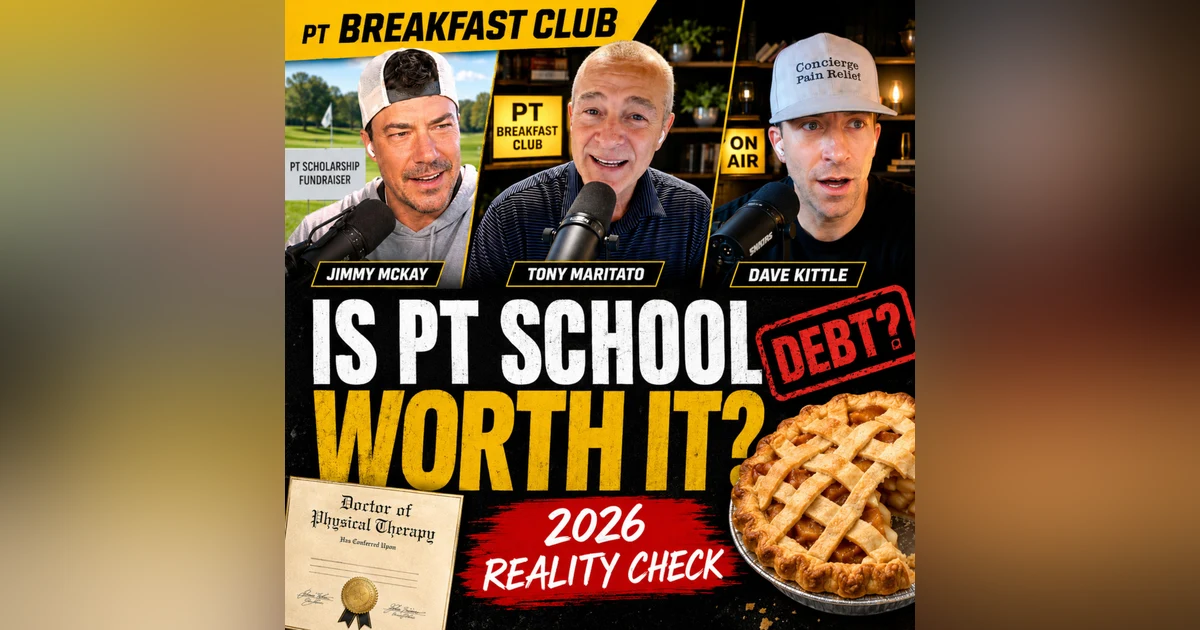



Is physical therapy school still worth it?
In this episode of PT Breakfast Club, Jimmy McKay joins from the APTA Connecticut golf fundraiser at Lyman Orchards, where every round comes with a free apple pie. That becomes the first business lesson of the morning: people remember what is worth remarking on.
Tony Maritato, Dave Kittle, and Jimmy use that idea to talk about what makes a clinic memorable, why healthcare defaults to being bland, and how practices can show their value instead of just saying they are different.
Then the crew tackles the bigger question: is becoming a physical therapist still worth it?
Jimmy says it depends. Dave says yes, if you choose the right school, manage debt, and understand the opportunities available. Tony says the degree is an asset, but only if you use it in today’s world instead of trying to practice like it is 2002.
The conversation also covers Dave’s new video strategy in New York City, recording patient care with consent, using anonymized patient stories, AI in PT education, and how future DPT students should be using AI as a study partner.
Then Dave shares a $652 refrigerator repair story that turns into a surprisingly useful PT business lesson about urgency, diagnostic fees, same-day service, customer education, and selling access to expertise.
The takeaway: physical therapy is still worth it, but the old story is dead. The opportunity is still there for people willing to be modern, visible, creative, and clear about the value they provide.
<p>This episode is part of the <a href="/physical-therapy-business-podcast">Physical Therapy Business Podcast</a>, where physical therapists and clinic owners learn how to get more patients, improve operations, and grow their clinic without relying only on referrals.</p>
<p>Looking for more episodes? Explore the full <a href="/physical-therapy-business-podcast">Physical Therapy Business Podcast</a> for real-world strategies on physical therapy marketing, patient acquisition, and clinic growth.</p>
0:03 broadcasting way too early from three separate wi-fi connections it's pt breakfast club with tony maritato dave kittle and jimmy mckay all right we are live and jimmy is on location so jimmy tell us where you are and what you were doing I'm, you know, we're playing some golf today. It's what you do in the Northeast in the summer. We got a small window of good weather. So APTA, a lot of these state chapters do it. APTA Connecticut is having a tournament, a little fundraiser for their legislative efforts. And they inflated me out to gently heckle is what I'm going to do.
0:49 I'm not playing today. I'm just going to roam the course and sort of gently heckle the seventy five or so golfers they got out here on the course today. The course is called Lyman Orchard. And you're going to love the marketing gimmick. Yeah. So it's built for the same family. I don't know the backstory, but. It's built next to an apple orchard. So if you play a round of golf, you walk out with a free apple pie. Oh, very nice. If that just it doesn't make any sense. There's no connection, but there is a connection with the course. So now there's a story. And who doesn't want a free apple pie? It's a tiny little single serving apple pies.
1:31 I found out about it when I was coming to the course, when I was coming to the tournament. I mentioned it to a buddy who does not live in the state of Connecticut. And I said, I'm going to this tournament and they serve apples. He goes, lime and orchards? Those pies are fantastic. So there's the thing. This is a buddy who's played hundreds of golf courses. So I don't know. Maybe if you come in and you get treatment, you walk out with an apple pie from your PT clinic. I'm not saying that's the connection, but I'm saying there needs to be something there. I love it. That's awesome. I thought you were going to say you get like a free bushel of apples, but apple pie is a thousand times better. Hey, listen, if you come out on the driving range and you get a bucket of balls, you buy five buckets of balls, you get a bucket of apples on the way out. That's how it works.
2:12 Now, I know you've asked me, but I forget. Are you a golfer? Can you play? I can play. I'm not bad. I don't play often and it shows. Let's put it that way. You know my brain and my attention span. If golf were like eleven and a half holes, I'd play more often. Every single person says that. Nobody's ever built an eleven or twelve hole golf course. As soon as we hit the turn, I'm so excited because I'm like, grab a hot dog, get a beer, grab a water at the nine hole turn. I'm like, this is great. And then I turn, I'm like, we got to do the same number of holes again. But you got some people like my buddy who'll play thirty six holes and never think twice.
2:55 I can't do it. But I play twelve holes. before i get dave here um so yes yes no sunday this sunday this sunday marks like the family palooza every summer so the first event in this family palooza and for the record people who don't know my wife comes from a huge family she's one of fourteen siblings i'm an only child on my side so every july A bunch of out of towners come in. And basically, every family sponsors an event. So Sunday was a big family golf scramble. We had twenty five, thirty people. We broke up into teams of four.
3:39 I, you know, I'm the lowest on my foursome, but they divide up all the teams. This is like a highly organized, sophisticated operation. So you get an A player, B player, C player, D player. I'm the D player. But we had an amazing time. It was so much fun. But every single person was like, twelve holes is the perfect amount. Leave them wanting more. Today, they're canoeing and kayaking. Yesterday was a huge pickleball day. all day event at the Pickleball Courts in Middletown. I think tomorrow is Kings Island, which is like a huge amusement park. We've got the fishing tournament on Friday.
4:20 We've got the Fourth of July at one of the brother in law's houses. Every single day is organized on a rainy day. We throw in bowling. It is the most incredible family like week and a half ever. My kids have been doing it their whole life. So Dave, jump into the conversation. Jimmy is on the golf course in Connecticut with APTA right now. Yeah, I know you mentioned the big Meritato extravaganza. This is the one where there's like a family race, right? And you got family members running. Yeah. We'll do the five K on fourth of July morning.
5:00 Most of the adults are running like five and a half to seven minute miles. Not me, but I will be out there. I'll be supporting. So. And now this, this is family only or married in family, but this, this is, there's no friends. It's just family. No friends, no girlfriends, family, like in-laws and outlaws. All right, because I was going to ask, like, how many years do we need to do this show until Jimmy and I get an invite? But it sounds like we're not married. We have to marry a customer. That's right. You have not made the list. Got to marry in, man. Gee, it's the only way. Every event's like forty, fifty people. There's just not room. I understand. All good.
5:43 All right, so Jimmy, since you are APTA sponsored this morning, what are some of the big topics? And I want to talk about a couple because I've been seeing on social media, before we started the show, we were talking about loans. APTA is trying to get physical therapists added as a profession to increase loan limits. Not a huge increase. I've been seeing all over TikTok therapists, and I want you guys to answer this question. Is becoming a physical therapist worth it? Separate from the loan issue, whether APTA gets physical therapy added to the professional status and increase the limit on federal loan, which I'm not a proponent of.
6:33 The question is, Jimmy, first, is it worth becoming a physical therapist, you know, going into school today, coming out in two thousand eight, two thousand nine? uh i'm gonna i'm gonna drop a a fully pt answer it depends if you understand what you're going into um it's fantastic for some people which is which is why the comment section of many of these discussions you have people pat talking just absolutely past each other one person's talking on logic and they're right and the other person is talking on emotion and they're thing that gets you out of bed in the mornings, you can absolutely make a living and be thrilled by it.
7:17 If you like doing it, and if this is the business you want to be in, right? I mean, I still think we should go back and take a look at all of our parting shots. I'm pretty sure I just recycled the same three, but know what business you're in. If you love this, if this is something you'd love to do, it's a great investment. If you're looking at it that you're going to write a check, go to school for three years, and then come out and sit on a conveyor belt and just be brought forward and just progress and progress and make more and more money without having to do anything more you will be greatly disappointed so is it worth it it depends dave all right i will give you one side of the fence yes it is worth it i was just interviewing and speaking with one of my staff physical therapists the new the newest one that's uh about a month in and he happened to go to toro university or toro college here in brooklyn and it was basically like Like a third or two thirds cheaper.
8:15 So like his student loan repayments were, you know, two thirds less every month. So the answer is yes, because there's still options around. There's still options out there where you could be in state. You could stay local. You don't have to run up the student loan debt. And then once you're in the profession, it's something that a lot of not everyone, but a lot of staff physical therapists love it. They like it. They love it. They enjoy it. They look forward to going to work. They're helping people. They're making an impact. Also, I've talked on the show that you then, you then learn a whole bunch of information that you can help for yourself. You can help your family members, whether it's Tony triaging a family member, like, Hey, don't worry. It's not that big of a deal, whatever. Uh, just giving people certainty and confidence about their movement.
8:56 And there, there's so much of the complaints online about capped, uh, capped salaries, capped hourly rates, all that. And that's like, there is truth to it. I don't want to dismay. Um, I don't want to disregard it, but there's also practice owners that are making really good money and obviously here in New York city too, like working for me, but also, also my competitors, my, my buddies, we, we sit down and I mean, there there's, there's practice owners taking home, you know, after after taxes, right? So like, like, obviously, you have to build a team. And that takes a while. And that takes a lot of effort. And that's not for everyone even to go into physical therapy.
9:38 But there's so many different avenues that you where you can make an impact. You can make good money. You have to find it, though. That's the thing. It's like you have to you have to be proactive. I agree with Jimmy. Like if you just want to sit on a conveyor belt and you just think all the stuff is going to be brought to you, you're going to be in for a rude awakening. But I think that's that's the same as anything else. Like if you're going to go into school to be an accountant, like there's a ton of accountants that leave the world of accountancy. There's a there's lawyers that there's lawyers that leave law because they hate it. They get burned out, whatever. Um, you know, you can go to work for Kirkland and Ellis and your first year or two out of school, you're going to make two hundred and thirty grand or something per year. But they're going to over they're going to overdrive you to the point that they don't they're just you know using you for billable hours and you're going to work evenings and weekends and all that and you thought it was great that you thought the number was great just like my buddy my buddy's coming out of school in from my university pharmacy and they're like oh man we could make you know we got to sign this ten-year contract and we can make a hundred and ten grand out of school and guess what none of them are working for cvs walgreens raid aid anymore They're working in compound pharmacies or hospitals or specialty places.
10:49 So every single degree or profession will have the people that come online and say, this is the worst thing ever. And then a lot of the people are so busy making an impact and succeeding that they're not sharing the positives because they're They are growing a team. They're doing all this other stuff. They're expanding what they're doing. I mean, I wish there were more. I wish there were more people online that I know personally where I've either seen their bank accounts, I've seen their P&Ls, I've seen what they're doing, I've seen the behind the scenes of what they're doing and creating...
11:30 a ton of momentum in the profession, even if it's self pay. So anyway, that's my side of the fence, which is, yes, it's still worth it. But there is the downside in every single profession or choice doesn't matter what you choose plumbing, HVAC, legal accountancy, whatever it is. Yeah. Yeah. You can make a million dollars as an HVAC person. Do you like crawling in attics? Like, do you enjoy troubleshooting mechanical things? Is that a thing that your brain does? Because if it's not, every day will suck. But you have a lot of money. Well, not if your business doesn't go sideways or you get fired. So none of this is guaranteed.
12:11 Yeah, and I'm in the same camp. It depends on what you do with the degree. It depends on what you do with the letters after your name. It's one of those deals where we need to take accountability for the decisions we make. I can go spend a ton of money on something that sits in my closet, or I can use whatever the tool is that I just bought. I'm trying to pull it up, but I can't get to it. There was a Instagram channel where a guy created a personal training studio. I shared it on my personal profile, I think on Facebook. It was amazing. Like this guy had all this comic book stuff.
12:52 Now I'm not a comic guy, but it was Marvel characters and like Spider-Man dumbbells and everything was wrapped with comic book stuff. There are so many different cool things out there. that if you want to be a physical therapist in two thousand twenty eight, but act like it's two thousand eight, you're never going to succeed. You can't be a twenty year, you know, a therapist twenty years ago. You have to be a therapist today. You have to include media. You have to include creativity. You have to be willing to step out of the conventional model of third party reimbursement if you want to do something better than the standard of care.
13:34 So if you which many of the people I knew back in the day were like, I can always get a job. Yes, this is true. Steady salary. Nobody gets fired unless you're like, you know, doing horrible things to your patients. Yeah, like that part exists, but that's also the bottom ten, fifteen percent. You're going to make the least amount of money. You're going to be expected to do the most amount of work. if you want to take the profession and the credential and move to six figure salaries you have to do something modern something unique something new with it so it can be worth it hundred percent and i don't care if the government wants to loan you money uh up to two hundred thousand or whatever the professional limit is it doesn't matter Because you're talking about something that potentially is going to generate six figures, you know, low six figures a year.
14:31 And then, of course, like Dave said, if you want to step out of the patient care clinical role and step into the business side of it, there's no limit to what you can make. You know, so it just depends on what you do with the asset you're purchasing. But make no mistake, you're purchasing an asset. I bought a license. I bought the license to bill insurance. That's not necessarily as valuable as it used to be, but then I also got the information and the education along with the license. Correct. Yeah, people have a difficult time separating it because I think some people bought a degree years ago, but they I don't want to hear that.
15:16 You bought a story. The story was told by a recruiter that you will do this. Your day will look like this. Your salary will look like this and your life will look like this. And they got there and they're like, but now I want something different. And that's difficult to hear. And that's difficult to see. Yeah. It's all Marvel themed. This guy's whole things. He's got dumbbells with Captain America logos on them. He's got a, you know, a Spider-Man. Oh, he's got three. He's got a cold tub, a hot tub. But this is what this guy loves. Is this a gym? Yeah, it's like a personal training studio from what I understood. He's got all the equipment, the lifting platforms, the dumbbells, the passive modalities.
15:59 I don't think he's a physical therapist. I think it's just a fitness center. But it's cool. I mean, this is something unique. If he had just made this like, you know, Spider-Man colors, it would have been neat. This guy shows that you have to sort of go all in. Now, he like, you know, we mentioned earlier the golf course that I'm at. If you play around a golf, you get a free you get a free apple pie. Doesn't make any sense. Like the market doesn't make any sense. But they're connected to an orchard. So the family probably had a lot of land and was like, we're going to take some of it and turn it into a golf course. Let's connect these two things. And then a buddy from two states away still knows it. So that guy is going â he is, as Seth Godin would say, remarkable.
16:41 There's a lot of gyms out there with a lot of heavy stuff. I've been in a bunch. I don't know how many I make a remark about. But the golf course that gives away apple pies doesn't make any sense. And once you taste them, you're like, oh, my God, these are great, worthy of making a remark about. Healthcare loves to be mayonnaise, though, right? I mean, are there other people doing, you know, things? I mean, like, you know, like people like Josh Funk and Rehab to Perform go out of their way to not just do something remarkable, but to show the remarkability over and over again. In the last few weeks, Dave has been on the street in New York City with people with nice shirts talking about outcome.
17:23 But I'm picking up on that. Like, you guys are on the Upper East Side. I can tell why. I don't know. It looks like Sex and the City backdrop. But that's what you're showing. Don't tell me you're concierge this. Don't tell me. Don't tell me. Show me. Show me and I'll believe you. Tell me and maybe. Dave, how's the new video stuff going for you? Good. My new therapist, Ethan, had played some baseball in college and some, you know, after college type, you know, men's league stuff. So he's been pushing me to have a catch in Central Park. And I'm like, dude, like we're busy and we're onboarding you and you still got stuff to learn. And we are so ripped, you know, but I was also like, actually, you know what?
18:05 Like this is a good time because soon you're going to be so busy that like you can't, you know, during the day. So we went out and had a catch in central park last week. I brought my new, I don't have it here. I brought my new extender tripod. That's like six feet tall. I put my phone on it. Like I put my phone on it, like right, like right here. we each have a lapel mic and he's ninety feet away. We're having a catch. And I'm like talking to the camera. But you can obviously hear both of us really well. So we're having a catch. And I'm just talking to him like, hey, how do you think it's possible to live a comfortable life as a staff physical therapist in New York City? And he's like, oh, well, it depends on where you live and it depends on how much student loans and how much you spend in general.
18:46 So we're talking about city stuff. We're talking about city restaurants, um, not just clinical stuff. I did it also. We're doing more video inside the clinic, inside like the treatment room and on the table. And he'll, he'll like anonymously tell me about like one of his new evals and like, Oh, I thought it was this, but it was really this. And this guy came in with leg pain, but, and he was convinced it was, you know, hamstring tendinopathy, but really it was, uh, it was actually like a positive slump test. And it was actually like a peripheral nerve or a, or herniated disc, right? So we just talk about like anonymous case studies like that. And also on the sidewalk, like you said. So we're just mixing everything in and I'm just trying to record as much as possible.
19:28 We're getting patients, his patients to consent to video during their treatment, which like that, I feel like that is almost like the holy grail of social media. Like because- yeah i mean obviously some people don't want it and our our ideal client doesn't want video typically done in their home for house calls but if in the clinic it's like you know there's like other people around or whatever and you know some people are okay with it So then I got, I got Ethan with the lapel mic soon. I'm going to have, I want to have the patient also with the other lapel mic with their consent. And then that way we can hear them kind of go back and forth.
20:08 And Ethan does a great job with like explaining like the drill or the exercise. And then like the patient starts it and then perform it. So we're just, we're just doing all the different types of content. Jimmy, if you need to jump off or whatever, do what you need to do. Just rubbing elbows. Eric Fulmar, former APTA Massachusetts president, coming over to the dark side in Connecticut. I think the more that you show, you know what, Dave? If you couldn't get one patient to consent to be on camera, then I think you mix what Will Boyd does, which is he doesn't tell anybody's name that he's working with. He says, I'm working with a construction company doing three million a year.
20:52 That becomes your character. Do you know what I mean? Like, wouldn't it be great if every time Dave steps out like a really great, like, like, you know, entryway of a great building. Hey, just got done treating some, you know, fifty three year old guy was bummed. He couldn't get back on the links, but now he's driving at two fifty. And that's great. You never have to show them. Just show them where they live. You can assume what that guy looks like. You don't need his permission. Make some of them up. right I mean think of some patients you had thirty years ago but I tell you what I think you have the ideal scenario right now like if my wife would let me get her on camera I would be the therapist or vice versa she won't do it you are willing to be the patient you're you're holding the camera you're the patient and Your therapist is doing the explanation.
21:45 You don't even need to have other actual patients. You fit the demographic. I don't think you're that far from who the ideal client is. I think just those videos which you've done before I think those would perform really well. And I would experiment with different ways to do that. Either the phone on the selfie stick where it's out in front of you. You're close to the camera. The therapist is behind you. You're both mic'd up and kind of talking about what he's doing. I think you've done it with your wife maybe, but that is good enough. Like that is a great scenario for you to keep making those videos and they're easy to make.
22:30 Right on. All right, so we're going back. I'm going to go play some golf. What's that? I got to jump off and go play some golf. We're going to tee off. But I would say my parting shot would be it's worth it. Know what business you're in. Understand what business you're in. And then it's worth it to you or not to you. But it can't be an everybody question. All right, guys, we'll talk to you soon. Enjoy. All right, so before you jumped on, we were talking about some APTA stuff and just general professional topics. There is a therapist who I've interacted with a little bit on TikTok.
23:12 I can't get his name right now, but we were talking about AI coming into patient care. Obviously, there are all the efficiencies on documentation and billing and insurance verification, stuff like that. My thing, and I'm curious, you as a young dad, as a new young dad, I said AI needs to be a bigger part of the PT curriculum. They should be developing AI tools to help DPT candidates, DPT students learn better, learn faster, improve the scope of information.
23:53 And thankfully, the person that I was talking to agreed. Now, he said within academics, there's a lot of professors who are completely against AI. There are professors who are proponents of AI. But I just couldn't imagine being a PT student today, not having my own personal AI chat, who I could do case studies with, I could do twenty questions with, practice evals with, clinical scenarios with. What are your thoughts? Because obviously your son's going to grow up in an AI world. What are you guys seeing with that?
24:34 Well, even before he was born, my wife and I, we were already very focused and on the same page of minimizing any screen time. So, The only thing he does on a screen is at the end of speaking to a family member on FaceTime video calls is he wants to come and he wants to press the X to hang it up. That is literally the only time he has ever touched a screen. He doesn't know how to really, he doesn't know how to swipe. Uh, you know, you've seen videos of like, you know, three months or six month olds where like they somehow figure out how to do a swipe on like an iPad or something. Um, we're very focused on avoiding the tech integration, if that makes sense.
25:19 Now in the future, yeah. When it becomes part of school or whatever, I think there could be benefit on how to leverage it, like how to you know, almost get like a, like a class or a tutorial in AI in terms of like what a student would use it for, for like research purposes and how to find research articles or how to, I don't know, like, I guess how they'll use it for book reports instead of like the old school way that we did book reports. I don't know. I don't know. Like what else? Um, second graders, fourth graders are, are using AI. Is that what your, your, your line of thought on that? The point of school is, teach me how to learn, right?
26:02 I'm a student in school, whether it's second grade or twelfth grade. Teach me how to learn. Teach me how to find the research. Teach me how to ask the critical questions. I think we all agree, there isn't a single human that's like, no, give me the information, spoon feed me so I never have to learn anything. We all want to be lifelong learners, but the human educator in front of a class only has so much time, only has so much energy, only has so many resources. So you take AI, you make that machine teach you how to learn, I think that's where we're missing each other in this conversation because you've got the people against it who are concerned about environmental impact.
26:51 They're concerned about all this other stuff. They're working against data centers. They're working against the infrastructure build out. But they also are saying, well, it's just going to make everybody dumb and give everybody the answer and nobody's going to think for themselves. I completely disregard that argument because I think it's wrong. I think anybody who understands how tools function, how tools work, understands, no, the purpose of AI isn't to give me the answer. I don't trust any answer AI gives me. It's to teach me how to think critically and ask better questions. I think you use it that way today in your business operations, in your life. it helps you analyze numbers it helps you look at different perspectives and as a dpt student in the programs right now i just every single day i'd be using it as my study mate i'd be telling it to create you know analyze the performance of this test take the questions i got wrong if i was practicing for the mpte look at the ones I got wrong, create study guides, create testing material, drill that information with me so that I don't get that wrong on the actual test.
28:03 It's what we all did when we were in school, it's just now we're using a computer to do it faster, better. um but i have not heard a single story coming out of any of the universities about how they are implementing ai to improve the quality of education improve the quality of new grads coming out and even the person who's not against it He still said, we have to research it more. We have to kind of put more time into it to figure out how we're going to use it. I'm like, by the time you figure it out, it's going to be ten iterations ahead of you. It's not going to stay where it is right now.
28:45 I can certainly see the value and the benefit because it is kind of like a new, I don't know, it's like a new frontier, right? Like this whole shift. At some point it was like, The new frontier was, I don't know, like laptops, I guess, you know, like for students and then maybe at some point tablets or smartphones or, you know, but yeah, there's never been, I guess, like an acceleration of this magnitude that can help with so many things like how to study, how to find information, how to process that information, how to take that information and then you utilize it. for students in, like you said, even like how to actually study or how to prepare, which is huge.
29:28 And your initial question was, should schools be helping students with that? Or should there be some types of like courses or framework on how to like approach it to use it as a student in like grade school or high school? A hundred percent. Yeah, embrace it, you know, It's already here, it's not going away. So let's figure out how to do it properly, ethically. I'm just looking at what other topics we had. I got something from yesterday. Well, yesterday we had a technician come over same day urgent for our refrigerator.
30:12 So our refrigerator has been just leaking water underneath. the coming out from underneath the refrigerator for probably too long, probably, probably a couple of months, probably a couple of months. And then intermittently recently, it's been making some weird noises. You know, it's almost like a, like a, like a whale noise or, you know, like, or like a dying whale noise or something like that. Like just, I'm not even gonna do the noises, but you've heard different fridge noises. Where you're like, oh, no, is the fridge dying? Is it, you know, is like the ice machine? Whatever. Something's going on. So we've kind of been putting it off. And then it started to make worse noises yesterday or the day before. And then the temperature inside the refrigerator, the freezer was still good.
30:57 The temperature inside the refrigerator was like, whoa, like this is not really cold now. And we're like cranking up the button to increase the coldness. That didn't help. So then I'm grateful for my wife because I was out yesterday. So she was looking around and like every place nearby that does like refrigerator repair, like they all have like horrible Google reviews, except for this one place that has like four point nine star reviews, like all these reviews. But some of the reviews are like this place is great. They're very prompt. But they're also expensive. And at this point, it's like, hey, we're taking food out of the freezer and the refrigerator, putting it in the coolers with ice packs.
31:41 When you're at that point, you have no leverage, which means you have to potentially buck up and pay what they're charging, which is, guess how much the hourly rate is, Tony? Now, again, I know this is New York City, but... What do you think? My best guess, my truthful guess, I'm going to say three hundred and fifty dollars an hour. Yeah. Four hundred and fifty dollars an hour. OK. Yeah. Uh, the, there was like a hundred and forty nine dollar diagnostic fee that like it, that would be subtracted from the, the, the deal. Uh, if, if you went with them, right.
32:21 And if you decided like, all right, I'm going to like go with someone else or, or not have them do like the hourly rate or whatever, then you would still have to pay a hundred forty nine dollars. Like, I guess like even if they were here for like ten or fifteen minutes or something. So obviously like they want you to do the whole, you know, have like do the whole job. Right. so the guy the technician was excellent he was explaining everything uh and he was very thorough and he basically took apart the entire refrigerator unfortunately we had to take all the shelves out we had to take everything out of the refrigerator it was a big process uh and then he was here for an hour and a half and uh it was yeah after after after selling him so if it's Zelle or Venmo, whatever, like there's still, there's still a sales tax.
33:06 I'm like, Oh God. Right. But I don't, you know, I don't have, I don't have six hundred dollars cash in my pocket. Like who does now? Nowadays. Right. So I, we sell them. It was, that was an hour and a half of the hourly rate plus tax or whatever. It was six hundred and fifty two something dollars. Um, which I, that's another thing. Like when it's Zeller Venmo, it, it's just, I mean, it feels, it feels a little bit better. Like if I'm, if I'm handing over six hundred fifty two dollars of cash, it's like, oh, that's like a gut punch. But it's like, it's Zell. So it's almost like fake money. It's like funny money. It's, I don't know, like it's, I guess it's mind of money, but it's some digits out of my bank account. Some digits go into his bank account. Um, but the, the, the thing I wanted to mention on the show is that, um, yes is a lot of money.
33:53 Then I'm asking my wife, like how much is like a, how much, I have no idea. Like how much is a new refrigerator? Like a thousand or two? Because if this happens again, like we're already potentially two, we're potentially halfway or three quarters of the way towards the next refrigerator. Then I'm asking like, when did this, when did we get this refrigerator? Or when did you, when did you get like, was it, I don't know, twenty two thousand nine or twenty eleven or something like what? How old is this? And then if this gets all fixed, like what's the what's the longevity of this refrigerator after today? Assuming everything, you know, he had to like melt ice inside the refrigerator and there was some flap that wasn't closing and it was like the airflow. And I didn't know this, but the airflow from the freezer, that cold air is what goes up into the refrigerator.
34:36 It's like a one way or a one or a one area flow of air inside this refrigerator unit. But the reason why I wanted to mention this is because of everything I just said. But then also at the end, we're opening up the back of the refrigerator and he's like, hey, can I teach you how to change this thing? You need to change this like little silicon filter thing in the back. He goes, I'll show you the product online. It's pretty cheap online. I'm like, yeah, sure. So I record video on my phone. he opens up the back of the refrigerator. He shows me how to change this other little tube and filter. You can, I can see, he shows me it's, it's basically worn out just from wear and tear or whatever.
35:18 And for, for years. And so he's like, I'll, I'll teach you how to, I'll teach you how to do this because otherwise I would have to come back and that would be like another, you know, three hundred dollars or whatever. Like that would be like another call, another visit here. Uh, so he's like, or I could just teach you how to do it. And it's like very easy. He shows me the part online with the, with the model number, the part on, on Amazon is like, so I'm like, I'm like, great. We'll order that. Shows me how to do it. I record the video on my phone. So now I know how to do it. And then we settle up and there, anyone that's watching or listening, like I'm not making the direct correlation to physical therapy because he and our interaction is kind of like a one-off like he he the whole thing was framed around capturing as i guess as much value and as much dollars that would you know equally match uh what he did and how he did it but it's different than what we do in terms of it's almost would be like the evaluation only which sometimes tony you do and that's that's why i want to make the connection there because he's teaching me how to do this other thing to prevent me from having like a second house call you know a second appointment or whatever whereas physical therapy is obviously like obviously in our business like we never do that like we're not we're hardly ever going to be like all right that's all you need and let me teach you all the exercises you can do on your own because we know people are not going to do them anyway and um i just can't imagine doing an evaluation and then like not doing a plan of
36:50 care i think for most people at least for our clientele and or my brain that that's just how i work like I know people are going to need the accountability for the follow up and it's going to take more than just an hour and a half like it did for this guy with the refrigerator. Obviously, like we're dealing with humans and physical therapy. And in this case, this guy's just dealing with this refrigerator that he knows how to fix and it just took him an hour and a half. So yes, the six hundred fifty two dollars even in New York City is expensive. And there's just like some similarities, but obviously there's some, you know, areas that are like dissimilar from what we do. So I just wanted to throw it out there. I think we could take so many lessons away from that. And let's spend a little time kind of diving into that scenario.
37:31 So from a marketing standpoint, from a new patient relating it to physical therapy standpoint, you as the consumer, I'm in the same boat. We had a washing machine and a dryer. Something was malfunctioning on the washing machine. And I went through the same thought process as you. I'm like, all right, if I call a repair person, is it even worth it? By the time the repair person comes, There's the diagnostic fee, and then there's going to be the parts and the labor. If I'm going to be invested six hundred, seven hundred dollars, how much is a new washer and dryer? This one's already, I don't know, twelve years old. What's the life expectancy of a typical washer and dryer?
38:15 You know, if another three hundred dollars, I can get a new one and just replace the existing one. That is kind of, in my opinion, the same thing the typical physical therapy consumer goes through when they're sitting there and they're like, I've got this shoulder pain. What is physical therapy going to do? I don't even know what physical therapy does. I don't know who I'm going to see. Are they going to massage it? Are they going to exercise it? Is it going to cost me? What is it going to cost? And then if I invest that money, do I have to do more visits? Is it going to cost me more? Are they going to try and sell me on a twelve visit package? I wonder, in the product repair world, I have somebody that I know who's a plumber.
39:02 They have a huge plumbing business. They do more than ten million a year in revenue. And I'm like, guys, why don't you just set up the ability for one of your plumbers to Zoom in, like literally Zoom, FaceTime, video. I think we talked about this a long time ago. Like, let me pay a fee, seventy nine dollars. Your technician guy can be at their own home. I'll get my phone, I'll go to my washing machine, I'll show him what I'm doing, what I'm looking at, or I'll go to my sink or whatever. And like, maybe it's a simple fix. Maybe your guy is gonna be like, oh, you just need this gasket, go to Home Depot, buy this specific product, unscrew that bolt, and it'll be fixed for twenty bucks.
39:49 Right. They get the fee. They never have to leave their home or the office because he was saying we have to have people on call. I have to pay my plumbers to be available twenty four hours a day, seven days a week. The plumbers, he said, would love it. They never rolled this out, but I'm just saying this goes back to the concept we talked about, low barrier to entry. Somebody has a nine-year-old kid on the soccer field at nine thirty at night. Kid sprains an ankle. They don't know, do I go to urgent care? Do I go to the emergency room? What are the odds that something is fractured? They pull a therapist up, FaceTime.
40:31 You go through your questions, you go through all of that. And then the thing with that interaction, you get paid for the interaction. The client saves time, money, hassle, fear, anxiety, all of that stuff. But now you just recorded a video of a real world interaction that is going to be the same exact interaction hundreds or thousands of other people in the future are going to go through. And so why do I need to have a human diagnose the same problem every single time as opposed to just letting the consumer buy access to that video interaction It works for physical therapy.
41:13 It works for plumbing. You know, when I go to YouTube and I'm like, hey, this is the code that my washing machine is showing me. YouTube has a series of videos that allows me for free to see maybe that's the problem. And how did they solve that problem? You just take it a couple of steps down the line. I think physical therapists should be doing this. I think every single evaluation should be documented. It should be shared. I think we would help on a public health basis, but then we would increase the understanding of the consumer. Well, what's physical therapy going to do? What can I expect?
41:54 Is it worth the money that they want to charge? Because right now, it's a black box. The consumer has no idea walking into the scenario what's going to happen. And we're trying to sell, whether it's insurance or private pay. Something that nobody even knows what they're buying until they get I Love it. I've even been considering Us charging more for private Visits like meaning the traditional way of like it's just the therapist and the patient regardless of whether it's the home visit or the office visit and then having it almost like forty or fifty percent cheaper than if they consent to every single visit is recorded, like whether it's clips and the therapist is kind of like, you know, doing the video or if I'm there and I'm recording clips kind of like the whole time.
42:45 So that way, like we wouldn't even have to ask like, Hey, is it cool if we do some video, whatever, like there, it would be choosing like the completely private traditional option, which is like the physical therapist is there. And especially a home visit, like it just, the therapist and the patient, which, Obviously, some of my patients will still want and they will probably pay higher to not have it recorded like they want that much discretion and privacy and confidentiality. And that's fine. But then we want video assets. Right. And I'm really, really trying and pushing hard for it right now. So Then the patient is incentivized to then pay less. They get to benefit by paying less.
43:27 If they're like, ah, yeah, whatever. Like, yeah, of course you can. Yeah, you can record it, whatever. Like, no problem. So then we still get income, maybe not the full amount of the private experience, but we still get some revenue, still cover our overhead and everything. and capture video assets, then easily I could have the patient or client wearing a lapel mic and the therapist wearing the other lapel mic. Then I can capture all the audio regardless of, where they are in the clinic or whatever, and kind of getting my camera, my phone, if I'm there, in the patient's kind of face and in their way. And they'll be so comfortable doing it.
44:09 They'll be so comfortable with me being in their space, whatever, because they already chose the lower cost option that includes the video recording. And if that was an issue, then they would have chose the higher option cost to not have it recorded at all. And then we'll know very clearly like who's okay with it and who's not. And whatever they pay kind of goes with those options. It makes total sense. I know it's really small on the screen. Um, but just the reason why the consumer is paying a higher rate not to record is because not recording costs you the producer money.
44:52 And on the screen, you know, I can't necessarily zoom in, but I'll run through some numbers. This eleven minute, forty three second video of me answering a question, why your knee won't bend, why your knee won't bend after a knee replacement. It was recorded and published February twenty eight, two thousand twenty three. So not even that long ago, three years ago, a little over three years ago. It's generated two thousand five hundred dollars. It was a single recording, no editing, just me answering a typical question that a patient would ask me during a patient engagement. Ten minutes, two thousand five hundred dollars.
45:33 This one talking about the timeline for recovery after knee replacement, eight minutes, two thousand five hundred dollars. Talking about sleeping positions after knee replacement, twenty one hundred dollars. Showing a patient, like recording me with a patient getting off the floor using a lift chair, two thousand dollars. You know, multiple examples of the instance in time that was recorded, I didn't do anything different, I didn't do anything special, that continues to generate a return on that investment. So if somebody wanted to buy that hour of my life and tell me I am not allowed to monetize it in any other way, potentially they should be paying for the right to take that time and that money away from me you know that that it's a basic trade basic value exchange there um and i just i i keep saying it i don't understand why more people more therapists either aren't doing it or don't see it that way um And then of course, that's not even talking about turning these into digital assets that you can sell.
46:49 That's just monetized with YouTube ads. You know, you take an evaluation, your typical evaluation for low back pain, and somebody who doesn't have time to go get an evaluation for low back pain but reads the description that says, oh man, that sounds exactly like what I'm dealing with. I have pain when I'm standing upright, but I can push a grocery cart for forty minutes. I can't stand unsupported for five minutes. I'm dragging my feet. I don't stand up tall. It hurts me to extend. It feels better when I flex." You can describe spinal stenosis to a T right out of the textbook, and somebody reads that description and is like, that is exactly what I'm dealing with.
47:36 I want to see how a therapist evaluates and creates a plan of care for that condition. That's huge value. Somebody, absolutely. Plenty of people would buy that because they don't have time to see a therapist. They don't want Dave to come out to their house. They don't want to do the stuff that, you know, you would typically have to do. So how would someone, you're saying put this behind a paywall? How would someone do this easily? The easiest way to do it, truthfully, is you start building your social media presence. You start sharing the videos, clips that show bits and pieces of it just to kind of pique attention.
48:17 Then you put a call to action out there. Hey, comment stenosis, comment back pain, comment whatever. They comment, you send them the like little introduction of these are the symptoms commonly associated with this condition. If you need more information, you know, like that's the free guide. Take this, go to your doctor, talk to them about what you think you might have. If you want to see how I would treat this or evaluate this with a real patient dealing with these real symptoms, this is the video, you know, ninety nine dollars or fifty nine dollars or whatever it's going to be.
49:01 They pay, you have an automation set up. So once the payment goes through, you just shoot them out an unlisted video link. If you don't want to pay for platforms and all the other stuff, like unlisted YouTube video link of that, who cares if they share it? Who cares what they do with it? There's going to be enough unique people. that are gonna buy that information just to get that fly on the wall perspective. You're not treating them. You're not telling them what to do. You are letting them see in a safe environment what a therapist does with someone else who's dealing with the same symptoms.
49:43 I love it. Can I just make a comment back on that Marvel gym that you posted the screenshot or the video? um as we wrap up so i was thinking about it and i think it's a horrible idea why because again now here's the thing the the the owner the the founder of this could have more intel than i do and he's probably thinking well he he has to be thinking I'm hoping because that looks like a lot of money. Yeah, that looks like a lot. It looks like a lot of money. And I could be risky. The reason what I'm saying is, does that guy? Does that guy know that in hit?
50:26 This was where California? Do you remember the state? Does it matter? I thought it was New York. This guy better know that. there are a ton of fans of marvel nearby because if not it'll it'll be a failure because people who don't want or don't care about marvel will have no incentive to go pay to be a member there so i hope he has intel that there's like some crazy amount i don't know maybe there's like um there's groups nearby that they go and see Marvel movies together, like almost like run clubs, but it's like Marvel movie clubs and they, they do Marvel movie showings and, and they attract dozens or hundreds of people or something, or he's, he must, I hope he's got some, better understanding than I do.
51:19 Cause I'm just making an assumption. I think it's, I think it's actually a horrible idea because imagine nearby there's, there's a crunch or there's planet fitness and there's lifetime and there's all these gyms nearby, wherever this guy's located. And there might even be Marvel fans at those gyms. Tony, this guy would have to hopefully influence those people to leave those gyms to go to his gym or, and, or, attract people who currently are not already going to a gym and want to pick and choose like this. Where should I go work out? Most people are going to pick like I work out at home, home gym, or what else? People pick a local gym based off of price or location, maybe the aesthetics.
52:03 You better hope they're picking for your Marvel aesthetics. But now you have to be charging way more because you're probably going to attract less people. So it's like, I just think that I mean, this guy probably knows more than I do about his ideal client customer avatar that is obsessed with Marvel. And so I would be curious. I think my gut tells me this is a terrible idea. I mean, it's like making my clinic in New York City like a Philadelphia Eagles physical therapy clinic, right? So I will attract some Eagle fans that are going to be like raving fans that are going to want to come to my Philadelphia Eagles physical therapy clinic. but it also could turn off a lot of other people that just don't want that type of an aesthetic.
52:46 They don't care about a Philadelphia Eagles physical therapy clinic. Right. So like in Philly, it would do well, maybe, but in New York, that same clinic will probably not do as well. So like, why would I redesign it differently at the same time? I hope, like I said, I hope this guy knows more than me because maybe he's doing like a Savannah bananas. He's doing something like so remarkable, different off the wall and, like maybe he'll attract people that are like, like one and two and three degrees away from Marvel, right? Like the DC comic fans and comic book fans. And I don't know, star Trekkie fan, I don't know, all that type of stuff. Like maybe, maybe. So I would be curious if we're still doing the show in a couple of years and we look back and we pull up this guy's business.
53:32 Is he still in business in two or three or four years from now? If you had to, if I had to, if I had to say it, I would say no, but he could also be like crazy growing with like multiple Marvel gyms in four years from now. So I could be wrong. I don't know. And this will be the parting shot. I think the reality is he's going to lose tons of money. He would have invested this money in building this gym regardless of ever monetizing it. I think he's hoping that it's crazy enough that he can build his Instagram channel just on the visual aesthetic. I wouldn't be surprised if he never trains a client, if he never sells a membership.
54:15 But it's just like the dad who buys a boat, who goes out twice a year. It'd be better to rent the boat than to buy it. You know, there's plenty of us who waste boatloads of money on passion projects that never take off. The closest success I think he can have is just on social media and monetizing it with that, brand deals and things. Because even if he tried to grow it, you can't license. I don't know how the licensing would work for all of that branding on something that he's selling memberships to. I don't know. That's beyond my knowledge base. So parting shot, I would just say, We all lose money intentionally, voluntarily on the stuff that we're passionate about.
55:07 I think that's a money losing proposition for him, but it's worth looking at on social media. For the rest of us who need to actually support a family, put money in the bank, save for retirement, I think like we said today, is physical therapy still worth it? one million percent as long as you're not delusional and think we live in two thousand two thousand one two thousand two time frame as long as you realize we live in two thousand twenty six you need to come into the profession with the expectation that what worked twenty years ago will not work today yes it's still worth it what's your parting shot Parting shot, I'll go with this Marvel comic gym.
55:53 So this guy, Brandon, on Instagram, his account says, I design themed home gyms and licensed character kettlebells. So there you go. He made this to sell that stuff. He's not making it to attract paying members. So I apologize. I didn't understand the full story. He's doing this on social media, like you said, to get in front of people that have... uh, discretionary money that want a crazy home gym like this. And they can, he'll use the Instagram and the visual and all that to show what's possible for crazy avid fans of whatever. And then, then he or his team or whatever would then do the, the themed home gyms.
56:35 I'm fine with just like my unfinished garage as my home gym. But you know, if you, if you got, I get, I hope I'm, I don't know. I'm, I'm sure I'll be, um, I'll be flushed with money at some point where I'm going to want some crazy themed home gym and maybe I'll come back and I'll, I'll pay this guy, Brandon. And then he can say that I was wrong when I talked about his business on, uh, on the show. All right, guys, that's a show. Come join us Tuesday, Thursday mornings, eight thirty, uh, a.m. Eastern. Dave, thanks for joining me. Thank you guys. That's it. We're out. Boys, what the hell are you doing? Follow Tony Maritato on YouTube at Total Therapy Solution. Find Dave Kittle at conciergepainrelief.com and on YouTube at The Dave Kittle Show.
57:19 And follow Jimmy McKay at PT Podcasts on YouTube, the socials, and wherever you binge podcasts you pretend are for CEUs.