Tech-Enabled Rehab: Scaling Quality PT Access with Ryan Eder
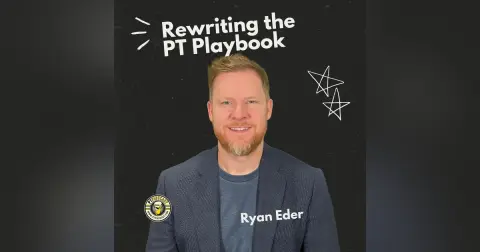


Episode Title: Ryan Eder: Virtual PT With Real Outcomes
Guest: Ryan Eder, Founder – Laina Health
What You’ll Learn:
- Why healthcare leaders care about completion rates and engagement
- How virtual PT at Laina Health is outperforming traditional care
- What every PT student should know about the next decade of care delivery
- How to talk to systems, payers, and investors in their language
???? Metrics That Matter:
- 60% completion vs national avg of 30%
- 68% pain reduction across thousands of cases
- $450 avg cost per episode = up to 70% savings
- Near-zero wait time for evals
???? Parting Shot:
“Let’s stop protecting the past and start preparing for the future.”
<p>This episode is part of the <a href="/physical-therapy-business-podcast">Physical Therapy Business Podcast</a>, where physical therapists and clinic owners learn how to get more patients, improve operations, and grow their clinic without relying only on referrals.</p>
<p>Looking for more episodes? Explore the full <a href="/physical-therapy-business-podcast">Physical Therapy Business Podcast</a> for real-world strategies on physical therapy marketing, patient acquisition, and clinic growth.</p>
0:00 You're listening to the PT Pinecast, where smart people in healthcare come to make noise. Here's your host, Jimmy McKay. All right. Before we kick off, I want to say thanks to Brooks Institute of Higher Learning, brooksihl.org. If you want to do a residency, a fellowship, pediatrics, geriatrics, neuro, pelvic health, orthopedics. They have like six more. I'm sorry. I don't have the notes in front of me. They've been in support of the show for like three years. They have a lot of them. Essentially, if you want to make sure you are better prepared, do a residency and a fellowship and get paid while you're doing it, brooksihl.org. Plus, it's in Florida. And right now in the dead of winter, Florida doesn't sound that bad.
0:41 So visit them online at brooksihl.org. Ryan's back on the show. Ryan, welcome back. You started as an internationally awarded designer. Did I know that last time that you were a designer? Yeah, my background, I went to school for design. No, I knew that. I knew that. Yeah, but like what kind of design? It's like intricate design. It's called industrial design, but it's not like industrial facilities. It's products. So like I worked for a design agency like golf clubs and medical equipment. That's what it was. That kind of stuff, yeah. Yeah. So a buddy of mine lives in one of those like bougie apartments and they have like a movie theater and a gym and they have one of those golf simulator rooms you can just rent. And I'm in there, you know, and I'm hitting the ball on the screen and watching it go into the water, even on the screen.
1:25 And my buddy just turns to me and goes like, dude, like how old are those clubs? And I'm like, oh, I don't know. I'm in nineteen ninety six when I was in high school. And he's like, my man, do you know the size of your target zone or whatever the term is? Like, how do you hit those? I'm like, my man, I play golf two times a year. I mean, so like I could tell you all the engineering behind getting the maximum moment of inertia and all this stuff. It does not matter unless you have a consistent swing. Correct. Otherwise, it's just a gamble every time you swing it. So. Oh, that is a great way of naming my golf game. A gamble every time I swing it. I'm going to say that every day. I'm out here for a good time, not a long time. That's what I do on the golf course.
2:07 All right. So now what are you doing? Now you're building AI tools that... Last time we talked, you introduced me to this thing called computer vision, which feels like not long ago, but I feel like... kind of feels like long ago but wasn't that long ago yeah so like I mean yeah right so like the kind of evolution here is that you know we actually how we got our start. So kind of think like medical grade tonal, if you will, that we installed clinics. All right. And then in nineteen, we did a partnership with Cincinnati Children's in Ohio and got us into computer vision. COVID hits. We decided to shut down the machine side of the business entirely and go all in on the computer vision.
2:53 and then but we wanted to be scalable so we ended up working with google for about two years helping develop their core computer vision models and then we piloted we had some sbir grants from the air force and piloted with them for about another year and then you know along came this rtm model and we're like all right we're going to deploy it towards that so that was the original plan but then uh things changed a bit as we progressed and so like we did that for a good two years Got really good results for the patients that we got enrolled, but getting in patients enrolled at the pace and scale, you know, was just brutal. It's always the problem, right? Like it's a problem in research. Hey, we got this great idea to test. We got funding. Where are the people?
3:33 How do we get the people to show up? Simple, not easy. I mean, we know all the challenges with the industry, right? And so then adding another, like essentially care model on top of that and implementing that through is tough. And, you know, you see it now, like people are predicting twenty six as the year of RTM. It's like that came out four years ago. But we haven't figured out how to make sure. We know the model. How do you make it run smoothly? That's the trick. Some have been really successful with it and, you know, others are still trying to figure it out. Right. And we were bashing our heads against the wall because, you know, we're venture backed and we're like, hey, we want to go fast. We want to go fast. This is not going fast. care navigation companies that we were supposed to be just the technology layer and working with other providers to deliver virtual care in mixed in hybrid care as well, and just could not get the adoption.
4:22 So like they approached us, which was in summer of twenty three, said, hey, we want to go faster. Will you guys consider becoming a virtual practice yourselves and treating these patients with your technology? So I said, whoa, okay. So my background's in products, right? I'm not a clinician for one, and certainly I haven't had a medical practice, but I had PTs on staff that were licensed in, I mean, over like twenty five states. Right. And so, you know what, we'll give it a try. And so in summer of twenty three, we actually brought the technology internal use and became a virtual PT practice.
5:03 And we've been doing that since. So what does that look like? What is, yeah, what is that? Like, let's get to the, like, like literally spell it out. Who, what do you do? How does it work? Okay. So first, like we work, I mean, we work with a variety of different clients. Okay. So we'll work with, you know, health plans, HMOs for health systems. We work with regional health plans, care navigation companies, or even like the virtual PT arm for health systems. OK, but the way that this works is like we're very adamant on being a pure medical model. So just right out the gate, we're not sitting here trying to use technology and displace the PT. So we're big believers of the therapeutic alliance. So, you know, and we're also not self-enrolled.
5:43 We're not going to employers and say, hey, enroll if you got to make some pains and a health coach is going to help you. Right. This is physician referral based. So we get referrals just like any other PT practice would. I mean, straight faxes coming in old school, right? But like, that's where it changes. Because then like, we then reach out to that patient via SMS, typically same day, no more than twenty four hours after referral with a self scheduling link to set up their eval. And so they schedule and then every episode starts with a forty five minute eval with a DPT on our staff. dedicated they're the only ones treating that patient and they understand exactly what's going on with them and making sure that virtual pt is appropriate for them and then once we kind of you know cross or check those boxes then we set them up with a care plan which is powered by our technology the computer vision got a whole collection of automated reminders and all and it's all web-based so it just runs on whatever the patient already has we don't have to send anything to them download anything any of those kind of like access barriers And so patients will complete their care plans on their own time, on their own device.
6:49 There's unlimited secure messaging between the PT and the patient. From a synchronous visit standpoint, it's either once or twice a month that they connect face to face. The rest is all async. And we collect a tremendous amount of data on how that patient is progressing, report that back to our partners, all while a whole month for us is typically less than the cost of a single in-person eval. Wow. And how are you able to do that? Because the RTM and because the time allotted? You think of your requirement of face-to-face time, right? That's very important and that's how we set up every episode of care, but we're not limiting access to PT based on when you can get two people face-to-face.
7:34 We are using the computer vision as essentially extension. of that and so that lets our patients which you know we treat patients from their teens to their nineties and but they're able to you know a lot of time you can't fit into the clinic schedule you can't get there your life is busy right so this is like all right i do it late at night i do it after my kids go to sleep or whatever it fits into your life and then so if you can remove kind of those logistical barriers but also if you can remove some of the economic barriers of co-pays high deductibles that kind of deal right um engagement just goes through the roof And is this being done, I get a link, I open my laptop, and now I'm told what to do, shown what to do, and then I do it, and it's being measured because of computer vision, what we talked about earlier?
8:15 Help me understand, pretend I'm an idiot, because this is where I am. Yeah, so your PT's gonna create a care plan, and it's gonna have a collection of exercises, functional tests, PROMs, PREMs, delivered at different times, right? So basically, every day you have something prescribed for you, you get kind of like a fresh link. And so it's a one-tap, tokenized link, just goes and opens the browser, you're gonna get the list of what you're gonna do, And then you just hit start and it goes through. And so like we rebranded, so we were previously include health. Last time we talked, we rebranded to lane. Elena's basically the personification of the technology. But she just guides you through. So, you know, sometimes it'll be here. We're just going to do some stretches. We're just going to do certain light activities this day. Next day, we're going to do some functional tests and get you in front of the camera.
8:57 I'm going to log your range of motion, maybe get you to do a five times at stand, that kind of deal. And then also collect your problems, you know, your regular pain and same, but then also like your joint specific ones. And so we just, we're very good at engaging with these patients. The average completed episode for us has thirty four visits in it. And it's collecting a tremendous amount of data that comes back that helps us understand how they're progressing. Right. And also shares that with the kind of the referring source that's sent to us. And with RTM, you can prove that it was done. It was done. How long was done? How well? What are the parameters? Again, people have spent like, what do I need to say that? to to to to clear the bar of rtm what is that again it's like well it's interesting because like we don't actually build under rtm we tend to build more under kind of like value-based arrangements but we do map it to rtm and rtm has engagement rates of like you know certain amount of data you need or thirty days and that kind of deal but like for us we look at i mean it goes everywhere from the very beginning so you've got a referral come in we have a thirty day window enrollment window and so we have a whole collection of ways to get them to set up their first eval And then they do their eval and then we continuously monitor like, okay, typically we ask someone to do something every day.
10:10 Spoilers, no one does something every day. This is human psychology to where if you ask them to do it, I'm going to do it five times. And they're like, okay, I did it three times. I want you to do it two times. So it's a win for everybody. Right. But then you said we have like these automated reminders that go out based off of their local time zone. And then if they didn't complete it during the day, we send another reminder in the evening. and people it's amazing it's so simple and people like patients love it because they're like oh it just keeps me accountable and keeps me on my and you're like yeah it's simple not easy yeah right right right i mean Yeah, because when we developed the platform early on during the COVID days, I had probably like forty five different devices here because I was like, all right, I need to be web based.
10:59 So it's got to run on every screen size, every browser, every operating system, different type of device. And like, where are the edges where this thing falls apart and how can we expand those further? So that took years of development to get it there. But once it's there, then it doesn't matter what you have. Yeah. You say PTs are not being replaced by tech. Other people say this is where it's similar. Yeah, but some people say PTs aren't being replaced by tech. They're being empowered by it. You say a funny twist, which is they're being exposed by it. I like that. What does that mean? Because it's different than what a lot of people are saying. It's similar, but not the same. Well, I mean, I'll frame it a little bit differently just in that, like, if you look at like the stats from the PT industry, some reports will tell you that somewhere between only twenty and thirty five percent of patients referred by a doctor.
11:52 Go get PT. You have an industry where a physician, your doc is telling you, you need this and a majority of the patients don't go. Yeah, I know. Right. So like there's a lot of framing of like, oh, technology is going to steal my patients. There's a whole population where going in clinic, going to PT works for them, works really well. Virtual can't replace that. Even right. You can keep virtual can't replace hands on manipulation. There's inclusion, exclusion criteria. You can't be delusional. But there's a whole chunk of patients that need PT and cannot access it. And so how do you use the technology to open that door further for them?
12:33 All while you still have that PT, like managing those cases, right? Like there was an analogy I heard of like a, just like pilots, like you have a co-pilot on a plane, right? But that it's not autonomous flying and there's no pilot in the plane that you can be able to have that pilot being able to do the really high cognitive load work. And then like the repetitive low tax test stuff, you're able to leverage technology to do all under your management. And like that model works. So I kind of think of us as like in between you got like traditional PT, every in clinic in person to then like the opposite end of the spectrum is just throw them on an app and self-serve, let them do your things or not have a PT involved or minimal PT.
13:15 We kind of split those up, right? You talk, you have PTs on your team. You talk to PTs. Yeah. What are the biggest myths about either AI or virtual care that keep PTs from embracing it? What are the things that you're like, hey, you hear from them and you're like, well, it's not actually like that. So you're sort of like doing some course correction. What are some of the things that come up over and over again in your world? I think people... When you mention AI, they immediately think full replacement or that it's going to be a hundred percent correct. And you're like, okay, no, it's not. And that's why you're needed, right? It's not a hundred percent correct.
13:56 But with anything, if you have one hundred percent of a job and something can get you eighty percent there and you can just focus on the last twenty percent, like you would do that. That makes sense. Access, access to chainsaws, to machines to cut down trees like this one feels more efficient, but I still need someone to do the thing. But now that person is doing the higher end thing. Right. And I think I mean, it's always easy for people to feel threatened by technology. I mean, everyone just self-preservation. It's human nature. But have i mean this is happening it's already i mean it's happening it's not coming it's here no it's here and like as just what has happened within you know the last week between gpt health and and then uh claude right like i mean it's it's here and how many people i do it myself like so i got blood work and i submitted it to gpt i was like what the hell does all this mean right and then and then i had my pcp meeting and i'm like sure enough that's exactly what it was Okay.
14:55 Now you still want to have, like, it's good to give you information. You still want to validate that information, but it gets you closer to that source of truth quicker. How do you pitch this model to payers? Because now we need to go from idea and practice to a translation of resources, money. And how do you pitch this to payers? And what metrics actually get their attention? In computer vision or KPIs or dashboards, we can measure a lot of things. But which ones actually pass what I call the eyebrow test that they actually get their attention and make them raise their eyebrow? Yeah, I mean, the pitch is simple. It's like, do you want to expand access to conservative care, virtual PT, and improve engagement, not compromise outcomes, and save on costs?
15:43 And they're like, yes, please. Keep talking. Got it. Let me understand what are those metrics, right? And so you start breaking it down kind of compared to traditional published stats on in-person PT. And so one big thing is completion rate. And completion rates a little fuzzy because like what you see published online, you know, they say, thirty percent of patients complete their prescribed PT. Well, what's prescribed PT? Well, it's what was prescribed for them. Right. And you're like, OK, but like, you know, for us, it's almost sixty percent. And then it's like, OK, and then, you know, how what's their engagement rate?
16:24 And that's what I was like telling you is like, you know, on average, our completed episodes have thirty four visits. So you're not talking like eight, right? And so you're talking meaningful visits. And then you're like, okay, what's the wait time? Well, typically the eval happens within a week from referral. So you don't have patients waiting to try to get care. Like, all right. And then you get into clinical outcomes. You look at pain. And over several thousands of patients, both chronic and post-op, our average reported pain reduction is sixty eight percent. Like, okay. All right. And then the costs. All right. You're doing all this and the cost, what would the cost look like?
17:05 Our average episode of care is four hundred fifty dollars. You take that across the different averages, cost of care, it can save upwards of seventy percent and care delivery. And on top of all that, we collect all the data and report all the data back. So they have complete visibility via APIs all time, real time. What's happening? Yeah. The set checks pretty much all the boxes. Yep. Understand whoever you're talking with, what matters to them. And if you can speak to how what you have matters to them, things, they're not perfect, but they sure do get a lot easier. You get to either know or yes, faster.
17:46 And that's okay. If it's not going to work, it's not right, that's sort of okay. But you get there faster when you can talk in someone's language. Right. Let me ask you, let me ask you a weird question. I was at an APTA, Ryan's like, okay. Uh, I was at an APTA New Jersey, uh, event last weekend just for students. It was like their student conclave. If you were talking to PT students and that's the ultimate self preservation, I don't even know the light at the end of the tunnel might be a train, but it might be the end of a tunnel. Um, what, what future would you paint for them? Cause they're the ones who are just, they're about to, you know, be sort of kicked out of the nest. So room full of PT, PTA students, what, what, what would you paint in terms of a view of the future look like?
18:26 I think a lot more people are going to be accessing physical therapy in the future. We wanted that, right? Yeah. Right. But the way they do it is not going to be the way it's historically been done. That'll continue to stay. That'll be there. But, these doors are going to open and people are going to start accessing this profession, this expertise from a multitude of different angles. And the more you embrace that and adopt that, the better you're going to be. Yeah. It's gotta be right. I mean, the only constant is change is such a cliche. It's like, but the reason they're cliches is they stick around and they're, you know, you can plug them in. I mean, I, And this is cliche as well, because they say it all the time, but I mean, patients are consumers and like all of us buy shit and all of us want convenience.
19:13 We all love Amazon, how quickly our stuff gets to us, like and how easy it is to return and like convenience is just real. And so that's going to make its way through and technology can make things infinitely more convenient. Doesn't mean it's always appropriate, right? That's why you need to have that governance and that regulatory governance there, but it's going to break down these walls of access quite a bit. Yeah, as my livestream co-host Tony Maritato would say, well, you know, some people might push back and say, well, this isn't quality care. And I would say quality to who? Who gets to define that? Exactly. I understand what Smith & Walensky's is and I understand what Wendy's is. And I understand when I want one and the other. And I make decisions based on my need now and what I value.
19:58 And that's not the same for everybody all the time. You can have two people that are very hungry. Some people can afford a steakhouse. Some can't. They still need to eat. And wouldn't it be better if? Wouldn't it be better? You just mentioned this is going to open up access. I don't think you'd find a PT who would be against that. This offers another door to walk through. Are you against that? But I understand going full circle why someone might be afraid of this, making an assumption, self-preservation like you pointed out. The answer is always in an emotion, a root-based emotion. It is. I mean, you think of like schools that freaked out when the calculator wasn't that. Sure. Right. Like, you know, I know now like universities are talking about, you know, infusing AI.
20:43 It's like, we can't fight it. Yes. They're using it. How do they use it as a tool? Right. And I'm like, yeah, when I was in school, I had like the cards with the encyclopedia and all that kind of, I mean, that was just access to knowledge. Correct. This is access to knowledge. Right. So how do you, it's going to be a tool that everybody's using moving forward. So how do you make sure people know how to use it? Yeah, I was in college when Napster came about and that was going to change the world, right? So for Pete, here's the funny part. We're so far away from Napster, half the audience doesn't know what it is. It was an app that you downloaded and then you could, it was a file sharing service, which doesn't sound very sexy, except if you're like MP threes, which I didn't know what the hell they were until they were a thing. You essentially now had access to virtually any song ever recorded.
21:27 So you could go on there and just get them for free. Without paying, right? Without paying. So this is where it's so funny, looking back, Metallica, who could be seen as this, you know, we're anti-everything, they were the ones who were raging against Napster, which I understand. Listen, hey, if anybody can just get our music, this is how we feed our families. Which I understand. And then someone, I think it was Dave Grohl from the Foo Fighters, came along and was like, listen, you can try... to yell and scream, to legislate against technology, I can also go down to the beach and scream at the tide not to come in. It just ain't going to do anything, except make I'm going to go horse.
22:10 You can even bring a lot of people and a lot of shovels and brooms. Tide's coming in, my man. Tide and technology, very similar. For sure. And then I would argue, how great is Spotify? Right, right. So that's the funny part. It's probably not going to look like this, just like this. This is the beginning of the tide. It's going to look like Spotify. We couldn't picture Spotify when we were just MP three downloading. But as long as there's a reasonable value prop, I mean, for me, Apple Music, ten bucks a month and I get whatever I want. Great. Sold. Here's ten dollars. Have a great day. To me, this is fair. I hope the artists get paid well and Nary the Twain shall meet. There will be something...
22:51 we talk about sword and hinge and we're like, Oh, Oh, it's never going to, this is going to fail. I go, it's not going to be like this five years from now. We're still toddlers. We're going to laugh at this time. Cause we're like, Oh, how did they not see? It was supposed to be like this. Cause we couldn't, we can't see around corners just yet. So it'll be something. It won't be exactly like this, but it's not going away. No matter how much you yell. It's not, it's not. And sword and hinge, you know, proved that there's, uh, a market for tech enabled services. Right. And we all know how big this space is and how big they are, but how small they are compared to this whole space. And but I think there's the opportunity of embracing this tech-enabled care, but doing it under a pure medical model and doing it by PTs and doing it referral-based and integrated into where patients actually access care.
23:45 And that's where it's ultimately gonna land. Agreed. All right, we're gonna play a quick game. You ready for a quick game? Sure. Let's do it. it's called the access challenge don't think just answer i'm going to give you i'm going to give you uh uh a quick question first thing that comes to your mind like you're you know a psychologist right word associate what is the most frustrating barrier to care in your mind what's the most frustrating barrier to care referrals okay one feature every aipt tool must have describe auto documentation i mean if it doesn't you're gonna that's the lowest hanging fruit it is uh people will skip it uh worst excuse for not showing up to pt worst excuse for not showing up to pt that's interesting uh traditional versus you know now virtual right uh i mean i guess now worse for us worse excuses for god Right.
24:50 Forgot. Or I was going to say time. It's like, well, you can do this when you want. So you're just, all you're doing is you're just taking the bullets out of the gun. You're like, we're going to make sure you've got no excuses. There's no excuses left in the, in the reminders. You're going to do it whenever you need, whenever you can. Right. One healthcare buzzword that you hate. What is a word that you hate? You're like, Oh God, cringe this again. Oh, that's a good question. It is funny because I actually don't like AI. It's so, it got old fast. Yeah. Like, it's just... It becomes whitewashing, and, like, it's just... I prefer... I mean, it's just tech-enabled care, but, like, everything's now .ai, .this, like, and all that.
25:31 Yeah, it got real stale real fast. Your favorite non-healthcare tech product. What is your favorite non-healthcare tech product? Oh, man, all my tech is around healthcare. It's probably... It's probably my â I have like Tonal and Peloton and all this stuff, and I just got the ring. I got all this healthcare stuff. Yeah, yeah, yeah. That's a shock, by the way. I'm shocked. I actually really just like the AirPod Maxes. Hell, yeah. Noise-canceling, man. Yeah. It's funny because I'll work out with those because they don't fall out or the pros in will pop out all the time, and they really isolate you.
26:15 really simple mine I can now start my car with my phone which this is the first time I've ever had an app and I'm like I can make seats I can butt warm the seats like before you know and not just from a range like just with a key I'm like oh look at the app I still have no idea how the hell my car has Wi-Fi I don't even know if it does I don't know how it works I don't care Last question. What's the next profession AI will disrupt? Like, PT is already here, but what do you think the next profession? I mean, the answer is going to be all of them. What is the one that hasn't been touched yet and you think it will? I think it's going to go into... I mean, it's the next wave of giving, putting AI into the physical world is through robotics. And so it's like, you know, just recently Atlas with Boston Dynamics for manufacturing, those robots are pretty wild.
27:02 They are wild. And then the humanoid robot wave is coming. We'll see. It's going to have an adoption curve to it because I know a lot of people have freaked them out, understandably so. But a lot of the stuff where people are like, oh, well, it's contained in software, it's going to be broken free of that form. Yeah, I agree. I mean, I've seen some of those robots and I'm like, you guys saw Terminator. Why are you designing to look just like that? You saw the end. But I mean, I guess history repeats itself, right? Well, I believe that the development of all this technology is all inspired because of what these leaders saw when they were young, right? And so it's kind of like the entertainment industry is almost like laying the groundwork of where people want to go.
27:46 I mean, when you call your robot Optimus, Right. It's going to happen. This is why the phrase art imitates life. It's like, well, now life imitates art. This is a circle. All right, you're off the hot seat. Last thing we do, as you know, is the parting shot. This is the parting shot. One last mic drop moment. No pressure. Just your legacy on the line. All right, thanks to Empower EMR, the platform giving clinics simplifying documentation, improved patient engagement, and get their life and time back. Your EMR doesn't have to be painful. That is a choice. You are choosing a pain in the ass EMR.
28:26 As long as you pick the right one, and I know the change, it's a pain in the ass. You're like, oh my God, I changed my EMR. I'm not even thinking about that. They'll make it simple and they'll walk you through it. Kick the tires, light the fires, EmpowerEMR.com. All right, Ryan, parting shot, your last chance for a mic drop moment, soapbox statement, whatever you want it to be. It's really super simple. Let's just stop protecting the past and start preparing for the future. Ooh, yes. Spoken like someone right at the intersection of where it's sort of all happening. Where can people go? I'll put it in the show notes, but where can people go to find out more and interact with you and the organization? Yeah. I mean, laneofhealth.com, and you can fill out forms if you want to check it out, do a deeper dive. If you just want to connect with us personally, LinkedIn's the best platform for us.
29:08 Yeah. Try it. Go down to the beach and yell sternly at the tide to not come in, and then let me know how that works. Do the same for technology. Let me know how that works. That was the rule when I was a lifeguard. Never turn your back on the ocean. That's when a wave kicks your ass. See? I was a lifeguard, too. That's it. Never turn your back to a wave. Dude, you're going to get your ass kicked. Don't do the same to technology. Turn your back and you will get run. That's it for this one, but we're just getting warmed up. Smash follow, send it to a friend, or crank up the next episode. Want to go deeper? Hit us at pgpinecast.com or find us on YouTube and socials at pgpinecast.
29:52 And legally, none of this was advice. It's for entertainment purposes only. See you. Bulls**t. See, Keith? We read the script. Happy now?