Scott Chesney: From Paralysis to Purpose, and the Fire That Changed Everything
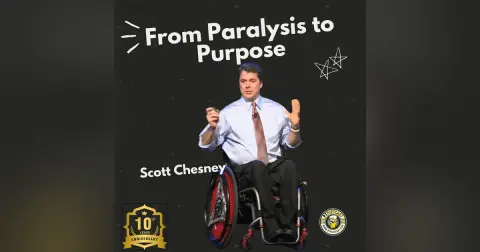


Scott Chesney’s life changed forever at 15 when a spinal stroke left him paralyzed. But that was only the beginning of his journey. In this inspiring episode, Scott joins Jimmy to share:
- How he navigated grief, anger, and acceptance
- The transformational power of physical therapy
- Why permission to feel is a crucial healing step
- What happened the day he walked across burning coals at a Tony Robbins seminar—on his hands
- How Deepak Chopra helped him look inward, while Robbins pushed him outward
- Why he believes he’s not done walking—literally
Scott’s story isn’t just about disability—it’s about rediscovering your purpose, trusting your heart, and refusing to be defined by limits.
???? Listen now and be prepared to rethink resilience.
Connect with Scott Here: https://scottchesney.com/
<p>This episode is part of the <a href="/physical-therapy-business-podcast">Physical Therapy Business Podcast</a>, where physical therapists and clinic owners learn how to get more patients, improve operations, and grow their clinic without relying only on referrals.</p>
<p>Looking for more episodes? Explore the full <a href="/physical-therapy-business-podcast">Physical Therapy Business Podcast</a> for real-world strategies on physical therapy marketing, patient acquisition, and clinic growth.</p>
0:00 You're listening to the P.T. Pinecast, where smart people in healthcare come to make noise. Here's your host, Jimmy McKay. All right, thanks, voiceover guy. Today's episode brought to you by Brooks IHL, world-class residencies, fellowships, and continuing education designed to turn good clinicians into great ones. Their mentors walk the walk. Their programs are built around real-world patient care. You're working while you're, you know, residencing or fellowshipping. And their grads consistently become the leaders in our profession. Check out Brooks IHL and see how far you can go. Their website, brooksihl.org. That is brooksihl.org.
0:40 Our guest today at fifteen, his life changed in an instant. A congenital condition left him paralyzed, but what followed has never been about defeat. It was about reinvention. He's been on stages across forty four countries, moved over one point seven million people and counting. And he's spoken inside the halls of the U.N., the Pentagon, Fortune five hundred companies from school assemblies to global conferences and one student conclave with APTA, which we'll get into. His mission, though, has stayed the same the whole time. Help people transform adversity into action. He's been called a navigator of life and the commander in change.
1:22 I like that second one. And you're about to find out why. Welcome back to the show after a little bit of a hiatus. Scott Chesney. Scott, welcome back, man. Hey, Jimmy. Thank you so much for having me. It's always a pleasure to reconnect with you. Yeah, good to see you. I don't know which story to tell first. We got two, right? So first of all, I said welcome back to the show because we recorded live at the APTA Student Conclave in Miami, I think Miami, in I don't remember what year, so we're looking at a decade. Wow. If you think about it. I'm flying by. How do you look younger? I grew hair. I stopped shaving my head, so now I actually look younger.
2:03 But you were there doing your thing. And we'll get into what that is. But I think it's funny that we got reconnected. I've got a cousin. My cousin's not a PT. She's no T. And, you know, she's a cousin. We follow each other on Facebook. And I rarely get pitches for guests from family members. Usually like, I don't know, Jimmy's over there doing something with a microphone. Again, we're not shocked. And my cousin, I think it was a text message or a phone call. She's like, listen, I see what you're doing on the Facebook with the interviews. And I got a pitch. And I'm like, all right, let's hear it. And she starts telling me this story about this guy. And I think I'm half listening to it while I'm cleaning the garage or something.
2:45 But all of a sudden, something clicks. And I'm like, I know this song. I've heard this song before. And then I pause. I was like, hang on. This guy's named Scott. And she's like, how'd you know? So what's the connection? My cousin is friends with who? Your wife? I don't know who this is. Katie Gribben. I know a lot of Katie's. I'm sorry. I should know that. That's okay. Katie's watching this. I apologize, Katie. That's right. But she's like, yes, yes, yes. I remember the first thing I did is I'm reeling back through the interwebs and I pull up the episode. I go, this guy? And she goes, that guy. So it got me to reach back out to you a month or two ago and you're back on the show.
3:28 So welcome back to the program, but we don't have to fly to Miami to actually get to talk to you. I don't know if we want to be there today anyway. They just lost to Indiana last night. That is a good point. It's not the happiest place on earth, Florida. So I mentioned a little bit. I tipped my hand a little bit to your background. You've delivered keynotes at the Pentagon, the FBI, Fortune What would your message be for an individual though? The people that we talk with, right? Very hyper-specific, right? A busy, burnt out PT listening right now. Mentioned in the intro, you like to turn adversity...
4:11 into action, right? I feel like you turn acorns into oak trees, right? So if I gave you this, no prompting, right? What would you say to a busy, burnt-out PT who's listening right now who feels like they're facing adversity? that's a fantastic question jimmy um it's it's all about um reconnecting with oneself and what's interesting is that when we don't take care of ourselves and i mean this mentally uh physically emotionally spiritually is that it's interesting how our body kind of receives the brunt of that and so while we're getting sent messages and signals all the time to say hey you know we need to reconnect with self For many people, and in no judgment, it comes down to, wait a minute, I'm not feeling well.
4:59 So it could be an ache in the body. It could be like a terrible sickness, an illness. And even in cases, I believe, a disability. Because what happens here is that we start experiencing enough discomfort, enough pain. When we experience enough pain in our lives, we will make a change. And we all have different thresholds for pain, so it's not to be judged. But that's what happens. And hopefully, and part of my message these days is that preventative care. So we kind of like all know that sooner or later, like, okay, there's enough pain. I gotta go to the doctor or I gotta take care of this, or I gotta start taking, because usually you go to the doctor and they're gonna probably talk about stress management.
5:39 They're gonna talk about like taking it easy and exercising more, all these things that are part of self-care. And what I'm really hoping for is that people don't have to come to that place, is that there's preventative care that they can do for mind, body and spirit. And the good thing about this is, is that we know what advice to offer other people. But when it comes to receiving our own advice and walking our own talk, that's where the challenge is. So I'm going to say reconnect with self. And some of you are going to be like, well, I don't know what that is. So it's not even a reconnection. There was a time. when um you did take care of yourself whether it was in the womb or something there was a time where you did care for yourself but if it's new and it's weird and it doesn't feel right then you know what just surrender put the white flag up and say you know what i need help one of my biggest messages these days uh jimmy and it's come with a lot of soul searching it's come with a a deep dive into mental health is i don't have to figure this thing called life out on my own And I realized before paralysis, I realized during paralysis, and I realized for a very long time that, you know what, I had to figure things out on my own.
6:51 And that came with a lot of challenges. And I understand where it all came from. I accept it. I own it. and now it's a matter of you know what i'm not alone i i need help um i'm not okay and when i do that and really trying to help people to like embrace that message i really feel that then i'm on the path to really taking care of myself i don't live on a deserted island and i don't know if any of your listeners are on a deserted island like tom hanks or anything he actually had wilson so he wasn't that alone but um is that we're not on a deserted island. So we don't necessarily have to take care of ourselves. Ultimately comes down to the actions we take.
7:32 I know you mentioned that earlier. I'm all about action. The actions that we take on ourselves. Yes, there are times where it's about us, but in terms of that support, that guidance and everything, that accountability, there are other people that are in your life. And if they're not in your life right now, that's where we got to take action and find these people. Yeah, you made me think of a quote. I love taking words from other people because they probably send it better, which is the results you're looking for are hiding in the work you're not doing. If you're feeling something and you're like, well, I don't know what will make this better, but I'll just keep doing the things I'm doing now and hopefully it'll go away or hopefully it'll solve itself. That's not usually how it works. And the second thing was you might be looking for something or someone to solve all your problems.
8:15 That's probably not likely. But there are people who can, if you reach out and do the work with them, who can help you solve each and every one of those things. So you're not on a deserted island. If you look for, I mean, especially in the profession that I'm lucky enough to be in physical therapy, most of the time, if you ask someone for help, they're either going to be able to help you and be willing, or they're going to point you towards someone who can do it right now or help you a little bit better. So I think your point of we're not on a deserted island is an important one. And even with physical therapists, I talk to them all the time. And these are my lifesavers. These are the people who got me back into life, got me back into work, got me back into play.
8:55 I met all these things in terms of being extremely grateful. They're probably close to the top of my list, but also I met, they fall into that place. They know, they know. See, what's interesting too, Jimmy, just think about this is that if someone, anyone, even a stranger out on the street came up to you, and said, I'm really struggling with my life and here's what's going on. You're not gonna say like, I don't know what to tell you, like best of luck. You're gonna give advice. Cause deep at our core, we wanna help other people. We wanna serve other people. The challenge is that listening to that ourselves. So we're all about giving advice. So what I've always said is like, keep one ear open to yourself whenever you're giving advice to another person and make sure that you're like following that advice as well.
9:45 Not to say that you still can't give advice, but it comes down to walking your talk. And even though I'm not walking right now, I realize that I haven't been walking in many ways in terms of following my own advice. And I've had to pay the price for it. I've had some major challenges in my life, all that I look back on and, you know, trying to take the message and lessons away because there's only one positive thing, Jimmy, that we can do with the past. Only one. And I have scoured this earth looking for this answer and it's learned from it. That's it. Any other thing that you choose to do with the past, that is a waste of time and energy. So as quickly as you can find the message, find the lessons and move on with your life.
10:26 All right. So you talk a lot about this, turning thoughts and feelings into positive action. Is there something tactical? We just talked about strategy. Is there something tactical? Are you someone who says, I got a journal? What's something tactical? Someone who's listening right now could say, okay, you're right. I got to lean into this and start doing this with other people, not a deserted island. Is there something you're doing right now that somebody listening could apply today? Well, I'm going to give you some other things, but I don't want people to go there right away. I am going to say, and I probably wouldn't have said this the first time that I was on the call with you, is that if you are not seeing a therapist at this time, make the call and see one.
11:08 I'm at a place where I believe, and I'm just giving a number right now, at the age of twelve, just think about this for a minute, it could be a different number, but at the age of twelve, I believe everybody should be seeing a mental health therapist and so forth. And knowing full well, yes, our parents do the best jobs they can with the tools they're given. I learned that, but I also learned in therapy, it still doesn't take away the impact that it's had on your life. So there's a lot to digest. And you know what's interesting? It's probably the most important job in the world being a parent. But think about this, Jimmy, and you're a brilliant guy. What do you need to become a parent? Biologically. Biologically. And I'm also going to say, outside of you as well.
11:50 There's two things. Biologically, we don't have to go down that road. We know what that's all about. What's the other thing that you need to be a parent? A car seat. You need a car seat in the car to drive the kid home. This is the only thing. We don't have to pass a test. We don't even have to sign up anywhere to get a library card. And I know that's old school and everything, is that they'll send anyone home with a kid. And yet it's the toughest job ever. So it's on job training. And as parents, it doesn't necessarily. It actually is not the case with the large majority, if not everyone, is that we don't have our stuff together. We're still working on ourselves as individuals.
12:31 We have this life that's come into our world and we're helping to have them navigate. And it's tough not to project our own stuff if we don't have it resolved. So I'm going to say, and I know this is going to like really take the wind. I know some people aren't going to listen anymore. Do me a favor. And I say this with tears in my eyes because I made up for I'm still making up. I'm in the fast lane now. Five years ago, Jimmy, fifty years old, thirty five years into paralysis. First time ever I saw mental health. Wow. And there's a lot there that we could talk about. And I'm not saying it just because of my situation. I mean, you think about the trauma when I was fifteen years old.
13:13 And yes, that should have been right up there with physical therapy and all this. So contact a mental health therapist, do some research and so forth. Find what your insurance pays for. Interview them. Find out who you resonate with. And just have this person doesn't mean you don't have friends or family that you can talk to, but someone who's like on the periphery who might be. Someone who is like for me, I've had therapists now who have basically been experts in trauma and realizing the amount of trauma that I've experienced in my life, even like in addition to paralysis when I was fifteen. So I'm going to suggest that. So make that phone call. And again, if anyone's listening to me in your old school, it's not a sign of weakness.
13:57 It is a sign of strength. It is a sign to say, listen, I don't have this. all together right now i need help i feel like i'm navigating maybe it's just your flatlining right now maybe you're crashing maybe you're spiraling whatever the case is there's nothing wrong with you the moment you decide to see a mental health therapist is the moment that you say hey you know what something's right with me and i don't have to and it's amazing to see what occurs there now with regards so plant that that's number one that's a huge number one And which I'm sure a therapist is not going to argue with. I love to still meditate. I think meditation is one of those things, and we talk to a lot of physical therapists who from like, you talk about burnout, is that bring back the silence and stillness into your life.
14:45 That's what meditation does. This is what I've researched as well. There is no close number two. And so a lot of the, not backlash, but a lot of people, well, I tried and it didn't work. And then I tried and it didn't work. I'm going to say there are so many types of meditation that you can get involved with. And sometimes it begins with a little just mindfulness, just being present where I am. For those of you that are thinking, I can't do this. I had the best opportunity in the world. I was trained specifically by Dr. Deepak Chopra. who's an amazing medical doctor, but also an alternative medical practitioner, specializing in Ayurveda and so forth. He taught me one-on-one how to meditate.
15:26 The first time I got out of my wheelchair, Jimmy, got down onto the ground. I'll never forget this. We're in La Jolla, California. That's where the Chopra Center for Wellbeing used to be based. Now it's in Carlsbad. And I'm on the ground and it's primordial sound meditation. So that's the one he teaches and so forth. So I ended up getting a mantra that we determined and so forth and started repeating that. All of a sudden, I get a little nudge at my shoulder. Scott, Scott, I'm trying to do his accent. I love Deepak. Wake up, wake up. And all of a sudden, like I open my eyes. And I said, oh, Deepak, I must have like drifted off. He said, you drifted off for forty five minutes, Scott.
16:10 i took a nap i don't know i i wasn't meditating and all of a sudden i realized that i because it's like and i started apologizing i said deepak i'm so sorry you're creating this time you're spending with me and everything and obviously he said scott first rule of meditation never judge a meditation he said you were meant to be sleeping more than you were meant to be meditating he said if two three weeks later when we're done with more practice and so forth you're still sleeping then we have a problem So it's something that I love to integrate into my day first thing in the morning before I go to bed for me. And I'm a believer in God. I don't practice any one religion more spiritually.
16:50 There's a higher power out there. I believe when I meditate, I'm listening to God. When I pray, which I still do in everything, I'm talking to God. So it's that exchange in everything that I find to be very powerful. But that creates, so even though I'm paralyzed, Jimmy, my life is full of movement. It's full of sound, speaking, doing all this. What I've learned in life is that, you know what, embrace life's polar opposites. So how would we know movement if we didn't know stillness? How would we know noise and sound if we didn't know silence, success, failure, pleasure, pain? So it's not about like, oh, I need to have a painful experience. No, no, no. It's learning when those experiences come to embrace it, because then it allows us to strike some kind of balance and actually gravitate more towards more of those positives that we want to do in life.
17:42 But meditation, it's productive. Because a lot of times I was sitting there in silence. I'm not getting things done. Or this is a waste of time. But the mind is the only thing, Jimmy. The mind is the only thing. And I still don't know. And I guess at some point I'm going to have to have a talk with God when my time comes. And up there, I was saying, like, why is this? I've actually learned about pain, too. I've done a lot of research in pain. It becomes existent when the mind tells it. Now, not to say you're weak when I'm in pain, but you know what? It's the mind determining this is painful. There are people I met in other countries and everything, and things are going on to them in their lives and everything. And maybe that's what happened when I did a firework. I did a firework on my hands. Tony Robbins held my legs.
18:23 I had my hands on burning hot coals. Didn't feel a thing. Why was that? I wasn't focused on that. That wasn't my focus. My focus was what was waiting for me on the other side of those coals. So, so I would put this in order. Yes. Is that see a therapist, a therapist, please. Meditation, journaling. You mentioned that before. Journaling is very powerful. I don't want that to replace, replace a therapist. I don't want that to replace talking with friends and family and colleagues who is a great complimentary thing to like share, like what it is that I'm feeling in addition to therapy. So I would suggest that. And it's just, you know what?
19:03 But following your heart, too many people these days are moving away from their passions. And it's like, I don't have time. I don't have time to do this. It's almost like this is last on my list. And it doesn't mean that it requires, like, I love to travel. I love to go to like different countries, do different things. But I realized that sometimes whether it be like time, a busy schedule, whatever, like I can't do that. so i have and i know i'm like going off on a tangent right now exercise is a part of that for me as well um i have two because we create a lot of excuses there's not enough time in a day uh uh it's not gonna change folks it's always gonna be that way so i have my schedule of when i am super busy maybe i am traveling maybe i'm out of a hotel room so meditation i love to do for thirty minutes in the morning thirty minutes before i go to bed when i'm not traveling when things are like pretty good like not too busy when I'm traveling though it could be ten minutes meditation ten minutes of exercise somewhere getting it in so I'm still honoring myself but still understanding that I have a lot going on I think that's so important is to honor yourself and to take care of yourself.
20:15 Because folks, here's the thing, and we can talk about like when you're on an airplane and giving yourself oxygen first before you give it to someone else. We all know about that, but that's the truth. The more that you take care of yourself, the more that you'll be able to take care of other people. You look at those people, there are even some people who like, oh my God, they do so much for other people. Like, why have they burned out? Why have they died? Because they're not caring for self. Even Mother Teresa, Mother Teresa, I've yet to find anybody, Jimmy, anybody in this world that has argued with me, whether you're a believer in religion or not. Mother Teresa, see, I love to study people. I love to find out like what makes people tick, those people who have really made an impact in people's life.
20:58 Influencers, before like the term influencer even came to be. Mother Teresa, Mother Teresa. She said she used to meditate in the morning, every morning, for an hour by herself. She said, this is my time to listen to God. This is where I embrace the whole thing. This is my time to listen to God. We don't even know the countless lives that she touched. But on the other side of the day, before her head hit the pillow, spent one hour praying. This is my time to talk to God, she said. So on either side of the day, she was filling her own cup to the point where she had so much energy and resources to help other people. So that was a big sentence, wasn't it, Jimmy? Jimmy, you could have gone to the bathroom, taken a break and everything. I want to step in here, man. I appreciate you. I'm going to listen.
21:39 You don't bring somebody on the podcast who speaks professionally to millions of people and then not expect that person to espouse wisdom. Scott, this is why we bring you on here. But that leads me to my next question. When I heard you talk, you start things off with a story. That's a great way to begin a talk. Brings the audience in. You zero them in on your story. You've told your story. I told a little bit of your story before this episode started. So I got a question, but I want to ask this one first. how does that feel still telling that story? Does that hurt you at all? Because you bring it up. Like I'm wondering that because I interview people a little bit.
22:20 So I remember when I looked at that, when I remember in Miami thinking, man, I see what happened and what, what, what became of that, what he did with that, but is telling it when you meet people from zero, is that painful at all? Is that, are you tired of, would you rather talk about something else? Jimmy, I almost, every time I share my story, since the first time I spoke back in the nineties sometime is that, um, Like, I always get a little bit emotional. And so there's never been a time. And the reason I share my story, too, is that that's my uniqueness. We talk about, like, sharing lines from other people and stealing quotes and so forth.
23:01 That's all we're doing. And it's a good way. We're trying to connect with people. What was the line they said one time? There is no teacher who can teach us anything new. They can simply help us remember the things we always knew. i um i i share my story because i want to connect i mean my mom has always said you know what you should just tell people what happened to you like when you first meet them because they're curious and everything like mom i think that's a little much i will tell you this though too jimmy is that the past five years um a midlife crisis you name it is that the story has gotten deeper the story has Man, I have finally, finally, Jimmy, grieved over what that fifteen year old lost.
23:46 I have finally like focused on, wow, not only my my teenage years from fifteen onward, my twenties, my thirties, my forties, fifth, like this isn't going away. And, Jimmy, what I've realized, too, is that, like, I love to take myself, rewind the past. Again, we can't change the past, but we can reinterpret. You know what? Why didn't paralysis affect me in the beginning? Why have I always been a person who, like, has his, like, emotions out on his sleeve, but this is something that, like, I couldn't go to? Yeah. It was so big, Jimmy. My life was all about movement before football, basketball, baseball.
24:27 It's hard to get me to sit down and read a book. But I also realized, you know what? I didn't have an accident or an injury. I woke up. I had an illness. I was sick. And I think there was a part of me that needed that break with paralysis. But then also thinking, you know what? Just as quickly as it entered my body, it's going to exit my body. And it was around the age of fifty like this isn't going away. This isn't going away. And Jimmy, one of the things that. I'm really fighting for these days. And there are some facilities that get it and others that don't. Is that I don't want to get into it because this rehabilitation center has been wonderful to me and so forth and and.
25:15 mean i still go there to this day and when i was fifteen years old i basically was given a sheet of paper um when i got to this rehab facility and it said this is when physical therapy is i didn't need occupational therapy being a paraplegic but activities of daily living adls that's what it was called um breakfast lunch dinner and then downtime No mental health therapy. So what I would find out many years later is that they screen people, screen people who needs therapy, mental health therapy, who needs to see a psychologist, a psychiatrist, and who doesn't. And I guess with the smile on my face, with all this support around me, family and friends, I was good to go.
26:00 I, this is what I, and I get it with regards to a traumatic injury with regards to spinal cord injuries and non-traumatic that's physical. I get that. But emotionally, this is mentally, this is traumatic for everybody. So what I'm saying is that everybody should, needs to, if you had mental health therapy down my schedule, I'm not going to say, well, I don't need that. No, I was in total surrender mode. I didn't know what the heck was going on with me. And even if I sat in those therapy sessions and just, uh-huh, uh-huh, I would have been listening. I would have had a traumatic expert trauma, someone who was an expert in trauma, be able to ask me questions to get me to think, to get me to maybe share, open up.
26:43 I don't know what I would have experienced, but that would allow me to start processing. This loss and still to this day. And if you think about it back then in nineteen eighty six happened in eighty five in December. Eighty six is when I was in therapy. Is that six? And this was for regular insurance. Six months as a paraplegic, a stay in a rehab center, a year for a quadriplegic. i got out in six weeks because my family didn't have major meds so i was out the door quickly i ended up getting two sessions of physical therapy because i only had one in the morning i said i'm not tired i need a second and so i was able to do that but six weeks but now paraplegics and and quadriplegics are out within six weeks Even more the reason, Jimmy, for mental health therapy to process what has happened to them physically, mentally, spiritually.
27:40 I'm all for peer support groups. I love it. I'm all for like the sharing and talking, but there's trauma. And most of us aren't trained in trauma and know how to process this. and this is something that is wrong so just up there i was told that insurances basically cover because i've talked to people at this facility but other facilities is that physical therapy occupational therapy and when needed speech therapy those are three mandates for insurance to cover sure where's mental health therapy so jimmy i just had forty years of being spinal cord injured on december twenty eighth of last year i can tell you now and tell everyone that's listening The mental game that is forced to be played, and I use the word game because I'm an athlete.
28:30 I'll always be an athlete within. The mental game is far more challenging than the physical. And if you think about this, just even if you don't have a disability, is that how much mentally... be going on in your life to the point where you check out what's going on with you physically just think of an athlete think of a baseball hitter you could be the best hitter ever and all of a sudden you strike out a couple times you're up here now you're up here now we understand the importance of mentally being there being present being there with our children being there at work this has a direct tone it gets us back to what we were talking about in the beginning is that with regards to our physical health So we keep telling ourselves and everything.
29:13 I'm weak or this isn't going well in my life or I'm not dealing with this or whatever. Is that guess what? It's going to result in more challenges physically with you to the point where that's going to be your wake up call. So this is so important, Jimmy. And I just there's more attention that's given to it now than it was back in nineteen eighty six. but not nearly as much. And I'm not just talking about spinal cord injury or disabilities. I'm just talking about in general, in terms of mental health. It's becoming more of a priority, yet it's still not on that level it needs to be. You're highlighting something. You're helping me through my question list, and I appreciate that.
29:54 You've worked with and spoken to students, corporate leaders. You mentioned Tony Robbins, Deepak Chopra. You've spoken with people high and wide, all different types. You mentioned a mindset trap, which is I don't need any help or there is no help or help wasn't provided, therefore I won't seek it out. What are some other mindset traps that maybe we fall into that physical therapists are not mental health providers? They are someone who's going to be with someone a lot who might be able to spot these things and then hopefully hears your words in their brain saying, maybe this is something I could suggest or nudge that person to.
30:37 So what are some mindset traps you see people falling to the most that we can read and recognize like a good quarterback would and then help to reroute? I think it's a great question. I know we're talking about physical therapists too. So it's giving. It's amazing with physical therapists is that, and there have been some people who have married their physical therapist. My first physical therapist basically was a student at the time. And when she got older and got married, she called me one day and said that she was pregnant. She wanted her name to her first born child after me. Wow. We love to name our child Matthew Scott.
31:18 And I said, wow. I was like, I'm actually crying on the phone as she's telling me this. Then all of a sudden I just said, just out of curiosity, why not Scott Matthew? And she said, well, Scott, we want to name him after a saint. And I said, you don't have to say anymore. I get it. There is no saint named Scott. Trust me, there's no saint named Scott. But there's a bond what happens is that when someone starts moving your body, even if it wasn't paralyzed, someone starts moving your body, it's going to trigger some emotions. So there's a great opportunity. And again, I don't know the parameters that a physical therapist has. But if they're that connected with someone, they might be that vocal piece. Hopefully, a therapist, a mental health therapist is going to complement that.
32:02 But they're going to get a lot themselves. And what I would suggest, and this is what I suggest, just give that person permission to feel whatever they're feeling. If they're really angry in that moment and maybe don't know why they're angry, you know what? Give them some exercise. Give them like a pillow to punch. Whatever it may be, get that anger out. And if they want to process and talk about it, let's do that. If there are tears that are coming, that's fine. is that let the tears come. I know there's some people that will say, hey, you know what, go cry in the shower or whatever. No, no. That's another sign of strength is when you allow yourself, you give yourself permission.
32:44 Because again, if you look from the outside in, if I was on the outside, not paralyzed, and I saw someone who was on a mat doing PT or whatever, and hearing a little bit about their story, I would say they have every right to be angry. They have every right to be sad. They have every right also, I don't want to just sound morbid here, to feel grateful. And I say this to people because I'm constantly still going into rehab hospitals and VAs and so forth and talking to like veterans who have like just, I let my country down. That therapist, I'm sorry, the veterans who have told me, I let my country down. And I said, by becoming paralyzed?
33:28 By suffering a traumatic brain injury? I said, let me tell you something. I understand why. So it's a matter of validating someone, like where they're at, and like helping them and allow them to like feel whatever it is, but to help them get through the stuckness, as I like to say it, is that I said, you're still here. You're still here. And I believe everyone, because so many of these experiences could have very easily taken your life. You got struck by a bullet and everything. It just raised your spinal cord. Could hit your spinal cord or hit you. You could not be here right now. You're still here. You were diving. You broke your neck or whatever.
34:09 You're still here. And so because you're still here, There is a place and a purpose for you. And maybe, just maybe, your purpose in life is greater than it was before. I don't know. And this is the beautiful thing. That's where your journey of self-discovery comes. This is what you have to figure out. We have people that can help us navigate, get us on the right path, be part of that team around you. But ultimately, it's you who is going to track down what that purpose is, personally, professionally, you name it. So I think that's very important is to give people permission to feel their feelings. And whatever those feelings may be, you might have a week of sadness for someone.
34:54 And then all of a sudden they might be laughing. Something might have struck a chord with them. Just let them know it's okay. And I would love to hear physical therapists just utter the words like, I'm just letting you know you're not alone. I know maybe there's gonna be a time later on in the day where if family and friends are visiting and all of a sudden it slows down with regards to the beeps and the noises of different medical machines that might be there and you're there, I was like, You're alone with your thoughts and your feelings. Yes. But you're not alone. There's a phone call.
35:34 There's a text. There's people who will listen. I've lost a lot of people. And I myself, I will say this, have had suicide ideations. Never attempted, but I've had them before. And that's when you're too much in your emotions. I've learned that we have this kind of... Practical mind. And then we have this emotional mind, the practical mind and everything. It's more like the stoic. Like, I'm just going to get through things, going to put the feelings aside, the emotions aside. And I know that stoic within me got me through paralysis for a number of years where I kind of shut everything down, put my head down, was that athlete, didn't let anything bother me.
36:21 But yet I suppressed all those emotions. And then we have something over here, which I experience as well, is the emotional mind in which, you know, a good place to be. But if we spend too much time there, that's when we spiral. That's when we spiral. And that's when we kind of feel like we're alone and no one's going to understand it much. It'll be much better if I wasn't here anymore. What I've learned is that the combination of the two and you put these together, this is like cognitive behavior therapy. And, um, it's just it's phenomenal is that um you put them together there's something called the wise mind so it's that balance between that stoicism to the point where you know i just gotta put my head down and do it and the emotional the the chew the balance of the two i'm not crying all day i'm not laughing all day And I'm not having my head to the ground and just being this stoic who feels nothing or whatever.
37:15 I'm giving myself permission to feel whatever it is that I'm feeling in that moment. Judge it. Try to understand. And here are some questions that people can ask themselves, too, Jimmy, is that and whether they have a disability or not, because this could be someone who's lost a job. This could be someone who's like struggling as a physical therapist right now, whether it be professionally or personally. There's this why me. and um which i think we've all said at one time or another um i know there's been people including myself who said why not me like bring it on like i can handle anything i think the most powerful question we can have is why this why this why is this happening at this moment and everything and it's almost like owning what i have created But why this?
38:07 And it usually gets me around to, oh, I'm not taking care of myself, whether it be emotionally, mentally, spiritually, physically or whatever, and not beating myself up, but getting around to, OK, this is why it's almost the way I say, Jimmy, this might sound a little bit weird. I feel like and please call this God, call this like a higher power. believe that there's this higher power that's constantly guiding us constantly guiding us and it's sending us on a path and everything and we're going and all of a sudden i'm gonna go in this direction and i almost think whether it be god or something saying are you kidding me look what i've pointed to over here look at how bright and amazing this is what you want but yet we've chosen to go in this direction.
38:54 And he's like, all right, I'm coming. I'm coming along with you. There's going to be some pain. There's going to be some discomfort. There's going to be some challenges in this experience, but I'm letting you know I'm with you and I'm going to steer you back to where you You want to go deep down inside at your core, your passion, your purpose, your reason for being here. I'm going to steer you back there. And yet when we do that, all those experiences are going to help. They're going to reaffirm. They're going to tell you like what I don't want anymore. different phrase. Oh, wait a minute. I remember when I was this way.
39:34 Don't want to do that anymore. Again, not beating up on yourself. Sure. Taking the past as that learning experience and being able to move forward. Good advice. There's no way I'm letting you get past this. I just wrote down hot coals. I'm going to need more than I walked on my hands on hot coals with Tony Robbins. I didn't talk about that at the APTA. By the way, anybody from the APTA, I want to come back. I was literally just thinking. I think my message was powerful back then. I got so much more to share. Yeah. With a lot of challenges. Well, you're in Jersey, right? Jersey, New York. I am in New Jersey. You know what I mean?
40:15 You can't say that because about like a thousand of your listeners just dropped off. They're like, are you serious? We've been listening to this guy from Jersey give this advice? Well, I'm thinking APTA, New Jersey. I lived in Miami, Florida, and I've traveled around the world for a few years. So I'm kind of like, I don't want to say worldly. You're worldly. I am in Jersey. I'm about eight blocks from the beach right now. So if that's enticing anyone. so i gotta know it's still like so i need to hear the hot call story but is tony robbins tony robbins in real life like is he is is that a thing he puts on or is that who he is is what's does he does he turn that off or is that him tony is genuine and i'm gonna say like every speaker now i'm gonna lose some speakers here because i and i'm including myself There's a little bit of a shtick.
41:07 You have to. There's exaggeration. There's embellishing. Well, you usually it's turning up. It's I was taught in radio to get me through this microphone to your ear. If I want you to feel a nine, I got to give you a thirteen. If I just put a nine through here, some of that is lost. So you have to project theater actors know this. Yep. Yep. There is some sense of that. And this is where we got to check in. And this is where I always like to say, because after I do a presentation or something, I like to check in. I was like, hmm. because I always have, I'll never have like note cards or whatever. I might have a PowerPoint or something, but I totally prepare and I have an outline.
41:48 But I try to be so much in the moment. I try to feel the energy of my audience because there could be a story, an experience that I share, or there could be a tip or a strategy that I wasn't planning on sharing. But yet, wow, you know what? This feels totally appropriate right there. Tony is amazing. And what's happening lately with Tony is that like so many, I call them disciples. So many of Tony's disciples have found their way into my life. And one of those individuals who I'll never forget. So after I got done with the firewalk, and this was back in nineteen ninety seven, is that I did the firewalk and everything, which was great.
42:31 And also there's this pole climbing. You climb up this huge pole and then you jump off the pole to this trapeze. And it's almost like breaking through the fear. Now, I couldn't do that. but i said to tone two things to tony tony i want to do this firewalk let's do it on my hands and everything you can hold my legs like a wheelbarrow race and he thought i was crazy but he's like okay i support you but then there was this telephone pole and it was like another thing my mind's telling me i'm the only one at this there's twenty five hundred people at this seminar back in ninety seven i'm the only one in the wheelchair so i don't want to be the only one so they ended up tying this string to this telephone pole that I got. I climbed up this entire rope, and then I reached over and grabbed the trapeze.
43:13 And I couldn't jump. I couldn't do that, obviously, but I ended up doing it. Anyway, following morning, After all this is done is that people gather like in the space and it's really dark and he's just pumping music. I mean, I know some people have referred to it as a cult. It's not a cult. It's just tapping into your passion. It's tapping into everything. Tony's a genius at this. And all of a sudden he goes, Hey, and as everybody clap and he goes, to start off with this and he goes lights and all of a sudden something pops up on the screen now i'm going to cry i i just this is that i start hearing this song jump from van halen like they're playing it from the very beginning i didn't realize tony had someone videotaping me throughout the day videotaped they couldn't videotape the firewalk that was just because they with the lights and everything at that time i know technology is better now but they didn't want any flashing lights because that could get you out of state and you could get burned even though we signed waivers but he had someone follow me when i was going to climb up that telephone pole and he's playing a song jump and i'm doing it in slow motion and so like my team, cause y'all and teams and everything, they're like, ah, that's great.
44:25 And everything. And I was like, just shaking my head, like totally embarrassed and everything. And then all of a sudden he goes, well, why don't we bring Scott up here to say a few words? Oh, no, no. Mind you, I had been speaking at that time, but like, like big time Robbins and being prepared. And I'm like, So they ended up a bunch of his trainers and everything carrying me, put me on stage. Tony and I have like this big embrace. I whisper in his ear. I was like, I'm going to get you back for this one. I spoke for about ten minutes coming from my heart. I get down. I'm coming down. And his top trainer at the time, his name is Keurig Ashley. He's like the Tony Robbins of Australia now. Just an amazing man.
45:05 He just says to me, go, Scott. In all my years of working for Tony, I have never seen him captivate an audience the way you did. He goes, this is your passion. This is your purpose. If there's anything that it's like any kind of belief that's going on inside, to the contrary, he goes, you got to push through that. And I'll never forget that because it gave me that confidence to kind of like really, really launch my speaking when I was traveling around the world and doing different things. But yeah, getting back to Tony Robbins, he has challenges. I mean, he's gone through a marriage. I mean, he's married again. He's had some financial. He's made some investments in some companies that you would have thought would have taken off, and they didn't.
45:50 And he's had some challenges. But you know what? Tony just keeps going. Tony finds a way, loves connecting with people, loves connecting people in general, and so forth, and has also evolved his work. Even during the pandemic, Tony, who's gathered millions, hundreds of millions of people, in like huge auditoriums convention centers he's now got like the biggest zoom following in the world and it's not that but he's realizing i still need to connect with people so tony i i will always and people like scott you're like the tony robbins in a wheelchair it's like ah okay uh but um No, Tony is one of my greatest teachers, as is Deepak Chopra.
46:34 And I love the combination. So Tony's all about movement. Tony's all about like creating like whatever you want outside of you, which is great. I mean, he goes inward too, but Deepak goes inward. He wants you to create this life inside. So to have the opportunity before I launched my travels to work with both of these individuals on a certain level was just like the perfect storm. But like everyone, I mean, Tony is an amazing man. And he's human born to make mistakes, learn from those mistakes and move on with his life. So, so what's going through your mind or how do they prepare you to be walking on cold? Like what? So I have to know because I love that because there was a part of me that I'm over to the side and everything.
47:20 And I'm hearing that people are going to walk along like crazy. a path of burning hot coals and he's talking people about like it's all about like the mindset and again getting back to the mind so basically he didn't want anyone looking down at the coals he wanted everyone looking up and saying the world's words cool moss meaning cool ground cool moss cool moss cool moss now as i shared with you before we all sign waivers Um, like if you got burned, I will tell you that night, people got burned and not to judge them, but at some point they looked down, I'm on burning hot coals mine. This is hot. I'm going to get burned and they got burned. They not terrible burns, but burn enough to the point where they jumped off the path of burning hot coals.
48:02 What was interesting when I told Tony this and everything, and I said, listen, I want, I want to do it on my hands. You can hold my legs and everything. But if you're telling me this is mind over matter, it's like, it doesn't matter if I do it on my feet or if I do it on my hands. So I had had like people hold my legs before, like when I was nursing a pressure sore or something on my bottom to get upstairs, to go different places. My arms are very strong, so I'm able to do that. So I didn't have any problem with that. So Tony said, well, let me just share with you something, Scott. He goes, you know, this little patch of burning hot coals over there. And all of a sudden I'm like, yeah. And I'm like, at first I'm like in this place of denial, I'm like burning hot coals. Like I'm not realizing the severity of this. So I reached down, I'm like, these are burning hot coals like how am i gonna and then all of a sudden the fear started to come in but i had trained myself quickly to move past that i like to say to do a head heart shift and this is something else that i would suggest to all of our pts out there to suggest with um those people and thank you jimmy you're tapping into this now is that Like we answer to our minds what our minds have to say.
49:08 I'm saying answer to this. When the mind is leading the way, it's about fear, disbelief, playing small in life, okay? When your heart's leading the way, it's about belief. It's about growth. It's about subscribing to the belief that anything is possible. So I like to say if we're here where fear resides, it's the only place fear resides, is that, okay, this is what my mind has to say. What does my heart have to say? And my heart said, just do it. And that's why I love the Nike slogan. It's almost like, just do it, think about it later. And it's not to say just go out there haphazardly because my heart says that. But it's not spending too much time here because ultimately it's going to get you.
49:50 It's not about creation. It's not about processing. It's not about taking necessary precautions. I agree with all that. But if you linger there too long, you're going to move to a place of fear and disbelief. So in that moment, my heart just said, you know what? Find a way. find a way and so that's when i talked to tony moore about it but he said to me he goes okay scott it sounds like you're prepared but it's not going to be this little patch of burning hot coals there's a path forty feet long and he points off into the distance of burning hot coals and he said whatever you want in life is waiting for you on the other end now folks i i can remember this is when i really which i again another thing see jimmy you're a mastermind of tapping into these things creative visualization What it is that you want to create, put on some good music, do it in silence, whatever you want, visualize it on the screen of your mind.
50:40 Make it to the point where you open your eyes. It's almost a reality. So he said, Scott, I want you to imagine whatever you want in life is waiting for you on the other side of these coals. So I remember closing my eyes and I remember walking along the beach, holding my wife's hand with one hand and a child's hand with the other hand. Folks, you could put broken glass down in front of me. There was nothing that was gonna stop me. It was my time, I got down on the ground. Now, yes, told to look up, not at the coals. My face is basically in the coals. My hands broke a couple coals. I just shattered them. And you might say, okay, now the rational mind's getting into place.
51:22 How do you do something like this? The only way I can describe it, first of all, I don't believe everything needs to be determined in life. Sometimes there's just a trust in the process. And I don't have to know. One of the main things I'm sharing with people these days, including CEOs of companies, three of the most powerful words you could ever use is I don't know. Tell your staff that tell your patients that, but say, listen, I'm with you and we're going to find out together. So, um, I'm there, and I get down. I guess the best way I could describe it, because I get done with this forty-foot path, and all of a sudden there's a couple people with hoses there who hose you down. And Tony, who's a huge man, he's like six, seven, six feet.
52:04 I hit him on the back of the knee to collapse. I'm like so excited. I hit him on the back of the knee. He falls right next to me. I jump on top of him. I was like, let's do it again. He just takes my face. He goes, you're nuts. And he pushes me away. I was just in such a state. But here's the thing that I tell people. We've heard stories, maybe not like those personally, but we've heard stories before of people racing into a burning building and saving a child or something and coming away unscathed. Is it adrenaline? Is it just a belief? Is it just luck? Whatever the case is, all I know is that there was not one part of me that focused on these calls hurting me.
52:49 It was almost like this is the path I need to take to get to myself walking along the beach, holding my wife's hand with one hand and holding a child's hand with the other hand. And nothing, nothing is gonna come between me and that dream. And while I went from a two percent chance of fathering my own children to a fifty-five percent chance, that's what I wanted to do more than walk in again. The walking, I'm looking and I'm going to say to everyone out there, it's coming. It's coming. And sooner rather than later. And I have no problem saying that I'm not in a place of like desperation or anything. I just realized that the time has come, I've taken away as many of the lessons and learnings from this paralyzing experience.
53:37 I'm ready to give back this gift because I will give it. It's a gift and it's also a curse, but life would be much, much easier on my feet with movement again, in every way across the board. I don't care if I have to adjust again, like a little baby and learning how to walk or move. And maybe it's just standing in my own spot. Maybe I'm not going to be able to totally eliminate the wheelchair. I'm not sure. All I know is that it's coming. It's coming. Powerful. If people wanted to follow along, is there a place on this digital landscape known as the Internet that you want people to contact you?
54:17 And where would you suggest they reach you out? I would say go to my website first, because there you can click on all the links to my social media handles. I mean, if you're a LinkedIn person, Facebook, Instagram, Twitter, I'm not a big I see. I don't even say what is it now? X. Not a big guy on there, but I go on there from time to time. But if you go to my website, you will see on the front page a link to all of these. So scotchesney.com. No relation to Kenny. Oh, can I tell a quick story about that? Yeah. So I'm giving a huge, huge presentation in Tennessee and Nashville. It's at the... gaylord hotel where they have almost like a city unto itself give this presentation car service is supposed to be picking me up immediately following taking me to the airport so i realized that by the time i got done talking to people afterwards and everything is that like i got ten minutes to spare so i'm gonna go to the bathroom i'll go use the bathroom i come out and in this hallway of this hotel there's i want to say there's like five hundred people maybe more and what they saw is that they saw a sign that said Chesney.
55:28 Not Scott. Everyone there, given that we're in Nashville, Tennessee, thought Kenny Chesney was being picked up. So all of a sudden I come over there and I'm just like, I'm Chesney. I'm Chesney right away. People just like shook their heads and they moved away. We wasted the good food prize on you. I had other people who came up to me who had heard of Kenny Chesney, but didn't like heard of his music and everything, but knew nothing of what he looked like, who came over, put their hand on my shoulder, said, oh my God, Kenny, what happened? Thinking that now I'm in a wheelchair because of something. I shared the story with him. I've never cleared a place as quickly as I did then. I am face to face with my driver.
56:10 And I said, one day, I don't know, but one day someone's going to ask Kenny, do you know who Scott is? gonna happen if it's happened but i was like someday that's gonna happen but that's uh i got more hair than kenny but otherwise yeah kenny is the man i love it all right uh last thing we do on the show is called uh the parting shot this is the parting shot one last mic drop moment no pressure just your legacy on the line Parting Shot brought to you by U.S. Physical Therapy, a national network of clinics focused on developing clinicians, not burning them out. Leadership tracks, mentorship, career growth, and the stability to build your future in PT how you want it.
56:51 If you want a place that supports how you want to practice, that's U.S. Physical Therapy. USPH.com. It's USPH.com. So Parting Shot, just your chance. To either reiterate something you said before, say something new, whatever your soapbox statement, mic drop, whatever you want to leave with the audience, this is your chance. Folks, no matter where you are in your life, just know that you're not alone. You don't have to go through this internal struggle anymore. You can absolutely go within. And I know it's kind of like a theory by just saying that or whatever, but there's plenty of ways. You're going to be the one who's in charge. You're going to be the tour guide and so forth, but allow other people into your life to help facilitate this.
57:37 You will... Be so grateful. And that's what life's all about, is being grateful for every single experience, knowing full well that it's led you, it's led me to where I am, speaking with the famous Jimmy right now and everything. So please, folks, do yourself a favor. Do yourself a favor. Go within. Great advice. Scott, appreciate you having back on the show. Good to catch up. And I don't think it'll be the last time, but I appreciate the time. Thank you, Jimmy. Thank you so much for the opportunity. That's it for this one, but we're just getting warmed up. Smash follow, send it to a friend, or crank up the next episode. Want to go deeper?
58:18 Hit us at pgpinecast.com or find us on YouTube and socials at pgpinecast. And legally, none of this was advice. It's for entertainment purposes only. Bullshit! See, Keith? We read the script. Happy now?