Routine vs Commitment: Rob Panariello on Building a Career That Lasts
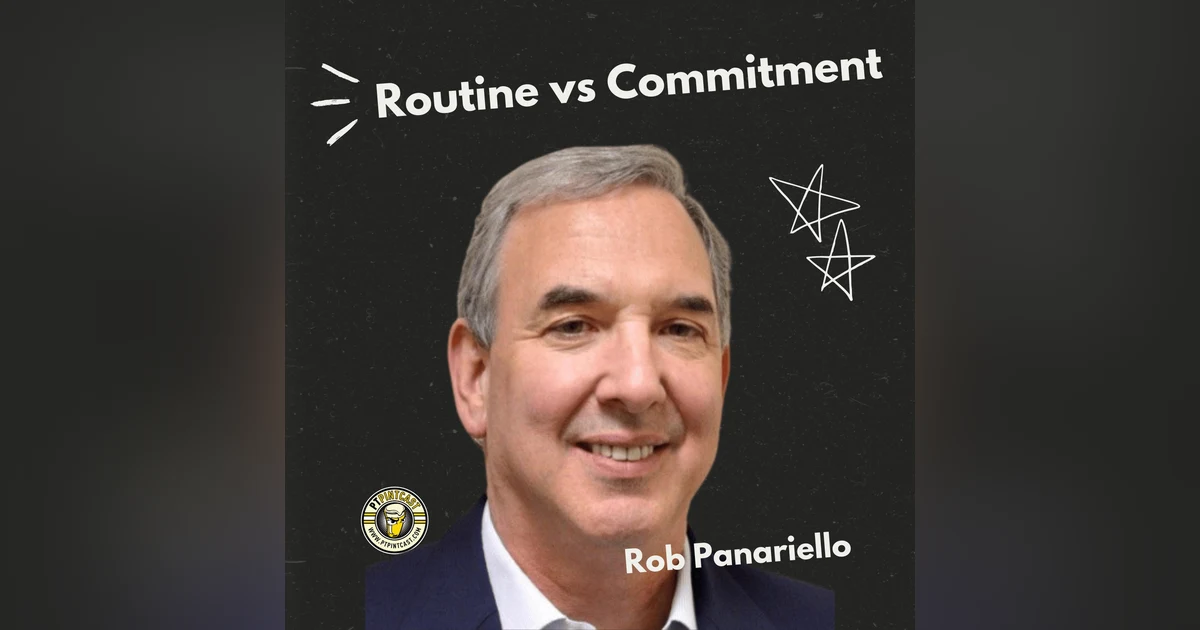

Rob Panariello has done it all — from strength coach at St. John's to Director of Health & Performance for the Carolina Panthers, to co-founding one of the largest PT practices in the country. In this episode, he shares:* The real difference between routine and commitment* What new grads consistently get wrong* The value of strength (and when to add RFD)* How to build a clinic-wide ROI mindset* Why "being busy" isn't the same as building a career???? HERO CLIP MOMENT: "There’s a big difference between routine... and commitment."???? LIGHTNING ROUND GAME: Name That Coach! Rapid-fire quote game: Did this come from Parcells, Vermeil, or Lou C????? SPONSOR PLACEMENT:* PRE-ROLL: SaRA Health* MID-ROLL: Empower EMR* PRE-PARTING SHOT: U.S. Physical Therapy


Rob Panariello has done it all — from strength coach at St. John's to Director of Health & Performance for the Carolina Panthers, to co-founding one of the largest PT practices in the country. In this episode, he shares:
- The real difference between routine and commitment
- What new grads consistently get wrong
- The value of strength (and when to add RFD)
- How to build a clinic-wide ROI mindset
- Why "being busy" isn't the same as building a career
???? HERO CLIP MOMENT: "There’s a big difference between routine... and commitment."
???? LIGHTNING ROUND GAME: Name That Coach! Rapid-fire quote game: Did this come from Parcells, Vermeil, or Lou C?
???? SPONSOR PLACEMENT:
- PRE-ROLL: SaRA Health
- MID-ROLL: Empower EMR
- PRE-PARTING SHOT: U.S. Physical Therapy
<p>This episode is part of the <a href="/physical-therapy-business-podcast">Physical Therapy Business Podcast</a>, where physical therapists and clinic owners learn how to get more patients, improve operations, and grow their clinic without relying only on referrals.</p>
<p>Looking for more episodes? Explore the full <a href="/physical-therapy-business-podcast">Physical Therapy Business Podcast</a> for real-world strategies on physical therapy marketing, patient acquisition, and clinic growth.</p>
0:00 You're listening to the P.T. Pinecast, where smart people in healthcare come to make noise. Here's your host, Jimmy McKay. All right, big thanks to Sarah Health, the remote care platform helping clinics boost revenue without having to add staff. Keeping it simple. They automate daily patient check-ins via text message. And that means no app. That means no login. I mean, say less if you get to that point. Just better outcomes. It's a simple way to actually meet those RTM requirements. improve follow-through and actually get reimbursed for care between visits. You can care between visits and get paid for that. It's skilled.
0:40 Easy to set up, simple to use, and patients love it. Visit them at sarahhealth.com. It's Sarah without an H. Don't get confused. One H. Sarah Health. Our guest today has been in the trenches, the boardroom, the NFL sidelines. He's helped build one of the largest PT networks in the country, worked with elite athletes, and mentored generations of clinicians. And now, after five decades in the game, he's got opinions about where this thing is headed next. And how do we thrive in it, right? We didn't show up to come in last, right? We want to thrive. From co-founding professional physical therapy to overseeing health, performance, and innovation in pro sports, this guy's career is like a roadmap, but like nobody else's.
1:22 Rob joins the show right now. Rob, welcome to the program. I appreciate it. Thank you. I appreciate you having me. I don't even know where to start. Like your LinkedIn profile, like gave me whiplash a little bit, just reading all the different things that you've done. How do you explain like where, which, you know, how do you, how do you wrap up a career like that into an explanation? I don't think an intro can do it justice. I just think as you and I have had discussions, I just think you work hard, you place efforts, and some decisions you'll make and some decisions will be made for you. And we spoke a little bit before. I used to be the head strength and conditioning coach at St. John's University with Coach Conaseca, Lou Conaseca. And those of you who are young, I know Coach Conaseca.
2:06 He's a Hall of Fame basketball coach, won three out of every four games he coached. And I asked him once, and I pretty much thought I had the obvious answer, but I just wanted his opinion. I said, Coach, what's more important â to winning a basketball game, the coaching or the players? And he didn't answer me right away. He just looked at me, paused and said, sixty percent players, thirty percent coaching and ten percent luck. But you make your own luck. And that kind of stuck with me. And so I think you make your own luck and that helps, you know, develop the pathways of your career. Yeah, luck favors the people who actually show up, right? Opportunity plus preparation.
2:46 When you say work hard, what does it mean in twenty twenty six? Like what is it and is it different than it than it was in two thousand and six or nineteen eighty six? I think working hard has always been working hard. Again, we've spoken a little bit before. What's new isn't always new. There's some consistency of what was old. Communication. You have to be able to communicate. That's always been a founding entity of success. Just things like that. That has never changed. I think situations change, but I think work effort doesn't change with regards to a definition.
3:30 Just the application may change, so to speak, based on the situation presented. Right. So great. Agreed. All right. But you've had an amazing career. Is it repeatable today? Right. So, like, I guess the question is. How much of someone's path is what Coach Carneseca said, which is like, hey, is it timing? Is it luck? Is it luck meets preparation? That's what luck is versus intent. Like, that's what we're looking for, which is like, you've had the amazing career. Is it repeatable? for anybody. I think it is. Sure, you still need directors of rehab. You still need good care. I think the field is wide open.
4:12 And I understand the hurdles to go through it. And the hurdles change. Like when I first started in my career, when you had surgery, There was a surgeon and an assistant attending surgeon, right? What do you have now? The fellow and PAs. No disrespect. It just changed. On a hospital floor, you had eight PTs. Now you have four PTs and four PTAs, right? Because you had to adjust. You had to change with the times, whether it was reimbursement, whether it was legalities, whatever it may be. And so you adapt and you change with the times, but the opportunities are still going to be there. You know, you talk about my owner of when I was in the NFL, my owner told me he'll take luck all the time versus anything else because luck's a hundred percent.
4:56 So, you know, if you make your own luck, I think part of that is through the hard effort. And doing the things that maybe other people aren't willing to do. And there's nothing wrong with that. But if you're not willing to make the efforts, don't expect the same rewards of those who do. That's all I'm saying with regards to some of the things I've written. Is there is there a point where you could reassess mid-game and say the juice isn't worth the squeeze? I'm putting more effort. I'm providing more opportunity and more hard work. But the ROI is lower. We interviewed Larry Benz just a couple of days ago, and he's done the math.
5:37 I'm not going to question his math unless I use AI because I can't. But he said right now we're at a point six nine. You put a buck in, you get sixty nine cents out in terms of education and cost. And then. We're talking about two different things, though. I'm talking about his career. You're talking about running a business. Those are two different things, even though they meet, right? Because they meet. Because in a business, when the expense line crosses the income line, you're out of business, right? Correct. And so there is definitive limitations on what you can do with the monies you have and the decisions you make on how you're going to spend those monies.
6:18 So with regards to the PT's career, yeah, I think there are limitations on ROI. What are some examples of those limitations? One is when you're one of the better people in the organization and you're very dependable, everybody's going to go to you with the tasks at hand, right? So you may be asked to do more work than other people because you're more dependable. Now, are you compensated and are you treated fairly for doing that extra work? And if you're not, that's not right. So then maybe I would advise you to look for employment elsewhere or opportunity elsewhere. If you are, then you have to decide, is the benefits I'm getting from working harder than everybody else worth it?
7:04 So, you know, if you're not getting those benefits, no, then the ROI wasn't worth it, right? You're just getting someone who's being overwhelmed with work and not rewarded for that. Right. I was taught this early in my career. There were some jobs around the radio station that were necessary that weren't as fun. I was excited to be in the building. So I was like, I don't care what you got. You need a toilet cleaned, whatever you need. And I learned the the the the breaking dishes theory, which was we asked some people who had some experience to do some of these things needed to be done. and they would do them but out of malicious compliance. They'd do them poorly on purpose so that someone would have to redo them so that then they'd stop asking that person in the first place.
7:48 Sort of a negative feedback loop. And you don't want to be that person, but then the flip side is we've heard if you're good at your job, you get rewarded with more work. which is a hard pill to swallow. But I think you give good advice, which is you have to ask yourself if that's if if what is happening is OK and if it isn't, you got to move. So let's take the same scenarios. You're you're you're an attorney and you've just graduated law school and you've joined a firm. and you desire to become a partner, who's more likely to become a partner in that law firm? The person who's overwhelmed with work and is successfully producing with the wealth work assigned to them, or the person who is continually purposely doing things incorrectly so they don't get more work.
8:35 So again, you know, like don't, don't complain if you don't receive the rewards for your efforts. Now, if you don't think again, if you don't think you're treated fairly for the efforts you're making, then to stay there for a long period of time and nothing changed, shame on you. Right. So, you know, That's when I was introduced to the sunk cost fallacy. I'd never heard of that before and it really was, well, you've been here for X long or you've invested and what you should look at is, well, what is the other side of that? I could have stayed in radio past, but I looked ahead five, ten, fifteen, twenty years and I said, I don't like the way that returns, not even just monetarily.
9:18 For me, it was turning into something I wouldn't have signed up that day knowing what it looked like a year from then. That's when I did the math and decided to leave. And two and two things that I'll point out to you that I've experienced both personally and as an imposition of authority, if you want to use that term. One is don't be surprised when you give your resignation is that's when all the rewards are offered. Right, right. Because they don't want to lose you, right? Right, right. Like, where were you before it came to this point? Correct. And then, again, you have to decide at that point in time, okay, I'll stay, or no, it's too late, I've got a better offer, I'll go, right?
9:58 Yep. The other thing is when an organization or a team or an entity over time becomes very successful, often the people that have contributed to that success are Their contributions are acknowledged, but oftentimes people think their contributions carry more weight or have more value than in reality they did. And that's an other side of that coin conversation. You sometimes have to say that, yes, you got X because This is what you're deserving for these reasons.
10:42 You didn't get why, even though you think you deserve why, again, for these reasons. So there's both sides of that coin as well. Yeah, I've learned or I was smart enough to read books by smart people. Chris Voss was an FBI hostage negotiator, and he outlines, listen, If someone's speaking to you in logic and you're speaking back in emotion, you will never see eye to eye. You're speaking English, but you're speaking two different languages there. So you have to make sure you both understand the conversation that you're having or there's misalignment and nothing is worse than that. Imagine someone working ten years and assuming that what they were doing was X when in reality it was valued at Y the whole time and that is when you see misalignment and that's when frustrations pop up.
11:26 Yeah, a hundred percent. And if someone, listen, I would put some of that responsibility on their supervisor because supervisors in my mind are responsible for clarity, right? But what was your line before? It might not be my fault, but it's still my fault, but it's my problem. So you own a physical therapy, Larry, right? You own a physical therapy business and his biggest referring physician gets upset because an employee, a physical therapist injured one of their patients or ruined the surgery. Larry didn't do that, but he's going to get a call from the physician saying, I'm never sending you a patient again. Not my fault, but it's my problem. Right. And so you address these things. Yeah. Some of the best advice I usually say is before you point a finger, like, how could I have done this better?
12:11 Or did I cause this? If you start there and you own it, even if it wasn't your fault, if you start there, probably a better chance of seeing a better resolution. Sure. Yeah. What do you think newer grads misunderstand about what it takes to succeed? Where's the misalignment? What advice? I mean, you've mentored people at all different levels. What are some of the common misconceptions? I think communication has to improve. And just so you know, as we're speaking, And I didn't have to do this. Okay. I had to walk to school, but I have to walk to school two miles uphill and four feet of snow both ways.
12:55 All right. And if I did, I wouldn't expect someone else to do that. Because if you had a better way to do that, God bless you. Don't be the idiot and choose the harder choice. Right. So I think communication is not what it used to be in some ways. And I'll go back. And again, I don't mean to sound like You know, the older guy. But, you know, today's day and age, like I have friends of mine, my children are a little older, but I have friends of mine whose kids are in high school. They ask a girl out on a date via text. They break up via text. There is something to having the courage to going up and possibly getting rejected. There is something to actually getting rejected and learning to talk because life is full of rejections.
13:39 Right. I mean, you read things nowadays where people, twenty percent of the population I've read, whether true or not, twenty percent of the population are bringing their parents to job interviews. Right. I mean. So there are certain, like, you know, be able to do, those are the things you need to be able to do in those instances where those things are recurrent. So you have to be able to communicate your feelings, your thoughts, whether verbally in writing, et cetera. I also don't think you poo poo a lot of the things that were done in the past. What do you poo poo? When I started in physical therapy and sports medicine, We casted our ACLs at thirty degrees in deflection, twenty degrees for six to eight weeks.
14:20 I would take today's rehab with an ACL ten times and twice on Sundays over the ACL of forty years ago, right? But some of the principles, some of the work ethics, some of the things that have worked have surpassed the test of time and continue to be effective. And so don't say just because we did that twenty or thirty years ago that you should poo-poo it because We have adapted as professionals, regardless of the profession you're in through the decades, because if you haven't adapted, you'd be out of business. Sure. Or you or you wouldn't be a successful therapist or whatever it may be.
15:01 But some of those principles also came along for the ride, like in strength and conditioning. You know, they'll talk about, you know, they used to say the next machine would be the next best thing to free weights. Well, the free weights was a standard. We still use free weights. We still squat. We still do things. There were exercises over a hundred years ago. Now, new exercises evolved. Have technology made things better? A hundred percent. But some things have survived and passed a test of time for a reason. Yeah, those basics. Exercise, whatever it may be. One of my first episodes started this podcast by accident as a student. And for some reason, it's still going.
15:42 But Eric Mara, who was a sports physical therapist, gave me his three A's. I want to see if you agree with his three A's. I said it was halfway through PT school. I was thinking about sports. And I said, how do you be a great sports physical therapist? I was I was expecting some big, fancy answer. And Eric went the other way. And I still remember this from ten years ago. He said, you need the three A's. You need to be available. Sports are a twenty four seven three sixty five situation, especially athletes. This is their body, their livelihood, their future. So he said, you got to be available and you got to understand that. He said, you got to be affable, meaning having a good at you have to be people have to want to be around you. These guys have a choice they could pick from lots of people.
16:24 If you're got an attitude, you ain't going to be there. And then the third one. Confused me even more. He said adequate. He said, you need to know the basics. Well, you can figure out the other stuff. So he said available, affable, adequate. How'd Eric do? You did well. I agree with him. I think there's other things, but all right. So you have to be available. There goes your forty hour work week. Right. Oh, yeah. I don't know that going in. Yeah. You have to be accepted by everyone. Communication. Yep. Right. And then the third one. Yeah. If you don't have the basics, how you. So let's just we'll talk about physical qualities because I'm not that bright a guy.
17:05 Sometimes. Right. So I like to make analogies. OK, because it's easier. It's easier to explain yourself. If you can explain it to a sixth grader, which I'm not insinuating you're a sixth grader, but then it's very easy. Right. So when we talk about physical quality, strength, power, speed, things like that. Right. Well, strength is the ability to produce force. So you can't produce force. How are you going to produce force quickly? Right. Right. Right. So if you don't have the basics, whether it's knowledge and or clinical skills, if you don't understand that or or know things, how are you going to progress it? So, for instance, you see me doing an exercise and you like that. You don't know why I'm doing it, but you like it and you start to do an exercise.
17:49 OK. And it works. now you now your athlete has plateaued on that exercise you want to progress the exercise well if you don't know what the exercise is and what it does how you're going to progress it right so you need to know the basics and eric's right on that as well yep whether it's business whether it's treating a patient whether it's treating people right courteous whatever it may be so you have to know the basics yep You said PTs need to bring value in the organization. I say it. Not just PTs, everyone. Sure. Right. I say understand what game you're playing. If you want more output, you got to understand which inputs lead to more output the most efficient way, right?
18:32 Yep. How would you explain to a new grad right now who defines that value? What's the best way to get an alignment? Sounds like it's sports, not coach, but owner. What's the best way to do that? Well, value is evaluated by everyone, right? So as you go to a course or you want to spend time with another therapist, was it worth the value of your time, right? When your patients are being treated by you, I'm going to make subsequent appointments because you provide value. I'm getting better. When the patient goes back to their referring physician and you get nothing but praises as a clinician and no complaints, that physician's gonna send you more patients.
19:23 You provided value, right? They don't have to deal with headaches. Their patients are having good outcomes. Now the patients are happy. They're sending you their families and friends. The doctors are happy. They talk about you. So they themselves, as well as their peers in the physician group, start sending you patients. And now the ownership says, well, wait a minute. You do your notes on time. You do what I ask. you have great outcomes, et cetera, et cetera, et cetera. I'm gonna, you know, I'm gonna promote you. You deserve a raise. I'm gonna make you a junior partner, whatever it is. And they see you as providing value. So providing value, goes across the board, right?
20:07 But it starts with yourself. If I want to provide value, what are the things that are necessary for me to accomplish so that I increase my worth, my value? as a general term, if you know what I'm saying. And that's what I mean when I say no one gets rewarded for not bringing value. Right. If you can't get your notes on time, if your patients are always canceling, if the doctors are always complaining about you, not only are you not going to get any of the rewards, you're probably not going to have a job. Right. So were there any things that you could spot on an interview that you know, professional physical therapy for, you know, more than two decades, co-founder, CEO, CCO, you've pretty much done it all.
20:53 Were there things you looked for? Was there a favorite interview question when you couldn't see them in the clinic, when you were trying to evaluate? Because that's a gamble. Like when you're hiring someone, that's a risk and you're hoping it pays off. Were there things that you looked for? Yeah, I just like, I would want to know what people's desires are, what their goals are. You know, you ask them, He'll ask some questions about, you know, work ethic, things like that. They're always going to give you the right answers. I mean, a couple of things that stand out, you know, my, one of my co-founders, he used to like the question of if you were a twin, why should I hire you? And one time versus your twin. And one time the candidate looked at me and said, well, as a matter of fact, I am a twin and this is why you should hire me.
21:34 And then I've had a person where, um, They pulled up their chair to the desk, leaned forward like this, and said to me, I need to know how I'm going to make partner. So I've had that end of it too. And you're not even hired yet, and you're asking me how you're going to make partner. So everything in between. So I just think part of it is a gut feeling through experience. A lot of it is through the recommendations, as you know. The older you get, the smaller the world gets. And so the phone calls you make are probably maybe someone you sat next to in high school or in PT school or worked with or speak at conferences with or whatever.
22:22 And they're going to be pretty honest with you with regards to the recommendation they made for this individual who's now a candidate for a position in your company. And so I put a lot on that as well. yeah there's a line it's not what you know it's who you know and i say kinda it's not what you know it's not just who you know it's what those people will say about what do they know about you so just being known that's not that doesn't solve the problem because that person is going to ask another question would you hire this person you know in six months am i going to be happy about this that's what you want to understand what that person knows yeah yeah yeah Just being known.
23:03 Listen, I think we're both in agreement here. Reimbursement will likely not improve. I would say act as if it's not going to improve. Great. Now what are you going to do about it? Pretend. And if it does, great. Pretend it's not. Where do you see the realistic levers of change? Where are the best levers to pull to get the most output in twenty twenty six as we go forward? Well, um charlie francis is a sprint coach and i always go back to strength and conditioning and sports and stuff because i really like that as well as i love therapy don't get me wrong but um i wish i spent more personal time with charlie but i got to know charlie and i'm very good friends with his protege a guy named derek hansen and charlie's big thing if you first met charlie he could frustrate you we we consulted together with with another friend of mine alvin meal with the nfl pro team for a while and you'd ask charlie a question and he'd say well it depends And what all Charlie was saying was I need more specifics, right?
24:03 And so what I'm saying to you with reimbursements, it depends. So let's take an individual private practice. And I don't wanna get into the politics of hospital versus corporate versus private practice. Everyone has its benefits, everyone has its disadvantages, okay? So you go to a single private practice, they're trying to survive, right? They have a single, and they have to either decide, I'm going to take this rate or I'm not going to take this rate. I'm going to go out of network, right? And I'll make more money. And that may be true, but if the F out of network benefits end, if you want to get acquired, probably someone by a corporate entity or something, they're probably not going to take you because they want you to be in network.
24:46 They don't want to take a chance on the other networks changing and all those types of things. So you survive that way. when you're a corporate entity, and if you've been following the field, a lot of companies are partnering, I'm not saying being acquired by a lot of companies are partnering with hospital institutions, like just yesterday sort of thing where NYU New York partnered with us physical therapy. And so with us, We have a partnership too with a hospital system, but what we did was, and you've read a little bit of what I put on paper, we established an educational curriculum that essentially that you went through.
25:29 And then we also offer an OCS residency and a manual therapy and fellowship. And in our curriculum, what we look at, we hired an outside entity for an outcome company to look at our results so that we couldn't fudge the numbers, right? Cause it's in-house who knows what may happen on the data, right? And any entity, any organization, I hope everybody's honest, but it's not always the case. And so as our outcomes improved, right? And we covered the body, foot, ankle, up to the cervical spine. So if we had therapists that, let's say, had trouble, low outcomes on cervical spine, we'd recommend they needed more work on cervical spine. If they had a problem with knee, they'd have to take more work in knee through our curriculum.
26:10 And we also provide monies for outside education as well for other entities. And so if the outcomes were not improving, we had to look at ourselves saying, well, we're not teaching the right things, right? So it was a checks and balances system. Now everyone says they give good care and they probably do. All right. Let's just say, how do you prove it? Right. How do you prove it? So we had outcomes and we went to payers and some payers agreed since you're more effective and you're more efficient and also the advantage of having a larger footprint, because we didn't have to worry about people, where they were going, et cetera, we saw.
26:53 We were able to negotiate better rates than maybe the single practice, standing practice, single individual standing practice. So if we... are able to negotiate higher rates, just like other PT companies can, then essentially, you have more money not only for business operations, but salaries and those types of things, right? So you give me the scenario And I'll say, yes, you're right. We're going to have a problem with rates. Now, is anybody happy with their rate? No. Even parts of the country. Look at parts of the country. Workman's comp is paid unbelievably in certain parts of the country and terrible in other parts of the country.
27:41 Why is that? you know, it depends, depends where you live, what your situation, et cetera. Now, generally, yes, I agree with you. Rates are not going to go up. Right. So what are you going to do as an individual private practitioner, meaning the clinician, the new grad clinician or the young therapist to create the value that we previously discussed to put yourself in a situation so that You have the professional and financial desires. You achieve those things that you reach for. This morning, someone responded on a LinkedIn to me, a gentleman saying he works five jobs and there is opportunity in the profession to make more money.
28:27 Okay. That's great. I commend your work ethic. Twenty years from now, you're not going to want to work five jobs. You're not going to physically be able to work five jobs. So it's not just working the five jobs to make extra income. How are those five jobs helping you in your plan to so that if you want to be a hospital administrator, if you want to be meeting a CEO, vice president, COO, whatever it may be, how does that plan help you achieve that, help you achieve a partnership in a private practice that you're already working in, help you open up your own private practice, help you work for an insurance company on the other side of the coin, help you to become the director of a PT program at an institution or a college, whether it's a hospital or college.
29:14 How do those five jobs help you achieve that thing? So, twenty years down the road, ten years down the road, you're working one job and you've attained the professional success and the financial success you desire. Or you work forty hours a week and there's nothing wrong with this. Now everybody could be a chief. You need Indians too. You work forty hours a week. You go to work, you do your job, and you go home. And there's nothing wrong with that. But you can't complain that you don't have the rewards of someone who has gone over and beyond when you've just stated with an average job and remained in that capacity, so to speak. An average work week, not an average job.
29:56 I think it's a great profession. But there's plenty of opportunity out there. People are still getting hurt. I'm part of the baby boom. I'm on the tail end of the baby boom. We're getting older. We're still staying. There's going to be plenty of business out there. So how are you going to take advantage of success in regards to this business? that's going to be available. It's viable. And I'm not disagreeing with Larry. Yeah, it cost me this, it cost me that. That's business. That's once you're a business owner or you're the CEO of a company or the COO or CFO of a company. I'm not talking about that.
30:36 I'm talking about how are you going to get to that point? Understood. All right. We have a tradition on the show, Rob. It's called the parting shot. This is The Parting Shot. One last mic drop moment. No pressure. Just your legacy on the line. No pressure. No pressure whatsoever. I do want to say thanks to Empower EMR. If your clinic's stuck in an EMR, if it slows you down, Empower gives you speed, clean workflows, and features PTs actually ask for. Better notes, faster documentation, smoother operations, all wrapped up in customer support that doesn't ghost you. Upgrade your clinic's brain with Empower EMR. Find them online and kick the tires at empoweremr.com.
31:19 It's empoweremr.com. So the parting shot is all up to you. could be a final soapbox statement, mic drop moment, quote from somebody, anything you want. What do you want to leave people as we wrap up? Um, I have a, uh, I have a relationship with, um, Hall of Fame football coach, Bill Parcells. And, uh, I've known him through years and he really was instrumental, not only in, um, And when I worked in business, but also when I was in the NFL, I would call him to speak to him often enough. And he has, he has a number of sayings and as a person, not only is he very intelligent, but he's probably one of the wisest men I've ever met. And he has a saying, there's a big difference between routine and commitment.
32:05 And, uh, that is very true. I mean, you could go to your job and do the same thing and go home, like I said. or you could be committed to your career and decide that I'm going to do whatever it takes. And everybody, that's a different level of commitment. And there's nothing wrong with that. I'm gonna do whatever it takes for me to put myself in the position that I wanna be in. So routine versus commitment. Well said. We'll put the link in the show notes for people to connect with Rob on LinkedIn. Thanks for the time and sharing the insight. Thanks for having me. A couple of decades in the profession, man. This is great. Yep.
32:46 I appreciate it. That's it for this one, but we're just getting warmed up. Smash follow, send it to a friend, or crank up the next episode. Want to go deeper? Hit us at pgpodcast.com. Yeah. Or find us on YouTube and socials at PTPyteCast. And legally, none of this was advice. It's for entertainment purposes only. See, Keith? We read the script. Happy now?