“Rehab Athletes Like Athletes” (And Prove It With Data)
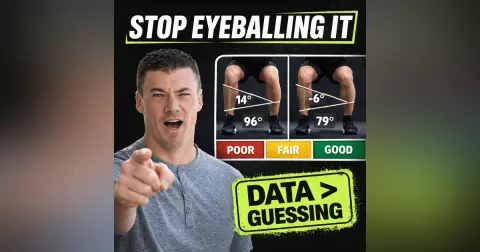


PTs are expected to be the movement experts—yet most movement assessment is still subjective: “knee valgus noted,” “pelvic drop,” “looks better.” Dan Seidler (Business Development Lead, DorsaVi USA) and Maka Lange unpack what changes when clinics can quantify biomechanics with video AI and wearable sensors.
They cover how objective data improves patient education and buy-in, strengthens documentation, and makes return-to-play/return-to-work decisions more defensible—especially as AI, wearables, and non-PT competitors raise the bar for “measured” care.
What you’ll learn
- Why “eyeballing” biomechanics breaks down across clinicians
- How objective data can improve patient buy-in and clarity
- The difference between quick video AI assessments vs IMU sensor “gold standard” testing
- How standardized movement reports can help documentation and communication
- Use cases: mass athlete screenings, surgeon referrals, workplace safety, workers’ comp/FCEs, and early pelvic health biofeedback work
Guest + Links
- DorsaVi: http://www.dorsavi.com/
<p>This episode is part of the <a href="/physical-therapy-business-podcast">Physical Therapy Business Podcast</a>, where physical therapists and clinic owners learn how to get more patients, improve operations, and grow their clinic without relying only on referrals.</p>
<p>Looking for more episodes? Explore the full <a href="/physical-therapy-business-podcast">Physical Therapy Business Podcast</a> for real-world strategies on physical therapy marketing, patient acquisition, and clinic growth.</p>
0:00 But that's the idea. All right, appreciate you, The Voice Guy. I want to say thanks to Empower EMR. If your clinic's stuck on an EMR that slows you down, Empower gives you speed, clean workflows, and features PTs actually ask for. Better notes, faster documentation, smoother operations, all wrapped up in customer support that doesn't ghost you. Upgrade your clinic's brain, that's what EMR really is, right? With Empower EMR, that's empoweremr.com, empoweremr.com. Today we're asking hard questions. Why are physical therapists, the supposed experts in human movement, still describing biomechanics like it's...
0:46 It's a great year, but it's still a long time ago. Here, while AI is quantifying everything... While trainers are capturing slow motion video, while patients are expecting data, most PTs are still writing knee valgus noted at sixty degrees. Our guests today believe that if we want to defend our space in musculoskeletal care, we need to measure what we claim to master. Today, they're representing one of the most interesting tools in movement assessment right now. Let's bring our guests today, Maka and Dan. Welcome to the show. Thank you. Good to see you, Jimmy. How was the intro?
1:26 Did I sort of capture like the goal of what we want to talk about today? Like, was I close or I'm just a podcast host. What do you think, Maka? Nailed it. All right. So let's start with this. What changed about the way movement is valued in our profession? Let me rephrase this. How it's valued just not in our profession, but even outside our profession and with our patients and with the people that we interact with, other professionals or sometimes the dirty word, payers. What's changed about the way movement is valued? Well, I'll start off. I don't know that anything has changed so much, but I think there's a very deep interest in understanding biomechanics, and a lot of people attest to understanding biomechanics and talk about it a lot, but can't really quantify it.
2:19 And I think sort of like made up terms for describing some of the things that they see. And of course, it's like, it's very challenging. I've been a PT for three years. And it's still, it's still very challenging to notice biomechanical faults or defects or asymmetries with the naked eye. And then how to describe them, right? Like how would you do, like describing them from one clinician to another is probably vastly different. Macca, how would you answer that question? How have things sort of changed? I think the competition has changed, honestly. So from PT to PT. So parents sending their kids in, you're trying to figure out which clinic you'd like to go to.
2:59 So I think who's going to assess the mechanics correctly, who's going to assess it differently. So I think that's the biggest thing that's changed. I think we know that valgus is bad. Too much valgus is bad. But I think we need to understand, like, how do you know if it's too much valgus? So I think it's changed. I just know I was just feeling right in a profession where it's not the profession where we'd never, that would never be okay somewhere else. So let's call this out. Are, are physical therapists too comfortable just sort of eyeballing biomechanics? I think some are comfortable. I think some are really busy too. I'll add to that, that, um, some are very comfortable with it.
3:42 Um, I've been a PT for thirty years. And by the way, I don't know that I'm always accurate. Right. But I am comfortable with it. I think I know what I'm talking about when I see a patient with excessive valgus or whatever it may be. But I also think that less experienced PTs are not very comfortable with it and kind of feel like they're guessing a lot. Right. And so what do we do? The question is, like, what do we do about it? So when we add quantifiable data to movement, what changes? What changes clinically? What changes? I'll stop there. What changes when you can actually quantify it? I think your rapport with the patient changes, definitely.
4:23 So being able to explain to them, this is too much valgus, show them too much valgus, speed of valgus. I think your direction of how you're rehabbing someone changes too in what phase. So is it too much valgus during the loading? Is it too much valgus during the landing? That's definitely going to change the way that I'm doing some rehab. I'm an athletic trainer. I'm not a physical therapist. I've worked with various ranges of population, but I think that's what changes a lot. Um, Jimmy, what was your question again? Sorry. Yeah. So, so sort of like what, what changes clinically when we can actually add quantifiable data, like when we can actually say, this is the number and I can do it and I can get to that number reliably and confidently.
5:09 Totally. Well, I agree with what Maka said. In addition, first of all, educating patients is huge. I mean, when you can show patients, this is what's normal and this is what you're doing. Now we have goals and objectives for them to, you know, targets for them to get to, but also documentation for standardization of documentation, right? We're all using the same tools to measure things as opposed to our own Different set of eyes and documentation for insurance companies being able to prove that a patient needs more therapy or has achieved their goals, whatever it may be. Quantifying.
5:49 Yeah, I was going to guess things like patient buy-in, which was mentioned, better documentation mentioned, better communication with other healthcare professionals, with PTs to athletic trainers or to MDs or to insurance companies. And also, I would imagine better outcomes tracking, like changing over time. I remember when I was in clinic, measuring one thing on the same person, twenty minutes later, felt different. Yeah, you open up your joint a little bit. You activate some muscles a little bit. It may change quite a bit. I think the, so you talk about the relationship or like the communication from, you know, the athletic trainer to the PT, the PT to the surgeon, that having substantial objective data is so helpful with that communication because it's not just like my eye looking at this.
6:40 It's like factually, this is where this person is in their state of rehab. I think sports medicine is return to play. So I will always communicate to the strength and conditioning coach, the athletic trainer, the PT, the surgeon, and then the parent too. So it holds that, it holds the clinician accountable, the athlete accountable, and then gen pop patients accountable as well. Yeah, I remember I was a swim coach for kids when I was in PT school and I was using like phone apps, right? That would allow me to put like sort of like a rudimentary goniometer on the screen quickly, easily. And when, you know, teaching a kid like, I need you to bend your elbow. I am. And me to say like, okay, look at your brother and let me show you this angle and yours is this and that number is larger than that one.
7:27 I need you to give me a bigger number and I could show them side by side. That changed understanding, which is simple but not easy. And the competitive nature to you're like, OK, yeah, elbow a little bit further, a little bit more drive, a little bit more awareness. So a real specific use case that we have is we call the AMI, which was developed by physical therapist Trent Nestler. Michael, you want to talk about it a little bit? Yeah, so our athletic movement index, it uses four IMU sensors. So there's two sensors that go on the back and then two sensors that go on the shin. And it's a standardized test. So Trent's dedicated most of his profession to understanding why do ACLs happen?
8:07 How do we rehab athletes back like athletes? And then how do we communicate them back to the surgeons or whoever needs to know this data? And so our sensors are placed on the body. And it doesn't matter if I like you as a kid or if I like you as a patient, you're working hard. the sensors are going to pick up the actual data. So we have them go through a series of movements like planks, double leg squats, single leg movements, single leg hop. And just the idea of it is to standardize the approach and to take all of that subjectivity out of it so we can truly do objective data, truly make our return to play decisions or return to work or return to real life decisions with actual data.
8:50 So it's been really helpful. There's with our system, there's sensors that are placed on the body, but you also have a video feedback as well. So that visual interpretation, that's helpful for the patients. And then you're gaining the rapport from them too. All right. So Mac is already like your telegraph and you're tipping off my next question, which was going to be if a clinic owner or a clinician is listening right now thinking that sounds cool. But man, I've been sold this before, right? Like, do I need another gadget? What would you say? Is it it's got to be simple. It's got to be easy. It's got to be quick. If it's not those things. It's hard to use. So talk to me about what the actual tech looks like and how it works. Well, I can show you right here.
9:32 So here's the IMU sensors. It's just you don't have the sticker on them. So it's an iPad. So it's an app that goes on to your iPad. It's called vMove+. We have two types of technology. So if you're looking for that quick assessment in the clinic, I don't want to put anything on the body, we have video AI. So you basically open up the application, start filming. Our system will place an algorithm over top of the body. We always blur out the face as well to keep it HIPAA compliant. And you can have them do any type of movement that you want. You can have them do a box drop, lateral bounds. I just did a mass testing with baseball pitchers. And what our system will do is it'll calculate the joint angles. For example, we have a module that's called lower limb and we look at the anterior view, auto detects the view.
10:19 Anterior view is going to look at the pelvis, pelvic drop, pelvic hip hike, Trendelenburg, whatever you're looking for there. And then valgus and then tibia to surface. If you have the person face laterally, then it'll pick up the lateral view. So now we're detecting trunk lean, hip flexion, knee flexion, ankle dorsiflexion. So you have the, I'll just give a pretty good example. I think that everyone has used before. um surgeons in this area still will do triple hop tests so we're looking at distance and speed for triple hop tests and symmetry but you're missing out on the kinematic integrity so if you want that kinematic integrity you want to build up the relationship with the doc you want to get the great you know assessments and the objective data you can have them go through the triple hop test but then you're just filming them and getting the actual objective data our system will give you the target values and what you should be hitting So there's that realm.
11:13 It's a five second clip. You open up the app and you just start filming. Then you have the IMU sensors that I just showed you. That's going to be like our gold standard. So we validate everything against Vicon. It's within one to two degrees of Vicon. You place the sensors on the body. I would say this is going to be your go to for like return to play testing. It's a tool in your kit, right? Like I would say, I still want to know, I'm thinking sports medicine. So I still want to know what do they look like on the field? What are they, what does their conditioning look like? Surgeon, what does the graph look like? But with the tech, the sensors, you place them on the body and it's capturing that data for you.
11:57 And it's looking at valgus, speed of valgus, tibial inclination, pelvic anterior tilt, right? So that's some interesting information. Time to stability. So it's putting together a whole like really good case of this is why they should return to back to play or this is why they shouldn't go back to play. And again, it's taking that subjectivity out. But it's a quick assessment. It's about fifteen minutes for a full AMI screen or you can break it down into some single leg movements. And that takes about three minutes. So super quick, super easy. And like, why wouldn't you be doing some objective testing? And then what is just some of the dashboard of the data look like? What are you getting in actionable information?
12:40 Yeah, so you're getting for the AMI, for example, we're putting it on. So when you're actually doing the assessment, it's live data tracings. So you're seeing it live on the screen, how much they're going into tibial inclination. And then when you're finished with the assessment, there's an auto-generated report. And so what we'll give you is red, yellow, green. This is where you're scoring on these specific movements. We'll give you target key takeaways. This is where you should look. If you're going into a single leg hop, and you're going into too much valgus and your hip is going all over the place, our key takeaways may sound something like lack of neuromuscular control, lateral hip weakness. So it's giving the clinicians, where do you need to look and how do you need to work with this patient?
13:25 So it's saving you time with that auto-generated report. And then you can just drop it into your EMR and bill nine, seven, seven, five, zero. And that's, you don't have to do any additional information on that. It's all right there. So we're currently not integrated with any EMRs, but that is something that we're interested in. Um, that would be, I mean, extremely valuable for that to auto-populate. So right now it sounds like a simple copy paste into the appropriate section of the EMR. And that's our, that's our AMI. We also have a run assessment too, which is so cool. No one's doing the stuff that we're doing. It's like ground reaction force during mid-stance, initial peak acceleration during foot strike, which we know is directly correlated with stress fractures, shin splints.
14:09 And then you also get a video AI component. So we're putting the force data together plus the video capability. So you can map out like, okay, during initial contact, this is what your IPA is. And this is what your hip flexion and ankle dorsiflexion is or your knee flexion. So you're putting together a nice story for that patient. Understood. So is this a this feels like it could be a shortcut or a multiplier? Or both? Yeah, test healthy people test patients in clinic, check your progress, Jake, test them when they're ready to be released. For sure. And the shortcut is it's fast. I mean, video AI, five seconds, basically have someone do one or two squats and you can get so much data and information.
14:55 And obviously you can have them do multiple reps and compare, particularly as you give them verbal cues, corrections, and show them how they're improving throughout a session as you told them to maybe shift their weight to the right as they get a little bit lower. Things like that, or correcting their running. But like you said, a multiplier, the amount of information and the quality of data that we get with the sensors is incomparable in clinical. in clinic. So, you know, to get that sort of that level of data anywhere else, I think it's Vicon, which is like you have to be in a studio with eighteen cameras and sensors, all the visual sensors all over the body.
15:39 This is four sensors you just stick on and simple. You can even send somebody out for a run in the park and use that data to show them how they're doing. Or do some online coaching. That's been a big hit lately and that's been interesting. So what would you do there? You would talk someone through where to place things and set that up and then tell them what to do remotely? You would use your video AI. So if you have the video AI application and you're on Zoom right now, I can just hold open my iPad and start filming any movement that I want. And then I can scroll through and teach them like, hey, during your single leg squat, you're going into valgus here, you know, looking at the shin angle versus the trunk angle on your on your squat from the lateral view.
16:23 There's no good story without tension, right? There's got to be pain that you're solving. So let's ask this. If PTs or healthcare professionals don't evolve their movement standards, what happens to our positions in MSK care? I feel like we just did an episode on this a couple days ago, which is everywhere else in medicine, which we like to say movement is medicine, everywhere else in medicine is highly measured, right? Blood tests and blood pressure, things are measured very, very precisely. And maybe in our professions for a while now, we've just said, you know, good enough or things like about or we all know how accurate a goniometer is or is not, right? Where's the tension in the story?
17:04 What happens if we don't evolve towards something like this? already happening right i i think the value of pts are just not valued as highly as they should be with the with the amount of value that they're actually adding to the healthcare system um showing the numbers quantifying is one of the pieces of the puzzle that can can help add to our story um The other part is efficiency. That's really where I'm targeting a lot of my energy, which is if you can observe somebody doing certain movements, a video AI with the use of AI algorithms can help PTs in their decision-making process.
17:52 Now, that might be scary for some PTs, like now I'm being replaced by AI. No, you're being enhanced by AI. You're being optimized, and you're you know you're still the decision maker as the pt but now you have a now you have a partner an agent who's helping you in that decision making and we're really honing in on that now well i think like i mean everyone's tracking everything or rings apple watches so if you're not jumping on board they're going to find another clinic that will i was just having a conversation about this which is The answer is usually fear or ego or uncomfortableness or imposter syndrome, right?
18:32 Like... I would never put together an affiliate list to suggest products to my patients. That would be ridiculous. But half of your staff on the way out the door saying, well, what would you get for this? And you'd say, oh, I do that. Just go on Amazon and search this. But the fact that you'd curate a list to do that is blasphemy. The thing is what we've known or I've seen in history, the things that are blasphemy now, are commonplace several years later like and it's usually the people who embrace the thing that's scary or uncomfortable or blasphemous are the ones that usually i don't know i would say get ahead but like usually get ahead or stay that's the reason they are ahead Yeah.
19:15 Why don't you say that I'm actually working on a partnership with a product company that that can be something that we might integrate to into our products. Like as, as an assessment is done, as analysis is done, a product could be recommended to patients right there. Ultimately, there, we could even include links and make it really automate exactly that I'm a big fan of not necessarily endorsing products, but suggesting products to patients. I think it's knowing who your patient is too, right? Like if there's someone who like runners, they're typically going to want to know all of the data right here, right now, they'll tell other friends about it.
19:57 Um, if it's someone who's not as tech savvy, maybe I wouldn't recommend it. I'd still do it in the clinic, but, um, maybe not at home, but you just have to know your patient for sure. Understood. What didn't I ask or what are some frequently asked questions that you get that we didn't cover from people that are leaning into adopt something like this that maybe we didn't talk about yet? Mako, maybe you want to talk about some of the use cases that we've already deployed or that are in clinics and with sports teams and other groups now? Yeah, so the system... typically we will sell the system to clinicians um a lot of the time so when i worked for a large outpatient division i'm not a pt i was trying to build a cash pay program i didn't want so i'm an athletic trainer i didn't want to be on the sidelines so what i did is i did mass testings out at the schools so i was capturing healthy individuals so i was bringing the system out capturing healthy individuals that's getting my company's name out there my name out there so if and when they do get injured they can come see us because we have that baseline assessment We typically charge cash for that.
21:10 And then we get gained referrals off of it too. So it's a tool in your toolkit to gain referrals. I also brought it into surgeons. So we have a number of surgeons referring directly in for our AMI assessment at six months post-op, whether they were our patient or not. So that was a great opportunity for us to say to the patient, hey, do you want to continue to work with us or while we have this test and we keep you on track? or we can send these results over to the PT. So it's not only are you capturing data, it's a great referrals like tool. So outpatient referrals into with the docs, current patients that we're using the system on.
21:50 Yeah. Anything else, Dan? Yeah. Yeah, I mean, we also have workplace safety modules and sensors. So a bunch of companies are actually using our sensors in the workplace to monitor at-risk employees in factories or assembly lines, things like that. Return to work, of course, we're working on workers comp, building a partnership with workers comp software company to facilitate FCEs. That's something that is a huge headache for a lot of PTs.
22:33 Could be a six hour test where we have this idea that we could narrow it down to four hours easily, maybe somewhere between two and four hours. And Mac, I'm not sure if you could talk about it, but women's health. So we're just in the very early stages of working through pelvic health. So we have a spine module. Our spine module assesses active range of movement of the spine. So flexion, extension, lateral flexion, rotation. And now we're adding in an EMG sensor. So for instance, I had an IMU sensor on my spine capturing the movement. And then I had an EMG on my transverse ab and then one on my QL. And so what it's showing is biofeedback.
23:15 So it's showing me, oh, I'm lighting up through my back a little bit too much when I should be using my core. So being able to see that data on the screen has been really helpful. Those are early stages. It's something that we'll release with our spine module here in a little bit. But the thing I think What we do really well at Dorsivee is we listen to our customers. So we have been in pilots with our large outpatient divisions to understand what do you want to use? What assessments are we lacking? How would you like to assess these patients? And then we'll capture that information and actually add it to our product. So the EMG sensors are coming soon. It's really exciting. Yeah.
23:56 This is the direction things are going, right? I mean, what used to cost a hundred thousand dollars in a lab with force plates and things you had to place on people. are now going to be measurable by my doorbell camera, right? Yep. Yep. Exactly. Exactly that. And we look at it as the â I've been with this company for a few months now, and I really thought the whole thing was about the sensors and the hardware. This is a company that developed the hardware to really high standards, but it's really a software company. So what we can do, like Maka said, is we can listen to our customers and customize just about anything when it comes to measuring human movement.
24:40 And that's super fascinating. You know, I've always been, I've been fascinated by that. Like when I was a kid, you know, you'd see like robotics and things like that. As I got into PT, I was like, this is the coolest part of PT, looking how people move. And then like being able to like really understand tech it out and measure it and then apply it. That's, that's awesome to me. Perfect. All right. We have a tradition on the show. It is called the parting shot. This is the parting shot. One last mic drop moment. No pressure. Just your legacy on the line. I do want to say thanks to U.S.
25:21 Physical Therapy. If you're tired of working for companies run by people who just don't understand PT, at U.S. Physical Therapy, they're clinician-led from top to bottom. It means your voice matters, your growth matters, and your career can actually feel like yours again. Explore opportunities right now at USPH.com. That's USPH.com. Two guests means two parting shots. Who wants to go first? I should say, who wants to go second? Because usually it's harder to follow up. But parting shot, what would you leave the audience with? What's your mic drop moment? Ladies first, Macca. Okay, my mic drop. So being in sports med, I would just say rehab athletes like athletes.
26:01 Use the objective data. Don't use just your eye. Use our sensors. Use the video AI. Build the relationships with the athletes. Build the relationships with your patients. And it'll be so much easier for you for the long haul. And they'll come back if they need you again. But rehab athletes like athletes is my mic drop moment. All right. I am a practicing PT, so I feel your pain out there. Using this Dorsibee system has made my life easier as a practicing PT for education patients, documentation, and facilitating decision-making.
26:43 We have to think about so many things as a PT all at one time. Having a partner in the clinic with me has been super helpful. Awesome. And if people want more information, we'll put it in the show notes, but where would you send someone? They can go to our website, dorsivee.com, or they can connect with me directly, mstewart at dorsivee.com. Perfect. All right. Dan, appreciate the time. Thank you, Jimmy. This was awesome. Keep up the great work, man. Appreciate it. That's it for this one, but we're just getting warmed up. Smash follow, send it to a friend, or crank up the next episode. Want to go deeper? Hit us at pgpinecast.com or find us on YouTube and socials at pgpinecast.
27:29 And legally, none of this was advice. It's for entertainment purposes only. Bullshit! See, Keith? We read the script. Happy now?