Proprioception Isn’t Optional
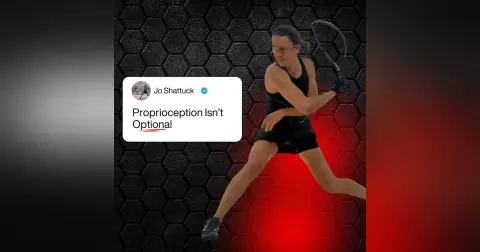


Former Top 10 Pro Athlete → Neuroscientist → Startup Founder
Dr. Jo Shattuck’s journey is wild: from cleaning carpets while living in a camper… to becoming a world-ranked athlete, then a neuroscience PhD, and now the founder of PantherTec. In this episode, Jo breaks down how we’ve been teaching movement wrong — and what proprioception, kinesthetic dissonance, and wearable tech have to do with fixing it.
???? Learn how PantherTec’s CAT device is helping athletes, patients, and clinicians unlock real body awareness — not just motion but meaning.
???? Topics Covered:
- What proprioception really is (and why most people don’t train it)
- Why your “internal body model” determines performance and safety
- How kinesthetic dissonance is changing rehab and movement coaching
- The limits of verbal cues and video — and why “feel” matters more
- How PantherTec’s tech is creating ah-ha moments in just minutes
- The true cost of wasted reps — and how to eliminate them
- Plus: chainsaw stories, social proprioception, black panthers, and one killer parting shot
???? Clinicians, athletes, coaches — if you've ever said "they just don’t get it" during a session, this episode is your wake-up call.
<p>This episode is part of the <a href="/physical-therapy-business-podcast">Physical Therapy Business Podcast</a>, where physical therapists and clinic owners learn how to get more patients, improve operations, and grow their clinic without relying only on referrals.</p>
<p>Looking for more episodes? Explore the full <a href="/physical-therapy-business-podcast">Physical Therapy Business Podcast</a> for real-world strategies on physical therapy marketing, patient acquisition, and clinic growth.</p>
0:00 You're listening to the P.T. Pinecast, where smart people in health care come to make noise. Here's your host, Jimmy McKay. Thanks, VoiceOverGuy. Big thanks to Empower EMR. If your clinic is stuck in an EMR that slows you down, that's not forever. You can just get a different one. Even if it's like, oh, getting a new EMR, that would be so frustrating. Yeah, it's that or dealing with the one you have now. Empower gives you speed, clean workflows, and features PTs actually asked for. which is nice. Better notes, faster documentation, smooth operations. Every time I say smooth operations, I hear that song, Smooth Operator, from like the eighties.
0:41 All wrapped up in customer support that doesn't ghost you. EmpowerEMR.com. That's EmpowerEMR. Just look. Just look. Take a look. Today, Our guest spent over a decade ranked among the top ten athletes in the world. I'm not even the top ten athletes in this room, and I'm in a room by myself. And when she wasn't dominating on the court, She was cleaning carpets at night to fund the dream. I love the hustle. Then she went all in on neuroscience, turned her PhD into a mission, and now builds tech that trains the one thing we never do in clinics, proprioception. From camper living to cutting edge motor learning, let's meet the founder of Panther Tech, Joe Shaddock.
1:25 Joe, welcome to this program. hey what an intro huh i'm like i have a rule i have a rule what's that the rule is if if there's ever a baby or a dog on screen you have to at least introduce the baby of a dog so who's over your shoulder well we've got two there is his name is sparrow s-p-e-r-o and he's wearing a cone of shame because he he likes he's got a little skin wound and he's like to lick it but His name stands for breath or light or hope. I like it. Yeah. Perfect. All right. So where do we kick this thing off? Where are we or why are we teaching movement wrong, Joe? What are we doing wrong here?
2:05 Help us understand. I'll tell you. Can you see a feeling or hear what something feels like? You know when you have that perfect swing or shot or posture or in sport, of course, but whatever it might be. You can't describe a feeling. It's like and I might have said this before. It's like if an alien came down from space and said, I want you to tell me what salt tastes like. What would you say? Salty. Yeah. What do I do? Right. Yeah. Right. Right. And that's why we struggle so much with trying to describe how efficient kinematic chain is. effective movement feels like is because you can't describe it but when you get it boy you just can't help but chase after right right so right now we use words and metaphors and pictures and say jimmy make look at that guy can you do what that guy's doing or push pull extend stretch to get you to do the thing we want you to do to feel the thing we want you to feel um it's just not very good words and pictures are just they they require the language processing centers of the brain and What you say, pull here might feel different or be a different definition than what I say.
3:12 So I saw a gap and I'm like, I want to see if I can fix it. That's all. Okay. So I understand that why we're sort of. not aligned on the way we teach it. So you said we don't train space. We don't train speed. We do treat, treat or train speed, power and attention. We don't train proprioception or feel why not. And then how the heck do we do that? Right. I don't know why is because it's, it's like the foundation of navigating your own body through the world. Right. Um, You're right. We train everything else, speed, strength, attention, focus, all the things, timing.
3:55 But the way that you perform well at all those other things is to have a mastery of your own body and time and space. And we don't teach that. We try. You remember the head, shoulders, knees and toes, knees and toes, little kid. OK, I know. Anyway, that's kind of the beginning of it. Like, oh, yeah. Crossing the midline with, you know, development age athletes, those types of things are kids. But we just kind of stop and we assume like, well, you know, if you're good enough or talented, you'll just pick it up on the way. And that's why Johnny sits on the bench all season. And the other one, you know, is a star quarterback. But I disagree. I think proprioception is a skill. It can be trained on the fundamentals of neuroplasticity, period.
4:37 And if we don't do it, we lose out. Here's a phrase I don't think I heard in PT school, but I was also in the back of the room the second and third year. Kinesthetic dissonance. What is that? And why is it powerful? And then I'll figure out how the hell I missed it in PT school. Oh, I love it. I love it. Well, you wouldn't have heard it in PT because I can brag a little bit. We made it up. Yeah, those are the best. So you've heard of obviously cognitive dissonance, which is conflicting beliefs at the same place. And the mental gymnastics you have to do to hold those two beliefs at the same time.
5:21 Right. Kinesthetic dissonance, it's a cousin of that. It's not the same. You can't actually be in two places at once. But when you think that you're, for example, here with your racket prep, I'll just go racquetball, but you're actually here. That's a problem. And unless you bring awareness to where I think I am, to where I really am, you're playing, you're trying to steer a car that the steering's off or the URT on the map is pointed the wrong way. If you can't navigate your body around the world or the field or the environment or the warehouse or space, if you don't have an accurate model of where your body is in time and space.
6:01 And that's where kinesthetic dissonance comes. That's what it is. It's that. There wasn't a term. You sort of had â you were like, hey, there's this feeling. There's this idea. I need to slap some words on it, and that's how phrases are born. You mentioned racket in the intro. I mentioned top ten athlete in the world. It's not bragging if I ask you to talk about it, so â Talk about what you were top ten in the world. You know, I mean, how many top ten in the world of anything did we get to meet in our day? Not many. Well, awesome. Thank you, Jimmy. I'm going to have a problem with leaving the room because my head's going to be so big. So racquetball is not like other racquet sports. It's kind of redheaded stepchild. There's no money in it. It's kind of the beer drinking crowd as opposed to squash or tennis.
6:42 Right. So you had to do a lot of other things to. Support your racquetball habit, like you mentioned in the show. Yeah, I played for thirteen years straight, missed one tournament because I got the wrong date. And near the end of my career, I peaked at number six. But I stayed in the top ten ten years. And it's such an amazing sport. Have you played, Jimmy? I've played a little bit. My dad's firehouse had a racquetball court in it, and he was so damn good. So I played. I played, you know, I've played a little. Not well. Yeah. Well, it's a mate, right? So it's not like tennis where you're like, hey, Bob, how was life? No, you're bumping around and running around your opponent, which is odd.
7:24 I mean, for that type of sport, I've played hockey. I'm bumping into my opponent. But in tennis, in squash, in badminton, in other racket sports, you're separated by a net. And I don't know, to me, racquetball is Thunderdome. It is. And it's three-dimensional. It's complex. It's like chess. It's eight surfaces. The ball, it's loud. It's aggressive. I mean, you can see why it got so popular, especially with the youth back in the day. Wait, wait, wait. You said eight surfaces. What are the eight surfaces? Well, you got your four walls, one, two, three, four.
8:07 or maybe six, and then you got your floor. Okay, I got nervous. I was like, maybe I wasn't playing racquetball correctly. I was like, maybe this is why you're top ten. I'm thinking six, and you're thinking... I'm playing checkers. Joe's playing chess. What did being... What did being... a top ten at anything, but we'll say with racquetball, what did that give you that you took elsewhere? What are the types of things, skills, that you were able to translate into neuroscience or the other aspects of your life? Well, first, let me qualify that by saying I don't think it's necessarily healthy. People on the overachieving disorder spectrum, which is kind of what I call it, and in no way do I mean to...
8:52 disparage real disorders that have really consequences. But you wake up and you think, in fact, our company motto is, if you wake up thinking about how to get better, we get you. And that's it. It's just singular focus on this thing. And my wife, she's like, hey, remember me over here? So I often have to remember like, oh, yeah, right. There's other things. Great at doing that. But yeah, there's other things than that. And I didn't realize that till after I retired December eight, two thousand ten. But who's counting? There was a whole other world out there. Yeah. Yeah. Do you want to thank our friends that we'll be seeing at CSM in just a little bit?
9:33 US Physical Therapy. You've built something special, but scaling your clinic and planning for what's next can feel overwhelming. At US Physical Therapy, we partner with clinics who want to grow without giving up their identity. You stay in control. We bring the support. Find out more at usphpartnership.com. That's usphpartnership.com. So now you went from racquetball and Thunderdome with a racket in your hand, and you went and got a neuroscience PhD. After that, you're in startup mode. And what do clinicians need to know from each of those worlds? I want to go a little further in the story. okay well uh near the end of my racquetball career i realized that um i can't do this forever obviously so i got a master's in sports science and that kind of kind of it learned all the words for all the things that i've been training with and doing for your shaking your head i'm like i didn't know this had a name and and a theory and a framework behind it right so that And then I'm like, well, I got to do this, this neuroscience thing, all about human performance.
10:39 So I went and did that in Nebraska. And I guess the, put me on the spot here. What do clinicians want to know about, or what do I think would be valuable in their practices? Is that the question? Yeah. Oh, okay. I think that it's funny how we separate like rehab movement and control from ping pong mastery and control from lifting a box or working on a warehouse. Like we separate all that out in these little silos and I understand it, but it's not helpful, right? If you're trying to feel a certain sensation that you want to recognize in whatever task you're doing, learning sit to stand or stand to sit, reaching for a glass, any of the tasks that we do, it's still the same body neurophysiology that you're dealing with, because you need to know where your body is in time and space.
11:31 And time is important, right? Time and space, because you can't. close your hand before you reach for the glass, right? That's a functionally dead movement, right? So I think if we, we as a community and I'm not a clinician, um, look at stop isolating a movement to a certain task and, uh, whether you're in the clinic or all those places I mentioned and look at it as like a whole way, the body operates in the world, in the whole world, not just when they're there in your clinic for half hour. Um, The actionable advice on that is why we built the CAT, kinesthetic awareness training, is to merge where you think you are or you actually are with the task that you want to do.
12:14 And so it's immediate applicability, is that the word, to what you want your client to leave your clinic with. Understood. Does that make some sense? Yes, and then you went right into my radio segue to my next question, which is, so what does this thing do? Talk to me about Panther Tech and CAT, and how does it actually train proprioception? This is where you get to pitch now, Jill. Tell us what this thing is, and what do we do? Okay, so the CAT comes on a little device like this. It looks like this. Actually, I have one on right now. It looks like a beeper from the night, from the eighties, a little bit smaller.
12:57 And it's a mix between a motion capture sensor, single site motion capture sensor and a shock collar, but don't, don't freak out. It doesn't shock anybody. It responds to whoever's wearing it. They're real time movements with beeps and vibrations that guide them into and through a movement. It's completely operator driven. So it's not a whole database of we think we're going to teach you how to swing a baseball bat or do a knee extension. Like, no, it's not that. It's a communication tool for an athlete to listen to a coach or a patient to listen to a clinician or a worker to listen to a crew chief or soldier to listen to captain. It's a communication tool for movement educators to use with their clients so that the ambiguity of words and metaphors and pictures is gone.
13:45 It's designed for Short term, low rep, high focus use, out of context, meaning we have a lot of players that do their athletes and patients that do it in the hallway or in the living room. So you don't need a big motion capture sensor. You do it for a few minutes before you go into your craft. And it's run by, let's see, where did I go? Oh, iOS, small portable device, iOS or Android. And it's a tool that helps people. I hate to use the word muscle memory, but accelerates muscle memory is what it does. Understood.
14:27 Now walk us through, how does it work? Who's using it? How are they using it? What are they looking for it to do? I understand sort of rudimentarily what it looks like and what it can do, but like what's it look like, feel like, taste like in action? I'll pull it out right here. So here it is. It's on right now, right? Essentially how you would use it is you put it on your person. I'll just tuck it right back here. And if I wanted them to learn, for example, a sit to stand transition, what I might do is capture this position. So it learns. We press a button on the app. It learns what you teach it. Just like saying, yes, Mrs. Smith, that's how far I want you to lean over before you stand up for your transition.
15:10 As you do that, you press a button. The thing remembers it. And then in your in your. putting it into context, you say, okay, I want you to lean forward and find the beep, beep, beep, beep, beep. Oh, okay. I wasn't going far enough or I was going too far. And so in the moment that you teach the movement with the words and metaphors and all that, it gives us physical sensation, vibrations on the body that directly communicate what that should feel like. It feels like this, beep, beep, beep. Okay, now I can stand. Beep, beep, beep. Okay, now I can sit. But You can wear it anywhere on the body. We've used it on the top of the foot for dorsiflexion and drop foot. Use it on the hip for hip rotation, obviously posture.
15:51 Use it on the head for some baseball and hockey and cervical dysfunction patients. Used it for, what's it called, hip drop? Yeah, Trendelenburg gait or hip drop. Yep. Yeah. And so you can set it to either provide feedback when the patient is doing it correctly or provide feedback when they're doing it wrong, meaning a habit that they don't know that they're still doing. Right. What else? I would say, what's the goal? What are the goals? And what's the output mechanism? What's the feedback? How do I get better? So you're saying it's giving you feedback in session versus watching video later.
16:38 I can't feel that video, but I can say, okay, my racket's low. But I want to know what it feels like when my racket's right. I want to know what it feels like, not just what I think I look like. Do I have that? Yeah. Okay. Yes. So the, the, the way to think about like the outcome measure that the thing is when you want your, your Ashley athlete or your patient to know what it feels like when, and you as the operator or the coach or the clinician get to decide what that when is, or, or when I have proper balance, when I sit to stand transition, when I don't drop my foot, when I'm keeping my core engaged, when I'm walking, so my hip doesn't drop.
17:19 When I'm doing a lateral lift and I don't lift my shoulder up, I actually do the exercise properly. So it's designed to, the outcome measure is, oh, my patient feels this, gets to feel the thing I want them to feel. So they get better at whatever the thing is. And it's just minutes. It's really, it's remarkable. I say so myself, how when you're, when a patient gets it and you get that, oh, either in sport or whatever, that's where the speeds, speeds the path to that point and then nurtures it so that they don't do wrong. I'll say wrong reps, but every rep. I remember when I was a PT student is watching really great experienced clinicians.
18:04 they do less, less talking, less guiding. They do so much less. I remember sitting there looking and I'm like, how the hell are you doing more with less? How do I do that? And the answer is cut away everything that doesn't need to be there. And it's hard to translate a feeling to... to words which is why i was i was taught why cologne and perfume ads look like the weirdest thing ever it looks like someone wrote it while they were on peyote and the answer is because they're trying to share what something smells like through tv and that's right impossibly difficult so it sounds like you're trying to speed that process up By more show, less tell.
18:48 More feel, less tell. Beautiful. More feel, less tell. That is maybe the best example I think I've heard about how the mechanism works. It's like you can't show how something smells. Correct. That is wonderful. Can I steal that? Hell yeah. Steal away. Oh my gosh. That's amazing. That is amazing. I thought my selfie was clever, but that's even better. So who do you get excited? Where is Panther Tech? Where is the cat now in terms of, because it's a startup, can someone buy this tomorrow and should they be using this tomorrow? Where are you in the process? They sure can. So the three verticals we have are sports, which we're embedded already.
19:30 We're in some major league teams, a lot of inquiries there, everything from youth basketball to national basketball camps, to baseball, tennis, all the things. Workplace safety, which is kind of a cousin, I guess, to occupational health, right? Because that's how you move, not just in the clinic. And then the clinical space. So I was faculty at CU Anschutz for four years in movement disorders. And that's where we kind of started piloting the technology there in clinical space. So if you're a rehab person, you can buy one now. I'm sure the website's on there. The beauty of it is that we've done some case studies. I'll share some partners. Quality Living Incorporated is in Omaha, Nebraska.
20:13 Carl Sterling up in upstate New York. He's opening his neuromotor training institutes. They use it quite a bit. Got Hansberger Physio up in Canada. They do a lot of athlete stuff and half a dozen other institutes. you know, single single point clinics that are small groups clinics that use it. So we're always looking for new ways, new new use cases to use the cat. And so instead of and we are a tiny startup. So this is not like, oh, make an appointment. Just just put my email on there. Just reach out. I'll talk to anybody at any time about how to use the cat. I'll put it in the show notes. But what is the website you want people to to go to?
20:56 It's Panther, T-E-C dot net, PantherTech dot net. The joke is we couldn't afford the H at the end of tech. Leave off the last H for humble savings. Yes. Oh, that's good. That's good. And side nerd note, PantherTech actually stands for Principles of Athletics and Neuroscience Towards Human Expertise Plus Technology. And CAT stands for Kinesthetic Awareness Training. You guys got it all figured out. All right. What's one thing you want PTs, who's our audience, to do differently tomorrow after hearing this outside of looking into Panther Tech? But what else? What's one thing you want them to do differently?
21:38 Okay. I guess the best thing you could do is to be aware of when your patient isn't getting it and it by the rehabilitative movement that you know they have to do this way or else it's going to be a waste of time. If you skip exercises because they're not getting it or you run out of time or they just don't get that feeling and you wish there was a way to, I wish I could make this person feel this thing. If you have that more than once a day, that's a reason to grab the cat. That's a reason to get it. Really low price point. For the clinical model, it's three hundred fifty dollars and you get to add up to five coaches with it.
22:20 Again, not a sales pitch, but as movement educators, we are trained to keep an eye on what is this person doing and feeling and how can I make them experience a sensation, recognize it so that they can replicate it and then put it in their normal life. Right. So If you have pain points like that, reach out to me. I'm happy to help. Perfect. All right. Joe, you're an athlete. You're a competitor. Are you ready to play a game? We call it Know Thyself Body Awareness Edition. Let's pay the bills real quick. All right. Thanks to our sponsor, Sarah Health, the remote care platform helping clinics boost revenue without adding staff.
23:06 Sarah automates daily patient check-ins via text, no app, no logins, just better outcomes and revenue. Who wouldn't like that? RTM compliance made simple. SarahHealth.com. That's S-A-R-A-Health.com. So you got to know thyself. for this game. What's harder, teaching movement to athletes or explaining proprioception to clinicians? What's harder, teaching movement to athletes or explaining proprioception to clinicians? Can I say it's a tie? Yes. Okay, it's a tie because the athletes are intrinsically motivated to move to do the thing.
23:49 That's what they're doing. And clinicians are maybe motivated to get another person to do something else. That's my first. When's the last time, Joe, you physically surprised yourself? Oh, I like that. Let's see. Oh, jeez. Well, I was using a chainsaw two weeks ago to cut up a tree that we had a big windstorm here in Evergreen, Colorado. Big old thing fell. And don't tell my wife, but it was on and I accidentally caught my pants and it didn't hurt me or anything. But I was like, oh, that could have been bad.
24:29 That reminded me about getting older and having to maintain mastery of my sensory motor space. Yeah. You coined a phrase that is... kinesthetic dissonance, I coined a phrase in PT school where I learned what proprioception was. I want to hear your thoughts about the phrase that I coined, which is social proprioception. The idea there is some people don't know how to present themselves socially. They lack social proprioception. Maybe they're a close talker. Maybe they talk too much. Maybe they don't know how to read the room. Social proprioception. Thoughts on my phrase? Fantastic question.
25:10 I would say it's a cousin. Proprioception is an internal focus of knowledge of where you are in space and time. And how you interact with the environment. I would say social proprioception is more of reading external information, not necessarily sensory input. But that is a great phrase, social proprioception. We have a book in my family. It's like, really? Yeah. I give people the heads up. It's why I do it where I still sound at least like a clinician. They'll say, what's that person like? Well, they're a little lacking in social proprioception, but we'll get there. We'll give them a little more feedback.
25:51 Last question. If proprioception had a mascot... What would the mascot be? It would be a black panther. Are you kidding me? Okay, got it. Why? Here's a panther. I don't know if you can see. There it is on the tattoo on the ink. Why the black panther? Where did that come from? Because have you ever seen how a panther moves? It always knows where it's got to be, yeah. Oh, man. And just the evolution that took from two cells to turn into, and that's panther, obviously. I wanted to be a panther when I was a little kid. But, yeah, so if it had a mascot, it would be, intentional no wasted movement one hundred percent awareness and mastering control all the time love it all right last thing we do on each episode joe is called the parting shot uh-oh this is the parting shot one last mic drop moment no pressure just your legacy on the line No pressure.
26:52 Can't be as pressure filled as you were, you know, when you were top ten in the world of ragged ball. Just whatever, what's the last thing you'd want to leave with the audience? Your mic drop moment, your soapbox statement. What's your parting shot, Joe? Motor, moving around the world is universal and ubiquitous. There's no point in your life where you stop learning how to do new things or move your body in the world for a fill in the blank task. Everybody does it from the time that they learn their own fingers when they're a tiny little baby to the time that they learn how to navigate with now a body that's not as strong and flexible and malleable as it used to. So it's a lifelong adventure.
27:32 And I'm not like, you gotta be fit for every day of your life. It's just being, paying attention, controlling your own body, mastering space and time. That's my parting shot. Boom. Joe, way to drop the mic on your way out the room. We've got the link in the show notes. Give that a click. Have a conversation with Joe. I really wish you were a little more extroverted. If you had a little more personality, it'd be better. You know what I'm saying? Talk to Joe about this. You could tell. She's not shy. She loves it. She knows it deeply in every direction. Joe, thanks for doing this and focusing on this for athletes and people of all kinds. Jimmy, I am so grateful, so grateful. I'm going to look up each and every one of your sponsors and give them a look, too, because I really appreciate what you're doing.
28:15 Education is huge. And with all the crap out there, it's refreshing to be on here. Thank you for having me. Joe, appreciate it. Thanks for the time. That's it for this one, but we're just getting warmed up. Smash follow, send it to a friend, or crank up the next episode. Want to go deeper? Hit us at pgpinecast.com. Or find us on YouTube and socials at pgpinecast. And legally, none of this was advice. It's for entertainment purposes only. Bullshit! See, Keith? We read the script. Happy now?