Payment, Reimbursement, and Grandpa the Mailbox Guy
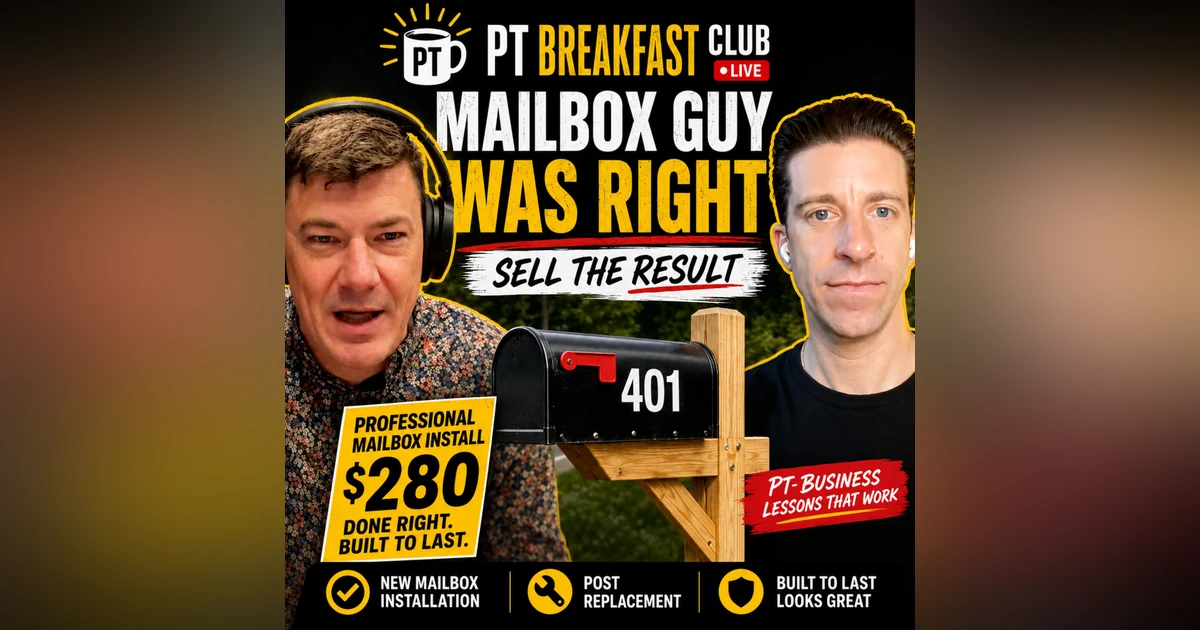



This episode of PT Breakfast Club starts with Jimmy McKay reporting from Prompt HQ after a trip to Portland for APTA’s Payment Summit and House of Delegates.
Jimmy explains how he got in trouble for live tweeting the House of Delegates, why he likes the word “payment” more than “reimbursement,” and what it felt like watching the profession debate policy language in real time.
Dave Kittle pushes hard on the bigger question: has payment advocacy actually moved the needle for physical therapy? If insurance companies and Medicare are not meaningfully increasing payment, should more PTs stop waiting and build direct-to-consumer cash-pay offers?
Tony Maritato adds the counterpoint: maybe some advocacy success is measured by slowing the decline, not producing giant wins.
Then the show turns into a business strategy clinic thanks to Grandpa the Mailbox Guy.
For $320, he solves the whole mailbox problem. No hourly rate. No overexplaining. No “here are the 17 steps.” Just a clear result at a clear price.
The crew applies that lesson to PT, including grab bar installation, home safety consults, cash-pay evaluations, AI content ideas, therapist recruiting, viral video formats, and what practices should do when a clinician calls out sick.
The takeaway: keep it stunningly simple. The customer does not want your process. They want the problem solved.
<p>This episode is part of the <a href="/physical-therapy-business-podcast">Physical Therapy Business Podcast</a>, where physical therapists and clinic owners learn how to get more patients, improve operations, and grow their clinic without relying only on referrals.</p>
<p>Looking for more episodes? Explore the full <a href="/physical-therapy-business-podcast">Physical Therapy Business Podcast</a> for real-world strategies on physical therapy marketing, patient acquisition, and clinic growth.</p>
0:02 Broadcasting way too early from three separate Wi-Fi connections. It's PT Breakfast Club with Tony Meritato, Dave Kittle, and Jimmy McKay. all right welcome to pt breakfast club live stream and i just realized i left my coffee somewhere on the train i just looked for like where where is it i have the laptop though don't leave the laptop and bring the coffee leave the coffee bring the laptop tony maritano on a beach are you at a lake you're the ocean where are you we're at the ocean we're at hilton head the boys are out there fishing in the surf right now so i didn't want to leave them alone Perfect.
0:43 And Dave Kittle, Dave Kittle somewhere. He's not in the bluegrass country again, is he? Not that I've heard of. All right. What do you want to talk about? I just got back from a road trip and a half, man. I did all sorts of APTA stuff and then I got on a train this morning and headed to, I mean, good product placement, right? I'm at the prompt headquarters in their podcast studio. The podcast studio. Wow. They've got a dedicated podcast studio. I walked in last time I was here, and I was like, it's all the toys in the background that people like Jimmy McKay play with. Microphones, cameras, and doodads, and power banks, and things like that.
1:24 But I got in trouble. by APTA. I broke a rule. I broke a rule. I didn't know I was breaking. So, all right. So this past weekend I was in Portland and it was APTA's house of delegates, which is like their Congress, you know, where laws, you know, get made and, and their payment summit. So payment summit came first and that's that the turnout was, I mean, I guess shouldn't surprise us for a long time. APTA critics are saying you're focusing on all the wrong things. Money focus on money will solve everything else after money. So this was an entire two day deal all about payment summit. whole thing the thing that surprised me four hundred and fifty people signed up for this and flew all the way to portland so was anything solved no but it's never solved in one conference right but a bunch of people get together you'll never know what happened in that room for six months eighteen months twenty four months the fact that it's happening and the fact that it's not called the reimbursement summit it's called the payment summit automatically for someone like me who loves naming things and words fantastic but four hundred and fifty people signed up for that thing and headed out there um so let's get dave in here dave would love this too there were there were more than a few i know it was the payment summit right so you think third-party payers uh but there are more than a few cash practitioners out there at the APTA event as well.
2:47 So the people like Dave Kittles of the world getting excited too. They're like, what do we need to summit for? You give me money. I give you QR code. What's the problem? We just swipe. Very simple. The reason I got in trouble was the next part of the weekend was APTA's House of Delegates. And I'm not a delegate, but I'm just in the peanut gallery. And of course I'm listening and I'm heckling or why are we talking about this? And I'm live tweeting what's happening. And then at the lunch break, they come on the big loudspeaker and they're like, we've been given reports that people are live tweeting what's going on here. And I was like, nice, that's me. And they're like, just a reminder that is against the rules.
3:30 You're not allowed to do that. So you're not allowed to do that. So I got in trouble. But what do they got to do? Put me in LinkedIn jail? So I stopped. But also because a lot of this stuff was a little over my head. But I cheated. You guys would appreciate this. I uploaded the hundred and forty page PDF to Claude. And then I sat there and I was like, all right, we're on RC for. What does this mean? Give it to me in eighth grade language. Why should I care? You know, is this going to pass? Yada, yada. And Claude was able to walk me through everything. So that's how Jimmy got in trouble at APTA this weekend. But we kept Portland weird. Let's put it that way. Real quick, it drives me crazy.
4:11 So my wife does social media for a local theater group that my kid's in. And every single show, they do three big shows a year. Every single show, it's the same argument. We need to show the audience what is happening, what is coming, what you're coming to see. Like, these kids are phenomenal. This isn't like a typical high school show. These are like professional kids. Many of them have gone on to be on TV shows and other stuff. And we're like, they don't want to spoil the surprise, right? but i'm like the parent these are parents coming to see their kids they're coming no matter what if you make it and show them how incredible the sets are they have like a thirty five forty thousand dollar budget for every show you show them how incredible the sets are the costume the design live orchestra in the pit But they won't do it.
5:08 They're like, no, we're going to ruin the surprise. We need the big reveal. We can't do it. And it drives us insane because we know we could sell out every show if people could just see that. Perfect example is every single inning of every single Savannah Bananas baseball game is streamed live on YouTube. And they still sell out one hundred thousand seat stadiums. Yeah. Yeah. Oh, I was at an APTA event when I was a student. I was like, why don't they record or share these things? If we record or share them, no one will come in person. Hello? Oh, the music industry is on line three. Apparently, when you download a song, you never go to see that band live.
5:50 Dave Grohl was famous. for saying i brought this up a couple weeks ago on linkedin when napster came around uh kids napster was like a free spotify that you never had to pay for or listen to ads uh when napster came around ironically metallica the biggest anti-culture and anti-establishment band was like was pro-regulation. And Dave Grohl was like, listen, guys, you're not seeing it. Give away the songs for free and live on the live show, the T-shirt, the merch, the community, those things. I don't know if you guys know this, but the movie industry, if you've seen a movie trailer, it gives away most of the movie.
6:30 But people still go see the movie. because you're giving away parts and maybe it's not in the right order or you're going or you leave me with a cliffhanger and now you've you've you've put an itch in my brain and i've got to see how those two things come together so hard hard agree on you can't over you can't over share like you can't you just can't so what were some of the big takeaways that you are allowed to share And why we've had this conversation, I still don't understand. Why do you like payment instead of reimbursement? reimbursement sounds like, uh, thank you, sir. May I have another, could I have some more, some more soup, please, sir.
7:13 Can we put another, you know, brick of coal, uh, you know, nugget of coal, which is exactly what it is by the way. That's exactly the process. And getting paid is like, uh, you want your, uh, you want your kitchen redone. It's up front and I'll get to you in six months. I just think it reframes the, it reframes what's actually happening, which is an exchange of services, not I'll do something. And then you're going to knock me down anyway. I think part of it comes from healthcare is not supposed to be profitable. Nobody's supposed to make, you know, extra money than you need to survive in healthcare. So they said, we can't use the word payment because that's, that's related to money.
7:54 Let's call it reimbursement. But I also think I am paying my staff, I'm delivering the service, I'm putting money out, and then I'm submitting a claim to get that money reimbursed from the insurance company. So, I mean, I don't care. I see it the same way. Reimbursement, payment, it makes no difference, but... Yeah, it feels, I mean, that's what it is, right? Like I've worked for companies where I had to spend a lot of money on like things up front and it felt weird me then asking for that money back. I'm like, my man, when I was doing that work thing and I kept swiping my credit card until I said, I want you to give me a credit card or you front me up front, I'll let you know when my bank of money for you is gone and then you'll give me some more.
8:43 So I think it's as subtle as that. Uh, I was in terms of the RCs or the bills, the first four were about money. And I would love to talk to this woman. Her name is Gwen. She's a physical therapist and a lawyer. I'm going to say out of Maine. Yeah, that's it. Yep. And she authored RC one and RC two. I sat down, I studied, I was like, you know, I put it in AI and had it explained to me. I studied the RCs and I was like, I can't wait to see how these get all voted. And, uh, I got my coffee and came back and they were on RC four already. It was eight minutes in. They were just adopted. They were like, we read these. We love like they did not debate them, which is a good thing, which means they were just got it.
9:27 Yes. Moving on. So they just accepted the first couple. What's RC reference. Give me a minute. Uh, like reference committee. Oh, okay. Reference committee, but it's like a bill. It's a bill. Like let's, we all know schoolhouse rocks. Okay. So that's how a bill becomes a bill. It's how an RC becomes a thing, but they released the official minutes, three days or something afterwards, probably. So all the teas are dotted and the eyes are crossed. You know how these things go. Um, so most of the things that were happening, uh, were a little over my head. Here's the thing, though. Here's the thing that I kept thinking.
10:08 They literally were like talking about debating uses of the word and or or, super minute things. And to me, I can't deal with things like that. I'm just like, you do it. I did think of that whole line where you say, if you're flying from LA to Washington, DC, and you miss dial by a tenth of a degree, you're going to wind up in Miami, whatever the example is. I'm like, I get it. I get it. Someone's got to do this stuff. Right. I mean, there was the Oxford comma. Right. Wasn't that the bane of our existence for for a while? So someone screwed up in a meeting like this. And then we dealt with the Oxford comma for a million years. So is there a need for a room like this?
10:49 Yes. Should I be on a delegation? I don't know. Probably not doing that stuff, not doing that stuff. Um, but the fact that everybody came together is also, it honestly, it's the bump ability of the nighttime activities too, is you're going to meet people from different States and different settings. And next thing you know, a business is born or an idea or a project launches. So, you know, I look at this and talking about payment for physical therapy or payment for healthcare. And, uh, I have no hope. I mean, I have no positive outlook on any of this. And I look at these posts on LinkedIn and you're going there and they're APTA, this and that with different stuff about payment and the actual, like anything they like would be substantial.
11:33 Let's say a four to six percent increase every year, right? It's never going to happen. It's not happening. It hasn't happened. There's no way that it's going to happen this year. There's no way that it's going to happen in five years. There's no way that it's ever going to happen. It is just. It's kind of wild, I believe, that like there are so many smart, motivated people, especially you get them together and they can maybe move mountains. But this is a mountain that is immovable. This is the ultimate immovable mountain. And I want to kind of like, listen, if you're like Tony, right? Like you're already in network for a lot of years and you bought real estate and your family set up and you can dabble online, like cool, like all good.
12:19 But even Tony is not with the pitchforks and signs at the Capitol or whatever with like, hey, I want more payment. Because he knows it's not going to happen. And it's just crazy that there's all these efforts for something that is literally out of our hands. These multi, multi-billion dollar insurance companies do not care about any of this. They don't care about the APTA. They don't care about any of the payment reform. They don't care about who goes and talks to any of the senators or Congress people or anyone. Literally, they're... I mean, tell me, Jimmy, please. Jimmy, Tony, anyone else that's watching live, anyone that's watching on YouTube or LinkedIn, comment here live because I want to be positive.
13:03 I'm super bullish on the future of the profession, but it's exchanging a dollar amount for... a package visit or one visit in person or some online stuff telehealth and some stuff in person and maybe some stuff that Tony has kind of sold and pitched but I'm very bullish on what we do and the value that we bring to people and the results and the confidence that we give to patients and clients but in terms of the insurance companies or Medicare paying us more ever, it's not going to happen. So there's all this effort and initiative and people travel and they fly and they go to DC or they go to Portland and they go to these different APT events about payment.
13:45 And you're talking about RC this, RC that, and this four things got passed, whatever. It literally, none of this matters. None of this will move the needle. And please tell me live, if anyone is here commenting, let me know where I'm wrong. I would be open to it. But it's why there's so many... twenty and thirty year olds that are doing out of networking and self-pay practices now all over the country because they see the writing on the wall they see that it's impossible to make a living making seventy dollars a visit from an in-network physical therapy visit and then you got to see volume right so am i wrong am i out of line uh am i not am i overlooking something yeah I would say the policy people would have would have better that I've had these people on the show, they explain it better.
14:33 And they say this is the what have they done? They haven't done anything. Nothing works. What have they done? Like anything substantial three to six percent increase ever in any calendar year or even over the last ten years? It hasn't they haven't done anything. There are no results. Do they have any receipts? No, I would I would I would love to bring them on the show and let them answer your question. I mean, it reminds me of when you have that patient in the clinic who's like, forty years at a desk, out of shape, overweight, diabetic, hypertensive, you know, all those things. It's more about success measured as not getting worse as quickly as you would expect.
15:17 Right. That's what that's what this is. It's it's you're OK. We would have lost twenty percent a year in payment, not five percent a year. I really do think that's what their their claim to success would be. That which is which is horrific. Right. But you know, you can hate the player. You could hate the game. I could see if we had no advocacy, someone would go, not one person spoke up for physical therapy on the house floor. This is BS. Why would we not do this? Fair. No one did it. Right. Like, and if someone, you know, there are splinter organizations that have also started up and I interviewed some of those people and I said, their main gripe is APTA sucks.
16:02 So I handed them a microphone and said, what would you do? And they said, we'd send emails. And I said, APTA does that. How will your emails be different? And they could not explain that. They could not explain who they were writing to differently or what they were saying differently. And I finally said, will your emails all be written in bold and italics? Like you have to explain to me how it's different. And they couldn't. And eventually they actually relented and said, Yeah, we can't do anything differently than we're already doing. This game sucks. Like, no bones about it. The people in it, I imagine the people like Justin Elliott at APT are like, this game sucks. Exactly, exactly. So why not ten years ago, why not five years ago, whatever, say, hey, listen, we have to unplug from this.
16:45 We have to unplug from this. And every â they could have â I would have gone more aggressive. I would have said, hey, we've got to get the Tony Meritatos of the world. We've got to get all these people and say, hey â Let's all stop billing in network insurances. Let's get together. Now you sound like the guys from UPTA. And my response is fantastic. Have you ever thrown a surprise birthday party with eight friends? You can't get everybody there on time. If we got ten percent of the population or the profession to stop taking insurance, it's not going to happen. I mean, I love wishing that's not going to happen. Would that work if you could do it? Yes. The orchestrate, you can't get a hundred people to click like on a photo.
17:27 Like that's hard enough. It's just not going to happen. So if we unplug, it's like raging against gravity. It's like, I'm just not going to pay attention to it today. It's like, it doesn't, gravity doesn't care. This system does not care. And so, and so, so then there's a whole bunch of in that we're practice owners that unless they sell to a regional or national corporate that has better back end and all that, like they're, they're never going to have higher visit rate revenue per visit ever. Right, except this whole show is that way is closed. That way is as good as it's going to be. Someone else should advocate. Someone else should go to these meetings. I'll go to the parties. Someone else go to the meetings. What else are you going to do? Gravity sucks. Charging the consumer a dollar amount for whatever your service is.
18:09 It's very simple. And that's the thing is like, it has nothing really to do with the APTA. It's like we set our own prices and we either deliver value or we don't. We either deliver results or we don't. And that results in, I'll tell you, like, I had a therapist sell a thirty six hundred dollar package yesterday that basically pays for his next whole paycheck. Like the cash flow of self pay is just it's it's awesome. Right. I sleep really well at night because there's always cash flow. I don't have to worry about much revenue cycle management and, you know, begging for claims and denying visits. But it could happen everywhere. People, therapists could be doing it everywhere.
18:51 They could be doing it everywhere, but people could be eating healthy and exercising all the time everywhere, but they're not going to. So the only thing I learned from statistics is that lovely shape, the bell curve. So you are on the right side of the bell curve and you are, I don't know, three standard deviations from the mean. The middle is doing it this other way. Most of the profession is doing it this other way. And the cool part is economy is a scale. I mean, when you divide this amount of work by this many people or this large an audience, it moves faster than if a couple people did it. I'm not saying it's moving fast. I'm saying I'm glad someone's at least doing it. It ain't me, but I'm glad someone smarter than me is doing it.
19:34 But would you agree or disagree that any of the efforts in the last fifteen or twenty years have made any real impact. Yes. It may be a slow, maybe like Tony said, it's, it's decreased the ability for all these insurance companies to by twenty five percent. i don't know why i put any money into my four one k eleven years ago i didn't i have not felt anything from that i will when i take the money out so you could say i it feels like it's slow but then you could say direct access or you could say different policy wins here's what i'll do my homework before thursday i'll get a list of things that have happened over the last twenty years let's look if they're significant or not if the juice is worth the squeeze but the alternative is nothing and to me nothing feels lazy All right, we got to loop Tony back in.
20:18 I know he's there on the beach looking all types of relaxed. I want to share this because this made me think of both of you because we've talked about Chris Corner. And if you don't â the problem with Chris Corner is he spells his name funny because I've told several people. They're like, I can't find this guy. And I'm like, it's K-O-E-R-N-E-R. He's got to change his name. He's got to change his name. Now what he provides people is stunningly awesome. Chris corner is the kind of guy who looks at a business. He could look at a lemonade stand and be like, look at this kid. This kid's out here selling lemonade on a busy corner. Why did he pick that corner? Cause it's busy. We talked about an idea on this show that I thought about doing with my brother, which was, and then I saw a post in a local to my town, Facebook group.
21:04 And it is this post grandpa, the mailbox guy. Now, two hundred eighty dollars to install a mailbox and he gives this is clearly ai generated but i don't care because it's actually ai generated but it looks pretty nice four different types of mailbox designs and if you dave have you ever dug a hole with a post hole digger tony have you ever dug a hole yes of course of course i'm from a blue collar family man listen come on now I got to be honest, digging a hole with a post hole digger will humble you real quick because one hole ain't that bad. But when you got to install a fence, fifteen, twenty holes sucks. So if you look at this, you're like, man, the snowplow has been blowing up my mailbox all winter and it looks like ass.
21:48 And I got the crappiest mailbox in Milan in the neighborhood. You're like two hundred eighty bucks. Never mind the labor. It's the mailbox, the post, the da da da da da da da da da. The margins on Grandpa the Mailbox Guy, which is a great name, by the way, because who doesn't want to throw Grandpa some cash? Grandpa will do it. The neighborhood grandpa. The margin on this must be like. It's fifty percent. I'll do the math in a second, but two hundred eighty bucks for a brand new mailbox and the post. And here's what you're paying for. It's freaking done. Well, is it including the, like in that price, you think it includes the supplies? Because it says installation. It doesn't say.
22:28 Yeah. I can't imagine. I can't imagine it includes everything. Yeah, maybe not. You know what I'm going to do? Here, keep talking. I'm going to text this dude to see if he responds at eight fifty three in the morning. So call or text the grandpa guy. So I'm going to call him right now. But I just like here's what I'm saying with Dave. If the only way you could make money is. whatever the normal way is, or wait for someone to decide how much money you make, that sucks. This dude's like, I am... Now, this guy probably also has other side hustles. But when you text him and you're like, are you the grandpa, the mailbox guy? He's like, oh, got it, grandpa mode. I know who I'm talking to. But this is just a way of saying...
23:09 He's selling mailboxes, but he's not. He's selling the to-done version of this. And that's why it's stunningly simple and stunningly stupid. So I saw that in the wild after we had talked about it in my hometown Facebook group. I wanted to bring it up. So while you text him, this goes back to, okay, how do we apply this to what we do? I would say like the obvious solution is, hey, I'll come out, install a grab bar for a hundred and fifty dollars. As soon as you say to a physical therapist who's complaining about not making enough money that you could be installing grab bars for one hundred and fifty dollars. The first thing they're going to say is it's too risky, too much liability.
23:51 I don't have insurance. I don't do construction. What if I hit a pipe? What if I hit the electrical? Like they're going to give you fifty reasons why they can't make one hundred and fifty dollars doing a grab bar. You know, so people like us do things like this. I love anything that puts a dollar in your pocket. But I just people don't typically go into physical therapy with the mindset of I want to make money. What's the best way for me to leverage this knowledge, this, you know, asset that I've purchased? Yeah. Yeah. Yeah, because you've been taught a way to operate in a machine.
24:32 Like this is the matrix. Like you've been taught that the only way is just do this and you do this and you do this and then something happens. And that works for some people. There's nothing wrong with that. But you have to understand you're going to put an X and someone else is going to sort of decide what Y is that you get out of it. If you're okay with that, Lather, rinse, repeat. If you're not, either change and do everything differently, which is what Dave does, or do a little bit of that and a little bit of this. And that's your deciding factor. Oh, I'm getting a text message. I'll flick this on the screen. This is gonna make both of you happy. But someone just texted me another example of doing this. I'll put it on the screen when I get the image.
25:13 Oh, I thought you said someone's gonna text you about the whole AP Day payment thing and that they were mad about what I was saying. I don't think people are bad. I think what you're saying is a very, very common expectation versus reality disconnect. But what I've found is typically it's usually not that off. It's not that different. I'm not saying you're wrong. I mean, I felt the same way for a long time. I joined APTA because I like being around people and meeting people. Plus, if you host a podcast, it's good to be around people who have different ideas. Oh, this is, I've seen this before. This is a grandpa.
25:56 So I don't need to put the image. This looks like it's a Craigslist post. And here's the guy on Craigslist. It's just a grandpa. He's grilling. He's grilling. And the headline reads, needed geriatric father figure for Bacchus Barbecue, Spokane, Washington. I'll be throwing a Bacchus Barbecue on June. We range in age from twenty one to twenty six. While most of us know how to operate a grill, none of us are prepared to fill the role of barbecue dad. That being said. We need someone of a geriatric father figure from six to eight. Minimum of eighteen years experience as a father. It's like a job description.
26:36 A minimum of ten years drilling experience. An appreciation of nice cold beer and a hot summer day. We can't pay you in money. All right, well, you lost me. They basically want like a grill master chef, but instead of that, they're trying to change the name of the role in hopes that they can pay less or basically pay in vibes and beer. But this is like what I thought this was when I first looked at the post. I thought it was like remember dad of the Internet, that guy with the YouTube channel who teaches you how to, you know, in ninety seconds. Here's how to change a tire. Here's how to tie a tie. Here's how to check your air filter. That's the thing. But the IRL in the in real life version of those things be those things.
27:18 Your parent like mine had a stroke. And if I didn't have a degree in physical therapy, I wouldn't even know grab bars existed. Or, hey, you have a tile shower? And you're going to use those suction cup grab bars? Super hard no, man. Because one hard pull and those tiles are off the wall and your dad's on his ass. Like hard no. I know that paying someone five hundred bucks to come out and do those things might seem expensive, but what's one trip to the ER? That math maths, right? But like Tony said, well, I don't know. What's the liability on that? Here's why I like AI. You can now go into that And say, how many people would I need to see a week to make this in the black and make it ROI positive?
28:04 I like it for idea generation and things like that. I tell you something cool. I don't think you guys saw this yet. I shared yesterday a post. I always knew like putting a person in the pool, you create pressure, you know, to reduce swelling. And so I started asking Gemini or chat GPT, one of them. You know, how do you compare this to a TED stocking, TED hose, compression hose? And it gave me the numbers. So I was like, all right, give me a number, twelve inches deep, one, two, three, four, five feet of water. What is the meters of mercury compared to a compression stocking? And it was awesome. Now, I don't know if the numbers are accurate, but it should be pretty objective.
28:48 Like, it should be reasonable. So then I took a picture of myself in the pool, front and back. And I started like using it to generate these comparisons. Now you've got me thinking, I'm like, oh, we could totally do like grab bar safety. There are so many things that you could do with this. You could do the throw rugs. Everybody needs to get rid of the throw rugs. Like all of that kind of stuff just within seconds using the AI tools that already exist. Correct. Yeah, Tony, your image was great. I'm going to get it up on the screen. Super simple. I mean, what was the approximate generation time for a prompt like that to get this image that I'm about to show?
29:29 I mean, it was less than a minute. Yeah. I got to show you guys. So we've been throwing the cat. No, we can't. But those are awesome. What are they? I don't even know. Take a picture and put it. Sorry, guys. Animals. Hey, wait, get me on the screen real quick. So we just threw the cast net. All right. Look at the fish. I got a whole bunch of little, I'm going to say jacks or something. All right. So now you're going to go put those fish on ice and sell them on the boardwalk or what? That's right. We've been catching stingray and whiting all morning.
30:14 It's the stunningly simple ideas that are the best. Did you know popsicles were invented when a kid left juice out in the winter? Just left it outside and then the next day was like, how's this work? You know, Velcro was invented when someone noticed the little burrs that when you walk through the woods and they stick to your clothes and then look for an application for that. So the best ideas are just stunningly simple and they're sitting out there. So if you want to pull that picture back up, we can discuss it real quick. Here's the thing. Everybody thinks like AI is going to give us the answer, but it's not if you don't have the originating idea.
30:56 Like I had to come up with the idea of, oh, let's compare Ted Ho's, which nobody can get on, with what the water can do in a pool. Now I related this to post-op total knee because that's my niche. And I got a bunch of posts about when it's safe to get in the pool. But this was very cool. This speaks directly to your target audience, which is why it's so great. I'm bringing up a post right now that I shared last week. I just completely stole this. I'll turn the music off so we don't get in trouble. I saw a post that was, it was for people in the military and it was like shape of sunglasses based on what your job was in the military.
31:43 It was like pilots. They wear the, you know, the Tom crew, you know, and, and I was like, that's kind of cool. What's the PT alternative to that? We're not really known for our sunglasses, but we are known for our footwear. So it was physical therapist specialties, but make it shoes. And it was like hokas, and you can see the pediatric PTs there, very colorful, inpatient, going with the Crocs on sport mode. It's quite literally that simple. But the people, our colleagues, myself included, will sometimes overcomplicate it and think it takes six weeks. I'll give an example of someone who wanted to create an in-person and virtual MBA for the physical therapist.
32:24 And they were sixty pages deep on a syllabus. Sixty pages. And they were structuring everything out. I came in and it's easier to have fresh eyes on something like this. And I said, sell it to ten people for a thousand dollars. If you can't sell it to ten people for a thousand dollars, stop writing the syllabus. Sell it now. Pre-sale it. And if you can't, why bother doing that? Why bother putting more effort into it? You're never going to get that ROI back. I thought it would have been like what the TheraBand you use says about you as a physical therapist. Give me twenty minutes. Give me twenty minutes. I'll get it back. TRX. Yeah.
33:04 Yeah. But you can have as much fun with this as you want. The barrier to the limiting factor is still the human and the person deciding if it has value or not or how much is still the human. And you should get excited about that, in my opinion. Quick separate topic. I don't know if you've seen on LinkedIn the last week or two, but I started to post some high level posts around like, hey, if you're a physical therapist, occupational therapist, PTA, would you ever consider relocating? Because I've been doing all these DMs to New York City area therapists. And I'm thinking like, I mean, I'm not getting... that close, but I have sent out, let's say in the last two years, like I have sent out like hundreds of messages.
33:48 So at some point I'm going to touch most of the PTs that are on LinkedIn or whatever that are in the New York city area. So then I was like, you know what I saw, or I was listening to like a physical therapy podcast where another owner had a new therapist that like relocated from like another state. And I was like, you know what? We have a, we have a good deal. Like we have a, we have like, yeah, it's expensive to live here, but like, um, we pay therapists well and we have a, we have a good offering. So I was like, I should, I should start doing some posts where I am like, inviting or just opening up the opportunity for someone to relocate to come live here in what I call the greatest city in the world. A lot of people say that in New York City. Yes, it's expensive. It's going to be tough to find an apartment, all that type of stuff.
34:29 But all the great food, all that. I know Tony and Jim, you both have kind of talked about different foods and different things over the years. And that could be a drawing point as well as like all the stuff that we have here and i was like let me put some money behind this post the the post in the first several hours like or the first day or whatever it got like random people to comment or dm me or email me like the resume and i was like and it was completely organic and i was like wow like this post didn't even have like a call to action uh but people are like reaching out right so i'm like so i put like i think like five hundred bucks or something behind it with like a linkedin boost and yeah we're getting more resumes and people dming and emailing and uh this this guy for example this guy in colorado's got like twenty years of experience as a pt and he's like asking for more information so that's why i send the information i send the i send the faq document I send the two page elite clinician growth opportunity, which is basically like, here's the base salary.
35:26 Here's the weekly performance pay. Here's your PTO, all that. There's no surprises. Everything is completely upfront. You get that information first before we ever speak, because I don't want, I want to speak only after you've read the information, you know what you're going to get. So it's just kind of like volume game, if that makes sense right now. And I'm like, wow. Yeah. I like just never occurred to me to look outside of a licensed professional therapist that's licensed in New York state. And I'm like, yeah, of course I should be doing that. And if other practices can get PTs to relocate, I believe I can too. Oh, people, I mean, look, look at travel PT. Like if you're saying, Hey, we can do this. If you, have you ever wanted to live in New York city? Right.
36:09 What? I wouldn't want someone to just do the travel contracts because there's like and then they're, then they bounce. Right. But like what I'm saying is like you live in a place that like people would like I would do that for a year or I would check that out. I would I would invest a year and say, we'll do that. Yeah. Thirteen weeks. You probably that would be hard to get back to zero on that. Right. After all, you have invested in someone, I'm guessing, Dave. I mean, at the very least a year, I mean, but in general, like like my my one third, one of my therapists from the two therapists that I hired this year, one told the other one. uh, like as long as I'm in New York city, like I, like I'm only going to work this type of job or for, for Dave or concierge payment.
36:52 It's like, it doesn't make sense to ever like leave this unless I left New York city that like that. I heard that and that like made my month obviously. Right. So it's like, okay, I'm getting feedback from my therapist that they're happy with the caseload, the medical record. It's not too bad with, it's very easy to cite notes. And what they make and they can, there's so much flexibility, right? So I'm getting that. And then that's obviously helping me with like refining the offer and attracting more candidates and therapists in the future. So not to change subject, but something I don't know if you guys discussed last week when I was out, Jimmy is at prompt headquarters.
37:33 Have there been any formal announcements about this? Yeah, we dropped it on LinkedIn, and I think â Right now. Nobody's on LinkedIn. There's a lot of people on LinkedIn now. Since Twitter sort of became a cesspool, you guys aren't on LinkedIn. So, yeah. So I work for Prompt now. I feel we're talking about myself. That's why I always tell people, like, sell yourself. So â Everybody's known about Prompt for a long time. I think people have a pretty good feel on them. I think they've got a pretty positive, you know, essentially the profession has a pretty good positive outlook on Prompt.
38:14 I'm not, I want to be very clear. I don't sell anything. I've tried to be a salesperson before. I don't know why. I wish I could be good at it because it's very lucrative, but I'm not. So I get to do, the job title is director of strategic, manager of, Strategery. Strategic Innovation Manager. What does that mean? I don't know. We're going to figure it out. They made up a job for me. We made up a job together that put my skills together with what Prompt was looking for, which is go to events like we were just talking about with APTA. And how can you lead with a give first? So my job will be like liaising with APTA state chapters and academies, universities, clinics. These are my people.
38:56 And everybody knows me as a guy. I'm not really the hard sell guy. I just get to sing a song of an organization that's trying to make it better for people who are in this profession. I did ask that question the other day. Would you do you call it the physical therapy industry or industry or physical therapy profession? Industry makes me cringe. Uh, so they're, uh, they're the business partner for, for PT clinics and well, not, I shouldn't just say PT, but PTOT speech chiropractors. Um, so that's what I get to do. So that's why I'm sitting here with the logo behind me. Well, really I'm just in the office today and this is their podcast studio, which should also make you excited. The fact that I work at a place that has their own podcast studio.
39:36 Well, congratulations. Thanks. What else do we have on the docket? I don't know. I literally got back from Portland last night at ten p.m., got up at five a.m. to get on a train to Hoboken. So I'm a little I am wired awake. I guess by noon I'll be completely crashing and burnt. But I'm here now. Let me I sent you guys I don't know if you replied to it, but I sent a screenshot or a link to the the one on one basketball like street basketball video on Instagram. And it had two hundred and fifty five million views. And I sent it to you guys and I said, have you ever seen. a short or a real or whatever with that many views. I clicked into this guy's account. Um, MK Matt.
40:18 And it's like a Greek glass name, but he's like, he's pretty good. And it's like a very specific rules with like one-on-one basketball. Like if, like if I'm playing Tony and if I shoot and I missed the ball, like the game, it stops for a second. Like Tony now gets the ball. Like there's no, there's no like, there's no rebounds and like you're continuing to fight for the ball. So there's like very specific like streetball rules. And he wears like a microphone and he's got like a lapel mic and he's all social media stuff. He's got like three million followers. And then he goes to different countries. What is the league called? No, it just, it's just this dude. It's just this dude. I sent Matt, I don't know, Matt K, but it's like a Greek last name. But I saw the, I saw one of his videos and I thought it was pretty good from like the, like, don't like the newsfeed or what like the the for you page or whatever on instagram and it had like millions of views yeah this this this video here uh where it's it gets kind of you know like combative and it's like great content it's like very it's not really much editing and it's like this guy gets a ton of people at every like a crowds of people because he does you know like youtube and social media video content and he goes to different cities and he calls out like their best player.
41:32 And some, like most of the time this guy wins, sometimes he loses. Um, but they get like pretty physical, almost like, you know, like, like jail basketball. Yeah. You have to watch. Cause it's like when a fight breaks out, like it's in our nature, man, you don't need to explain to people while, when someone yells fight in high school, the world stops. Yeah, but I kicked it over to you guys because I was like, I've never seen two hundred fifty five million views on one Instagram reel. And the guy's got three million followers. I never even heard of him. And it's just crazy. And so. just to dissect it real quick do you think it's just because that many views yes it's yes there's like they're smack talk you know all that type of stuff and then also it's like you don't know what's going to happen right so that kind of results in more people watching it to the end of the video or more people watching in general and sharing it i watched it when you shared it and i was waiting for does this end in a brawl because these dudes were not cordial like they're like like they are right next to a fight like one dude's like you know you know headlocking this guy and it's basketball uh that's a reason it's also showing a score like every time they score a point that's too nothing right you want to see how it ends does it end in a fight which dude wins which i mean they're both jackasses right you don't know which guy to root for It's shared by two accounts.
42:54 This guy, the guy who shared it, Matt Kalaptis, it's got three point three million followers. And it was also shared with on fire streetball Brazil. They have two hundred thirty thousand followers. So the answer is all those reasons. All those reasons are contributing factors as to why this thing spreads. Right. Dry climate. Windy. Forest fire, like it would have been a small fire, but because it got real windy or it was just a slow news day or and then you see eleven million likes and sixty eight thousand comments, one hundred and fifty thousand reshares, almost one hundred, almost a million cents. So you start to see all those different things come together for that.
43:39 Yeah, I've never seen those kinds of numbers, but I haven't really been looking for it. But I think this is the kind of stuff that we could take lessons from. Like when you mentioned the score up on the screen, I was like, oh, I should totally put like the range of motion for the knee flexion as we're going through different positions. to measure range of motion, you know, like there are these elements. Now I did, yeah, I did see a, like a massage therapy video where they used AI to create a video that shows somebody massaging what they were calling a knot in the muscle. And it was kind of gross. It was like a nasty illustration, but I was like, oh, I could totally use that.
44:23 So then I made one showing massage, like a thumb on an IT band. Then, then it goes into like translucent skin and the fascia below. It got a hundred thousand views in the first day. I haven't checked it today, but I'm like, yeah. So, so these are the inspirations that I try to pull from to be like, all right, how do I model this to improve my reach? Right. It's promising a payoff. Love or hate chiropractor videos that say biggest pop ever, dot, dot, dot, wait for it. Number one, you're gaming the algorithm. What I mean by that is you're hooking that human's brain that something's going to happen.
45:06 And if you just give me one more second and one more second and one more second, you're going to get a payoff. algorithm or the platform looks at that like this is compelling content i don't know anything about it but people watch longer than usual so there's a promise for payoff so you could easily do a video where you have patient a walk in and say well we're six weeks post your knee replacement will we get to today there's a reason a drum roll exists it's to build tension for the climax and the payoff So you could easily steal that little trick from the streetball video with the score. Who will win?
45:49 Yeah. Yeah, there's psychological principles at play. The outcome is unclear. You also need to make it super simple. The rules require no explanation. Like if I were going to do, if I were going to create a new Instagram account tomorrow for a sport, I would do musical chairs with drunk adults. i'd say welcome to musical chairs with drunk adults you now know and i would and the video would start with the crash right with the woman about to crash oh my god you're going to give away the ending yes because you want to see how it got there you got b you now need a and it makes you watch more of the video which is what you want the algorithm the algorithm wants you to do yeah i want to go back to one of the first things we talked about is how is your youth theater group getting fifty K for set design.
46:35 I want to know their fundraiser is because that person needs a raise. And they get donations from Money Man, Tony Meritato and other folks in the area. We do. We donate talents more than treasure. But no, I like seriously, these kids are phenomenal. They're incredible. So, you know, you sell tickets and even within this, the game that they refuse to play is If you get more little kids on the cast, you're going to get more grandparents, more aunts and uncles. You're going to get more family members. You go to sporting events. Like Dave, in another year or two, he starts hitting the T-ball circuit.
47:18 Everybody in Dave's family is going to come to see his son. By the time his son is like fifteen, sixteen, you're lucky if mom and dad show up. I was going to say, because I'm in my thirties playing weekend baseball and no one shows up. Exactly. So like even with this theater stuff, you know, we're like, look, guys, go more junior shows, get more little ones in the cast. They do anything. I think it's like six years old is the youngest. My kid started at age six. He's seventeen now. you age out once you're out of high school. But I'm like, the more little kids you have, the more money you make, the more tickets you sell. And we sell out thousand, fifteen hundred seat theaters.
47:59 Wow. Yeah, pretty consistently. And like I said, they do three shows a year. But my wife has been doing the social media. But, you know, it's like pulling teeth because she's the only one that really is trying to bring technology into the group. They're still using paper forms. They're still, you know, everybody, even though you've been in the group for a decade, you still have to fill out a new release. You still have to fill out new paperwork. You still have to handwrite your address instead of a simple Google form. I have an update within show. Grandpa, the mailbox guy, has texted me back. We've got a text back. Tony was right. Two hundred eighty bucks is the installation or he'll go to the store and buy everything.
48:44 He's talking about post mailbox cement, everything for three twenty. So three twenty is the all in price. Two eighty is just the doing it for you. Notice what he didn't say in this ad. How many dollars an hour he's offering to do this for? Why? I don't care how, if you could do it in twenty eight minutes, God bless you. If it takes you all day, I also don't care. I have put a mailbox in an hour. right? You're going to dig the hole. You're going to square, you know, squaring everything up. You're going to wait, you know, waiting for it to cure is also the different part of it. But as long as it's, uh, as long as it's done, right. So three hundred and twenty bucks, I would say I don't, I would have to do it better.
49:27 I don't want to start saying how much a post in a mailbox costs. I could research that. I don't know. Mailbox, eighty bucks post, eighty bucks. I don't know. Eighty bucks. So you're looking at three hundred and twenty bucks. Oh, look at that. So let's say cost is one hundred and sixty and you're charging three twenty. Your margin is fifty percent. Congratulations. You just paid yourself one hundred and sixty bucks an hour. Let's say you have to go to Home Depot. One hundred and twenty bucks an hour. I like that business because you can do six in a day if you're if the top of the funnel is working. If you can get a bunch of people in a geographic area to know you as grandpa, the mailbox guy.
50:07 Well, again, it's hard to make that comparison of making a post that's a physical object versus a physical therapist helping someone like Jimmy, a weekend ice hockey player who has hip pain. And then it's like, well, I don't know how long it's going to take, right? So that's why it's more important to just like, especially in the self-pay world for us, it's like really the phone call for Jimmy would be like, hey, we're really just selling that first visit. Cause in that first visit is like the evaluation, the concert, we're going to look how you, we're going to watch how you move your posture. We're going to check your range of motion, your strength, all that. Then we're going to lay out a plan, give you some one or two exercises or drills to do on your own. And at the end of that visit, we're going to present the plan of care.
50:50 But either way, I agree that we're not saying here's what, you know, here's what we charge per hour. Yeah. Visit hour ambiguous. It feels transactional. Grandpa, the mailbox guy says you're gonna have the nicest mailbox in the block on the block. just give me this and walk away and I'll solve it for you. The thing is, I think there are certain things that have benchmark pricing in your head. I don't know about you guys. If I'm thinking about a new mailbox in front of my house, I'm thinking five hundred dollars or less. It's a no, no brainer, no thought. Just do it. If if. I'm trying to think of what is like the no brainer for physical therapy.
51:31 I do think it's the one-time visit. Yeah. One-time visit. I'm calling, let me get this taken care of today. Tell me what to do. Give me the evaluation. Give me the home program and we're done. And again, I'm kind of thinking that five hundred dollar price point has always been in my head for something like that. it's just a one time in and out, get it done. And, you know, DC. Yeah. But then if you want the accountability, right, if you want the handholding, if you want the oversight, if this is something that keeps coming up every year, every couple of years, and if you're looking to actually address it, now you'd have to invest more money and time for the full plan of care.
52:14 Either way, you should kind of let them know at that first visit, here's the plan of care. Here's the game plan that we would do. You could certainly do some of this on your own. If they ask for five or ten or whatever exercises or give me exercises that I could progressively do over the next six weeks or six months, it's like, no, that's what we would do together. So that would be a separate dollar amount. Yep. This â This goes into what I shared or tagged you guys on yesterday, I think. Let's close the show with this topic. Somebody was saying, what happens if a physical therapist calls in sick the day of or the night before? What do you do with that person's scheduled appointments?
52:57 Now, before I chime in, Dave is probably the best option. In your business model today, if one of your guys gets sick, what are you doing? then the patients are not seen because everyone has like their own one-on-one patients yeah i mean maybe maybe i'll maybe i'll go out but like some days i'm i'm booked with other stuff right so like could i be the safety net for some of my therapists for coverage yeah i totally could i might be available i might not be um if they are ill or uh unable to go see their patients then we're gonna try to just move those patients to another day um partly because we're partly mobile, also with office visits.
53:40 But every patient is booked with one particular therapist at that time slot. So it's challenging for another therapist to kind of absorb that compared to in a network practice, especially if it's brick and mortar. I believe it's easier for a therapist to kind of absorb some of that. And maybe patients, they get the expectation of maybe you're not going to get as much care with like if tony is absorbing his jeremy's patients then you're going to probably get a little less treatment or whatever but we could still you know continue your plan and all that there were there were some good comments in that post because some someone said like well you signed up for two visits a week not two visits a week with john and it's like well yeah but at the same time it's like it depends like are you paying a twenty dollar copay and respectfully you might not care as much who treats you.
54:34 Like, yeah. But then if you're paying three fifty a visit, you kind of have some higher expectations about who you're seeing and don't want to just be seen by someone random, even just for today. So there's challenges depending, I think, on insurance and payment and all that. And also, again, expectations in the model that Tony has versus the model that I have. And Tony would be able to navigate this way better than us and for us probably be more lost revenue for that day. I think it's a great post. I shared that screenshot of that post with the prompt social media team. And I was like, do you guys ask questions like this to get, cause there's no right answer. There's the right answer for you. But a lot of times the goal of sharing that post is someone shares a solution that you've never thought of that you're like, that would be a good option.
55:20 My head goes to friends that have brick and mortar clinics, which would be the problem is time and effort to give that person a choice and then route that choice the right way. That's an automation technology thing. So if you're like Jimmy's out. Fire a text message to every one of Jimmy's patients and give them a decision tree. Do you want to reschedule? That leads to a reschedule within seventy two hours or whatever. Or I want to keep the same time. Which which clinician do you want to see next? These two or I don't care or like have fun with it. Surprise me like spin the wheel. Right. Like make it fun. Or I want to wait for Jimmy next week.
56:01 So that's simple. But if you set it up and you know that that's going to happen, guys, that's going to happen. So putting time and effort before the morning of that happening is worth its weight because you walk away with a good experience. We just did something like this because Jeremy was out of town for a week. Now I'm out of town for a week. There are patients who only want to see me. There are patients who don't care who they see, right? So we're still small enough that we don't have to systematize it to the point that everybody has to follow the same rules no matter what. That's the advantage of being a small practice versus being a ten location clinic. Where I think this gets really interesting, especially for a listener, is beyond, you know, when it's in the clinic, it's look at who you're hiring.
56:52 Is the person you're hiring somebody who gets sick a lot? Because there have been people we've hired in the past who are like freaking sick every month. And they're calling out sick. They have no guilt. They have no consciousness about calling out sick. Then there are people who will come into the clinic like you want to send that worker home because they, you know, are obviously like in horrible shape. Right. So one is who am I actually hiring? What is this person's work ethic and what are they like? What's their constitution? Two is, you know, what is the business that I've built? Have I built a business that says, hey, this is your therapist and only your therapist.
57:34 And if I'm selling that, am I charging for the added value of that like Dave does? um and then who are the clients if i'm treating a bunch of chronic pain highly complex individuals who need specialized care who build these relationships with therapists i'm likely to be building a business that's very sticky patients don't just leave but on the flip side i'm paying the price because I'm shocked to hear Dave lets a full day of revenue go, but like a lot of us can't afford to lose a full day of revenue. Even if you're deferring that revenue down the road, if you're not opening an extra day on Saturday, Sunday, like how are you giving up, you know, a thousand or a ten thousand dollar day?
58:23 That's crazy. So I think we have to take three steps deeper To first look at who you're hiring, then look at the system you're hiring that person into. Then, like Jimmy said, develop the solution to solve the problem. It could be a technology solution where immediately at, you know, eleven o'clock the night before when your therapist says, hey, I can't make it. It automates a text that goes out to the future patients to say, hey, this is what's going on. I don't know, but I don't think people are thinking about that when you're sitting there saying, I hate my job. I hate my life. I'm going to go start my own practice so I can work for myself.
59:04 Yeah. I have to run. I think we need to spend a little bit more time on this topic maybe next time or in the next couple episodes, because there were more comments that I agreed with and disagreed with with that post. So there's there's some more, I think, to get into. Yeah. But yeah, it certainly depends on the practice. It depends on the team you're hiring. I agree with you, Tony. It depends on your patients and clientele, their expectations. I think a little bit also, again, with the payer, like is it insurance or versus out of pocket? There's different expectations there. For my parting shot, we kind of bounced around with different topics. But I always like just the simple focus on expectations, right? So whether it's the mailbox, here's how much it is for this solution for this result and how much it is very clear and just managing my expectations with that example versus even what we're talking about now with like cancels and if you have a therapist that's that's sick, what are the expectations around that?
1:00:00 So that's my parting shot for today. Jimmy, I would say keep it stunningly simple. Keep it as simple as possible. Understand what business you're. I mean, it's the same damn parting shot every time, but keep it as simple as possible. This few point points is failure. And I say, guys, guys, let's congratulate Jimmy on his new venture. Looking forward to seeing it. We'll catch you guys Thursday at eight thirty Eastern. See you guys. That's it. We're out. What the hell are you doing? Tony Maritano on YouTube at Total Therapy Solution. Find Dave Kittle at conciergepainrelief.com and on YouTube at The Dave Kittle Show.
1:00:41 And follow Jimmy McKay at PT Podcasts on YouTube, the socials, and wherever you binge podcasts you pretend are for CEUs. And hey, just a reminder, none of this was for advice. This was for entertainment only. Our lawyers say that counts. Thanks, Keith.