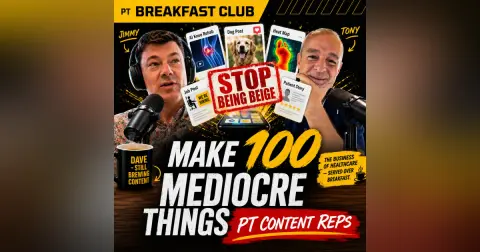
Make 100 Mediocre Things!


Your clinic is already full of content. You just may not be noticing it.
In this episode of PT Breakfast Club, Tony Maritato and Jimmy McKay dig into what is actually working in physical therapy content right now.
Jimmy shares what he is learning from LinkedIn, including why heat maps, rankings, dogs, sneakers, and “PT but make it…” posts perform well. The reason is not magic. People engage when they can identify with something, argue with it, correct it, or add themselves to the story.
Tony shares what is working on Facebook, including AI-generated knee replacement images, real patient photos, simple text prompts, and posts that invite patients to talk about their own experience. Some of the highest-performing posts are not polished videos. They are simple, direct, and built for conversation.
That leads to a bigger point: media should be social. Clinics do not need to produce perfect videos. They need to tell real stories, ask better questions, and get more reps.
The conversation then turns to hiring. Jimmy explains why most PT job posts sound exactly the same: competitive salary, fast-paced environment, great culture, mentorship, and all the beige phrases that say almost nothing. If every job post sounds the same, the clinic pays a sameness tax.
Tony pushes the conversation into access and rationing care. If patients cannot get into PT for weeks or months, referral sources may eventually stop referring. Same-day or next-day access may be a differentiator, but it also changes the business model, staffing model, and documentation burden.
The episode wraps with charting beer, call-in show energy, TikTok rage bait, viral injury stories, and the reminder that content creation works like physical therapy: one perfect rep does not change much. The reps do.
<p>This episode is part of the <a href="/physical-therapy-business-podcast">Physical Therapy Business Podcast</a>, where physical therapists and clinic owners learn how to get more patients, improve operations, and grow their clinic without relying only on referrals.</p>
<p>Looking for more episodes? Explore the full <a href="/physical-therapy-business-podcast">Physical Therapy Business Podcast</a> for real-world strategies on physical therapy marketing, patient acquisition, and clinic growth.</p>
0:02 Broadcasting way too early from three separate Wi-Fi connections. It's PT Breakfast Club with Tony Meritato, Dave Kittle, and Jimmy McKay. Welcome to your Thursday PT Breakfast Club. Yesterday, Tuesday, I wasn't here. Now Dave's not going to be here. But, you know, two out of three ain't bad. That's actually the same. That's right. My original idea for this was we would have two at a time because three is too many. But we consistently have done it for over two years. Two years, man. two years so that's more than a hundred plus episodes is it only two years because it actually might be a little longer no it might be longer yeah i just i knew two years was a conservative guess you know the funny part is we get a decent amount of people watching live but like obviously time zones and schedules and whatnot when i'm at conferences or places you'd be i'm you know constantly like wow because we forget like to us it's us just like shooting the breeze for a couple minutes or whatever sort of verbal processing.
1:15 Clinicians, students, C-suite people are like, hey, listen to the show. I get something out of it. And I'm like, huh, not everything needs to be Um, it's not that we don't plan because we overproduced, not everything needs to be overproduced, overproduced. That's it. So we do plan and we sort of are very transparent about our process, which is I think what a lot of people do. We get a group chat, we fire funny pictures back and forth at each other. And then, uh, we see what pops up. What did you guys dig into on Tuesday? I didn't even get a chance to listen on Tuesday. yeah so we were well you inspired the conversation around hiring recruitment culture yeah um you know the conversation i asked dave i was like hey you you're in the hiring process right now i said i've had great pts and ptas in the past who they were amazing, but they were sick all the time.
2:13 They were sick like once a month. And you book a full schedule for them. Everybody loves them. They do a great job, but you can't rely on them. On the flip side, Jeremy, who I work with now, I told him the other day, I'm like, you haven't been sick ever. I don't think you've ever called out sick in like fifteen years. I've maybe called out sick once or twice in that time. So we were just talking about like the soft skills, other things you look for when hiring. You've been kind of talking more going down that road of recruitment and hiring and attraction. Um, what are some of the things that are hot on your radar right now related to that?
2:58 This wasn't planned, but maybe Tony, because you like data and you're good at like paying attention to sort of like data and what it says. And I think we all should be better at that. And I've been trying to get better at that. So take a look, seize at this. I decided in November that I was going to triple down on LinkedIn. And I've had some runs and just like you and I, and I hear, I feel like you saying it makes me feel better because I'll do a lot. And then I'll just sort of like, I don't want to even look at it for a few days. So I should be better at like when I'm hot, schedule in advance. But I get so excited when I make something. I'm like, I want to see how this does. I want to share it, whatever, whatever. But take a look at some of this LinkedIn data. I'll see if I can zoom.
3:38 Does it help if I zoom in a little bit? Yeah, yeah, yeah, yeah. That's my last seven days on LinkedIn. Two hundred and eighteen thousand impressions. Two hundred eighteen thousand impressions. And then you look at engagements and those are up ninety five percent. Seven days is hard, though. So let's go back. Let's go to a month. So in terms of impressions, almost half a million. Yeah. And you can see that spike right there. And here's the secret. I've been paying attention to what has spiked over the last three hundred sixty five days. LinkedIn will tell me that if you go to your data and say, show me my best producing content in the last three sixty five, it'll show it to you.
4:18 And then what's Tony going to tell you to do? What am I going to tell you to do? Put that back into ChatGPT because you probably created it with ChatGPT in the first place. But now give it the context. Hey, remember that thing we made? And if you don't, I'll remind you, copy and paste. Look how it did. And the next step, let's figure out why. Why do you think? Best guess, right? Best guess with AI anyway. And you can see, so let's just look at the last like, fourteen days. Some of the best content. Man, if you look at the top two, I've been making some of these heat maps of salary to tuition. I'm just comparing two things and then mapping it out by state.
4:59 And people... Freaking love this. And this is one of the content that's actually crossed platforms. This is done well on Facebook because of images. It's done well on LinkedIn because that's where people are for cool business. And it's done well on Instagram too. People love to do a couple things. Look at it. Agree with it. Disagree with it or tell me where I screwed up and my map is wrong or how I screwed up data, which I am fine. And Tony is fine with all of it. Agree with me. Disagree with me. Tell me where I've screwed up. People point out things that, yeah, I didn't I didn't take that into consideration. You're right.
5:40 And then the other series is so that's heat maps and the other series that I've been doing that's played pretty well. were these images where I said, physical therapy, but make it drinks, physical therapy, but make it sneakers, physical therapy, but make it dogs. People have lost. I don't know why I didn't start with dogs. People have lost their minds for a couple of reasons. Number one, I couldn't do all the specialties in one image. It would just get crowded. I also left a few off on purpose because I wanted people to get pissed that I left off blah or blah or blah. But here's what I found in these two posts. There's something for the audience to self-identify with.
6:22 Oh, there's one more post. I did the NFL draft board where I took two data points, cost of PT program, tuition, First time pass rate. So like an objective measure in cost and an objective pass rate. And I ranked them. So I'm looking for the best bargain bang for buck. And it's a lot of schools that maybe we don't talk about a lot. It's not a lot of the and I'm using air quotes here, kids, the best ranked PT schools. But the people who went to Angelo State have a PT degree for thirty grand and their first time pass rate is like one hundred percent. So there's something for people to bitch about. Either they saw their school and they agree with it or they didn't see their school and like, wait, my school was great.
7:04 How come they're not on the list? So I think in content for me anyway, it's something people can identify with. Flip that to what Tony shares about. something super specific as knee replacements, but there's something for people to identify with because they all had one. They've all got their own experience. How long after this did you do this? Did it hurt when you did this? Did your doctor do this or not? There's a way for me to walk in that's about me. So I mean, if there's one lesson I've taken the last, you know, It really isn't about the creator.
7:44 There is some content that is about the creator. The day in the life videos. That's not really my jam. As much as I like to talk about me and be part of the thing, that's not really my jam. It really is, can I find a button to push for the audience to get engaged? Yeah, I love it. I still have not gotten back on LinkedIn for probably half a year, maybe longer. I just did not get, well, my audience shifted from therapist to consumer. And I just, I have no need to be there. That's not the community. Do you go on LinkedIn just to look? No, I don't even go on it.
8:26 This backs up my thing when people say, where should I start? Everywhere. And I go, fish where you like to fish, where you already are, man. Like if you don't like, I don't like I, my jam is not tick tock for some reason, but people like you're leaving a lot of attention on the table. And I'm like, Now, I'd rather double down on LinkedIn because I like reading some of that stuff. I actually like commenting on some of that stuff because I like finding the clear like rage bait and being like rage bait. Like, I don't know. I like fish where you like to already fish. If you don't like consuming the content, my opinion is, and this is not universal, but you're probably going to hate creating the content that will do well there. Yeah. It's a mirror. Yeah. Yeah. That's when I was more active on YouTube, I produced more YouTube content.
9:12 Then when I saw the opportunity shift to Facebook, I produced more Facebook content. Even Instagram is another one. I really don't, I don't consume content on Instagram. I the content I share to Instagram is a byproduct of what I share to Facebook. Yeah. You know, and so there's no intentional effort on Instagram, but I don't spend time there. But it's a two for one. If you make it on Instagram and Facebook, they're very easy, obviously, because they're owned by the same company. I think the lesson for single solopreneurs, small businesses is. with a team but not a dedicated team, like dual role, like your tech or your admin might be creating content, or organizations with large teams, I wouldn't put someone on a platform if they didn't like it.
10:01 And well, if it's your job, they have to get at least comfortable with it. You got to be able to bear with it. And just because the thing that drives me nuts is with APTA organizations or businesses, they sort of give the duty, the job of creating content and earning attention. It's so consistent that I can map it out when I'm in a room with people. It's the youngest person. It's the go-getter. And I'm like, that doesn't mean they like doing it or are good at it at all. But we don't understand the social medias. That's when you know someone doesn't know what they're talking about. They put an S on medias. I don't understand the social medias. They do that. They do the ticky-tocks. We don't do that. I'm like, that is a recipe for failure.
10:44 So since you shared those numbers, let me pull this up. That's bananas, man. This is a sixty day and I chose sixty day on purpose. So this is my Facebook business page. This is the total therapy solutions, the physical therapy page. Forty six million views in sixty days. You can see July eleventh. kind of the distinct jump that is when i was on vacation that week i was on vacation so i was like i've got nothing else to do i'm just sitting in my chair but that's also when i discovered images photos ai images what you put um i forget how to take this off oh here What you were sharing, those were images created by AI.
11:31 You did not hire a graphic designer to go out. My guess is you harvested the data in AI. Maybe you verified some of the data. You got it to generate the image. Correct. I was not doing any of that. And I think this is a very small window of opportunity for anyone listening and watching. Because literally, let me share my page. Like last night, you know, I get home and I'm like, ah, what am I going to do content wise for tomorrow? So pop this up on the screen.
12:13 Can you share? Do you see it down there? Yeah. How come it's not going? I don't know. You said StreamYard was being kind of weird today. Oh, I know why. There we go. Okay. So, like, this is actually a photo. This was a photo shared. Wait, wait, wait. That's a photo on the top right? The big one? Yeah, the knee over the Grand Canyon. That's so funny because, like, now when you get dope pictures like that, everyone's going to assume it's AI, but that is a dope picture. Holy cow. So, but this is exactly what I would do. So I found that photo. It was in one of my Facebook groups. I would take this photo then, and I would use AI and I would say, Hey, put this photo on a kayak, put this photo on a, you know, what a cruise in Europe, in Italy, the, the Eiffel tower.
13:01 Like I, I would make this multiple photos knowing that that's going to resonate. This is a real photo, the real patient in my clinic. But now this- You didn't light them on fire. That's not a real photo. This is a real photo. And I told AI, ChatGPT, last night, I published this ten hours ago. I said, hey, put flames on one side, put lightning on the other. And I made a post about zingers and numbness and heat around the knee. One sentence, do you feel zingers, numbness, or heat around your new knee? Um, a hundred thumbs up, seventy-three comments. Yup. If I take a quick look, uh, it got fifty-five, fifty-six thousand views since last night.
13:49 You know, and that image will probably go on to do a couple hundred thousand views. I would love for you to hear, go back to the Zinger one. Yeah. I would love for you to wait a month or whatever, a cooling off period, share that again, and then do the move that I see other creators do, which is Give me a heart emoji if you feel heat. Give me a thumbs up emoji if you feel electric. And then you can sort of like, I don't know, it feels like they're weighing in. Because what I don't want to do is write something if I don't have to. You know what I mean? Yeah. This was another one I shared last night. One hundred and thirty three thousand views. Twenty dollars in earnings. And all it is, it's fully AI generated.
14:31 I said, give me an image of a woman standing inside a x-ray machine or whatever at the airport. Show me an x-ray of the knee replacement. And then I said, have you traveled on a plane or by plane since your total knee replacement surgery? You know, that's a real photo, that's a real video. So it's a mixture of these AI images and then just some text, plain text posts. Yeah, they're doing well. Yeah, this one got one hundred and sixty six comments, but I've got multiple text posts that are doing thousands of comments in a day. over a thousand comments last one another ai image hundred and thirty five thousand views sixteen dollars in revenue um you know these things take seconds to create less time to share if there's a lesson in this because i'm sure people out there are like but i'm not a content creator i think there's a couple lessons you're either a good content creator or you're a bad one even if you're like, I'm not, and that means you're a bad one.
15:35 You need to be creating something. Your organization needs to be creating something. The second thing is, it's not as hard, it is a skill, But it's something that repetition will get you. Are you using like the voice feature or are you typing what to do when you're like doing this? Are you using your thumbs or your voice? I use voice to text. So not the talking to and it talks back. I just use voice to text. I don't love that voice feature where we talk back and forth unless I'm driving. I don't mind that. And here's why. The AI's answer is often too long and flowery. I'm like, just get to the point. Like, I think I made a meeting to do a better prompt.
16:17 The other thing is I feel like there's a bell curve. So the middle is like getting no attention. It's super, super, super high produced, like high effort. Like the press conference video you shared. I forget the guy's name. I want to give him credit. You know what I'm talking about? I don't know. The guy you're like, I love to see is the creator. He does like if PTs walked out of the clinic and did like a post-game press conference. Brilliant format because everybody instantly recognizes it. And then he goes, but it's not football or basketball or hockey or baseball. It's PT. And that's where people go, boom, I want to see what this says. Great, brilliant twist of format. And I would call that high effort.
16:58 That part. Because it took him time to script it out. He had to set up the scene. It's not cinema movie effort, but it's more effort than what Tony and I are doing, which is sharing clips of a podcast episode or riffing with AI for forty five seconds, drilling down on an image and then popping it out. You know, I've never even looked at his channel name. It's Court and Clinic. The therapist is Taylor. I'm going to say Leiby, L-E-I-B-Y. I love his videos. I've commented on them before. I told him he's one of my favorite creators. He's got the best spin on humor in the physical therapy clinic.
17:42 I would say his content is more for clinicians than it is for consumers, but hilarious. Oh, yeah, yeah. He's put it. So I would say we should do a list. We should do a top ten, top twenty of PT creators videos. pointed at the at the profession because that's a niche within a niche within a niche matt huey matt the pt yeah is big uh k uh master cola is great dpts with anxiety she's big at memes but when she turns the camera on herself it's very good as well I'm sure I'm leaving people out because I'm not prepared for this. There's a bunch. We should get together a list. We should do a user-generated list.
18:26 Suggest who should do it. That would be good. So I just shared his Instagram page. But like, you know, Matt, I see Matt doing collabs now. Taylor did a collab with Spry. I see all of these little business things that are popping up for these guys and girls. Very cool stuff. I've been... I went to the APTA Colorado student thing and one of the students was like, hey, like sort of sheepishly. And this is where you just assume because someone's young, they're hip to the social medias. And that's not necessarily true, right? Because... I'm going to try to guess this girl's age. She seemed to be the age where social media has been a thing her entire life.
19:08 That's my guess. Twenties. And she was like, where do I start? And I'm thinking I was sort of thinking in the old cranky way. We're like, you're twenty five. Don't you know exactly how to start? She didn't. And I was like, oh, this is a great question. And I gave her sort of like maybe the two basic I think she was she was thinking that Jimmy McKay was going to give her some really philosophical whatever. And I was like, what do you like looking at? And she was like, what do you mean? I'm like, where when you're bored and you got twenty minutes, what do you flip there? And she's like, well, Instagram. And I'm like, then start there. But don't I need to also be I'm like, whoa, you don't have to do anything. You don't have to do any of this, right? But if you wanted to stand out. Now she, if I'm remembering correctly, physical therapist, had a niche in practice.
19:49 I can't remember what it was, but she was bilingual. And I'm like, that would be a great... hook right do either either and i was then we were like playing with ideas and i'm curious to see what tony would say if you're bilingual and you were going to make a post would you create an english version and a spanish version on the same channel or would you have two channels that were essentially mirror images but just translated Yeah, that's tough. Like a meta has AI translation to different languages. And some of those videos do really well for me in other languages. Historically, you know, I've heard good advice on both sides.
20:30 Like one one will say the algorithm will distribute the Spanish version to the Spanish community. Other people will say no, make a dedicated channel for that community. I don't know that there's an answer. Uh, the cool part about that for me was not her getting a million views or whatever, whatever she started. I said, in the next three days, here's what, here's what success looks like for me. You telling you, you showing me your first video. And I gave her like one, I literally, the only piece of advice I said, I would buy, I'm like, buy a good microphone. Your camera has a good enough. Your phone has a good enough camera. You don't need anything else. You're fine. And it's consistency. How fast can you get to ten or a hundred videos?
21:13 Shoot me a hundred C minuses. I'll show you someone who knows how to put out a B plus in a hundred videos or less. Yeah. Just showing real quick. This is arranged by comments. The last twenty eight days. So I literally went in the parking lot, took a picture of the pavement where there is the disability placard. Right. Um, one thousand three hundred comments, you know, and then an AI video, an AI image is still photo of an osteoarthritic knee next to a replacement knee with the prosthesis. Again, thirteen hundred comments.
21:54 A text only did describe your total knee replacement in one word. Twelve hundred comments. Yeah, one word is a great prompt because it's it's a low bar to hit. So there's four posts with over a thousand comments. I mean, it's just crazy. If you think about it, it is crazy. But I think sometimes we overcomplicate things. I think most of the time we over rather than undercomplicate them. Whenever I start talking to people, I say, I need you to switch the order of words. I want you to create media that's social. And that's not me trying to be cute. When people are like, we need to make more social media, they're talking about volume and quantity, where I want you to think about quality, but it doesn't need to take a lot of time.
22:42 You don't need to break out film quality cameras and scripts and teleprompters to get quality. Quality is decided by the audience. Look at what is playing well. I think you and I and Dave do this a lot, which is what's this? Oh, you shared the two videos we can talk about. from the auto detailers. Yeah. And one of them was higher quality. But I don't know if the production was the reason it was a better video. Do you want to describe these two? And why did you share them? We haven't talked about this. yeah there's really three so this this was on instagram um i've got you know a two thousand i don't know five i think car and i was like hey i want to get it cleaned up like my boys are trash in my car there's cleats and mud and all the the stuff there i start getting ads for car detailing they come out to your house they're all the same they're like two hundred dollars ish one was a young kind of awkward teenage guy standing in front of the camera do you remember the star wars like lightsaber guy yeah one of the first viral videos yeah it seemed like him yeah that's right this kid reminded me of him yeah he was like hey cincinnati you know i'm doing this and uh this is what it is and this is the deal it's usually and we're doing for and it was cute i don't know that i would look at that kid and be like yeah he's going to do a good job right then there was one without a person on camera but
24:13 basically a voiceover showing like steam cleaning and vacuuming and that was the one that i kind of liked um and then there was a third version that was more kind of synthetic and ai and i didn't like that one but i just thought you know How do these three interplay with me, the consumer, basically the same price point, basically the same promise, same geographic area, same everything. And then how do we apply that to our physical therapy, mobile practices, brick and mortar practice? I think this goes back to one of the first things we were talking about today, which is in hiring. I think it's transparency. I'll give you an example.
24:53 I'm in my town's Facebook group, right? And people advertise like yard sales and yada yada. There's these two kids who are in college and it's Liam and something. And whenever they come home, it's literally like a photo of them. It reminded me like almost is a photo, but of the first video you're talking about, like low quality. but they tell a story. Hey, it's Liam and Steve. We're home from break. We'd love to help you with all the things you don't want to do. We do garage clean out, landscaping. We're just two kids trying to put our way through college. And I think what that does is if you've been college kids or you've been nineteen and you had no money, you instantly go, yeah, because this is what we need.
25:36 We need kids who want to, these kids today don't want to work. Good. That's the trope. That's the cliche. They're the opposite. and they're doing that. So if you were like, look at this kid, he is awkward. Man, that kid, I wanna help him out. So it's not that any of these are gonna be better. I think, obviously, if you're gonna A, B, and C test these, some things are gonna pop. But for the person who wants two things, their car cleaned, and to help out the plucky kid who's a little awkward, that kid wins. But if it's, listen, I got a little dirt. I got to get off my shoulder here. I'm a little classier. I'm going to go with the flashier video because I align with that. I got one more example.
26:18 This got me to go spend two hundred and fifty bucks on plants. Tony, I could count on one hand how many times in my life I bought plants. It's that number. It's one. OK, in the local Facebook group, somebody else, maybe they're related to this greenhouse. Maybe they're just pissed off that this happened. This woman tells a story how this family-owned greenhouse, you can tell the family's house is in the back on a busy road. And then in the front, right in front of this busy road is like three greenhouses and their store, their business. And they did almost like a news story with photos and text how someone went over there in the middle of the night, took a razor blade, slashed all their greenhouses.
26:59 A bunch of plants died because of, I don't know, the heat, got cold, something, something. They slashed the family's pool, everything. And they did thousands of dollars in damage. And I said, I needed to get some plants because people have been telling me your house looks like a frat house. Like it's just a dude who lives there. Like, well, it is just a dude who lives there. Put some plants in your house, Jimmy. And this put me over the edge. I was like, they're down my street. That's screwed up. I want to help them. I don't want to just go throw money in a donation. I want to help their business. So I did. I went and dropped like two hundred twenty fifty bucks on plants. She was terribly nice. I literally just said, I need you to give me plants that even I can't kill and they got to be outside. And, you know, I'm going to plant them now.
27:40 It's all good. And she was like, got it. You want this? And she was awesome. Then that story gets picked up by the local actual TV news. So now it gets even more. And I'm like, this is awesome. I go to the comment section. I see people going, you should buy a gun. You should buy a camera. You should buy a dog. And I just commented, you should all buy some plants. Those are all great things that she should have done six weeks ago. She didn't. Also, a camera. Would you show you some dude in a hoodie with a razor blade? Like that ain't going to help. Buy some plants is my story. So that's an example of real media that told a story that hopefully got them back to at least zero, right? Got them back to where they were before pre-razor blade.
28:21 But telling good stories, people want to rally behind them. And the realer they are, I think the more they spread, the more people look at them and want, even in an era of AI. And our clinic is full of real stories. Full of them. Yes. One hundred percent full of them. And I think the barrier, there's a couple of barriers to telling them, I don't know how to do this. I feel awkward as the clinician or the clinic owner. I'd feel awkward asking. I wouldn't know exactly how to do it. It would be too whatever. But you've found that people are what's your batting average of if you ask ten people, how many of them say yes? How many of them say no? So what to share in the video like patients?
29:04 I mean, I'd say in ten years of doing it seriously, probably three have said no. Wow. Three out of ten years. That's pretty good. Many thousands have said yes. Right. And then if, you know, I think the next is people feel like they need to aim for perfection, which is why the next question is, what do I have to buy? What do I have to get? How long does it take? And the answer should be barely anything. Get a twenty nine dollar microphone off of whatever for your phone. Your phone has a good enough camera for video and photo. And then look at ten videos of Tony's. And then I love when people steal my format, steal the strategy. Because there's more collaboration than there is competition, right?
29:48 Like the person who makes the video in California is not competing for patients with Tony. What's the problem here? In fact, it probably helps the profession overall. Yeah, absolutely. Anything else on this topic before we move on? On this specifically? No, but we veered off of what you asked me in the beginning, which was hiring. Yeah, yeah. So I will share, I'll find some of the posts in a second, but I mean, my latest post has been getting some pretty good, my last series, I decided to do a series. I'm actually following, Larry Benz is teaching me about communications. Larry's very big in, I'm going to write an article for his sub stack, but it's going to be part one of a five-part series.
30:33 Because I think if he wrote one article that was five times as long, it would be, it's too much. So he was smart enough, that's his strategy. So I started doing that. I was like, okay, five parts of the series, five days in a week, this is what I'm gonna do for the week. And they're doing not half bad. This one has been doing well because I think I've been working a lot on the hook. And the hook for this one is physical therapy hiring is basically two strangers lying politely to each other for forty five minutes and hoping the next two thousand hours work out. Yeah. And I've been very careful to not take a side because I want to play Switzerland because I actually think it's both nobody's fault and everybody's fault the exact same time.
31:17 And that post walks through the dance that we do. I'm sort of taking the clinician side a little more on this particular post because I'm saying I did this with AI. Hey, you know, Claude, go find me one hundred random PT job descriptions. And it did that random. It went to it. But I watched it, too. I watched the thing. It was going to indeed and did it. now i want you to create a word cloud for all the words that get used over and over and over and over again right and then i want you to create a separate list of outlier words that like never appear and of course the list of words that appear in every one competitive salary fast-paced environment all the cliches were apparent yeah and then i just said listen a couple things You're not telling any story.
32:01 So when people say job boards don't work, I go, no, you're just fishing with invisible bait. There's nothing to discern these ten posts from each other other than salary, if they even list it, or location, right? So I'm guessing. And then you're confused why more people don't apply or why you have to go through a whole stack of hay to find a needle. You're being beige. And then I even said the clinics pay a sameness tax. What I mean by that is, let's say, God forbid, you did create an amazing clinic that did all the things. And you're sitting here going, look at this thing. We invested. We made. We have all the things that PTs are looking for.
32:42 but the job posting was boring as hell. Imagine if Josh Funk wrote boring posts. He'd be like, look at this dope facility. Why is no one showing up? And I'm saying you did the hard work of creating the environment and then you put up a beige post. So I'm sort of taking the clinician side maybe a little more because they really can't change the post or they can't read between the lines because the lines are all the same. I think there's a buyer's market and a seller's market. It is a buyer's market right now. The buyer is the clinician.
33:23 They command the conversation, they command the salaries, they command everything. And even locally here, I mean, one of the topics I pitched to you about today was rationing care. Like when do we have the conversation about rationing physical therapy care? because we don't have enough to go around. And so the therapist who wants to take somebody through forty visits, they're taking away thirty visits from other people. They're denying care to three or four other patients if they would have split the forty visits across four people instead of dedicating the one. Nobody is talking about that. I took two or three calls this week, and I don't want to change the topic from recruiting, but I took two or three calls this week.
34:09 Every single one of them was like, I called the hospital. I can't get into October. Okay, well, we'll see you tomorrow. I can make the schedule work, even though we're booked. I can make the schedule work to get you in within twenty four hours. Right. But like I had a patient yesterday, been seeing her for months. I want to refer her to an OT. There is no OT for me to refer her to. I want a mobile OT will go out to the house. Doesn't exist. Best case scenario is I make her go to the hospital for outpatient OT there. It's going to be, you know, months before she can get in. There's no priority. And it's I, I just give up, I don't refer anymore.
34:53 You know, and so like, that's what I've said, I think is the biggest threat to the profession is the people who refer to our our profession are gonna quit referring because there's no one to refer to. Yeah, you can find alternatives. How many times is a physician going to touch the stove and burn themselves before they stop touching, before they stop reaching for the stove? How many times are they going to refer to us? And then they hear back from that patient. They say, well, it's an eight-week wait list. And they get frustrated and they just stop altogether. Yeah. Right? Wasn't this the big thing? Yeah. I don't know. Fifteen, twenty years ago when physician-owned practices were the thing, they're like, well, they're never going to refer out to us. It's like, well, now you're so full.
35:36 Your waitlist, and people will get into it. They'll be pro or anti. Some people wear their waitlist length as a badge of honor. We're six weeks out, man. As they wipe the dirt off their shoulder and they're like, buffing their fingernails. We're six weeks out, bro. That's how good we are. How do you measure efficiency? Or how do you measure good? Is it efficient? Are you available? Um, you know, I sort of flirted with the lady at the dentist's office to get my dad and within seven days, cause he had a broken tooth. She was like, I dunno, it's, it's August, October. And I was like, oh yeah. I'm like, well, he's a retired New York City fireman.
36:16 He's in pain. He broke a tooth. And she's like, all right, let me help out. But if I had been on the phone and I hadn't been schmoozing the, you know, sixty five year old receptionist, I have no shame. And I will flirt with a sixty five year old receptionist to get my dad's tooth looked at. And I had to. But like, that's the problem, right? Not enough dentists, not enough PTs, not enough, not enough. And then you have people saying there's no there's no there's no opportunity in the profession. So now this is where we go back to recruiting, to culture. It's like, all right, so if the candidate is saying, I want an hour with every patient, I want to determine when I discharge, I want the potential to see a patient for twenty four visits over multiple months. That's nice, but that's going to put me out of business.
37:00 It's not even that I can't afford that. I literally cannot offer that because one of our differentiating factors is we will always get a new patient in. Right. I guess that should be lesson one, which is what is your differentiating factor? And we can tie these things right together. Because if it's high-paced environment, friendly, if it's all the cliches and the tropes that you're going to see, that ain't it. Because now it's the sea of sameness. How are you going to stand out in the sea of... of sameness and you're going to pay a tax for that. Right. I helped someone. I won't say who, until I ask his permission, but I saw someone writing a cheesy, boring job description on LinkedIn and we were connected.
37:42 So I DM him and said, Hey man, can you send me the actual, the thing they shared was sort of a truncated version. Give me the full thing. And he goes, okay, here you go. And then I sort of AI'd it, gave it to him. And it was blatantly transparent, true, honest, to the point where two days later, I saw another clinician screenshot it and sort of bash it. This guy's saying, sixty visits a week. And I look at that and say, if you don't want sixty visits a week, I don't want you applying because that's what we do here. If this is bad for you, I don't want you to apply. So like that guy bashing the job description proved my point, which is your job description Therefore, your clinic description should remove everybody who when you see them on your schedule and you go, that's not a good fit.
38:33 They should never, ever, ever even get past the website. They should never get to the phone call or the form of the front desk. And God forbid, get on your schedule. My last patient as a student, I've told this story, was a pediatric patient. like a under-thirteen-year-old who had a TMJ that frequently dislocates. And I remember being like, I know I'm supposed to be a general outpatient orthopedic PT, but I don't want to go anywhere near that. And my CI was like, oh, hard no. How did that get on the tip? Like, no, no, no, no, no, no. I know the perfect PT to send them to, twenty minutes away. But your job description or your clinic description should be more exclusive than inclusive. And I think as we have the Peace Corps gene, we want to be everything to everybody.
39:16 And I think that is doing everybody a disservice. Yeah. Yeah. So during your... Scott is saying if you have a waiting list more than forty eight hours. Love the bold statement. Look at that. Forty eight hours. You have a problem. This type of problem is where the, this type of problem is where the profit is. Have a fixer mindset. I don't know how to agree more with something like that. Scott, what is yours, Tony? You said, Yeah, objectively, our metric was twenty four hours from the phone call. So if you call, I like that. We want you on the schedule booked for an appointment within twenty four hours. Now, there are occasions where the patient post-surgical isn't allowed to start less than twenty four hours.
40:02 Right. But too much can happen between now and then. And the reality is like we get people are like, oh, let's look at next month's calendar and I'll book an appointment. No, I call us back next month. Don't call me now because I'm going to get you in right now. Let's see what Ben is saying because I like what Ben takes the other points. I can argue the other way not because I believe it, but you can make the argument that it is higher profit to have less new. less new patients and attrition than constant churn. What is he saying here? He's either, he might be talking about new hires. Oh, new hires. And that's an argument that I've, I've always heard. And I've told my own people and I talked to Dave about it.
40:46 I'm like, look, when I was hiring, When I was hiring, I would tell the candidate, I'm like, look, you're a new grad, you're fresh out. I understand you don't have the skills. I understand you don't have the experience, but you have the raw materials. You have the personality, you have the disposition. This is what I'm hiring. I'm not hiring your knowledge and expertise. I will make the trade. I would rather have you for a year or two, knowing you're gonna go on to be better and greater than I can provide on my platform. But I'm going to get the best of you for now, you know, and I am going to turn over my staff every two or three years because my compensation doesn't go up.
41:28 Medicare just keeps cutting. I can't provide that cost of living raise. So my business model for a long time was come in, give me a year or two, maybe three, move on to the next opportunity, and I'll bring in new talent every single couple of years. because I can't raise you. I can't give you the compensation you need or deserve. Ben, Ben then chimed in and just said, no, I don't know. We might not be understanding what Ben is saying. Ben, if you're, if you want to chime in, uh, I will DM you my phone number and we can do a live call or whatever to get. Cause Ben usually has really good points. Yeah. He's got the experience. He's been counterpoints. Like he, like I like when he takes the other side.
42:09 Cause it's like, okay, okay. What do we do if that's the case? And then if he was talking about patient turnover, I would say the same thing. I get the highest compensation per minute for an evaluation. I have no problem just churning through the evaluations, get the revenue up, but I would need a clinician who understands their role in that business model. Oh, okay. He's saying constantly getting in new patients will actually cost the clinic more compared to if it can keep the patients it has coming in. Not unless you optimize for it. And only if you're looking at lead generation as a cost.
42:49 Like we don't have any lead generation costs. If I was marketing and I was paying for all these new patients, Facebook and that stuff, absolutely. We have a steady flow, ten to twelve new patients a week. We don't pay anything for them. We don't market for them. There's nowhere else for them to go. They're actively trying to go somewhere else and they can't get in, so they come to us. And from my perspective, we've optimized the workflow so that it used to be, and I totally agree with Ben, it used to be more expensive. And I've got old videos saying keep your patients on, complete the plan of care. More new patients is more expense.
43:32 But then at some point in the last decade or so, we changed things. And I was like, no, I'm happy. I'll do a twenty minute about show you three things to do at home. Turn that table over. I said this in the clinic the other day. Patient was sitting around talking, socializing. I was like, hey, we need to turn this table over. We need more people. We need new people coming in here. You're finished. Get out of here and go enjoy your day. Just like a server. Oh, Chaminade from Colorado saying he's booked out three weeks at least. Usually not sure how that's less profitable. Well, he's got a different format, right? Because he's a solo player, I believe. So it's going to be different for each, right? Absolutely. Yeah, Ben is then saying the admin burden. I think he's continuing saying on the same idea, the admin burden, the percent of no show, the cost of acquisition.
44:17 You need to know your customer acquisition cost. Right. And those three things are huge. So from my perspective, how do I deal with each of those? Admin burden. We've streamlined the admission process to practically nothing. It's a single signature. We did this before. If I want to go from website to seeing Tony, how many steps are there and what are they? They're not fancy at all. I mean, most people are still calling. We do not have online scheduling. I've pushed for it. I've tried. There's no good way for us to get that done, just on the technology side. But aside from that. Calendly.
44:59 You call, we get you in. I don't care if I have three other patients scheduled in that block of time. You call, I will get you in. You have the priority as the new patient over everybody else in the clinic. I just won't charge for those other visits. I have no problem not charging for those other visits. They can still come in. They can still work out. They can still do their stuff. They would have no idea that they didn't get a physical therapy treatment billed to the insurance. So I eliminate that. We have no acquisition costs because, like I said, we're the only option in town if you want to get in quickly. The docs know us, we've been around forever. We don't market anything. And then from the administrative perspective, it's literally take the picture of the cards, put them into the system.
45:43 Pretty much everybody around here has three insurance plans. It's Medicare, it's United, it's Anthem. Occasionally we'll get an Aetna or a Humana, but it's not that big of a deal. And the same thing, and this goes to the culture of the organization. I talked to my wife yesterday about it. I was like, look, We could hire an admin person, pay him forty, fifty thousand a year, or we could take a fifty thousand dollar loss on authorizations that should have been gotten and didn't get got or, you know, claims that got denied and never got reprocessed. Right. My gamble, I probably lose less than I would pay in an administrative person.
46:30 Recoup it. Just making the mistakes and that's okay. Yeah, I'm happy to lose twenty thousand, not not getting authorization on a couple of cases, then lose fifty thousand hiring an admin person. And I'm not growing. That's the other part of it. I'm not growing. I'm not opening more locations. I have zero interest in growing the clinical side. So so my advice is very different than maybe what somebody else would say. This is where I think a call-in show would be great because a lot of these things do depend. If you were doing Dave Ramsey, it would be like, well, what's your goal? What's your goal? If it's not growing, then it's going to be wildly different than if it were staying the same or downsizing.
47:12 Ben chimes in again, like a restaurant, do you have five sittings in a night or two? Both can be profitable if set up. Yeah, yeah, yeah. Not to change the subject, but got to share this. This is a friend of mine sent me this video that I went to undergrad with. So he's not a PT at all, but because he sees so much PT content and he DMs me every once in a while. So Carl sent me this. I've never really tried to get free stuff for PT Breakfast Club, but Tony, I want to get one of these for each of us. Are you ready? Kudos to this clinic.
47:56 charting break lager they made their their own they made their own beer uh how do we get in on this i want to get me some charting break lager i mean that would be an out-of-the-box way to be like listen our average uh our our clinicians on average do uh Forty-five minutes of documentation, but everybody gets a shift beer. In the restaurant industry, a shift beer, you get free beer at the end of your shift. That was like a thing when you had a cool boss. It was like, all right, you can sit down, grab any beer you want, make a drink, whatever. And while you're doing your tables and your taxes and your tips, whatever, we'll figure it out. Charting beers...
48:37 I don't know how much the licensing boards would appreciate that, but Proactiv, I believe they're out in Washington. So one can get word to the brewmaster at Proactiv. I will drink that on the show. We, locally, we have Coors Molson distributors and their employees get free cases of beer. It's the craziest thing to me. And I remember we had them as patients at one time and they would come in, they'd be like, I've got cases and cases, take some, take some. So we had, I started off, again, I always talk back to when I ran a radio station, we had Bud Light Free Beer Friday and Bud Light was smart enough.
49:20 they would give us a case of beer to give away once an hour, every hour from seven A to seven P. And we do that every week. And trust me, they got more promotion than they gave away beer, right? But the bonus was if people waited, I don't know if it was two weeks or three weeks, if you didn't pick up a prize within three weeks, it just, it became ours, property of us again. Oh, nice. So I didn't buy a beer for... eight years i didn't have to i had so many beers i would give it away i would show up to the party and i was the most popular guy when i walked i'm like do you guys need three cases of beer because i didn't want it to go bad or i had to actually throw it away so maybe this is another twist too right so we started with bud light free beer friday Then Miller Lite was like, we want Thursdays, right?
50:02 Thursdays. And so there was Miller Thursdays or it's Miller time Thursdays, whatever the catchphrase was at the time, Bud Light Free Beer Friday. Then Coors comes in and I'm sitting with them and they're like, what are we going to do now? Just take Wednesday? And I'm like, hold on. I thought I went even better and sneakier. Do you remember the movie Office Space? Yeah, of course. looks like someone's got a case of the mondays it has the word case in it yeah i pitched to chorus light i go listen let bud light have friday let miller light have thursday when when do you really need a beer and like what do you mean i'm like and i just played the in the meeting i played the clip looks like someone's got a case of them so we called it cores like case of the mondays like hey and the whole thing was talking to people at work on the worst day of the week, although I actually saw a recent survey.
50:51 Tuesday is apparently the worst day of the week. I don't know why. But I was like, the worst day of the week. Mondays suck, man. So I was like, they suck. And the tagline was, make Mondays suck a little bit less for the case of Coors Light. I don't know who that is. Maybe it is Ben. Oh, crap. I just hung up. I thought it was a spam call. Ben, was that you? Call again if that was you. so that was that was the twist that we did we've got nine minutes so we're around in the corner let's talk about on a serious note because i i do think this is impactful tick tock for me i think i've said this before it is just a stream of rage baiting i swear most of the stuff tick tock oh yeah most of the stuff that i see cannot be real these are people that have to be trying to grow you know their revenue by saying the most absurd ridiculous stuff video came across and it was i'm not going to mention the the video but basically it was a young female i'm young i'm going to say late twenties early thirties uh roll later in front of her well-dressed big smile on her face saying that a physical therapist basically ruined her life a physical therapist i saw this yeah hurt me a physical therapist herniated two discs blamed every every single video starts with a physical therapist hurt me I'm like, what?
52:12 No. So, of course, I'm hooked. I'm watching it. And this person goes through and looking at the person, you know, they're relatively healthy, fit looking. You can't see what's behind the scenes, but says that the physical therapist had her doing a deadlift. And I was like, oh, deadlift. five-pound dumbbells. I was like, come on. Then ten, then fifteen, twenty-fives, then went to a bar. The story is, as I understand it, and I could be wrong, the physical therapist asked her to do, I think it was a barbell, and I want to say twenty-fives on each side, maybe ninety-five pounds. Totally reasonable. And she herniated a cervical spine disc and a lumbar spine disc and it's ruined her life.
52:57 She can't work, she can't function, can't afford her house, husband and her moving to her mom's house. Every single day there's new videos and every single day it's leveraging this injury that was caused by this physical therapist who in my opinion did absolutely nothing wrong, nothing crazy. But even in the best of situations, she sounds very legit. I think she really believes that she's been disabled by this physical therapist. She's never talked about litigation yet, but she did announce a program to help other people who are suffering in the same way.
53:38 And I'm sure it's gonna turn into a paid program and I'm sure she's seen the obscene amounts of money that come through. and i'm just like oh man like this this is why i as a physical therapist understanding muscle physiology understanding exercise science understanding dosing you know you see the jokes about therapists using yellow therabands for everything um yeah this is why i am never gonna load somebody to an appropriate dose for strength when i know that even one in ten thousand people could experience this And now my life is ruined.
54:19 You know, it's not going to happen. Yeah. I mean, just you telling me this, I've seen one or two of the posts. I didn't see the one where now she's going to create a course. And then it just makes you, you know, I, it sucks that this is the world where now I think, did this actually, did any of that actually happen? Did it happen? And you like, now you've got to question sort of everything and say, you doing it for the ticky tock so you can get the blingy bling, right? Are you doing it? You know, I don't know. I just think that this is the kind of stuff that Leads to I think it's more impactful to the profession degrading than all the other crazy stuff we see out there.
54:59 Right. You know, because this is real. This this is like a real lawsuit, potentially real negative media. And it just feeds into this loop of I am fragile. I am a victim. I have been injured as opposed to. And I tell patients when they walk in the door, my admission paperwork. Physical therapy involves exercise. Exercise involves risks. It is my job to make sure you don't do anything crazy, but at the same time, there is real risk of injury with anything we do here. And I can tell you that we brought in a whole bunch of new equipment into the clinic.
55:40 Every single minute of every single day, my first priority is making sure nobody trips and falls and cracks their head on a piece of equipment. I'm not thinking about the best possible intervention for this person because I am so consumed with making sure you don't get hurt. Right. Before we go, this is where someone went. Michelob Ultra ran an ad that said if it's physical, it's therapy. The APTA had them take it down? Did they? I don't know. This must have been recently. Michelob Ultra's only been around for, you know, ten years? Fifteen years? I don't know. It's been around a while. Has it?
56:20 Really? Oh. Yeah. All right. Maybe. I don't know. That sucks if that's true. I hate that. All right. Parting shots. Was that your parting shot? Parting shots. Get out there. Produce more content. Tell good stories. Yeah. I'll say this again. The distance between you and your next hire... or you and your next patient is the thickness of the glass in your phone. I know that sounds like, well, it's so easy. It's not. It's not. Go make a hundred mediocre things and then you'll notice around a hundred and twenty, it's better. Isn't that what we say in PT? Like it's not going to happen overnight. And then we freeze when it's like time to do something out of our comfort zone. Isn't that your whole pitch? Isn't that your whole pitch?
57:01 You can't do one perfect rep. You got to do thousands of reps. It's not one rep and you're going to do nothing. You're like, great, go do more reps. So get over that. We'll be back on Tuesday. See you, Tony. All right. That's it. We're out. Boys, what the hell are you doing? Follow Tony Meritato on YouTube at Total Therapy Solution. Find Dave Kittle at conciergepainrelief.com and on YouTube at The Dave Kittle Show. And follow Jimmy McKay at PT Pinecast on YouTube, the socials, and wherever you binge podcasts you pretend are for CEUs. And hey, just a reminder, none of this was for advice. This was for entertainment only. Our lawyers say that counts. Thanks, Keith.