It’s Okay to Be a Generalist
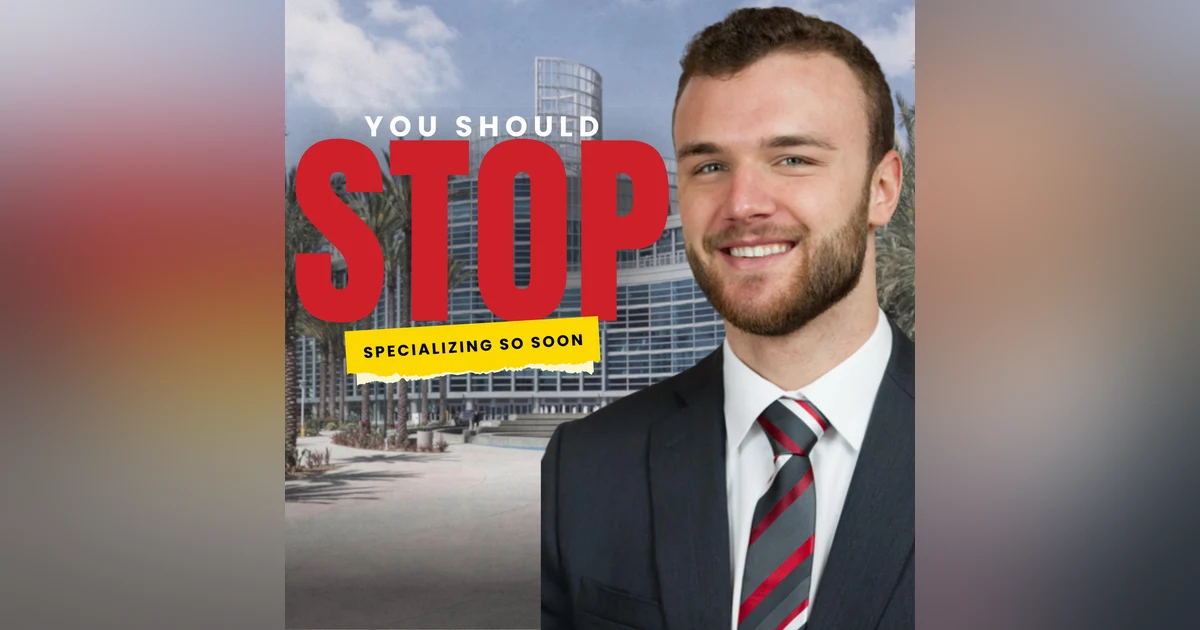


From CSM 2026 in Anaheim, Jimmy sits down with Ben Lindaman to discuss one of the biggest identity tensions in physical therapy:
Generalist vs. Specialist.
Healthcare rewards depth.
Marketing rewards niche positioning.
But patient care often demands integration.
Ben argues that:
- Early over-specialization can stunt development
- Generalist thinking is critical in rural and primary care settings
- Most patients don’t need hyper-specialization
- Confidence and competence matter more than credentials
- PT’s versatility is both a strength and communication challenge
If you’ve ever felt pressure to define your niche immediately — this episode is for you.
???? Key Takeaways
- Specialization has value — but so does breadth
- Young clinicians should explore before committing
- Value-based care demands better triage and integration
- Rural PTs must be adaptable generalists
- Clinical identity should be internally driven, not externally pressured
???? Guest
Ben Lindaman, PT, DPT
Assistant Professor, Tufts University
PRN Clinician, Philadelphia
???? Benton.Lindaman@tufts.edu
Social: @ben10dpt
Recommended Book: Range by David Epstein
???? Sponsors
Supported by:
SaRA Health
EMPOWER EMR
U.S. Physical Therapy
<p>This episode is part of the <a href="/physical-therapy-business-podcast">Physical Therapy Business Podcast</a>, where physical therapists and clinic owners learn how to get more patients, improve operations, and grow their clinic without relying only on referrals.</p>
<p>Looking for more episodes? Explore the full <a href="/physical-therapy-business-podcast">Physical Therapy Business Podcast</a> for real-world strategies on physical therapy marketing, patient acquisition, and clinic growth.</p>
0:00 She's like, I'm in bed. The best conversations happen at happy hour. Welcome to ours. Welcome aboard. This is the PT podcast. Here's your host, physical therapist, Jimmy McKay. Good timing. Live from CSM. Twenty twenty six here in Anaheim. Want to say thanks to Empower EMR. If your clinic is stuck with an EMR that's slowing you down, that's your choice. That's your choice. You chose that. You can also choose a way out. Designed for PTs. Better notes, faster documentation, smoother operations. I always yell, smooth operator, whenever I say that. All wrapped up in customer support doesn't ghost you. Upgrade your clinic's brain with Empower EMR.
0:42 Visit empoweremr.com. In a profession obsessed with specialization, our next guest is here to make the case that being a generalist isn't a weakness, it's preparation. Ben Lindeman, welcome to the show. Thanks for having me. Appreciate it. Where are you from, man? I live in Philadelphia. nice yep right now where this little shindig will be next year yeah yeah i'm right down smack down the middle of the city in the convention are you from pa uh born and raised in iowa but then moved out to pa for grad school and then just never left fantastic all right so uh there was an oxford debate a couple years ago at generalization versus specialist uh it was very interesting as oxford debates which should be brought back to the apta that's a hill i will die on and i'll keep pitching about until it gets brought back um and it was interesting to hear both sides yeah We like chasing things like titles and specializations.
1:33 It is neither good nor bad. It just is. So why do PTs feel pressure to sort of specialize or do these things? I don't know. I think it's a couple things. I think if you, like, zoom out and just healthcare in general, like... physicians like everyone has a specialty and I feel like every time I have patients they're like yeah I have to go see the ortho guy but then he specializes in the knee and then it's only the right knee but not the left knee and I think it's just how our health care is designed from a top-down approach and I think it's just trickled into PT and there's a time and a place like I have my neuro specialty I'm not here to rag on it but I think just so often I hear oh you need to go see Ben he's the neuro guy he's the neuro guy and I'm like People are people.
2:17 You don't necessarily need to have the specialization to provide best care for them. I get people know me because I have a podcast. And people are like, he's the podcast guy. And I'm like, actually, I have a degree in communications and journalism. So I could do words, too. Or I could do pictures. Or I could do a combination of both. So yes, you might be a neuro PT. You're still PT and there's a time and a place and neither is better or worse. But where does that pressure come from? Is that is the call coming from inside the house? I feel like it's like patients like some want that specialization because they feel that they're going to get better outcomes because of it. So I think it's a patient customer service based marketing thing.
2:59 I'll take credit. Yeah. Shame. Yeah. And then I think it's, you know, people want to have that identity of like, I have this thing that nobody else has or very few people have. And so then it promotes this level of autonomy that you maybe don't have as a generalist or in that sense. So I think there's like talking about in absolutes, like it's just patients or just therapists or just administration. Never is. No. Yeah. But yeah, it's just one of those things that it was always kind of annoying when I was in full-time clinical practice was like, You know, I would just get all these people like, oh, Ben, you're the neuro guy. I want you to see this person. I'm like, did you even do anything with this? Like, did you eval them? And they're like, well, I don't have like you have skills like you graduate as a generalist and you like very few times I had to like truly dig in with my neuro knowledge and like to provide care that that probably that therapist could have done.
3:48 But I'm like, ninety percent of what this person needed was just basic attention or a set of eyes, all those all those different things. What do we lose when we undervalue a generalist? I mean, here's the thing. We're at APTA. Fifty state chapters. Eighteen components. None of the components. There's pediatrics, geriatrics, orthopedic sports. There's no academy of generalists. I know. So maybe it's a little bit of like, well, if I don't belong somewhere, I don't belong. And I think they're trying to probably funnel that population into the new primary care and specialization stuff. Oh, that's a good point. Yeah. So to me, I view the primary care, this is my own thought, it's like you're kind of now a specialized generalist, if that makes sense.
4:31 Now we're just going in circles. Now we're just talking in circles. I mean, it's just also like I enjoy the variety. I enjoy working with people with neurological conditions, but I love treating my runners. I love treating, you know, anybody who has a pulse. Really, I'm happy to work with them. So well said. So how does value based care change this type of conversation? That's a tough one. So I think. You have to define, like how would you define value though? Like what does that mean to a payer? What does that mean to the consumer? What does it mean to me as a therapist? And probably all answers are different. Yeah.
5:12 They have to be. They will be. They have to be. Yeah. So I don't know. I haven't really given that one too much thought. But I think it would be kind of understanding or triaging or better triaging like who is truly going to benefit from a specialized individual. And I was, before I came on, I was like looking into some research and there is at least some research to support. Yeah. If you have like F and D or something that's really, really niche, then yeah, you're probably going to be best off with somebody who specializes. Cause some of this stuff is coming out of Australia. They're putting a lot more research into this idea of generalist versus specialist. And they're basically just saying, yeah, like you may need a specialist for like certain very niche things, but probably you don't need it for everything.
5:56 Yeah. I mean, it's probably like a bell curve. Yeah. There is an extreme on either side that will need it. And then there's the middle of the bell curve and that's how bell curves work. Yeah. Crazy. It's nuts. Yeah. Yeah. Um, Why is generalist thinking critical in rural and primary care settings? Because you might be the only person within hundreds of miles or months. Yeah. The only person in health care. Yeah. And so having that adaptability in that range and that depth of knowledge is you're it. So because these people may not necessarily have specialists with access, even with telehealth. So having that really strong generalist mindset, I think, is what's needed, to be honest.
6:43 And so many times it's just Yeah. I had a patient last week who was like, yeah, I went to this physician. I went to this physician. I went to that physician. Now I'm back in PT. And I was like, you just went to twelve physicians and still aren't anywhere near where you need to be. So, yeah, I think generalists are what's needed, especially in those settings for sure. You can't walk more than ten feet without running into a pack of students at CSM. Yep. It's a constant question from, I don't know, second grade. What are you going to be when you grow up? And then you get close to college. What are you going to major in? And when you're in PT, where are you going to practice? It's constantly what is next. Yeah.
7:23 So... how would you speak to a younger clinician talking about identity and scope in terms of generalists during specialists? How would you, would you tell them to slow it down? Would you tell them to, what would you tell them? So my path into PT was I graduated then went right into a neuro residency. And I think that, accelerated my thinking in some aspects but i think it really put me in this kind of pocket of all right this is all i'm doing and this is all i can do and then once i actually got out into practice full time it's like i actually kind of like more of the generalist thing so i for a younger clinician i think you know try it out like pt is such a versatile profession where you don't have to be a specialist like you know a physician going from med school to residency Um, so like, yeah, take the first couple of years, like work in a place that's going to have lots of variety, right?
8:13 Whether it's an outpatient, whether it's impatient, whatever. Um, and not feel pressured to feel like you need to define who you are right when you leave PT school. Cause I don't think that's, it needs to be the case. You get one PT license. Yeah. And, uh, when you want to go from piece of geriatrics or there's no, there's no toll booth. Yeah. There's no one saying you have to have this thing. And that's a little, it's, it's awesome. Yeah. I went from sports outpatient to peds, and I was sort of like waiting for someone. I was looking to get pulled over. I was like, where's the cop? And they're like, there's no cop. You can just do that. And that's, I think, part of our strength, but also maybe part of our weakness when it comes to explaining to people what we can do because you're a PT.
8:54 Who do you work with? And you're like, okay, so I could work with this to this to this to this. So it is a strength, but it's hard to explain a profession to people or the many possibilities. For sure. A hundred percent. would you say to a pt who feels less than for not specializing how would you make them i feel like we need like soft music like okay sit down look right into my eyes i don't know like where is that thought coming from though like where who put that in your head that you needed to specialize or that you need to do that like So I would want to tell that person, well, you need to get new friends because that thought didn't come from just organically probably.
9:35 But I think you then just go back to your patient outcomes. Are your patients getting better even if you're not a specialization? Do you like doing this? Yeah. And then is this satisfying to you? If you hate neuro and want to be a neuro specialist, then that's on you. Yeah. Yeah, I think there are people that love specialization, and that's their jam, and I'm not here to rain on that parade. But I think it's just my clinical observations and just seeing that it just organically happens where people get boxed into these... profiles or demographics. And I think it just really then is challenging for younger clinicians because then people just keep getting triaged.
10:16 And then you never fully develop a skill set because younger clinicians would be like, oh, Ben, I want you to see this person with a stroke. I'm like, well, you can still learn from this person. And now you're just really limiting your ability to work with all sorts of individuals because they get scared or they're not confident. And I'm like, you can still do the basics really well. And then, yeah, if the patient's not getting better, then potentially triage or something like me. Yeah. But so many people just punt the ball so quick. And I think that's just limiting your growth. That's internal, right? That's our own problem. I'm guilty of it. That's why I can spot it. Guilty of myself. I'm not the expert in this. But I heard someone smart say, most of the time because only the sith speaks in absolutes i learned that from uh star wars uh most of the time you've gotta you don't need to be the world's expert on anything.
11:04 I've never been the world's expert on anything. We need you to have enough expertise to speak confidently and competently. Confidence and competence is sort of the ticket you need. And then when you realize, hey, spending more time with me will probably be a disservice, that's when you do that power move, which is a handoff, when you notice that. Last thing we do on an episode, we call it the parting shot. This is The Parting Shot. One last mic drop moment. No pressure. Just your legacy on the line. No pressure whatsoever. So you can have your own parting shot, or I can give you a parting shot prompt.
11:44 Let's do the prompt. Prompt. What's one mindset shift physical therapists need to make about their clinical identity? That'll be your question. What's one mindset shift? I feel like you've said it a few times. Yeah. I think you just need to... know just eliminate the noise around you and like don't be influenced by what your boss wants you to do necessarily or what other people are doing around you like find what you want and make that your identity and if you haven't found it keep looking yeah yeah and if you need a place to look that's good too you don't know where to look uh come to an event like this yeah and just Listen, look, consume, figure out what you like, and then take bits and parts of your favorite things that you see and make your own thing.
12:29 I'm a physical therapist radio DJ. I literally just made this up. You just make things up. You're an N of one, right? Yeah. I would have loved for some help along the way or like a guidebook, but you can just do things. Yeah. And that's how things happen. Well, and it's part of the growth. Like, you know, the struggle and making mistakes and trying to figure it out, like that's part of the journey. Yeah. what I like about it the most. Listen, I'm here for a good time, not a long time. Ben, appreciate the stop by here at APTA CSM. Here, in.