Is PT Education Broken? A Candid Talk with Benz, Flynn & Childs

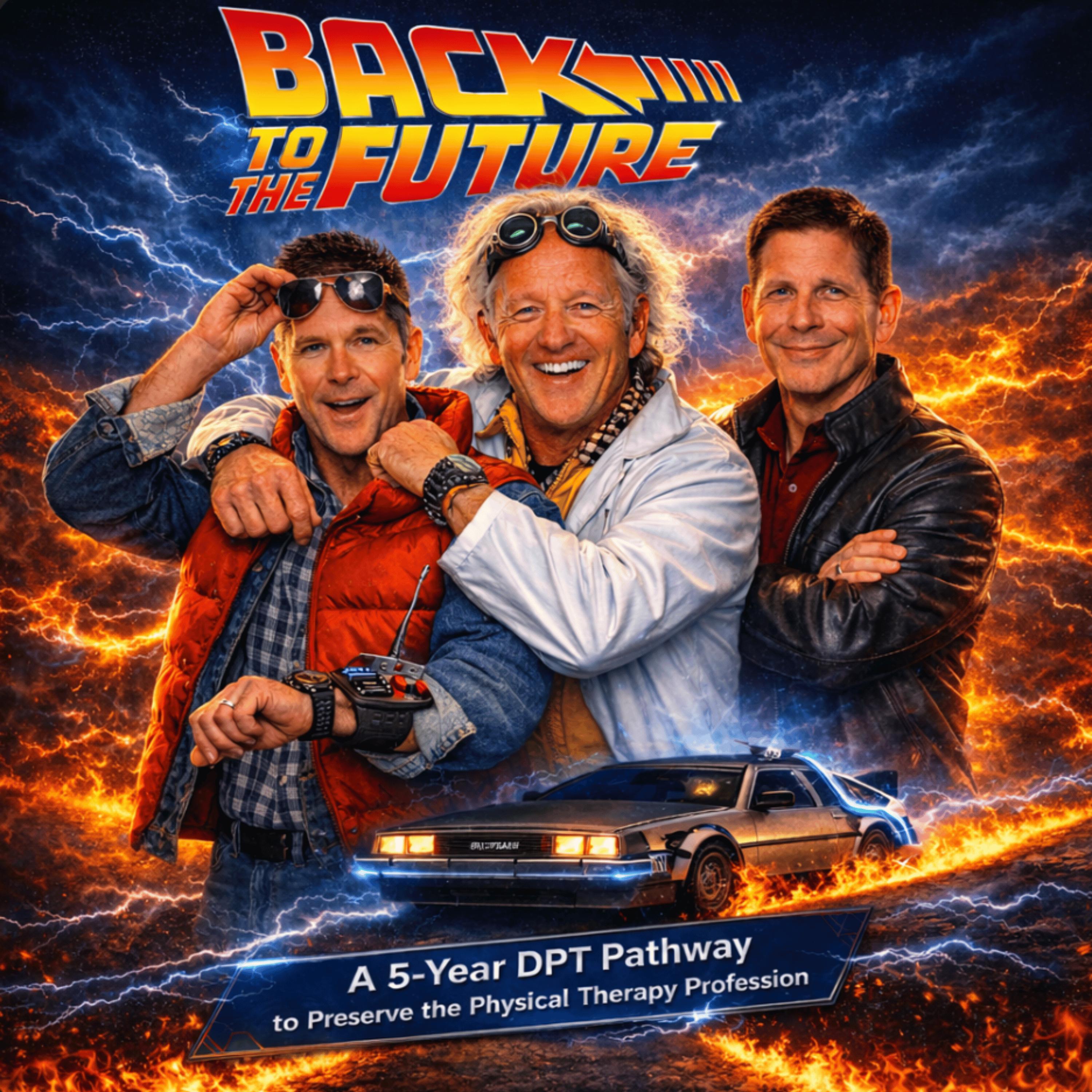


Larry Benz, John Childs, and Tim Flynn join Jimmy to tackle some of the most urgent—and uncomfortable—questions in physical therapy. Are we educating students into a broken system?
Why do most PTs say they wouldn't want their kids to become PTs?
And what would it take to fix this before the next generation gives up?
From the burden of tuition to the unintended consequences of accreditation rigidity, this episode pulls no punches. It's a high-stakes conversation with voices that have shaped PT education, and who believe it's time to reshape it again.
Topics Discussed:
- The unsustainable cost of DPT education
- Why hybrid programs faced institutional resistance
- What accreditation bodies are getting wrong
- How young entrepreneurs might save the profession
- The question every PT should ask: "Would I want my kids to do this?"
Featured Guests:
- Larry Benz — Confluent Health
- Dr. John Childs — South College
- Dr. Tim Flynn — Evidence in Motion
<p>This episode is part of the <a href="/physical-therapy-business-podcast">Physical Therapy Business Podcast</a>, where physical therapists and clinic owners learn how to get more patients, improve operations, and grow their clinic without relying only on referrals.</p>
<p>Looking for more episodes? Explore the full <a href="/physical-therapy-business-podcast">Physical Therapy Business Podcast</a> for real-world strategies on physical therapy marketing, patient acquisition, and clinic growth.</p>
0:00 You're listening to the PT Pinecast, where smart people in healthcare come to make noise. Here's your host, Jimmy McKay. All right, thanks, voice guy. Big thanks to Sarah Health, a remote care platform helping clinics boost revenue without adding staff. Sarah automates daily patient check-ins via text. That means no app, no logins, just better outcomes. It's a simple way to meet RTM requirements, improve follow-through, and actually get you reimbursed for care between visits. Find them online at sarahhealth.com. That's S-A-R-A health.com. Now imagine... You're in a DeLorean. But instead of checking the time circuits, you're scanning tuition statements, burnout rates.
0:45 The year on the dashboard, twenty twenty six and the dashboards flashing red. Something's wrong in the timeline of PT education. It's bloated. It's broken. And it's barreling towards a cliff, or maybe we went over one already. So three longtime disruptors, part educators, part entrepreneurs, part Doc Brown with spreadsheets, grab the keys and hit eighty eight miles an hour. Together, they founded programs, launched companies, taken on the APTA and lived to tell about it. And they're back not just to warn the profession. but to rebuild it. This is Back to the Future, part one, the radical proposal to save physical therapy through a five-year DPT redesign.
1:30 Let's welcome in the show, Tim Flynn, Larry Pence, John Childs. Gentlemen, how was my Back to the Future intro? Was it DeLorean-worthy? I would say it was Rivian worthy. Rivian worthy. There you go. Now, I got to tell you, I started this podcast by accident ten years ago when I was still a student. And I remember. A couple, and I think it was John walked by and you were having a conversation with someone and I said, who's that? And I remember someone saying, oh no, you don't want to talk to that guy. He does crazy stuff. And I remember hearing about you guys because I was still in school and hearing about you guys over the years going, all the crazy stuff they're doing feels like it makes sense.
2:12 Am I the crazy one? So let's start out with this. What year would you set the time machine back to? When did PT education go off the rails? If we were going to go back in time to sort of change it before it sort of forked, when was it okay? And then when did Biff Tannen show up and ruin everything? Well, I'll just start off with a lighthearted comment. I should defer to my elders, Larry and Tim. They have more of the history than I do. We live the history. In fact, we graduated pretty close together, Tim before me, so he should go first.
2:54 All right, Tim, when did we mess up? Well, I started as a bachelor's and actually with a bachelor's was teaching people like Larry who was getting a master's at Army Baylor. So I guess I am the oldest. So I think from my perspective, probably, and I think I was part of the problem just when I look back at the time. But it was really when we went to the DPT, when you look at how that came about, the the conversation around that time was such that none of the universities are going to buy buy this you know it's going to be such a heavy lift to really go from a master's degree because the ninety it went to the masters to the doctorate and but what was fascinating uh literally you know within about five years everybody went there and i as you look back you go hmm You sit around the university and at the board of trustees or even down below.
3:55 So let me get this right. You want to go from two years to three years and with the same number of faculty. So you basically we get another years of tuition with really little cost. Yeah, we should do that. We should do that. So basically all these universities went from zero to sixty and all of a sudden we have seven years of education. but i'll defer to my my junior colleague uh dr benz here because he he really has the most uh detailed perspective i think yeah so i think there's a couple surprises here and when i talk about this sometimes people look at me kind of strange but let's rewind the clock to how the profession looked at it by the profession i mean apta international organization because they led and carried the banner.
4:47 And you also have to remember CAPT is to an extent intimately tied to them. So, you know, when I was in graduate school, in nineteen eighty four, Tim, you were getting out probably nineteen eighty five. You got up right at the beginning of eighty six. And so Tim is correct. He actually was one of our clinical instructors while he had a bachelor's. I chose a master's program. in part because it was the Army Baylor program and it was subsidized, but also in part because it was one of the few master's programs that was available then. Again, think about that. In nineteen eighty-four, there weren't many master's programs. So what drove the master's degree? What drove the master's degree was our profession. APTA said by nineteen ninety, and I think it was nineteen ninety, I'm going to be directionally correct here, All one hundred and eight programs at that time, whatever the number was, need to be at a master's level with whether they're both private or public.
5:39 And obviously the privates exceed the public's because they have the flexibility and the autonomy to do so. Unfortunately, it wasn't until likely the last master's program probably hung around until the late nineties. We could look this up. but um there were a few laggards and lo and behold by the time the last master's program actually complied with the regulations by the way ot tried to do this very unsuccessfully just a few years ago it didn't work for them they tried to do it to the dpt or to the otd but in any event our profession said the body of knowledge is worthy of a master's degree Not everybody complied on time.
6:19 And even though the mandate was, let's say, nineteen ninety, it took another ten years. Unfortunately, it only took a few years to convert from master's to DPT. And why was that? As Tim alluded to, it was driven by higher education. It was driven by the desire to get more bites of the apple in the tuition dollar from students. It just affect PT. It affected almost everything. They call that academic creep. Accounting went through it by way of example. Pharmacy went through it. Speech and hearing went through it. OTD obviously did as well. Many others did. And so that's a really fundamental thing we have to remember. At some point then the profession, Creighton I believe was the first program to go to a DPT level.
7:03 And again, private schools exceeded, many states had to pass things within the regulatory bodies of their state's own higher ed to get physical therapy to a doctorate education. But the point, main point being is that it transitioned. It didn't take, let's say, fifteen years to go from bachelor's to master's. It was supposed to take ten. It only took about five. It was like, it just absolutely exploded because the tuition went crazy. So much so that when I have lots of friends and when I first started to employ PTs, we used to actually pay, we were still out of undergraduate programs when I was first in business, we used to actually pay scholarships. for PTs to get their bachelor's degree and then come work for us.
7:45 Obviously by the time I got to a master's and certainly a DPT, who's gonna be able to afford three and four years of tuition dollars. One last point, I'll let John speak. We should not let higher education continue to dictate our profession because our profession has migrated. We'll talk about COVID and the impact it's had on quality and types of education and hybrid and all that kind of stuff. But we have the control. We have the ability to retrain this and go back to the future if we want to. It will take some regulatory changes. It'll take some gnashing of the teeth.
8:26 But it really is going to take our profession to go back to commanding control of itself like it did from the bachelor's to the master's. Yeah, I think the primary comment I would have, and this is being as a critic to some extent of higher ed, I'm absolutely convinced if there was enough demand for a ten-year DPT program, higher ed would absolutely support it and move in that direction tomorrow. Now, that's a little bit facetious, but the reality is to some extent we are a victim of our own success. There is such demand for our services and a lack of therapists that are out there, that there's this motivation, obviously, to produce more and more therapists as needed.
9:11 And the demand is so high and the willingness of the federal government to subsidize these loans, higher ed is just sitting on this heyday of extended academic creep, as Larry said. And again, that might be a little bit of an overly cynical view, But I think back to the time when I was in PT school in the Army Baylor program, similar to Larry, it was a master's program. And at that time, every program was a master's program, and most every program was two years in length. You know, we were being sponsored by the Army or the Air Force, in my case, who was incredibly interested in getting us out of school as soon as possible.
9:57 Right. The motivation is entirely different. They're paying us salaries as lieutenants and captains to sit in a classroom and be relatively unproductive. Right. We're not seeing patients. We're on a pathway to get a degree. So the motivation was acceleration. The motivation was motivation. full time class, you know, eight to five. The motivation was no summers off. And so the Army Baylor program, even when I was there, was eighteen months. I mean, it was six months shorter than the average, quote unquote, two years master. And so you know, I think even with the master's program, we saw academic creep because there were at least some models where the incentives were different, where the time from inception to graduation was significantly shorter.
10:48 All right. So now we fast forward and we've got regulations that are coming into play. So that rise rule, which everybody read, but they didn't read it. They read the abstract and panicked or they read it and said, well, you guys are the guys who actually read and understand this stuff. The rise rule could change everything. Are we about to see the federal government make DPT education impossible or is this a good thing? Help me read these tea leaves here. Let me comment on a couple of things before we go there a bit because there are some monumental inflection points in our profession. Um, two thousand one And the teaching point here is that we've never tried to control for supply demand or volume of PTs.
11:36 And when the profession has tried to, they've been grossly wrong. So in two thousand one at that time, there were about ten thousand new graduate new PTs per year, ten thousand in two thousand one, five thousand American graduates of schools that would take their exam. And most of them, if not all of them, would practice clinically. At that time, there would be ten thousand foreign trained therapists that would come in the US. Half would pass the exam statistically. So another five thousand would become employed in the US. Now, up until about a year or two ago, we're now graduating about twelve thousand, although not all twelve thousand are practicing clinically, not all of them are passing the exam. But we are literally now in two thousand twenty six, roughly where we're at in two thousand one in terms of the same numbers.
12:23 That is when we should have made a decision on PT education because we needed more PTs. Surprisingly, though, the academic community actually predicted that we were going to have this huge surplus. And that huge surplus caused this pushback for developing not only programs, expanding programs or innovation. Those three things, when you halt program development, you halt innovation, and you halt the expansion of programs, you literally are trying to restrict PTs in order to be able to get the number that we need. And now what we have is literally Seventy to eighty percent of people who apply for a PT education somewhere are going to get accepted.
13:06 We have seats that are open. Who would have ever predicted in my monologue to this week's post, which will come out tomorrow or Wednesday, who would have ever predicted there'd be a time where anybody could become a PT? The qualifier is actually quite low. That has its own unintended consequences. So when we talk about rise here, we need to also, of course, correct the quality of students, coupled with those who are passionate and really want to become a PT, coupled with the ability to do it, the affordability and student loans, all those things. So we have to really kind of address all the challenges simultaneously, but we're going to keep pushing on one part of the sweater and another part is going to get a flaw in it. I sat in a room with two hundred ninety nine other applicants.
13:49 They had narrowed it down for how many applications to three hundred in-person interviews, three one hundred person sessions for thirty eight seats. And I remember doing the math when I walked in going, man, I got it for every ten person, people that walk in. I got to be one of them. Sorry, I'd be nine of them. I got to be the one. And that gets a little intimidating. And now you hear some of the application rates falling through the floor. which is again, shocking in that short time span. Again, that was twenty thirteen for me, twenty twelve. All right. So where do we go next? Do we go do you want to fast forward to the to what's happening now or is there still some context? Well, I'll take briefly the rise question. It's obviously still out for comment.
14:30 I think we're all hopeful that PT is going to get its due recognition as a profession, so to speak. It's to some extent, I don't know if it's humorous and or sad, probably some of both, that many other disciplines not to be named here are considered professions when we're not. But if we go down the path of sort of this worst case scenario where all of a sudden graduate loans are significantly curtailed, right, wrong or indifferent, it will absolutely force innovation in PT education. We will overnight see programs getting shorter, faster, more innovative.
15:11 I'm not saying that's necessarily the path I wanna see us go down, but smaller under-resourced programs that have big buildings and lots of fixed costs they're all of a sudden, I mean, if you don't have more than fifty to sixty students in your program, you're going to go away. You simply don't have enough revenues at that level to support the cost of running a program. And so I think what we'll see in that worst case scenario is the strong getting stronger. And boy, there will be a third of DPT programs that will immediately start to struggle and or, you know, at some point, you know, disappear. Now, having said that, I've been predicting this, you know, third of PT programs going away for ten years, and it's just not happening at the pace at which I thought.
15:59 So I'm guilty of, you know, maybe early forecasting, but certainly a significant change like we're talking about with some of the RISE regulations would absolutely force that, you know, those smaller under-resourced programs to rethink whether they want to be in the PT business. And you guys are going to go into detail with a series of articles, as I'll mention in the show notes. We'll give a link to that as well. So let's get to the solution. I mean, I think people are pretty familiar with at least some, if not all the problems. So great. As my research professor in PT school said with a great Irish accent, we know what?
16:40 now what i'm sorry what so what now what break down that five-year dpt proposal is this the hoverboard everybody's been waiting for you know what how does it look what does it do to solve some of the problems we're we're currently in have at it well i'll i'll speak to that and um to say that really, all of us here probably had many undergraduate courses that really didn't prepare us to be excel and PT. And what I would mean by that are certain we're certain heavily on certain courses that just didn't translate. So but just as we've accelerated the DPT from three to two, at the bottom line, our our entry into the PT world should be quicker.
17:28 I mean, three years as a three-year bachelor's degree, heavily focused on the skills of healthcare professionals so that the skills really are. Yes, a strong liberal arts background, actually, but liberal arts, it's applied to those skills that make you great at communicating with others. You know, those skills that actually translate across all the health care professions. So whether you go into a DPT or an OT program, a PA program or to medicine, You essentially have the background of the people skills. And that three-year bachelor's should include credit for people that are working in the health care industry already that are in people focused business or even people focused business.
18:24 I often say, you know, I've always felt that bartenders and servers and waiters and waitresses are some of the best people to come into our profession because you basically have to think on your feet. You have to look people in the eye. You have to communicate with people. And when shit goes wrong, You have to think on your feet and pivot and make things right. That to me are a skill set that people should have credit for as you go into health care professions. To me, you know, there's heavily on the the sciences that are focused to what we need in PT and heavily on the humanities side of it, but also with practical skill sets that are people facing.
19:15 And just one last comment. The thing that comes back always is, oh, you know, that's higher ed, you know, it's, you know, they're not going to pivot. And like we've said, people pivot immediately, like we did in COVID, when the situation requires it. But that's how I had probably started. I'll start on that kind of the entry point side. Just a couple observations. One on RISE, I'm going to predict that it's not going to end up being anything of significant, even if it stays intact, it'll get kicked down the road many years before it actually gets implemented.
19:57 Again, this is just my opinion in part, not because of PTs, but because nurses, nurses usually win. They have strong advocates, advocacy. The reality is healthcare shortages are not in dispute. And, you know, putting forth an old reg on new student loan limitations doesn't make any sense for anybody. You think we have one of the lowest diversity percentages in PT would only get worse under those scenarios of rise. I think brighter minds will prevail. Having said that, regardless, we need more innovation in PT. The best example I'll go back to is nursing. You could get a nursing at an RN level, a BSN, MSN, a doctorate and nurse practice now.
20:38 And we have to have some tools to do that. So I do like the three-year bachelor's into a two-year DPT. But I also like other flavors too. I like the idea of graduating in two, you know, baccalaureate for four even, two years in a DPT. Okay, that's an additional year, but then you would get a master's and you'd get paid. The reason why that's you get your license and you get masters, that's critical because we have horrible regulations that basically say if you treat a Medicare patient that is in, you know, life threatening Part A, you can do so independently without supervision.
21:19 But in Part B, you can't get billed or reimbursed unless you are consuming the same oxygen as a licensed PT standing next to you. And so that regulation, we're not going to change. We failed at every Medicare regulation change. We take shallow victories and things that don't matter and things like direct access and things like the regulatory supervision requirements, eight minute rule and student supervision. We're not going to win, in my opinion. And so let's play the game and say, let's give them a license two years or halfway through PT school. So that way their billing will count. They will not be as productive. They do not have to start as a full time salary. Residents and interns don't get full time salaries either in the medical model.
22:02 And that can become a pathway when you complete that time frame of a year, whatever it is, then you can get your DPT. So my point being is I think we have to develop a multitude of pathways, all of which uphold the rigor of academic and the competency and the knowledge base. But to Tim's point, what scares me the most is we will oftentimes default to too much technology, and then you're going to lose all tacit knowledge skills. You're going to lose collaboration and teamwork and empathy and compassion. And the things that really, you know, we're a victim of our success because we have the hands-on skills, we have the quantitative skills, but we also have the qualitative parts to our profession as well. And I'd hate to see that also be sacrificed for efficiency purposes.
22:47 Yeah, I don't have a whole lot to add other than I do think nursing is a good example of, I mean, they have their own, you know, issues with so many accreditors and some of those kinds of things, but they've certainly been innovative in having lots of different pathways to all sorts of variations of master's degrees, bachelor's degrees, doctoral degrees to specifically equip you for the role that you're going to play in the nursing ecosystem. And at least in PT at this point, we sort of have a one-size-fits-all kind of an approach. And I would say I think the good news is we've got a lot of room to innovate. I mean, if you go back to the four-year bachelor, there was a time where there was I don't know if it was ever a third, a third, a third, but you'd be working in the same clinic with bachelor PTs, master's PTs, and doctoral PTs.
23:42 Everybody would be in the same. And as you looked around at each other, I don't think any one of us would say, well, I'm a better PT than you are, or you're a better PT than I am. You've just had a different degree. Right. And now we're in a situation where there's probably few to there's probably still some, but there's probably very little bachelor PTs that are still practicing. And it's a mix of mostly doctoral PTs and some and some masters. My point in saying all that is we've got we've got like three years of room to kind of play with. Right. We went from four years all the way up to seven years. And so surely there are some innovative opportunities to bridge that gap.
24:25 I think about it from the perspective of, you know, when we went from the master's degree to the DPT, you know, if you really look at it at its most foundational level, you have to ask yourself, OK, well, what else are PTs going to be learning in order to go from this master's degree to the DPT? At the end of the day, it was like diagnostic imaging, some primary care, medical screening. Think all things that would prepare us for direct access, right? Most programs were two years in length and higher ed, again, found a way to justify that that amount of content deserves an entire another year of education.
25:08 When in reality, I mean, if we're really honest with ourselves, could we have done that in three months? Could we have done it in six months? For sure, we could have done it in six months. And so, you know, I don't think we have to get rid of the DPT and go back to the masters. I don't think anyone thinks that's really the path we're gonna take, but we can absolutely create these milestones along the way, like Larry alluded to, where, you know, we get a, a bachelor's degree, whether it's three years or four years, we go to a master's where we become licensed and we have the opportunity then to complete our, our DPT on the backside. And so there's just, there's a lot of opportunity, but we do have to have a regulatory body and a professional association that will embrace that, that innovation.
25:59 If we continue to just You know, hit the hit the nail with the hammer and say it's a, you know, seven year DPT program. You know, we're never going to get there. Right. So who decides this or who needs to be the person that says this has to happen or else? Right. There needs to be consequences. It's a nice thing to have or it's a need to do. Who's in charge of that? Yeah, so just to allude to this, but employers of PTs are severely underrepresented in this argument. We grouse, we complain, but we seldom have any voice or influence. And so we have to have employers banding together and locking arms with our academics and our higher education with our regulators around this.
26:45 You know, there's this other interesting phenomenon that sort of happened, I refer to as the post-COVID hangover. And that is the reality that during the COVID time period, things were incredibly relaxed regulation-wise, which allowed people to do remote learning. We were deemed heretics by our own profession for trying to do a two-year hybrid PT program. And we had decent number of years, even prior to COVID launching. COVID launched, our phones were ringing off the hook with people, how do we do this? Because we suddenly had academics, particularly in our own profession, said, never, ever, ever over my dead body will I teach online. Now, wanting calling and saying, how do I teach instructional design?
27:26 How do I learn? and do things online. All good. Things have changed. There are a lot more programs. That's a step in the right direction, but it hasn't cured anything. And the reality is, as an employer, I can tell you that PTs are coming out with less reps. They're coming out with less clinical confidence and less clinical readiness. That's not an old fogey saying, you know, they're not as good as they were when we were there. That is well documented amongst the employer groups. So what do we have to do? We have to even put more resources into the training of new pts that have suddenly paid for six or seven years of school and aren't clinically ready now this just isn't a pt phenomenon i work in dentistry now it's the same thing there it's the same thing in primary care it's the same thing across because the regs relaxed enough were enough reps enough clinical experience so we do have to go back to a more lengthier you know, time period and on the clinical side and regain that.
28:21 Is it a less quality student? I don't know. I'm not willing to go there necessarily, other than the failure rates seem to seem to suggest a correlation there. But I want to get a better clinical education, which we've collectively referred to as the big black hole. And we have some strong opinions about how to correct that. But I'll let Tim comment on the regulatory side, how we can figure out a way amongst the key stakeholders to get this thing turned. Well, thanks for that, Larry, I think. Part of it is... As the most current practicing academic, I thought you might have some ideas on how we can do that.
29:06 Maybe not. Well, I was always offended when I was called, and I still am. called an academician. And I mean, I just have always felt that I'm a clinician and I never fit in the world of academia because it just, it's an area where, and again, I have wonderful colleagues in academia, but the difference between sitting around a table for an hour and a half and discussing things and debating things that just, you can't do that when you're actually trying to make payroll.
29:49 I mean, that just, it just doesn't happen. Unfortunately, you know, you think about, you know, academia being liberal thinking and out there new ideas, and I would argue it is not. It is very much rooted in, you know, tradition and the threats of, you know, something doing something different. And that's just so I don't think unfortunately, universities are where we're going to look to see change happen. And and when it comes to regulatory bodies, you know, that's that's again, you know, rigid hard to push through hard to do anything innovative i really think the change happens unfortunately through the through a crisis is what we're seeing you know as we see you know this huge demand for our services but not able to create a product out there that that can meet that demand.
30:57 So I'm more hopeful that, you know, our business leaders and our actually work areas will be able to change and partner with higher ed in a way that other businesses have to say this is what we need and we're willing to come and partner with you to create this if you know we know that you're gonna feed us a quality person to work in our in our in our field so that I guess my sense is it's going to be going to be hard but the second thing is with the this quote-unquote educational cliff I think the bachelor's thing isn't going to be that difficult because there's so fewer students that everybody's competing for and that bachelor's level that those that are innovative there I think we'll be able to scale up and have larger programs, especially if they really focus like some of these private, dare I say, for profit institutions that are actually responsive to a bottom line to say, hey, we can scale up and get more people through a bachelor's program in three years and feed into all these different health care programs that we all need kind of a similar skill set, I think.
32:24 Whoever does that, and maybe some people are, but it's definitely not common. Whoever does that quickly, I think can rapidly fill seats and be able to help that side of the workforce and roll them into DPT. So that was a long-winded answer to say I'm not real hopeful that I can see disruption happening anytime soon but maybe i'm curious what larry's thoughts are actually because you always have those uh oh go ahead john Well, no, I was going to say, I'll just add one anecdote that sort of touches on sort of the resistance in higher ed and amongst accrediting bodies.
33:06 And in our case, that's CAPTI. I mean, this is ten years ago, but I will never forget the moment that we sat across the site visitors. This was the very first hybrid two year DPT program at South College. This was probably I don't know if it was twenty thirteen, something around that time frame. This was the hybrid model where all the didactics were going to be done online, synchronously, asynchronously. Then when they came onto the campus, it was going to be eight, nine hours a day on your feet, getting all those reps in. This idea that psychomotor practice over and over and over, you know, over a seven to ten day period, you know, maybe those skills could be retained in a more effective way than this sort of lecture lab, lecture lab model that's very inefficient in a lot of traditional programs.
33:57 And I will never forget when one of the site visitors looked across from me with this sort of blank stare and said, but John, by having them in labs all day long, you're going to exhaust these students. And I'm sitting there and I'll never forget my reaction. I had a really hard time not almost lashing out. I mean, I wanted to be like, that's exactly what we do as clinicians. We stand on our feet going from patient to patient. I mean, it's a marathon in the day of the life of a clinician. And so my point is, is that you have these sort of incumbents, dare I say gray hairs, that have not been in practice for many years, who've completely lost perspective with what a clinician does every day.
34:46 And so, you know, we have to get the perspective of clinicians to Larry's point, employers have to band together, you know, without employers, we don't have clinical sites, employers have far more potential influence than I think we've realized as employers. So I think employers are a bright spot. Nursing, again, we've talked about nursing. They have so many different pathways. In part, that's because they have so many different accreditors. And so those different accreditors have sort of different flavors of kind of risk appetite for innovation. And it depends on the state you're in.
35:28 I personally think we should have more than one accreditor. Right now we have one in CAPTI. The problem is individuals have looked at starting other accrediting bodies, but I'll forget how many states it is, but in let's call it twenty to thirty, it might even be forty states. CAPTI is specifically named in the practice act as you have to graduate from a CAPTI accredited program, not just an accredited program, right? And so in order to compete, so to speak, with CAPTI, you'd have to literally change practice acts in all these states, which would take fifty years to do and it may never happen. So, you know, at the at the end of the day, we need more competition and we need more willingness to accept really innovative practice models or educational models.
36:17 What happens if it doesn't change? And we mean we need more Well, part of the unintended consequence of all this is, you know, physical therapy tuition in the higher ed level, I'll start there, has been unabated relative to their increases in cost and tuition factors. And so as that has exceeded inflation for so many years, it's finally starting to have, you know, some counterbalance in it because of some other disruption that's going on. I'm not talking about PT, I'm talking about higher ed in general. But the reality is who would go into the profession for the ROI that you get at this particular stage? That is our selfish motivation for wanting to correct this.
36:59 We want our best and brightest to go into it. There is absolutely, in fact, the way you can tell the ROI is so bad is only about on an FTE basis, only north of of all licensed PTs practice PT, okay, on a full-time basis. What other profession can you name in health care that has that obstacle? What other profession, period, health care, unrelated to health care, can honestly say we've had less productivity today than we had ten and fifteen and twenty years ago? I don't know of any other occupation in America that can say that. But PT, we have. So the issue is we are overregulated.
37:42 And unless you get a combination of decreased regulations and or enhancement of reimbursement, certainly don't see that coming. You're gonna have a degree that has priced itself out of competition for the souls and the minds of young people. I think the other issue is you have to get, you know, the problem is the states are relatively the easy ones. They basically say to get a license, you have to graduate from accredited program. I think we can get the ones that say CAPTI reverse with probably opening up that practice act. But, you know, it's an obstacle, but they're the easiest. The more difficult one is CAPTI. And CAPTI is intertwined, co-located, and housed by APTA and needs to respond to its constituents, which are PTs and employers and academicians.
38:30 And we failed the first two times to try to get a hybrid PT program. We failed at it because it was unacceptable in the view of the accreditors. I don't know if that's public knowledge. I don't even know if I'm allowed to say that, John. But it's absolutely because they could not handle that type of innovation. Now you've got highbrow universities doing two-year hybrid programs. And we have to go down that same route, unfortunately. But what we can't do, we thought within a few years of the first hybrid program that there would be imitators. It didn't take till post-COVID. until, you know, two thousand twenty two, two thousand twenty three. These other programs came out. Meanwhile, we've got, I don't know, fifteen or seventeen of these.
39:12 And now it's becoming more and more normalized. That's a good thing, but it's not enough. We need multiple pathways, but we've got to get the creditors in a room with employers and academicians. And like we said, the States are the easiest ones I think to overcome. And then you've got to get, you've got to get some pioneers out there and it's probably going to come from the for profits because they tend to be the most innovative and flexible. You cannot name great innovation with the exception of maybe Arizona state, not on the PT side, just talking generally, there are not a lot of high innovators on the public side that private side or even fewer. And so it's the for-profits that got to say, we'll do a bachelor completer program in three years and get you ready for a PT program that you can do a three plus two model.
39:56 I think there's a pathway there and there's an opportunity, but it's going to take probably a younger set than Tim, Tim, John, I, and Rob Wainer to get it done this time. Maybe not. Follow along in the series as these guys keep writing about it. I'll share the link in the show notes. Do you want to say thanks to Empower EMR for supporting the show? If your clinic is stuck on an EMR that slows you down, you have to innovate. Empower gives you speed, clean workflows, and features PTs actually ask for. Better notes, faster documentation, smooth operations, all wrapped in customer support. It doesn't ghost you. EmpowerEMR.com. EmpowerEMR.com. If we don't change the timeline... If nothing changes, what does twenty thirty look like if there if Marty can't lose?
40:41 Right. There's no tension in the story. People won't pay attention. I mean, I'm guessing if there if there isn't some consequence on the line, which we can see very clearly, even someone like me who's an amateur at this can see there's consequence. If we don't change the timeline, what does twenty thirty look like for the profession? And then we'll do parting shots. Looking at you, Tim. Okay, well, I guess if nothing changes, we'll continue to see fewer seats filled in DPT education. The type of applicant that we'll get probably in no shade here, it'll be people that love it.
41:24 the profession, but probably have a trust fund or something else that allows them to go through higher ed without debt, but also probably would rather work part-time on the outside of it. We'll continue to see people doing it as more of a hobby, if you will. Again, more and more people working less full-time doing other things and having side gigs in the profession. And what fills the gap? Then it's just every other flavor of body worker will fill the gap out there.
42:07 And the health of our society, I firmly believe will go down. As a physical therapist that sees over and over the failure of our system I'm not it's going to get a lot worse in terms of health care outcomes in our society. All right, Larry, John, anything he missed there is going to get harder as we go along because he's covered a lot of bases. Anything you'd want to add to that? I'll just sort of, I think, amplify what Tim said. We'll see less diversity in PT. It'll be largely Caucasian, affluent, passionate people that maybe had a real positive experience in PT and debt to income sort of ratios.
42:52 They don't even think about what that means for them because they have no debt. I think we'll see certainly a contraction in the number of of PT programs. There's just no way these smaller under-resourced programs will be able to, you know, I think, you know, survive in that scenario. So, you know, I'm always a glass half full. I think the crisis is in front of us, like literally as we speak. So I'm hopeful we can, you know, really you know hopefully eyes are opened uh even amongst the the those that are that have been most resistant to change and realize um uh you know without significant reform you know our profession is in uh some amount of of peril yeah all right larry no pressure but twenty thirty nothing happens yeah just a Well, I expect if you think there's twenty to thirty thousand shortage of PTs now, that'll increase five to seven thousand per year, notwithstanding because you have less graduates that actually practice clinical PT than ever.
43:59 We will have less clinicians per year than we had prior to two thousand one, which is actually quite scary given the demand for PT. But the unfortunate thing is that PT will continue to be highly undifferentiated. Digital front doors and digital exercise will be conflated with PT, as will at-home remote therapeutic monitoring and YouTube. And so there'll be this bifurcation. If you've got money and you're young and you're healthy, you'll be able to access PT. But if you're sick and you're elderly, your access points for PT, my goodness, if you're in a long-term care setting or a home health setting, even in acute care setting, certainly neuro rehab, you're going to have a hard time accessing hands-on PTs and pediatrics is probably on that list as well.
44:45 So the specialties are really, really be, be bludgeoned in terms of numbers. Those who are getting PT that are more into longevity and health and fitness and wellness are generally musculoskeletal. They'll fake their way into a conflated PT. That'll be a combination of a digital front door and YouTube. Yep. All right. Last thing we do on the show is called the parting shots. This is The Parting Shot. One last mic drop moment. No pressure. Just your legacy on the line. Pressure there. Today's episode brought to you by U.S. Physical Therapy, a national network of clinics focused on developing clinicians, not burning them out.
45:26 Leadership tracks, mentorship, and career growth, as long as we have a profession, and the stability to build your future in PT. If you want a place that supports how you want to practice, that's USPH. USPH.com. That's USPH.com. Tim, you've done this before with me a bunch of times. You get to lead off. So what's your parting shot? Final thoughts, soapbox statement, what do you got? okay well i still love this profession and i still feel like from a societal perspective we have so so much to offer and despite the gloom and doomed said today uh i i still believe the future is bright and we just need to accept what's in front of us and just like you know we we have rehabilitated people We can rehabilitate our system.
46:13 And so I'll leave it with that. It's time for some serious, deep rehabilitation. Love it. John, what do you got for your parting shot today? Yeah, I think I would just end with a little bit of optimism. There are some, you know, when I look at all the engagement on the initial post that both Larry and Tim did, there's some really well-informed, smart, younger entrepreneurs in our profession. that are probably hell bent and have ideas we haven't even thought about in making change. And, you know, that's where we were ten, fifteen, twenty years ago. And I'm very optimistic that those individuals are not going to take no for an answer.
46:56 And they're going to you know, they're going to couple themselves with some mentors, whether it be us or many of the other you know, leaders in the profession that have done, you know, contributed to some significant reforms. And so, you know, hopefully that energy and youthfulness, you know, will thrive in a way where, you know, we'll see progress perhaps in a way that us gray hairs ourselves, you know, may not even be able to see ourselves. So, you know, so to any of those young entrepreneurs in PT, whether you're an academician, a clinician, you know, dare to dream and don't take no for an answer.
47:37 All right, Larry, no pressure. You got to wrap this up. Well, while I share in my friends, colleagues and partners empowerment message that we do in fact have the ability to course correct here, I am also bothered by a serious data point. How many, if you just look at Tim and I, our kids are all older, John, your kids may still be in a way that they can, but how many will become physical therapists? And the reality is that most PTs when interviewed, do you want this career for your children? Absolutely unequivocally say no. The same thing happens for physicians as well. And so my parting shot would be a question. If the answer to your question is, do I want my children to become a physical therapist?
48:22 If that answer is no, what action, what activities and what do we need to do and what are you willing to do and help so that you can answer that question in the affirmative? Wow. Yeah. Bold questions. We'll put the link to the series of articles that are going to be dropping throughout the next couple of weeks. Thanks for the insight, guys. We appreciate it. And thanks for setting a little optimism, then also putting some tension in the story because no pressure, no diamonds. That's it for this one, but we're just getting warmed up. Smash follow, send it to a friend, or crank up the next episode. Want to go deeper? Hit us at pgpinecast.com or find us on YouTube and socials at pgpinecast.
49:09 And legally, none of this was advice. It's for entertainment purposes only. Bullshit! See, Keith? We read the script. Happy now?