Getting Patient Buy-In When They Don’t Want Help

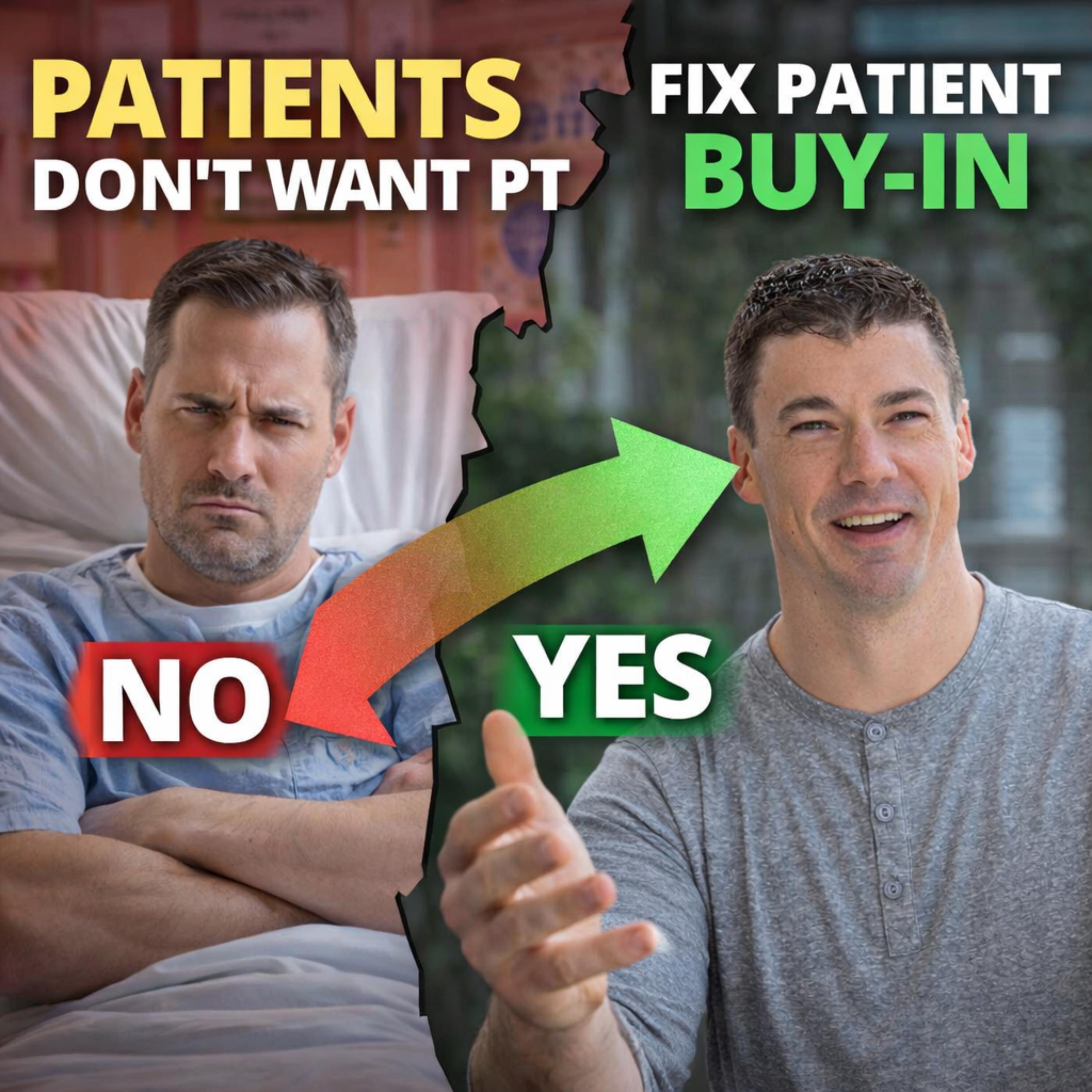


Most patients don’t want to be in physical therapy—especially in acute care. That creates friction, resistance, and missed opportunities for better outcomes.
In this episode, Sid Stoddard breaks down a practical communication framework PTs can use immediately to improve patient buy-in without adding time or complexity.
Key Takeaways:
- “Embrace the suck” → patients are already frustrated before you walk in
- Patients don’t want PT—they want to leave or get back to life
- Use the “onion” approach: uncover layers before pushing interventions
- Always explain the why behind what you’re asking
- Adapt your communication style (wear different hats)
- This applies to outpatient PT just as much as acute care
- Small actions (like helping with self-care) build massive trust
Why this matters:
Better communication = faster buy-in, smoother visits, fewer refusals, and more efficient clinics.
Guest Links:
Sidney Stoddard
https://scholars.georgiasouthern.edu/en/persons/sidney-stoddard-2/
<p>This episode is part of the <a href="/physical-therapy-business-podcast">Physical Therapy Business Podcast</a>, where physical therapists and clinic owners learn how to get more patients, improve operations, and grow their clinic without relying only on referrals.</p>
<p>Looking for more episodes? Explore the full <a href="/physical-therapy-business-podcast">Physical Therapy Business Podcast</a> for real-world strategies on physical therapy marketing, patient acquisition, and clinic growth.</p>
0:00 you're listening to the pg pinecast where smart people in healthcare come to make noise here's your host jimmy mckay want to say thanks to u.s physical therapy look you've built something meaning meaningful but scaling or planning what's next can sometimes feel overwhelming US Physical Therapy helps you grow while staying in control. Find out more at USPH.com. That's USPH.com. And if your EMR slows you down, Empower EMR gives you faster documentation, cleaner workflows, and support that actually responds. Find out more at EmpowerEMR.com. They know switching an EMR is never simple or easy.
0:44 But kick the tires and see what you might be leaving out in terms of money or time. Both of those things are valuable if you run a clinic. Again, empoweremr.com. Today, well, here's the idea. Most physical therapists or healthcare providers in general are trained to help fix problems. But what happens when the patient you're working with doesn't even want your help? What are you supposed to do? In hospitals across the country right now, Clinicians are walking into rooms where patients are understandably tired, frustrated, and just counting the minutes until they get to go home. And yet... Clinicians are expected to motivate movement, build trust, and drive outcomes fast.
1:28 Today's guest has spent years navigating that exact tension, figuring out what actually works when patients might be hesitant or resistant to care. What are you supposed to do then? From acute care floors to the classroom, he's developed a practical framework PTs can use immediately. Let's welcome to the show, Dr. Sidney Stoddard. Sid, welcome to the program, man. Hey, Jimmy, thanks for having me. I appreciate you bringing me on. Looking forward to our conversation today. Yeah. I mean, people are looking for, when I hear the word framework, I'm like, great. It's not rules telling me what to do, but it means that someone recognizes that, yeah, this is a problem. This is difficult. This is simple, but not easy.
2:22 we need them to do. So we've got that paradigm to be able to motivate people. So let's start with a strong take. Hey, listen, no one wants to see a PT in the hospital. I did a rotation there and I recognize that this was not a small problem. This walked into the room before I did. Let's start with belief. What led you to that belief or what was your experience to say, hey, I got to figure out a way to get past this or overcome this? Yeah, I think, you know, in my time being in the hospital, it's one of those things where we're all going to encounter patients who maybe don't necessarily want to be there. And I think it's not even the hospital, it's the outpatient setting as well.
3:03 You know, you're going to encounter somebody that is taking time out of their day if it's in the outpatient setting to come and fix a problem they didn't anticipate. And so we have to find a way to navigate that. And in the hospital, it's even worse in that they've been taken out of their typical routine and placed in a situation that breaks their habits. kind of puts them at the pace of how the hospital is moving versus how they want to move. And so there's obviously going to be some frustration there. And even some of the best hospitals in the nation still suffer from these types of problems. And so my personal experience has been just, you know, having worked during COVID in some critical care type settings, as well as some medical surgical settings, I had a lot of experiences where patients were, they couldn't have family members, they couldn't have, Visitors, they really were kind of cut off from the outside world, right?
3:52 And really the only experiences they were getting were interacting with the healthcare providers, albeit in a very awkward and masked way. And so really what I started to develop is like, how do I recognize that like, yeah, this sucks, right? Like the patient doesn't want to be here. Like this is not their ideal situation, but I know how I can help them to get back to doing what they want to do, whether that's to go home, or whether that's in the outpatient setting to improve their function, whatever their functional limitations are. So I think really like the first thing I think about is like this idea of like embracing the suck, right? As PTs, we really need to focus on thinking about how, what we're doing.
4:35 Yes, we have our goals in mind that we want to do, but at the same time, nobody that has a Foley catheter, three IV lines, you know, just recently got extubated is going to want to just get up and walk around. That's not on their to-do list today. Like, And so what we need to do is just recognize, hey, you know what? It does suck. I recognize that, you know, what you're going through is not the most entertaining thing in the world. It's not the most fun thing in the world. But all of our patients have goals, right? Like they all want to get back to doing something. In the hospital, most of the time they want to leave, right? And that's kind of like my second point is like they want to leverage, like, what they want when we're trying to get them to do things. So, and that's to leave the hospital.
5:16 And we know a lot of different ways as physical therapists, right? We're movement experts. We know a lot of different ways that we can go about trying to help patients to improve their mobility in an effort to get them home. And I think if we can really kind of help them to understand, we recognize this is not an ideal situation for you to kind of embrace that suck. and then also start to leverage some of those, those goals that the patients have, which is to leave, we can really kind of make a breakthrough in that communication barrier that sometimes presents itself. Well, it sounds like, and we'll get into this sort of this six-step approach that you have, but it sounds like what you've already started to do is put yourself in their shoes or in their bed or where they are, right? You're starting to think like, gosh, before I walk in this room, man, what is this patient going through, right?
6:01 Before I write down patient noncompliant, this person's likely in a hospital situation going through like one of the worst experiences of their life maybe, right? And not because of the care, but because of the reason that they're there. Number one, it sounds like you're trying to put yourself in their shoes or their, you know, no slip socks, building empathy, which is critical for improving or even beginning to improve engagement and outcomes. So that's sounds like step one, but where does your six step approach begin? Is that number one or is that even before the approach? So I think really like, from what I've seen, sometimes it's easy for physical therapists to forget that patients are people, right? Like sometimes we think of them as a number.
6:42 I've heard you talk about it on this show. Like we sometimes get in this habit of like metrics driven and there's a time and place for that, not arguing that. But I think we kind of forget that main idea that like these are people that have been removed from whatever part of life they're going through at this time and placed in a situation that's less ideal. How I like to personally think about it is like, one, if I was in that patient's shoes, how would I feel right now? Or two, if I had a family member that was in this situation, how would I feel observing how I'm interacting with that patient? And so I think if we can do that before we even get into these six steps and just put ourselves in this mindset of like, I'm just going, I want to be treated how I would want to be treated or how I would want to be treated.
7:25 I think that's like step point five, right? So I think that's an early, early starting point for sure. Yeah, that's the golden rule, right? Treat others and remembering this is a person, not a patient. It was hammered into us in PT school, right? But as soon as you saw it, the ICF model makes complete sense, right? Like the person should be at the center, which humanizes everything. That one scene from Patch Adams comes to mind. If you haven't seen it, like that's on my top ten. If you're going to go into healthcare, you need to watch Patch Adams, Robin Williams, and Champ. And they're asking all these questions about the condition, the condition, the condition. And of course... you can't even see robin williams he's in a group of doctors and he's what's the person's name they're like why would we want to know that it's like well it's kind of important man yeah and i think it's too easy you know we just get in the habit of like okay we have these eight patients we need to see or ten patients that we need to see and you just start looking through medical records and picking out who you want to see and you kind of lose track of that that that person that's behind all those charts and all those notes that you're reading and so i think you really need to kind of put yourselves back in those shoes whether you're a new therapist or an experienced therapist.
8:32 I think we can all sometimes be reminded of the importance of remembering that. Yeah. All right. So hit me with the paradigm, man. I mean, you work in education too. I think this is vitally important. It's something to stick to. It's an approach, which means it's not, you have to do all six, but it's a, it's something to sort of follow and get good at. Yeah. And my goal, I think is not, this is not going to necessarily improve your clinical, your clinical skills from like a hands-on perspective. This is more from a communications perspective. And really like, You know, I haven't delved into the research behind any of this. I think this is just more what I've seen and what I've seen good therapists do well. And so I'd like to share that with everybody. It's really five steps and then like a six bonus step at the end that kind of ties this all together, no matter what setting you're working.
9:14 So really that first step I was talking about is the idea of embracing the suck. Like we have to recognize that our patients are not going to be happy because they've just been poked and prodded all night. You know, they've been woken up every hour for blood draws, or they've been looking up every hour for vital signs. They haven't gotten a good night's sleep. The hospital bed's likely going to be uncomfortable for them. They may not be eating the same types of foods they typically like to eat at home. I think any of us, if we put ourselves in those shoes are going to realize like, this kind of sucks, right? Like we're, we, we, we don't want to necessarily be here. Now we may know that we need to be there because we have a medical issue, but that doesn't mean we necessarily want to be there. And so I think by embracing that suck and helping our patients to almost in a certain way, embrace that suck too, we can kind of get past that initial barrier where they might be a little bit disgruntled or they might be a little bit frustrated.
10:04 It's like, okay, Hey, I get it. I understand why you're frustrated. I recognize that, you know, you're going through something that you didn't plan for. And now I'm potentially a barrier to you going home based on how you're moving around. And if we can help get past that a little bit, I think we can really start to tap into figuring out what the patient's wants and needs are, which I think is super important. And embrace the suck is, you know, sort of a line that I know David Goggins uses that he's a famous, you know, like motivational ex namey seal. can take it to the extreme, which I saw is sort of his thing. But what we've seen is people that can understand like, okay, I'm going to level with you.
10:45 This sucks. But like, you've now just explained that you see where I am. People want to be seen, heard and understood. Right. You know, I now recognize what you're going through and I realize, hey, maybe I might be asking you something that's not ideal. If you have the choice between sitting still and doing nothing or doing what I'm asking you to do, I recognize that the thing I'm asking you to do, it's going to be even suckier. But the next step is it will lead to something you want even more. Yes. And I think that then gets into step two of this whole paradigm, which is leveraging what the patient really wants. You know, at the end of the day, sure, we as PTs, we have goals that we want to achieve for patients. We know, okay, we got to find out their home setup.
11:27 We have to go ahead and then try to work on it if they have stairs, making sure they're safe to do the stairs, making sure they're safe to get around. Cool. Those are our goals. What about what the patient's goal is, which is typically to leave, right, as soon as possible. They want out. And so what can we do to try to leverage that a little bit and figure out what's going on? And so what I like to think about is asking my patients, like, what's the first thing you're going to do when you get out of the hospital? Sure, you're going to get discharged at some point, you're doing well, things are going well. So what do you want to do when you first get out of the hospital? And sometimes I'll hear, I want to take a shower. Great. Well, you know what you need to do if you take a shower? You need to be able to stand for five minutes. You need to have good static and dynamic balance.
12:07 You need to be able to walk in and out of the shower, potentially get over a shower lip. Those are all functional things that we can work on in a acute care setting. that we can then relate back to that patient's goal. Like, hey, I want to help you take that shower when you get home. I want you to do well at getting in and out of that shower. I don't want you to fall into the back in here and then I have to see you again. Like, we want to get you home and ready to go. And so if we kind of can then take those patient goals and incorporate them into our treatment, I think that that's really how we can kind of improve that buy-in with patients. Because then, like you said, they feel heard. And then it also helps us to accomplish their goals. Because guess what I'm doing while I'm walking them you know, in the hallway, I'm talking about, Hey, how does it, how does it to get into your shower?
12:48 Do we have to go around any turns? Is your bathroom on the second floor? Things like that. So I think if we can just kind of break past that barrier and figure out how do our goals, like design our goals to meet our patient's goals, we'll be able to get them to buy in a lot more to what we're trying to do with them that day. Yeah. Yeah. If content is king, context is queen and putting those things in context to make your, the things you're asking them to do in the suck aligned to what they want to do when they're out of this. That's the fastest. It's the only way through, uh, through the suck is through. There's no around. Yes, you're here now. You're going to go through it, right? So how do we get you out of this as quickly but as safely as we possibly can and get you back to doing what it is that you want to do, which is live your life without whatever medical condition brought you in here or with that being as managed as well as we can?
13:36 And I think the other thing is, too, too often you have patients being like, oh, I'll be fine when I go home or whatever. It's like, well, tell me what you usually do during the day. Well, I walk from the kitchen to my living room. And then I like to watch TV. But then I'll have to get up and use the restroom things like that. So, okay, well, guess what? If I'm the only thing standing between you and getting out of here, and the doctor said, hey, until PT sees you, we can't discharge you, and now they're just waiting for me, and then I show up, and they're like, hey, I need you to get me out of here ASAP, great. Well, then show me you can walk a hundred fifty feet without falling over. Show me that you're safe with navigating a carpet or an uneven surface. Show me how you navigate your kitchen, which has a big island in the middle of the room that you have to use your walker around.
14:17 So I think if you kind of lay those things out, like, Hey, this is how you get out of here that I'm happy to provide my safety recommendation based on seeing what you can do. Your patients are usually going to be much more willing to do that. And I found that they'll, you know, they'll start throwing the covers off. They're ready to jump right out of the bed because they're like, great. I can go home now if I just do these four or five things. So I think that's super important, especially in the acute care setting to think about that as we go through it. Yeah. All right. What's up next on your, on your six pack. So next I got, so I, you know, I'm sure everybody, or maybe not everybody, I'm sure most people have seen Shrek, right? So like, I always say patients are like onions, they have layers, right? So too often, I mean, how many times, you know, you said you did a clinical rotation.
14:58 Do we, you know, always go talk to our nurse partners first? Hey, I want to see, you know, bed two, three, four, how are they doing today? And you get the, oh, you're going to go see them. Okay. Good luck with that. And you're like, well, what's going on? It's like, well, they're super frustrated. They're super agitated. You know, they don't, you know, they're very grumpy right now. It's like, okay, well, That's fine, but I still got to see him. So how do I break through that in order to try to still get the patient to participate in therapy at a level that will be beneficial to them and also helps me achieve my goals of trying to determine whether they're safe to go home or not. And so I think about like the onions, like you got to peel off that first layer, right? You're cooking, you go, you buy an onion. When you get it home, it doesn't look very appetizing, right?
15:38 It's got all those scrunchy layers on the outside, maybe a bruise or so. And then you cut it and you start to peel it and suddenly it looks like a good onion, right? And so our patients are the same way. I like to say like, well, what's going on? Why, like, you know, why are you upset? Or why are you, why are you angry right now? And, you know, they'll usually tell you because one, you're the first person to ask them that. And two, you know, they're, they're happy to share their complaints with you. And it might be something like, well, you know, I came in here because I fell and now I had to use the bedpan all night. And I just, you know, I can't stand that. I was walking to the bathroom at home. No problem. All I did was trip. You know, and now I'm in here, I can't even use the bathroom. It's like, well, great.
16:18 You know what was on my agenda today? I wanted to try to do the stairs. However, you know what we could do on the way to the stairs? Why don't we swing by the bathroom and I'll make sure that you're safe with doing that. And then you kind of almost use what those concerns or those complaints were. in order to kind of help achieve your goals while also making the patient happy too. Because chances are, they're going to be willing to get out of that bed then and go use the restroom. And then while you're up, once they're up, chances are you could redirect them over to the stairs and achieve your goal as well for the treatment session. Yeah, I love the onion analogy. Number one, great Shrek reference. Number two, the whole journey, like there's nothing in the middle. There's no pit to get to. The purpose of an onion is the entire onion and it's layered.
17:00 And I also like, so the purpose, the journey is the destination, right? It is about the peeling, right? The other thing I like is if you try to skip steps, if you try to just cut your way to the middle of the onion, that's when you start to cry. Like it doesn't, going faster doesn't necessarily work. In fact, it probably hurts. So looking at conversations or interactions like this, like an onion, is that you know chef's kiss you know no notes on that analogy it's perfect it fits yeah i think too like what i found most times is that like grumpy patient that everybody oh that's that he's you know disgruntled or he's grumpy well chances are once you just talk to him and maybe address some of those basic needs that he's looking to get addressed or she's looking to get addressed chances are you take off those couple external layers it's perfectly a good onion right so you know i think as much as we don't want to compare our patients to food, you know, I think it's, like you said, a good analogy because chances are, they're going to end up being just a normal person underneath and all that.
17:56 And they're just in a situation they didn't plan to be in. They're in a setting that maybe is not conducive to how they'd like to live their typical lifestyle on a day-to-day basis. And so if you can just navigate that a little bit, you might have some good success in getting them to, to, to meet your goals and also meet their goals too. It's all about the onions. We're all layers. All right. What's up next on the list. What's number four. So this kind of gets a little bit into what I was talking about earlier, but it's like the why behind the walls, right? So figuring out like what, are the patient's goals. And I talked a little bit about how asking them, like, what is your goal when you get out of the hospital? What do you want to do there? I think it's also looking at like, well, what do you typically do outside of the hospital? Besides, you know, we tend to look at it from a home setup standpoint, right?
18:39 But most of our patients aren't just living in a home. They're going out into the community. They're moving around. They're engaging in different things. You know, I'm down in Savannah, Georgia. We have a very active retired population up in Hilton Head and they're very active individuals. They spend very little time in their home. And so what I found is that you need to find out exactly what they're doing, because if they're going out on the golf course, they need to be able to walk on uneven surfaces, even if they're using a golf cart. And so I wouldn't know that unless I asked them, like, what are you doing outside of just your house or outside of these hospital walls? So understanding how we could then tie that into what we're trying to accomplish in the acute care setting, I think is gonna be critical to getting them to buy into things.
19:22 So we use the shower example earlier. However, I think like more of a recreational activity like golf or pickleball or something like that is another great example of how we can get patients to buy into what we're trying to do. If you find out somebody is a golfer, you could easily start to use golf analogies or talk about, i've even just had conversations with them about golf to take their mind off of what we're actually doing from a functional standpoint and it tends to distract them yeah chris voss who's somebody i reference a lot he wrote a book about negotiation he was a hostage negotiator i'm not saying that this is a hostage situation but he framed he frames it as every conversation is a negotiation for information so before i ever ask you to do anything I want to know who you are, what's preventing you from maybe preventing you from doing that thing.
20:09 Do you want to do that thing? Do you know how to do that thing? Why don't you want to do that thing? Who am I? Who am I? Why am I asking you to do that thing? And these are all simple things to do, but not necessarily easy. But if you're moving humans or asking humans to move or do something, it's typically not. Bribing only works if you got a bag of candy and a seven-year-old. You know what I mean? Like, bribing is only going to get you so far. So these are communication skills. Yeah. And I think if you think about like even, you know, a non-hospitalized patient, just like you said, when we're going about our day to day, we're going to be much more engaged in something that we understand why we need to be engaged in that situation. You know, so like, for example, if I'm driving my car, you know, I know that if I start trying to text or something like that, I'm going to have an issue where I'm not going to be paying attention to the road and something bad could happen.
20:58 And so by understanding that, why it gives me a reason not to do it. It's the same situation, I think, in the health care environment where, If you can help a patient understand why participating in whatever activities you're trying to get them to do will lead to an outcome that matches what they want to do. You're automatically going to have better buy in because they're going to understand that why they're going to see how that step A gets to step B to that in between. And that's that's I think where I've seen a lot of people. I don't want to say struggle, but like they lose that concept. And I think when you lose that concept, that's when you start just saying, well, get on the stairs or we're going to go for, you know, take a walk around the hallway. And the patient's like, well, why do I have to do that? I haven't gotten all sleep all night. So if you don't give them that why, it's not going to work out for you.
21:40 Right. And all these things are, they're, they're, they're not perfect, right? Doing these things is not a hundred percent of the time going to lead to success. But I think, you know, I put, you know, at least start in the inning on second base. You know what I mean? Like you get, you get a better chance. of success when you're understanding this process. All right, so we got two more. What's next on your list? So next on my list is, and this is something my students, if they're ever listening, they'll be laughing because they hear me say this all the time in class, but I always say, don't be afraid to wear different hats, right? So we all have our communication style. I'm a pretty extroverted guy, fairly outgoing. I tend to do well with those patients that love to interact quite a bit in the hospital setting.
22:23 They love to talk. I'm happy to talk with them. But then we'll get those patients that don't really respond well to that because each patient, just like each therapist has a personality, each patient has a personality as well. And so you really need to recognize that sometimes the personality that you're best, that you're most used to navigating in the hospital setting with from a communication standpoint may not match with every patient's personality. This is something that I learned from a mentor of mine. He explained it quite a bit, you know, when I was a student working with him. And it's really like, you know, what you say to one patient may not work with the other patient. And so we have to be able to take off one hat and put on another one pretty quickly. Like I may find out quickly, this patient does better with like more of like a handholding type thing.
23:07 Like, Hey, it's going to be all right. We're going to get through this. I understand that, you know, you're worried about this. Like, let's talk about this a little versus, you know, a personality that does better with cracking jokes and things like that. You really have to be able to adapt that communication style for a lot of this to work because you could go all out extrovert style. And then you have an introverted patient that just doesn't respond well to it. So you got to adjust. Yeah, we've all been there. We've seen that, right? One size fits all does not fit anybody, right? It doesn't make anybody feel good. So I think part of along with that, with the four steps before that, or even before we started with that, with point five is understand who you're talking to and start to try to figure out which strategies might be best for this patient.
23:52 person because again as you so eloquently put before these people these are not patients these are not diagnosis codes these are not numbers so number five is bring in different hats and be prepared to wear different hats yeah you got to be ready to wear different hats because if you don't you're going to get thrown out of a room you know patients gonna be like get lost i'm not doing pt today so you got to be able to adapt on the fly i think a lot of that comes too from just being able to talk to patients and getting to know them before you even get into what your goals are So asking them, how are you doing? Are you from around here? You know what? You know what brings you in here today? All those things. Talk to them about what they'd like to do. Did they catch the basketball game last night on TV? That will help you to get an idea of the type of personality that might be.
24:33 So then you could start at least maybe trying to put the correct hat on first before you have to switch it off and then go in that direction. Agreed. All right. Last one on your six. So there was a bonus one. Yeah, this is the bonus one. So, you know, as much as I'm talking about things from an acute care standpoint, this is for you to outpatient PTs out there. All right. As much as I'm talking about getting buy in from a hospital setting and patients who don't want to be there. I mean, nobody blows out their ACL is like, I can't wait to get into physical therapy for my blown out ACL or nobody like bends over to pick something up, throws out their back. It's like, you know, I can't wait to see a PT three times a week for, you know, one hour session. Like, no, nobody wants to be an outpatient PT either.
25:13 And so all of these principles can still be applied in a similar fashion. You just have to be able to apply them to the functional goals you're trying to achieve in the outpatient setting or the neuro setting or the pediatric setting. Like we're all we all have our specialties, but these principles are just basic communication one on one. And so I think if we can do a good job of that, you're going to get your improved buy in no matter what setting you're working. Person's got a choice. I make suggestions. You make decisions. Me yelling at you probably doesn't work. I mean, maybe if somebody does work, right? But I make suggestions. I also heard someone say the other day, I can't care more about your recovery than you.
25:58 And not to give people like a pass to not try, not giving clinicians a pass to give up, but it's like understanding who am I working with? Right. Because you have a finite amount of time in a hospital setting. I know you guys are. I mean, it's productivity requirements to the extreme. I mean, there's not a minute that's not unaccounted for in some of those things. And how do you speed some of these things up? Yeah, I think the person in front of you. Yeah, I couldn't agree more. And I think that, you know. lot of times like people say oh productivity is the reason a lot of these communication styles get lost and i would disagree with that because a lot of the types of things that i'm talking about you can do as you're starting to find out more about the patient from a subjective history standpoint and so like you don't have to take twenty minutes just to establish a communication style with a patient you could do that as you guys you're learning about their home setup So I agree.
26:52 Productivity is a big thing, but it's not an excuse to lose. That's not going away. So you can complain about it all you want. You can bitch about it. What are you going to do? What are we going to do about it? Embrace the suck on that. That sucks. Moving on. What are we going to do about it? In your experience from being a clinician and in education, which one of those steps do clinicians struggle with the most in real world situations? That's a good question. I would say I think it depends on the therapist, but on average, I think that helping patients to understand the why behind what we're trying to get them to accomplish is simply because from a time management standpoint, that takes time to explain the why instead of just saying, Hey, let's walk to the bathroom, explaining to them why that's important to do so.
27:41 is super valuable, but I think it often gets lost. And so that's one thing where this isn't like a playbook for new grads. This is a playbook for any PT. And I think we can all be reminded of it, myself included. I find myself making the same mistakes on a busy day. I'm just trying to get through things. But I think if we could take that step back and recognize that, and if we do get a patient who's a little grumpy and is getting even more grumpy with us, take that moment to step back and say, hey, wait, Am I not communicating appropriately with this patient before I just say, oh, he's a grumpy patient. It is what it is. I can't do anything about it. Yeah, agreed. So and I think from a new grad standpoint, it's the being afraid to change different hats. I think that that is something that comes with experience and time and being mindful of it is important.
28:25 But, you know, for all those new grads out there, as you're going through your evaluations and things like that, Like, don't be afraid if the conversation isn't going the way you want it to, to try a different communication style. Because that's how, one, you're going to get more experience at it. But two, that's how you're going to get better at relating Sure. Mike Tyson, everybody's got a plan until you get punched in the mouth. Everybody's got a plan until you get somebody who throws a bedpan at you and says, get the hell out or drops F-bombs. I mean, again, I did a short rotation in inpatient and I heard and saw some things. I was like, yeah, the same for me. I ain't going to last here. But see some wild stuff. You see some people in inpatient, especially at their absolute low or again, going through or coming out of you know, some of the worst times in their lives, simple, not easy though.
29:13 So this gives you some skills because half of, I think what you've explained is recognizing who that person is or trying to figure out who that person is not in whole in that moment. That's sort of the moment that only matters. Yeah, no, I couldn't agree more with that. And I think if we do a good job of that, you're going to find that your buy-in is going to go up. Will it work for everybody? No, but I bet you're going to have a lot better success rate of trying to get patients to engage with you and participate in what you're trying to get them to participate in. Agreed. Excellent. All right. So we have a tradition on the show. It is called the parting shot. This is the parting shot. One last mic drop moment. No pressure. Just your legacy on the line.
29:54 no pressure uh parting shot brought to you by our friends at sarah health find them online at sarahhealth.com it's s-a-r-a-health.com get paid more between visits and finally uh keep track of those things uh sarah helps pts ots ortho pain practices engage with patients between appointments through simple text messaging which means no apps and no lost passwords or anything like that. Improving outcomes, increasing plan of care completion rates, and unlocking meaningful reimbursement for stuff you're already doing. Find them online at sarahhealth.com. All right, Sid, parting shot. What do you want to leave with the audience today as we wrap up? All right, so you talked about how you were looking for some hot takes. I got a potentially slightly controversial one.
30:37 Now, there may be some audience members that don't agree with what I'm about to say, but I firmly believe this, and I tell my students the same thing. It is well within PT's scope of practice to perform self-care on patients. It is not the nurse's job. It is our job, too. And the reason I get on my soapbox with this is because not only is it a safety issue for patients, but if we're trying to treat patients like a person, like we just talked about for the last half hour, why would we go and then just leave a patient and say, you know what, I understand that you have a soil brief, but I'll let the nurse know she'll be in in thirty minutes or so to get you changed. Would you appreciate that? Probably not.
31:17 I wouldn't appreciate that either. So why would we do that to our patients? So hot take is pouring shot is it is well within our scope of practice to do so. And I think that that not only is going to build rapport with your coworkers, but also going to build rapport with your patients as well. And I will give one quick example of why I say this. When I was a student, I had a doctor come in. I was working with the patient. He didn't want to interrupt me. I was getting the patient cleaned up. And I said, if you just give me a minute, I'll finish up here. He said, no, you know what? I'll give you a hand. And he actually did it on his own and just asked me to roll it. And I remember that to this day, twelve years ago or whatever it is. So if I remember that to this day, just think about how your patients are going to think about that. Yeah. You're going for trying to get them to buy into what you're trying to do.
31:59 Patients, coworkers, patient in the moment because again, if it were you or your mother or your father or grandma, what would you want? Coworkers are going to be there for the long haul and people pay attention to stuff like that. You remember that from twelve years ago. People remember these things and that's important about building everything is people remember these things. Our nurse partners, I love our nurse partners. And that's not their only job. They have other responsibilities as well. And so who do we go to when we need to get bailed out of a sticky situation? The nurses. So why would we not help them in an effort to try to build that relationship so that when we need help, they're more willing to help us?
32:43 I think that alone is also a great way to build camaraderie amongst staff. Got to get these on a t-shirt, man. Sid's six steps. It rolls off the tongue. Siddy, I appreciate you dropping by and sharing this with us. Thanks so much, man. Yes, sir. Have a great day. That's it for this one. We're just getting warmed up. Smash follow, send it to a friend, or crank up the next episode. Want to go deeper? Hit us at pgpiecast.com or find us on YouTube and socials at pgpiecast. And legally, none of this was advice. It's for entertainment purposes only. See, Keith? We read the script. Happy now?