Gamify PT: Can Clinics Compete Like CrossFit?
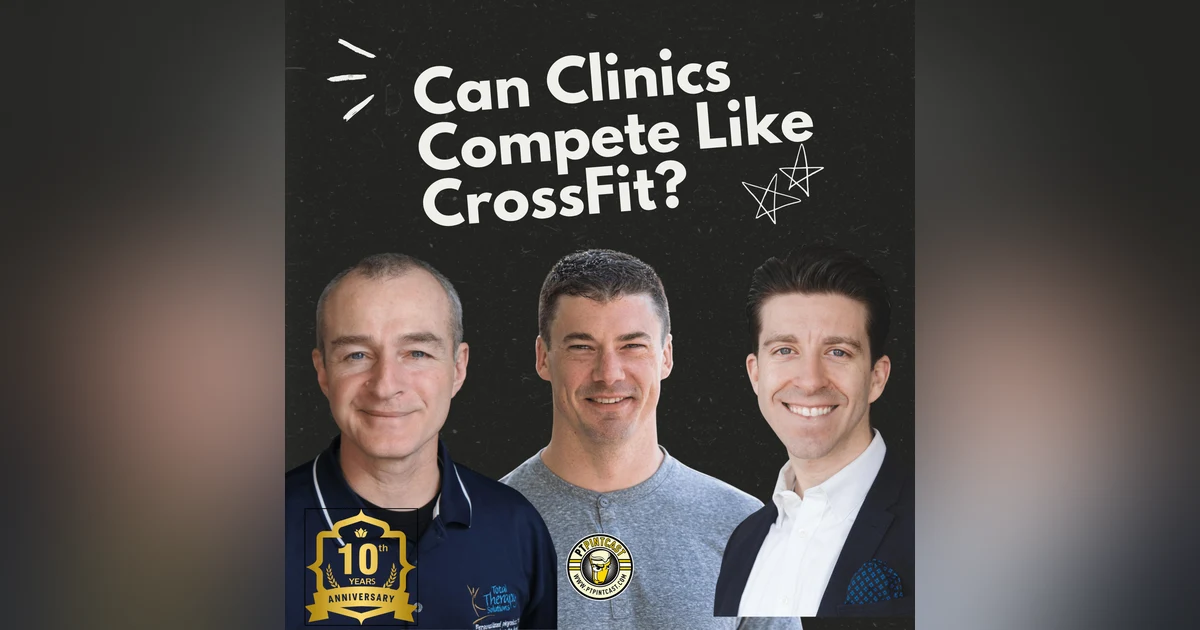


Physical therapists are short on time, long on complaints, and totally missing the point: we're in an attention economy. In this episode, Jimmy and the crew dive into:
- How RTM is "free money" and still ignored
- What ESPN's ridiculous programming can teach PT clinics
- CrossFit, Peloton, and OrangeTheory as models for gamifying outcomes
- Why most CSM booths are $20,000 toilets
- Clinic competition, trivia-style leaderboards, and The Floor is Lava: Medicare Edition
This isn't about hype. It's about attention, strategy, and clinical creativity. Want to build the PT profession's Savannah Bananas? This episode's your blueprint.
CHAPTERS:
00:00 Intro: The Attention Economy in PT
04:22 RTM Is Free Money (But No One Uses It)
09:45 What We Can Steal From ESPN 8: The Ocho
14:36 Clinic Games & CrossFit Leaderboards
19:52 The Real ROI of CSM Booths
26:11 Medicare Edition: The Floor is Lava
31:22 Alternative Halftime Shows & Fake Game Testing
36:44 Clinic vs Clinic: Building a PT Leaderboard
43:00 Final Thoughts: Outrun the Bear, Not the Pack
LINKS & RESOURCES:
- Subscribe to the show: https://ptpintcast.com/subscribe
- Follow Jimmy on LinkedIn: https://www.linkedin.com/in/jimmymcpt/
- More episodes: https://www.youtube.com/@PTPintcast
<p>This episode is part of the <a href="/physical-therapy-business-podcast">Physical Therapy Business Podcast</a>, where physical therapists and clinic owners learn how to get more patients, improve operations, and grow their clinic without relying only on referrals.</p>
<p>Looking for more episodes? Explore the full <a href="/physical-therapy-business-podcast">Physical Therapy Business Podcast</a> for real-world strategies on physical therapy marketing, patient acquisition, and clinic growth.</p>
0:00 I'm gonna power way too early from three separate Wi-Fi connection. It's PT Breakfast Club with Tony Meritato, Dave Kittle, and Jimmy McKay. All right, good Tuesday morning to you. Welcome back to PT Breakfast Club, where every week feels like Groundhog Day, and yet somehow reimbursement gets worse. You figure if it was the same thing over and over again, it would just stay the same, but it's not. The Groundhog popped up this week. I think we've got six more weeks of low reimbursement. Of course we do. We've got six more generations. Only if you choose lower reimbursement.
0:40 Ah, we'll get into that. The Groundhog did pop up this week and saw its shadow. That's a bummer. Which means six more weeks of prior auth denials and Medicare audits. See, that's where I was going with the intro. uh but we got the fire to warm you up today i'm going to pitch an idea so wild it just might work to you this is a real idea i had a conversation with someone in our profession who's doing something outside the box i'll pitch it to you tell me where it sinks and where it fails um you'll hear the pitch and then i want you to judge it live plus we got a hot proposal to shorten the dbt degree i talked to larry ben's john child's and tim flynn yesterday i'll drop that episode later today but i want to discuss that a little bit uh plus some slippery stare espn strategy stealing and a clinic owner wondering if diagnostic tools are innovation or just burnout with bluetooth today we do want to thank our newest sponsor this is going to be exciting if you're watching this on tv let's welcome Stairmaster Showdown, the first nationally televised balance and fall prevention tournament for older adults over forty watches patients compete in the Bosu Dash, the foam pad shuffle and the legendary quad burn gauntlet.
1:51 One missed step and you're on your hip out of the bracket. All events supervised by licensed PTs and fueled by a copay rage. Stairmaster Showdown will be on ESPN The Ocho. It's not just a fall risk. It's a ratings opportunity. This inspired by something I'll talk about in just a little bit. But first, this one's big. They're calling it back to the future. Tim Flynn, John Childs, and Larry Benz dropped a bomb just last week. Five-year DPT pathway to replace the current model. Why? Debt is choking the profession, enrollment is falling, and students are asking, is this even worth it anymore? You would think this is about academics, and all these guys have touched academics, but they're also looking at this from a business lens, which is, if there are less workers to do the thing, organizations aren't going to be able to do the thing.
2:40 So as much as we think we can say academics is this isolated ivory tower, like no. So do you think a shorter DPT bath would actually help or would it cheapen the degree? Like, I don't know. What are your thoughts on that? They have an entire structure ready for this thing. I think it would help. And I think they have the resources to make it happen. Like we can say it as much as we want. It doesn't matter. They actually have the levers to pull. You got three guys who are in academics industry. I remember I said this, I think, during the interview I recorded yesterday that I will drop later on today that I was doing interviews. I think my first or second CSM. And I remember John Childs walked by and there was a big group around him.
3:24 And I was, of course, like, I don't know who's that dude. I'm a student. And they're like, that's John Childs. Don't talk to him. He does weird stuff. And in my brain, I go, cool. That makes me want to talk to him. And I was like, what's the weird stuff? And they're like, he wants to try to shorten the school from three years to two years. And I was in my second or third year. And I was like, that feels like a good idea because I'd already be out of school by now. They have this entire... This is going to be a series of articles. They're going to lay this out. But this is sort of what it looks like. And they've mapped it out. I mean... if you're going to go at Larry Benz with a counter idea or why this won't work, like be prepared. Like dude comes with citations, receipts, the entire, the whole night.
4:05 He even has, uh, the return on investment is a point nine. He said, that's the worst professional collegiate degree outside of a few. He didn't want to name them. I would like theology, like gets like a lower ROI, but you kind of don't do it in a theology to make bank. I mean, I guess you could, um, what do we lose if we cut a year off of it if any i don't know even some of the academics were like i don't know not a whole lot but what do we lose i mean you probably you probably lose some of the advanced stuff like pharmacology or maybe a little less differential diagnosis or well you you think all that's going to be in the undergrad part or the how how much how much can you fit in uh if it so we're talking if if someone has like the they go to either the three year to three year.
4:52 So then it would be five total or it would be undergrad and then the three year DPT. So instead of three, it's two. Yeah. So they're saying like, make it five years going straight through it. I'll bring that graphic back up. I flicked it off. Assuming, assuming the student wants to commit and make that decision when they're seventeen, eighteen years old coming out of high school, which is what I did. But some people get into it and they're like, oh, my gosh, this is not what I thought it would be. So really, really talking about is that really talking about the DPT, the three year, you know, over the summer, like nonstop instead of that being three years total, cutting it to two years. Is that just to get clarity on where we're Correct. Yeah. Transitioning to three years of undergraduate study, two years of graduate work. And you can see that in the bottom there underneath the bridge.
5:34 This is infographic I made from Notebook LM. The reasoning being on the left, enrollment is going down. You're also going to see a, what they call it, a demographics cliff. There's just going to be less people of college age, nevermind what they're choosing. There will be, there is a, you know, we can track these things, which I never thought about, right? There's just going to be a bunch of less, a group of less, Less people coming. So less people from the applicant pool to even choose from. Here's the best part. If you see over on the right side, just under five-year proposed pathway, if you're watching a live stream, this is successful in other countries. Larry's even saying, I'm not inventing this.
6:16 I'm just saying, hey, look at nursing. Look at this. Look at this country. These things are being done successfully. Yeah. I think the position assistant degree is two years. Correct. I was doing my lifeguarding as my prerequisite when I was taking my prereqs before between radio and PT school. And I had lifeguard led Tower Forty-One in North Myrtle Beach. I remember there was a PA there and his family renting a house for a week. And the key was on Sunday, Monday, when the people move in, make friends and they bring you food and snacks. So I would make friends with people. And he was like, what's your story, man? And I'm like, I'm going to be a physical therapist. And he was like... Be a PA. One year less of school.
6:57 I'll hire you. He's like, I'll hire you right now. You're a hustler. Have oversight forever. Not be able to really open your practice if you wanted to. I mean, you can, but not easy. Ben Wade in undergrad will have to be willing to remove most of the BS fluff core curriculum, which should be all majors. Yes. Mary addressed this. Can I just make a quick comment that, you know, I love anything that almost anything that Larry puts out and I'm always going to be receptive to it. However, we're talking about taking something that's three years and cutting it down to two years. So we're talking about something that people are paying for and it's Are we also saying it's going to be thirty three percent cheaper? It's going to are we saying it's going to be one third cheaper?
7:37 Do you think that do you think all the DPT programs across the country are going to with their committees and their board meetings and all that and say, all right, moving forward, we're going to choose a route where we now have thirty three percent less revenue from our DPT students and our DPT program. Do you think that that is what they want? Do you think that's what they care about? Right. Well, here's the problem. And here's the lever that Larry mentions. Because again, these guys aren't looking at it in one direction like me. They're looking at it in three sixty clinical sites. So if industry starts saying, oh, yeah, we can't hire anybody. So we're going to start we're going to stop taking clinical sites that you can't graduate students. So there are things that large organizations and small organizations can start to do.
8:23 Why would they have less clinical sites because they can't hire? They want that free labor as a DBT student. Even if I'm still taking the students, and of course, yes, we want this thing where everybody wins. Schools are churning out great students. There are clinical sites for them to become great therapists. But if there are less therapists, what Larry is saying, and again, they say it way better than me, which is you would need coordination between industry to say, we now need to talk, not schools and companies, industry and academia.
9:03 We got to come to a table here because we got a problem. we're subsidizing your students or we're not getting enough to actually run the business. There's not going to be a profession anymore. This was going to be a topic that I talked about. I think we sort of alluded to it. Is there going to be a PT profession in five, ten years? I think I made a stupid remark about this a year or two ago where I go, what if you just Voltroned PT, physiatry, OT, athletic training, and you were like, that's a rehab profession. Voltron, whatever that is, is that easier than it is these little turf wars, right? So what Larry's saying is we want to have PT in a couple of years. Like what if we just took the best parts of all of them and mashed it together?
9:46 So I don't know if I can answer these questions, but I'm going to bring Larry and John and Tim back on the show a couple of times. Yeah. I think there are a couple of interesting elements here. So to Dave's point, I think Jimmy is saying the graduate program would still be three years. So you're not losing that tuition. It's not going to be thirty three percent cheaper because you're still keeping the three years. It's the undergrad programs that would be giving up some of that time. Now, I know when I went through school, this was two thousand twenty three. What made the decision for me was who had the quickest path to graduation. I applied to like five programs.
10:27 I think I got into three. One of them had the quickest path, and that's the one that I took. I didn't take summer off. I didn't waste time with other stuff. But the other part, Jimmy shared a post recently and I was trying to think about this. We were talking about like, what's the one thing that can provide the biggest impact to the profession moving forward? What do we have control over? And I was like thinking to myself, what if we just changed who we were trying to bring into the profession? What if we let go of this idea that it's gotta be this kid in his twenties who wants to help people And we looked at people like us. What if we looked at post-professional? These are men and women who have already achieved success.
11:10 Maybe their kids are out of the house. They're looking for something to do. What if we focused attracting fifty year olds into the profession of physical therapy? They already have a bachelor's degree. Most likely they already have some post-secondary education. We make the path easier. And now they're coming in for a second career. And so I think that they don't have the financial restrictions that a twenty year old would have. They've proven, you know, that like they can do whatever they're going to do. It would change the culture of the profession. And I think it would bring a nuance to it that we don't necessarily have right now. Just food for thought.
11:51 I like it. I mean, are you saying to clinicians or for owners or just are you saying like that would be the profession owners or clinicians, not owners, staff, clinicians, people who want to treat people who are looking like, again, I am sitting here. My youngest is in seventh grade. within five years, everybody's gonna be out of the house. Now I have a business, but if I didn't, I'm gonna be looking for things to do. And if I want a profession that I take all of the good out of physical therapy, I can interact, I can socialize, I can make a change in somebody. And I just don't have the financial pressures.
12:35 I don't need to buy my first house. I don't need to, I'm not going to, we're not going to have more kids. Like those are the things that are really challenging for a younger person coming into the profession that an older person doesn't have. I can't remember which one of the three said it, but they said like, why aren't we like, you know, I think it was Tim was saying like, we need to be recruiting bartenders. Like we need retail and food service. He's like, I, that, that can pass. Amen. Amen. He's like, the problem is you're, you're recruiting people who then get out and they're like, I'd have no entrepreneurial or background or desire. And that's okay. He's like, but the problem is we need that or we won't be a profession.
13:17 Dave, what were you going to say? Historically, the physical therapy degree and most other degrees, it went from a I mean, I'm sure at some point it was like whatever, like a certificate or whatever. And then eventually it became a bachelor's degree. And then in the maybe late nineties, two thousands at some point in most of the schools, a transition from a bachelor's to a master's. And then in the in the two thousands or the twenty tens, there was kind of like this transition to the degree. And now are we so we're going to retain the same terminal degree is what we're talking about. Right. So it's still be the DPT, but less but but less school, but less schooling. I just with with how universities and institutions are.
14:03 Of course, they want to keep the same tuition and they'll say to us and they'll say to Larry Benz and all that, sure, we'll keep the same tuition and we'll make it shorter because they actually will now have more profit. Their costs are already covered and they're not going to ever, ever... decrease tuition. So let's talk about that. If even if I was a new grad coming in, I got a option for a five year terminal degree, I get out a year or two sooner, I start earning an income a year or two sooner, I will gladly pay the same tuition as somebody who's going to sit in school for seven years. I don't care if it's not cheaper, if I can get out two years quicker.
14:45 and start earning an income that will raise the value of the degree so that I will. It's the same thing we talk about in the clinic. You get me into a clinic. You make me better in ten minutes instead of sixty minutes. I will pay you the same rate as the sixty minute therapist because I get an extra fifty minutes of free time back. Yeah, this just came to mind. Who do we piss off when rehab aids became a thing? You know what I mean? Who'd we unseat? Nothing? Were we a category creator? There was nothing before Rehab Aids. I don't think there was anything. People just sat in hospital beds and traction and it was bed rest.
15:27 The treatment was bed rest. It's Reconstruction Aids. That's what it was. Sorry. Reconstruction. It's my bad. I didn't know my history. All right. So listen to this. This is a great forward tease. Listen to the episode. I'll drop that at noon today just after we get off the air here. And it's not going to be the last time you're going to hear. Larry's like, this is going to be a five-part series. And again, Larry, it's not like he doesn't have any skin in the game, but Larry's like, he's moved on to dental. And he's like, I'm seeing the same problem in dental. These are guys who don't have to be solving this for their future. They do not. Like these guys are, they don't. They're looking at this going, hey, everybody. These guys are the canaries in the coal mine, although these guys are not canaries. What's a louder bird that is squawking and warning us that stuff's going on?
16:12 An eagle or a hawk? They're doing something, but they're squawking. But not as loud for this game. Could you imagine? Here's a revenue generator. Want to thank Dodgeball for discharges for sponsoring the show. The new gold standard and PT discharge testing. Forget subjective reports or functional hop tests. cue up some limp biscuit and throw them into a dodge ball arena to see if they're ready for return to life. Reactive agility, check cardiovascular capacity, check emotional processing from their middle school trauma. Remains to be seen. Dodgeball for discharges because if they dodge a ball, they can probably navigate a Costco parking lot.
16:54 Dodgeball for discharges. All these are inspired by something I'll talk about a little bit. So here's the pitch that I teased. I won't say the name of it yet, but I had this conversation with this. I like him. I don't know. We just met this young PT. The organization wants to standardize MSK testing. Essentially, they want to become... I'll say the name at the end. I'm pitching a business on their behalf. I'm going to throw it down Shark Tank style-ish. And then you tell me like, I don't know if I see it or whatever. So this organization wants to standardize MSK testing, essentially become the quest diagnostics of PT. Instead of you having to have all these crazy force plates or whatever in your lab and then know how to use them, This would be, in my mind, it had to be city-based because you'd have to have enough clinics.
17:45 You would pay a yearly fee and then you would send all appropriate evals for this lab testing. And then the people there would be trained in how to actually get that. The report would be sent back to you as the PT. And you would then read the results and then plan accordingly. You refer patients, they do the testing protocol, send back a clean report, objective data, third-party testing, insurance-friendly formats. So is this a good idea, bad idea? I believe the cost was between ten and twelve thousand dollars per clinic per year. So you're paying a thousand dollars a month to send as many patients as you want right now because they just want as many people through the door. I imagine this would change like there'll be a cap on it or it would go to per per clinician per patient pricing but it's called uh movique is the thing are you gonna pull something up yeah you're gonna you're gonna you're gonna show us i don't know i don't know what we're talking about here like what's what what's what's the idea what's the idea i woke up this morning that's vala nyquil the fact that i'm still remaining vertical is beyond me right at this point so it's called movique essentially it's a clinical biomechanics lab.
18:53 We've got to work on the website because the first time I saw it, I thought it was like an app. Like, you know, now it's turned your... But it's not. Essentially, this is a standalone building in Las Vegas right now. They've got more than... They've got double digits clinics paying... To be able to have access to go to send your clinic. So you get somebody who's like, I have pain when running. And you're like, got it. We'll do the rehab. But you know what? They have Doug Adams run Helix, run DNA. So you don't have to buy Doug Adams thing, which I'm sure Doug is like, I want to sell fifty of these things. But now he's going to sell it to one. Right. You send your patient. You're like, hey, go over to Movique on whatever street. They're going to run you through this battery as a test.
19:34 They're going to give us the results. We're going to plan. Then we're going to do our eval and plan accordingly. What are your thoughts without me weighing in? Because I had a forty five minute conversation with this kid. I like him. Dave, you go. OK, this is a clinic. Where did you say Las Vegas? It's in Vegas. They're going to have all the toys. Yeah, they're going to have the technology such as the Doug Adams RunDNA and what else? Like just motion capture stuff, which nowadays is â Tony probably knows better than I do â almost free. Like it's more and more available. If I was in Vegas, if I had an outpatient clinic, why would I send my client and customer anywhere else?
20:16 Just go buy the RunDNA. Go buy â The motion capture, I had a company on LinkedIn hit me up about motion capture that requires no physical products or anything, no sensors or anything. So the technology is getting better and better and better. As a business person, it makes zero sense for me to send my patient or client down the road to some other clinic that will probably try to keep them there or do some paid virtual program or whatever. Now, of course, if that's what bets for the client, then whatever. you know, all the way do that. But I don't understand why this would remotely make sense if I'm a business owner in Vegas.
20:59 I'm on Dave's team for this. I don't see physical therapists being the market for this. I could see maybe like a personal training studio or something like that. It's one of those deals where I think we as a profession tend to have either we think we can do it all. And I'm like, why am I going to send them there when I can just see it? I can put them on my treadmill. I can watch them do it myself. Or if I like gadgets, I'll just go buy the stuff myself, do it myself. I love the idea of, well, why do I go get blood work at a lab instead of blood work at my doctor's office? There's something there.
21:41 I'm not sure what it is other than, you know, a lab does it cheaper, easier. The doctor is too busy with other stuff. So like if I was a clinic that was just book solid, too busy to waste time testing, then maybe I could see an opportunity for something like this. But for most smaller individual kind of practices, I think they're just going to want to do it themselves, either with their own eyes and brain or with their own equipment. I'm just worried. Number one, I forget the kid's name, but I like him. He's nice. He's a hustler. He's smart. He's trying to tell the story, and I appreciate it. I don't know if there's margin there for this. The reason you don't do it as a primary care and do the lab is it's bandwidth.
22:25 That stuff's time and effort intensive and equipment intensive, and maybe it breaks down. I don't know if there's margin in that for PT. If this thing were to take off, this would need to be city-based only because you're going to need I don't know how many clinics to support it paying ten, twelve, fifteen grand a year to I like the story aspect of it, making it look like, hey, I sort of said what I normally say, which is like, this feels like everybody's going to be an NFL wide receiver and be a prospect. But then I'm looking around going, how many patients did I see that needed to be treated like an NFL wide receiver? Eight percent? I don't know. I wanted it to be more, but it wasn't.
23:05 The comparison of Quest Diagnostics is a little faulty, right? Because if I go to a physician's office, they take my blood, they send it to Quest or some other lab or whatever. I, as the consumer, patient, customer, whatever we want to call the healthcare consumer these days... i'm never going to quest diagnostics for anything else i don't even need to go to the brick and mortar office right it they're sending a little vial of my blood and then it comes back and then the physician you know you have a follow visit or you call them and then they tell you like what's the recap on your blood work or they send it to you or there's a portal or whatever in this example this place is a brick and mortar office in las vegas right correct This is why it doesn't make sense to refer, if I have a practice nearby, I should just buy this technology.
23:54 Why would I refer my patient or client to this facility for the Quest Diagnostics movement-based version of physical therapy or just movement diagnostics? Because then, I mean, if they have an amazing facility, they're gonna just win over my client, which that's just competitive business. And then the client could then do whatever potential future program that they could pitch the client because they're there in the brick and mortar office and say, oh, you want this, you want this, back to running, back to golf, back, whatever. And if they have a nice facility with equipment and all that, they could create, you know, Tony's wellness model and have an in-house gym type of thing for their nearby consumers.
24:34 Maybe they only want to stick with diagnostics, but it doesn't make sense business-wise. What's the thing? I would say their position is they don't have physical therapists. They don't have sports performance. They just want to do the testing. I've got two blood work orders sitting on my desk for two of my kids. The doctor will do the basic panel, but like one is related to allergy testing. I literally have to go to the lab corp or whatever it is. The other one is related to some other kind of specialized testing. So to Dave's point, like, yeah, the basic stuff, the doc's just going to have somebody in the office draw it.
25:18 This though, I literally have to take my kids physically to the testing site. So I do understand. And I think what this person would say is, look, yeah, you can buy the RunDNA equipment and you can buy the other stuff and you can buy the other stuff and you can buy the other stuff. But we have all four or five of them here. So instead of you going into that, send your people to us. I'm sure the idea behind it is, look, we can give you objective measures to show and track improvement, to make your outcomes better, to improve patient buy-in to sell more expensive plans of care. I totally get all of that and the appeal is there, but I still think you're talking about the clinicians around you adopting a new business model that they're probably not really that interested in adopting because just like me real quick, I can have a ten pound dumbbell or I could buy a three thousand dollar tonal, you know, like I'm just going to stick with the ten pound dumbbell and just go with that.
26:25 I'm shocked that neither of you kicked this out. This was my first thought of another market to at least tide them over until this pops or doesn't, which is youth sports. Yeah. Oh, yeah. I thought of that. I was like, but you know what I've seen? Because I'm in youth sports. All of my kids play all the sports. None of the coaches want to send their kids out to anything because the coaches are like the time is so limited. Right. I do think there's a huge opportunity. I'm surprised nobody's ever done this. Dave, I don't know if I ran this by you years ago, but I'm like, we've got all this information on professional athletes getting injured. We have information on college athletes getting injured. I can't believe somebody hasn't started a database of high school and middle school athletes.
27:11 What are they doing? Injuries, you know, analytics on all that stuff. Because if you can predict an eighth graders chances of making it through high school and going to college without an injury, there's real value in that. So a company like this starting to track those data points in sixth grade, seventh grade, eighth grade into high school. That's where I think there's a huge opportunity. I like that. I like that. I love it. A good idea that I don't think I heard any of us say at the end of this little diatribe. I love how Ben, my vitamin on the show wants to be a guest. He's like, I don't have anything to say. And then he writes, you know, Homer's. He said in the. I've seen this one yogurt.
27:52 Let's talk about it. Go ahead. Well, he's saying, he's saying not all patients need such a comprehensive eval. And there are things that can do like motion cap, markerless motion cap. Like you don't need to like Xbox three sixty camera. I remember when I was in PT school a decade ago, they're like, we can measure twenty seven joints in real time, power and force estimations like good enough, good enough. But the second half of this thing is in the personal injury world. There are companies who come to your practice like this once every other week to do comprehensive measurements. It's billable and see like their, their movie health. You're in Vegas. There's a lot of dancers who get injured in Vegas.
28:32 There's a lot of personal injury. There could be your estimate. There could be at least a side market, right? I love, I love the ingenuity to try to solve a problem. I just don't know if it's a big enough problem for outpatient PT clinics. Average. Now, go to the fringes, personal injury, youth sports, something like that. Like, I don't know. That could be a better, a better one. Go ahead, Tony. I was going to say, what's the cost of run DNA and one of these markerless motion captures? Is it more than twelve K a year? Because it's like, just get the technology yourself. Why would you, why would you ever do this? Costs.
29:12 I don't know what the helix costs. Maybe I could look it up. I don't know. Don't quote me. I want to say seventeen thousand. It might be more. It might be less. So you got to, you know... Plus, I think there's a monthly membership because there's the analysis software and stuff like that. You know, I mean, a lot of this equipment is expensive. It's not cheap. When you look at financing it, yes, you can make it a real business. But that's why I'm saying you're talking about changing the business model. If I purchased that system, amazing system... I am going into that line of business. I am selling that test as my primary revenue source. There are, go ahead.
29:54 I was gonna say, and if you're not, you're making a shitty investment because now you're just buying something to sit in the corner. And like, my man, that's not a great idea. are plenty of therapists who will wait who will spend the money I don't want to say waste the money they will spend the money without monetizing the equipment just because they love gadgets and they love that kind of stuff you know makes them feel good real quick I swear you're hitting all the things I've been thinking about this this morning I was thinking about pelvic floor therapists Jimmy said dancers and Vegas, which I imagine means strippers. And I was like, why don't we see a pelvic floor therapist who specializes in certain industries that require that kind of training?
30:39 Like there are sports performance therapists, you know, like golf therapists, football-based therapists. Why don't we have an OnlyFans-focused therapist who is pelvic floor? There's some real opportunity there. Listen, I've told you guys before, one of my dreams is to do, I want to be the Mike Rowe of PT. I want to go dirty, dirty jobs. I will investigate this for you. I can hear them right now. There are specific therapists who work with like on Broadway, like hi, hi. I think I interviewed someone before who did Cirque du Soleil was her job. Yeah, I remember. And I remember being like, what's normal range of, like, do you just take a goniometer and just throw it out the window?
31:24 You're like, there's no normal. These people are not even close to above average. They are bananas. So like it is, you know, it's an industry within an industry. Only gonies. I'm trying to think of what the only fans, only gonies, only, only, I don't know, only MMTs. I'm like, yeah, there's gotta be an industry. Your, your body's your money. So cool business, cool idea, but just like anything else. Again, we've used this example. Who would have thought strangers were going to get in my car and pay me to give them a ride home from the bar? Who would have thought strangers would borrow or pay to rent my spare bedroom?
32:06 We're saying it's basically a bad idea, but it doesn't mean anything. Yeah, it doesn't mean anything. Yeah. Did you see this? I'll find it. Somebody had the video of the guys that invented YouTube. They were like, all right, all right, we're live. And they were like, two hours later, they're like, we had three videos uploaded. And now, as I've said this sentence, like four million videos have been uploaded. It's like, yeah. You went in like Slack wasn't designed for Slack. It was designed for something else. So I think you have elements of some things. Maybe you just haven't found your home. I also like the kid behind it. Like he's very he's I don't know. I keep calling him a kid because he's ten years younger than me, but he is a jockey, not the horse.
32:47 Yeah, but I'm a jockey. All right. Who knows? Who knows who watches this show? That's them right there. I love the idea. Give us some pushback. Give us some pushback in the comment section. Let us know. What are we getting wrong? What are we overlooking? He's PRing. That's why I like this kid. Thanks for the great feedback. He appreciates it. I think they understand this. I think they've got, like if you were shark tanking this, we'd be like, what are your numbers? They have some clinics buying in. So maybe they're seeing something. He loves these smart people. I mean, the greatest example in the profession is RTM is like free money just sitting out there.
33:28 No one's touching it. And yet therapists are not adopting it en masse. Like, how is that possible? Because anything that is a distraction, anything that takes even a moment of attention, anything that, you know, very few clinicians in my experience are ever motivated by money. Right. And they're all short on time. But they'll bitch about it. Yeah. When I came into this profession, I was very...
34:08 I get yelled at for going too fast in wherever, wherever the hell I am, healthcare, whatever. I came from an industry where however fast you think Jimmy goes, I am slowing down. You have to move faster. The people who do... break things. And I'm not saying go all the way, but try some things. And we're like, let's form a committee and let's do it. And I'm like, what the hell are you talking about? What are we talking about? The ship is sinking. And we're like, is it though? Is it sinking left or right? I'm like, does not matter. Ship go down. We're a boat. I don't know. I think move faster. And I like things like this because they're trying to just pressure test faster.
34:49 So I think I like the energy and the emotion there. I also like games, and I like this game. We all play this. No one even ever needed to teach you how to play this game. Every kid comes hardwired with this game in their brain operating system. It is called The Floor is Lava, Medicare edition. The only balance training program where the ground is literally lava, and your reimbursement depends on your patient's survival. foam pads across the clinic and let your seventy-year-olds fight for their lives with flaming cones, unstable surfaces, and two e-stim pads stuck to their calves for motivation. Clinically inappropriate? Maybe. Hilarious? Always.
35:29 Check it out on ESPN eight, the Ocho. The floor is lava because balance training is more fun when it's life or fake death. This is where all the... Have you seen the TV show version of that? Yeah, it's hysterical. Yeah, it's awesome. But this is where it came from. So I think I, you know, we have a group chat. This is how we get in. Ninety eight percent of what we talk about on the show. And I was, I don't know, doing something on Saturday or Sunday. And now is like the weird law. Oh, I almost said the word. The super large football party. I'll get in trouble by this month, but whatever. The super large football party is this coming weekend. So this is the weekend between. I think the Pro Bowl happened, but like nobody wanted the Pro Bowl. And there wasn't a lot on.
36:10 And I'm like, what's on ESPN? And they had. Slippery stairs competition. It was a ballroom at like Disney World, right? Or the hotel. And there was a large staircase covered in latex. people using those like water guns to make them slip them up. And they had adult male, adult female, boy, girl competitions. It was an hour and a half of fake games. They had, what was it called? Oh, extreme archery. So two people running around like almost like a paintball course firing like arrows, but they were like, you know, nerf tip, but they were like legit. Like they were zipping.
36:51 And people were watching this, and they had an hour and a half of the World Dodgeball Championship. And this is why we make fun of ESPN, the Ocho, except their game is attention. I watched it because it was dumb. They had to put something on there. And there was nobody playing, right? College football's over. College basketball wasn't on that time of day. So my question would be, gosh, what's the steal here? What do we steal from this? Which is, again, if we're in the attention business, let's do some stuff. I don't know. high level how can we steal this is they're putting a bunch of ridiculous stuff on espn like cornhole and the the omega soccer the three the three goals faced each other and it's teams of like four or five guys uh people you know uh three teams against each other at the same time they're just putting they're just i i shared it to you guys a while ago months ago they're just putting a bunch of stuff on TV and they're hoping one of these things becomes Survivor or becomes, you know, the Kardashians or whatever, right?
37:56 Like they're just putting a ton of stuff on there. I'm sure there was a show for, you know, I don't know, beer pong or just any type of game now. I mean, if the floor is lava, I had no idea. So this is a news break to me this morning. I didn't know that that was a TV show. So that's brand new for me. But anything that... espn or any of these other affiliates can try to put on tv that's even remotely similar to an in-person game that you play at tailgate or a party or used to play when you were a kid yeah it makes sense they are literally testing in real time they're kind of doing like savannah bananas you know style testing iterating and and they're hoping they find they're hoping one of these tv shows or games becomes like a savannah bananas yeah I mean, they understand that they're an attention game, but they already have distribution.
38:45 So now you're like, we got to put something. This is inventory. I looked at in radio and TV, six a.m. on a Saturday is inventory. I got to put something on the air. What is it? Because that's inventory. Tony, what are we going to say? I don't remember. I think you were talking about, and I don't know why you don't want to say the name of the game, the big game coming up. We used to joke in radio because in radio, if you did that, you could get sued by the NFL. So we would make all these ridiculous, like the Super Bowl promo day. Like it was just tongue in cheek. So, I mean, Victoria's Secret, didn't they used to have like a halftime show? Animal Channel used to have a halftime show.
39:26 why wouldn't like we, you said ESPN has the distribution, but if you made something that people actually wanted to watch, Facebook will give you the distribution. YouTube will give you the distribution. You have to earn it. You have to earn it. So with as much complaining as I see in here about halftime shows and performers and, People don't want to watch it, but they want to watch the game. I could totally see somebody coming up with their own thing from scratch, promote it as we're going to run this alternative halftime show and then run it across the social media platforms. Because again, what do you have to lose? It is a lottery ticket that if it hits, you will just do tremendous success.
40:10 I'm releasing three hundred and sixty five podcast episodes and three hundred in twenty twenty six. I probably won't be doing one a day. I did ten in one day from Graham sessions last week. I decided and this will land with most P.T.' 's. that the exercise principles, frequency, intensity, time, type, volume, and progression are also communication principles, frequency. I just decided to say, what if in twenty twenty six I just hammered frequency and I went bananas? It costs me zero extra dollars to launch a podcast episode. My time, my effort, it's all right. But I'm like, I'm OK with it. Because everyone that I do might hit and bring me a client to work with. It already has.
40:50 It just does. Us doing this ridiculous live stream for two plus years. I'm like, I can't wait till we do this with like an ESPN style desk at CSM and not that we get invited, that people are like, well, we'll pay you to sit at our booth because right now our best strategy is drop twenty grand on a booth at CSM. I'm looking at you, every industry, every company that you're doing. You are f***ing this up. You spend twenty grand. You're in a meeting and you're like, I need twenty grand. Why? CSM. Great. Great. No justification? What are you going to do when you get there? Stand? Pens? Stress balls? Oh, we're going to go on LinkedIn and we're going to mention it over and over sixty-eight times.
41:34 What are you talking about? What are you talking about? That's your strategy? That's signage. That is a good strategy if you want to tell people where the toilet is. Like, yes, the toilet is down and to the left, down and to the left. But your strategy for spending twenty, thirty thousand dollars at the conferences? Well, we're going to be there. Now we're in the room. We have a chance. OK, how are you going to overcome the sea of sameness? I don't know. I'm going to do a lot at CSM this year. I am going to be polished six percent of the time. Everything else is going to be run and gun. So here's my question. Now, here's I want to add some spice. Could we connect clinics in some way who are not financially related?
42:17 CrossFit does it. Set up a game, and then everybody watches the leaderboard, right? There it is. There's Hyrox. There's the leader. This month, we're doing these three things that can be performed in almost any clinic. Where's our people? And now we've gamified. Now we take a stab back at the Orange Theories. Dude, respect. I'm going to crap it on Orange Theory. They're doing it well. CrossFit. How do we take... ridiculous games and say, let's standardize them. And I'm using air quotes, but like something we could do in any clinic, but make it leave the clinic. Now there's a reason I ride Peloton. I see a leaderboard while I'm riding, but I joined, I went on LinkedIn. I was like, who's riding Peloton.
42:57 I need someone to fight with. I need someone to feel like I'm behind. And now I have a little like, um, what do you call it? Like a motivation group or a, you know, um, permissions group. And I see where I stack against these other PTs. I'm like, all right, I don't really care about beating them. I want to make sure I'm not last. Like you don't got to outrun the grizzly bear. You just got to, you just can't be the, you can't be last. You don't have to be first. So what, if I throw that wrinkle in it, is that a thing? Would we care? Does that help us make money? It's got to help us make money. I think it'd be, I love it. I'm thinking like, it's got me thinking about trivia. When you go to the bar, you go to BW threes or something like that. You know, could my team can I put together a team of all stars at Total Therapy Solution that competes against Dave's team?
43:45 Could we have like real time analytics that are up on a TV screen, you know, just like in the pub where you're doing trivia? It doesn't have to be synchronous. It doesn't have to be at the same time. We have performance metrics. And then, of course, you bring in a testing company like the guys that you were just talking about. And we're like, could we have this objective testing? So my kids run track. They go to the track meet. They you know, all their timing and analytics is up. They're looking at what other kids in the state are doing. I think it brings it brings your immediate community together like a bowling team or a softball team.
44:27 It gives you something to promote across social media. Hey, look what we just did. You know, John just broke this record. There's a lot of opportunity in something like that. I think the way to do it is TVs. I think there needs to be a scoreboard. I need to know how close I was. I play those stupid games on LinkedIn every morning, and it shows me where I rank with the people that I'm connected to. And do I care? No. I do. I want to be... I was like number one a couple days last week, and I was like, yeah, what's up? Of course I'm bragging about that. Dave? I like Tony's idea... with these types of things, I always love him riffing first because he's so creative and outside of the box.
45:09 So the thing of the, what was the game we were just talking about? Like in bars, it's a trivia, like a trivia night that they do. So the, the, I wasn't even thinking that the other step, Tony of like, then do Moviq and do the, the movement diagnostic type component of this. What if it was just the first step, the first part you just mentioned, which is basically like the way that bars do trivia. They do that to get butts in seats. They do that to get people in the bar to buy more beer and maybe food if they have food. Just that across the country, if it's my practice versus your practice versus my practice and other practices online, anyone with movement impairments or whatever, now everyone is closer to the same playing field because it's just your cognitive recall of whatever.
45:54 It's just the trivia. It has nothing to do with physical therapy. Now, of course, there's some socialization and that could be beneficial, but it would help each of these clinics kind of improve their own, you know, culture and morale and, and build like a, whatever, a community or a tribe on, I'm trying to stay away from some of the buzzwords, but, You could get some folks that like, let's say I have five of our clients versus five of Tony's clients. And it doesn't matter if any of my clients are, you know, have they're in a Walker or wheelchair or they're twenty five years old and they are able to, you know, run a half marathon. If it's just trivia, that's something that could be filmed. That could be content that has it's not really anything to do with what we deliver in terms of like the service fulfillment side.
46:41 But it would be content. And maybe the second thing would be like the movement Olympics or the movie type of component of it, which then ties closer to the service, the core offering that we offer. But what about even just even just the front end, just just the trivia, the way that bars do it? And I don't know, like, Jimmy, have you ever seen on YouTube like two bars ever film this or is it usually never filmed? I feel like I've never seen content of trivia in a bar like this team versus this team. And it's funny because every team names their own team like a funny, stupid name. And that's a joke or an inside joke or whatever. Yeah. I used to do a version of this called the bar exam where I would go with a recorder.
47:24 This is pre cameras and everything. I would meet someone, I'd meet Tony and like, I'm like, Tony, introduce yourself. And you can clearly hear how hammered he is. And then I'd have two people on the phone live as I'm playing this back. So I recorded Tony on Friday. Now it's Monday. And now I've got Dave and Steve on the phone. I'm like, all right, we're going to hear a clip of this guy I met on Friday. Here's Tony. Tony's like, hey, what's up? Now you've gauged how drunk he is. And then then I would play a clip for Dave and Steve. Here's the question. You'd hear the question and then you'd bet I stole from a TV show. I'd say, do you think Tony got that right or wrong? So I was able to bring the bar onto the radio in a way that it wasn't live and it was a game being played live.
48:06 I like the movement aspect of it. Like I would make up, you could even just do like, I would stay away from like weight lifted. I would make it more repetition based because I want it to be accessible and You know what I mean? And then you steal a page out of the Olympics, the senior Olympics, the Paralympics, the special Olympics, like make it bracketable by ability level, age, gender, however you want to do it. And then you get somebody with a good coding degree or me with chat GPT for probably six weeks, but you know, someone else smarter would get it done faster. And then you figure out a way to be like, okay, input that person's thing. And then it's constantly on the scroll. Why do you keep putting money in Ms. Pac-Man? Because I want to put my three initials at the top of the list. We are big, dumb animals.
48:48 We want to score well. I think the access is trivia or competition. How do I connect out of these walls? Why am I doing this? Is it to beat someone? I ride like a moron when there's someone close to me in Peloton. I blow up my entire workout to beat that person that I'll never see again. I'm like, but that's right. That's right. You're three points behind me. That's right. And I get off the bike a little taller. Well, I have to think about it, but I definitely think, you know, like you said, you can make this a cognitive game. You can make it a physical game. You can just bring games. Like I bought a cornhole set years ago for my shoulder patients because I wanted them doing like a version of a pendulum throwing a cornhole bag.
49:34 There are so many things that we could do with it. And then we're just talking outpatient ortho because that's our world. The stuff that I see neuro doing outpatient neuro is just phenomenal. And, you know, you set up the overhead system so that they can't fall because they have the harness on. you just build your own obstacle course kind of stuff. You know, there, there is so much that's out there, but like you said, you, you have the leader, you have the scoreboard, you make it interactive, you have the big TV. So you'd have to be a way for us to see it. I would think a lie, like some sort of live stream or website that all you'd have to do is put like a USB into a TV and then go to a website and it just does the thing, right?
50:18 This is also the, have you guys ever seen the chive? The TV channel, the TV channel, the chive. Oh, this is brilliant. You go into a sports bar at noon on a Tuesday and it's playing like, you know, there's seventy eight screens. But what's on like you're just watching. Oh, you mentioned this before. Chive is essentially. America's funniest home videos like just wrap it, but just of like sports videos. Dirt bikes, fails, not fails, hockey shots. It's a clip show. It's ridiculousness, twenty-four hours a day. Now, there's some sort of agreement I'd have to look into it. The bar gets to insert their own commercials. Now you're part of the chive. Number one, you get to play it.
50:59 That's our content. You can't just play it. so we give that to you something to put on the screens chive is making their money because they get to insert net they get to insert their own ads and then they're like oh just drag and drop your ad here we'll make it for you whatever then you get your own so it's like you have the personalized television that's what you would need you would need something like that maybe it's not clips all the time but hey why wouldn't you now there would also need to be an easy interface stupidly easy for Tony or Dave when their patient did the sixty second sit to stand challenge to just be like Tony this clinic this patient name if they want to use their name or fake name and this many reps enter and now it computes where that person stands there it would need to be dumb easy for the clinician to get their patient on the board So rolling this together, and I know we're getting close to the hour.
51:49 What if we set up a situation where we know that live sports is probably one of the few times people will watch live TV? Nobody wants to record a game and watch it later to cut out commercials. We know that here, everybody's watching the Reds, right? During baseball season, we're all watching the Reds. We're all gonna see the same commercials at the same time. What if local physical therapy clinics created an alternative network so that when the Reds cut to commercial, people bring out their phones anyway. I'm watching the Reds on TV, commercial hits, I grab my phone and go to social media. We have a network of content that plays live during the commercial between, you know, innings at the Reds game or whatever.
52:38 You bring that into the Super Bowl. Obviously, if you don't want to watch, I know Super Bowl, you want to watch the commercials. But like, what if we can tie in some sort of live media? where we deliver our content, specifically time to when the TV networks cut to commercials that people don't want to watch, but that they could watch on their cell phones, on their mobile devices, things like that. I used to listen to my competitors, and then later on in my radio career, I would have my interns listen to competitors and write down in a notebook and try to figure out my competition locally, their clock. Right. Clock meaning...
53:20 What that radio station did, like, oh, we start the hour and we play two songs and we go to commercial. We play three songs and we go to commercial. I would always try to not be in commercial when they were in commercial. And if they weren't, I was close. I'm like, then I'm going to be this. I'll push for half. I was playing those games, dude. I was like, you will listen to them for five hours and you tell me exactly when they break every time. So yes, timing, frequency, intensity, time, type, volume, progression. Time is one of them. The when is important as well. There used to be a TV network, I can't remember, that started their shows at the five minute mark. Yes. Because you would be able to see what the other shows were and then you would go to them and their show hadn't started yet. You remember how long show intros used to be?
54:02 Like the intro for like Family Matters used to be like ninety seconds. Now you get a cold open. Like, it just starts mid-sentence in, like, Modern Family. It's, like, Phil falling down the stairs. You're hooked. Then they give you the first, like, LOL giggle. Then they hit you with, like, a twelve-second Family Matters montage, and we're back into the story. Because they understand... sunk cost fallacy. If I'm already eight minutes in, I've missed who killed the person in law and order. I missed it. All right. Well, that's why the murder happens in the first ninety seconds of law and order. Now it's the whole ninety eight percent of the rest of it is who done it. These are all principles we have to compete on now. Let's tease a future episode.
54:43 We've talked about the hook and all that stuff for marketing. What about for the treatment? What about the minute the patient walks in the door for a treatment, we open with a hook for the treatment session. And then we go through the psychology just like we would run an ad. But we do it for a treatment session. We should do that. Jenna Hoyos, who's the girl that Mr. Beast has said can make any clip go viral. Jenna Hoyos. And she's given away the formula and people still ignore it. I run it through that filter when I've created my videos. You see the video I sent you guys with the dude with the six pack and the ring light formula for that, which is you have to hook me.
55:25 I see PTs online now turning the cameras to themselves a lot. I love this. And the first ten seconds are high. I'm Troy McClure and I have eleven certifications and I live in Kansas and I'm like, boop, they're gone, bro. They're gone. Maybe do that later or do that as a lower third graphic. Why? Because it doesn't matter. So yeah, what if we mimicked a hook? What if we mimicked the psychology of a piece of viral content of a treatment plan? That is a side-by-side. Okay, wait. We'll do parting shots, but we are getting fined by the NFL. The commissioner just called because Tony said...
56:06 The S word you said instead of the big super game football game. We do want to make sure we can now pay for that fine with our sponsor, TheraBand Credit Union, the only financial institution for rehab professionals who financed one too many CEUs. At the TheraBand Credit Union, we understand your pain. That's why we offer flexible, get it, loan options in light, medium, and extra heavy resistance. Whether you're opening a clinic, buying a second shockwave machine, or just trying to survive Q for payroll... We stretch your money. Like you stretch your hamstrings. They're a bank credit union, stretching your dollars and your shoulders, parting shots. What do we got? Dave, what you got?
56:46 Uh, man. Um, I think more creativity is needed in the physical therapy world to on the front end, start with how can we all as practice owners and clinics get attention even before marketing. I've been so focused on marketing for the past five or ten years that, um, I'm now transitioning a little bit more to different ideas and testing things around attention and more of that to come. And what we were just talking about is really about attention first and then everything else flows after that. greed. You're in the attention business. The next time, if I ever have a nine to five again, my title will be director of the attention department. That's what I want to work in. I don't want to work in the marketing department.
57:27 Chief attention officer. Attention of C-A-O. Cow. Cow. Cow. Cow. Hey, pull that comment back up. Parting shot. So, Movique says PT is the movement profession, yet movement still lacks standardized diagnostic infrastructure. Totally true. Totally true. The only thing I would question is, does it matter? Honestly, like, does... Does it matter? We all talk about, you know, posture. Posture used to be the biggest thing. Now it doesn't matter. We used to talk about technique used to be the biggest thing. Now it doesn't matter. Tell us why a standardized diagnostic matters because people are going to move differently.
58:13 And so that's I think what matters. That's my parting shot. Yeah. Is it worth their time or money? If you're saving me time, making me money, or solving a problem that you can clearly define, that's good. I'm going to second Dave's parting shot. Mine was also that, which is move fast, break things. You need to be creative. We are getting more and more competitive. This will not change. This will only increase. So you need to figure out how you can gain attention first. The letters after your name are after your name for a reason because they don't matter that much. We'll be back on Thursday. Maybe we'll do that Jenna Hoyos parallel side-by-side. I'll work on that now.
58:54 And I'll see a lot of you at CSM next week. I'll be at the U.S. Physical Therapy booth doing a live stream. You can heckle me and throw things at me while we're live. All right, guys. We'll see you later. That's it. We're out. Boys, what the hell are you doing? Follow Tony Meritato on YouTube at Total Therapy Solution. Find Dave Kittle at conciergepainrelief.com and on YouTube at The Dave Kittle Show. And follow Jimmy McKay at PT Podcasts on YouTube, the socials, and wherever you binge podcasts you pretend are for CEUs. And hey, just a reminder, none of this was for advice. This was for entertainment only. Our lawyers say that counts. Thanks, Keith.