Craig Lindell: Building Prehab Guys Without Selling Your Soul
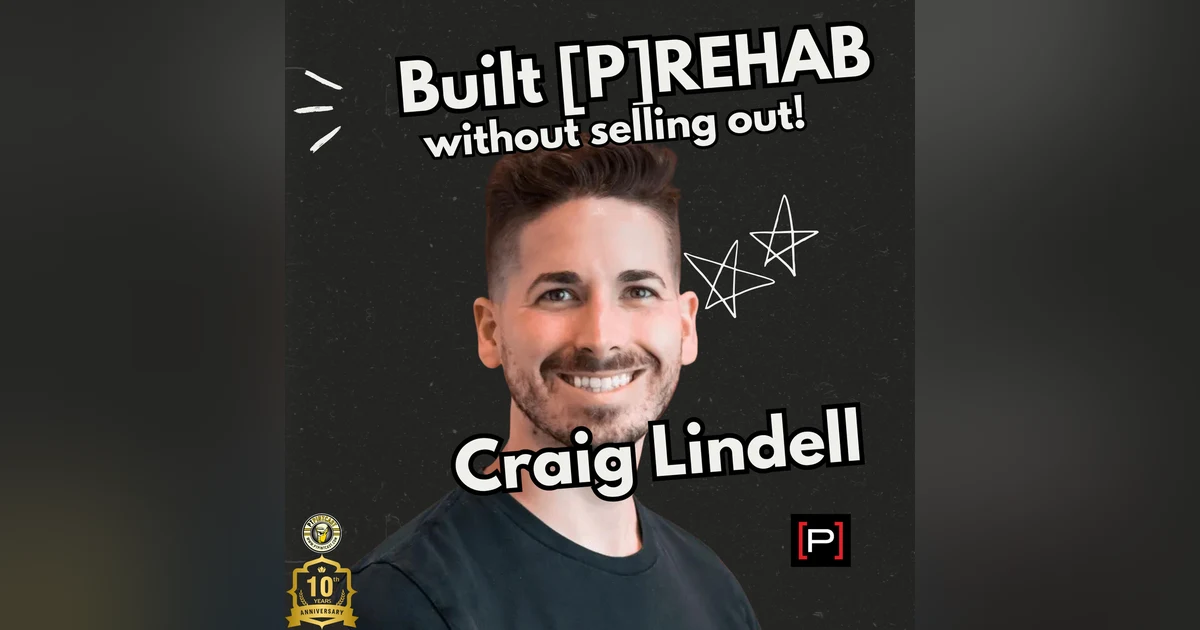


Craig Lindell, co-founder of Prehab Guys, joins Jimmy to break down how one of the most recognizable brands in PT actually got built — and the hard lessons learned along the way.
???? In this episode:
- How Prehab Guys started (and nearly ended)
- Building content that scales while keeping your values
- Why brand clarity beats being “every PT for every patient”
- How to niche down without feeling limited
- Craig’s endurance mindset and what PTs can learn from Ironman training
???? Resources & Links
- Craig Lindell: @theprehabguys
- Website: https://theprehabguys.com
- Clinic Owners: USPhPartnership.com
- EMR Upgrade: empoweremr.com
- CEU/Residency: brooksihl.org
<p>This episode is part of the <a href="/physical-therapy-business-podcast">Physical Therapy Business Podcast</a>, where physical therapists and clinic owners learn how to get more patients, improve operations, and grow their clinic without relying only on referrals.</p>
<p>Looking for more episodes? Explore the full <a href="/physical-therapy-business-podcast">Physical Therapy Business Podcast</a> for real-world strategies on physical therapy marketing, patient acquisition, and clinic growth.</p>
0:00 You're listening to the P.T. Pinecast, where smart people in healthcare come to make noise. Here's your host, Jimmy McKay. Thanks, Voice Guy. Today's episode is supported by U.S. Physical Therapy, a national network of clinics focused on developing clinicians and not burning them out. And you're nodding along because you're like, yeah, I don't want to do that. Leadership tracks, mentorship, career growth, and the stability to build your future in PT. If you want a place that supports how you want to practice, that's US Physical Therapy, usph.com. Our guest today, not just a PT, a founder, a marketing strategist, an endurance sports junkie. We like that.
0:41 but also obsessed with helping people do epic shit. While most clinicians are still debating terminology, he's, he's, he's, he's, he's, he's, he's, he's, he's, he's, he's, he's, he's, he's, he's, he's, he's, he's, he's, building a brand that's already shaped how thousands of patients and providers think about movement. And that's just before he left PT school. From life cycle marketing to global rehab access to maybe at one point a twenty thousand kilometer race. That sounds spicy and tiring. Let's meet the man behind the message, Dr. Craig Lindell. Craig, welcome back to the show. Thanks for having me, man. Do you remember the last time... Well, I think we had you on the podcast. Remember the first time you guys were on the podcast? We were live. We were in person in New Orleans. Yeah. We were at a charity event for Team Gleason, Steve Gleason's organization.
1:24 We were at a bowling alley in New Orleans. And I think... I remember I was trying to find the episode, but I have no idea. That's four laptops ago. It's like close to a decade. And I think I was like marveling how you guys... I think... You had just hit a milestone in terms of followers. And I don't remember if it was ten thousand or a hundred thousand, but whatever one it was, I remember in the room was like, that's insane. And now that's not even I mean, do you even look anymore? I recently got logged out of our Instagram, so I haven't been looking as much. So, so context set for people, they might recognize the logo.
2:05 They understand like my cousin sends me workouts and videos. My cousin's a nurse in Las Vegas, nothing to do with rehab, nothing. She goes, are these guys legit? And I'm like, yes. And I know them. And she's like, oh, okay. And I'm like, no, I actually know them. But reset people because I think it's gone long enough that like you need to rehash the origin story just for a hot second. Then we'll get into some deeper stuff. So like how do you explain to people that this started like serendipitously? It's going to be ten years. It's wild, bro. Less than thirty days since like Rosh and I created the Instagram account. And then walk us through again. Like you're in PT school.
2:46 You guys were at what? USC? Yeah. Yeah. And you're like, hey, we should do this. And again, ten years ago, Instagram was not, it's not what it was now. It was, I don't know, it was dance videos or pretty picture. I don't think it was videos as much. It was fifteen-second videos. That's, like, that's wild. Now it's live streaming. It's full-on shows now. But that just shows you where things go. All right, so who, like, how'd the idea happen again? Like, give them the beats. yeah we started pt school uh september of and then mike ross and i were classmates we got through first year pt school you start pt school you're in the echo chamber and you're just like dude i'm ready to heal the world and i got fortunately we had a big class we had like ninety plus classmates You're all in line.
3:43 You're all ready to heal the world. Faculty is telling you and teaching you how to heal the world. You get through first year. We go to second year. Start going out on clinicals. And then you step into the real world and you're like, oh, shit. Yeah, you get slapped in the face by reality. And you're like, textbooks didn't describe that this is what I would have to deal with. Yep. You're like, oh, I have to work with human beings that have real problems and it's really complicated. What do I do? And honestly, at that point in time, content on social media, there wasn't much around physical therapy.
4:26 If there was, there were just a couple people that were doing it. And The perception of physical therapy at that time on social media, as well as the perception of physical therapy outside of the classroom, outside of your classmates and faculty, was bad. It was even worse than it is now. And it's getting better, which is good. I know that we'll talk about that. But at that time, I had gone home at least once and people were asking me what I was doing when I was going to school for. And what I thought I was going to school for was very different than what they thought we were. Yeah, it's a disconnection. So that's where it really started. It was it was a identity problem that we're still facing today.
5:10 And it was a value problem. perception. So we were like, hey, we just need to start creating content and change the perception. We want to create the identity of what we plan on doing after school. This is the type of professional that we want to be. This is the value that we can bring to people. We just need to start getting the word out. And it was filming Fifteen second exercise videos and writing a description and posting it every single day. And that's all it was. But I like, and I've said this, like whenever someone or one generation poo-poos the next thing, I look at it and I go...
5:54 Fifteen seconds is a box, which means if you want to be different, you have to think outside the box like creative people actually like the box. I'll give an example. I did an internship for Howard Stern when he was on FM radio. So he couldn't say certain words or do certain. He would go right to the edge and he was edgy. Guys, that's why we call it edgy. The summer, my summer was his last summer on terrestrial radio. Then he went to XM. And when you listen to his first year of that, he could say anything he wanted. It lost an edge. There was no edge. He could say anything and it wasn't funny. And when, so then he had to like, he sort of like looked and reinvented.
6:34 It was like, oh, my skill now is not like, I'm almost going to say the F bomb, but not. or I'm going to get fined or not. It was, I need to be a better interviewer. And then he's just honed his craft. I see. I see. I see. I see. I see. I see. I see. I see. I see. And here we are again. We're back in short form. Yes, it's wild. It's a matter of what gets jammed in the fifteen seconds is insane compared to ten years ago.
7:17 Yeah. Has it been fun? Oh, of course. That was the layup question. The second one is what I want people to see is What you see on Instagram is the highlight reel, right? But what you are building, and we'll get to that because we can't talk about an Instagram channel anymore. We have to talk about a brick and mortar and we have to talk about a library, right? This is still work. I worked at a radio station. It was awesome. It's still a job. You built a brand on Instagram and now you have to explode it. It's still work. What I want to show people is no matter what your practice is or your business, dude, there's shitty days, right?
7:58 I mean, I'm imagining. Oh, yeah. He's like trying not to like, oh, yeah. But there are. You just choose your heart. We've been doing it for ten years, you know, and how do you do it for another ten years? Yeah, how do you reinvent? Yeah, how do you personally reinvent? So what do you guys do to do that? Like, are there any tricks? Not that I want to trick, but like, what are the good basic practices to keep things fresh? Like, how do you bring new people in? Do you try new things? Do you go places? What do you guys do? there's an evolution every single year. Like at this time of year, it's the end of the year.
8:42 It's reflecting on the current year. It's preparing for the next year. And every year we meet is like, how are we going to evolve? What, what is next? I heard a great quote the other day. And for anyone that plays sports can really appreciate it. Chasing the ball, chasing the puck, whatever it may be. Just know that the ball is always moving, whether in a sport, whether in business, the economy. And for ten years now, we've been chasing after the ball or we've been positioning ourselves relative to the ball.
9:22 The ball is always moving. What's the year? Twenty twenty five. The ball has a big fat A.I. label on. And the ball is pinging off the walls, nonstop. Right now it is. And it's just, okay, how do you position yourself relative to that? Because if you chase after the ball, by the time you get there, the ball is in a different spot. And that's all it is, is every single year, you know, just you're playing the game. You're playing the game of business. And how do you want to position yourself? What is your prediction? And... okay what's the reality and how do you just adjust accordingly yep i would say as time continues to go on what really matters is making sure that your purpose is anchored you're constantly revisiting your purpose for yourself and as a company what are your values checking in on those and continuing to play the game by the rules that you set as well as what are the rules out there that are being set for you.
10:28 Yeah. And understanding what business you're in, right? Because you could apply the ball analogy to if PTs think that they're in the standstill and patients show up in front of them, they treat them and they move on business, you will remain in that business. We talk about this twice a week on our live stream, which is What business are you in? One of my co-hosts is in Cash Pay Concierge, New York City. He knows what business he's in. The other host is Brick and Mortar Rural Ohio. They're both in PT, two different businesses. And this is where we have to say like, guys, listen, this is a business. And if you don't understand the physics, the gravity, the wind, the sun of your business, it's going to burn you out fast.
11:10 And even if you do, it's still not all sunshine and rainbows. Nothing golden can stay. everything is constantly changing so i think how do you keep doing it how do you keep reinventing yourself there's a aspect of it that's proactive but there's a lot that's reactive and it's a matter of do you want to keep playing that reactive game do you want to keep being signed up subscribed to it or not um or do you just want to be to your own drum and I think that all just kind of comes down to what is it that you value and what are your expectations on outcomes?
11:50 Expectations is everything. Yep. All right. So let's go back to that perception thing. You said back in PT school, you guys were like, man, we thought we were going to go out. We ran into the world, that world slapped. Why do you think the public perception of physical therapy has remained? Well, I guess it's gotten a little bit better. Maybe you sort of alluded, that's your view, but why, We always want it to go bigger, better, faster, right? Why haven't we gone bigger, better, faster? Or how can we? Or what do people need to hear to understand how they can? You guys can only do so much with one channel. I mean, it's only so much. What do people need to hear to make sure they understand that they can and need to change the world in order for it to change? I think there's just this dogma around what the title physical therapist means and we can't really move past it.
12:37 And I was having a conversation with a buddy the other day It's not about how you label something. It's about how does someone understand it? And speaking to physical therapists, you can tell someone you're a physical therapist and they understand what it is that you do. They may ask a follow-up question like, what setting do you work in? Do you work an outpatient? Do you work an inpatient? But then if I'm speaking to someone in the tech world, it's, I could get creative and I could call myself, I'm a human resilience designer. And they're like, huh. does that mean and now you're kind of speaking their language or if you're talking to someone who is younger and they broke their wrist because they fell playing soccer and they're like hey what is it that you do like are you a doctor and it's like you know i help people get out of pain and prevent injuries it's just knowing your audience and I think the title physical therapist is still kind of stuck in the boomer era and what the physical therapist did, who the physical therapist was, is still anchored to that identity.
13:49 And now moving into this new era, this new decade, there's so much investment. There's so much interest in this longevity movement. Do we still call ourselves doctors of physical therapy or You know, do we just kind of grab a whiteboard and start throwing some names out there and being okay with... Change. Change in identity. So have you guys played around with... I mean, we've heard this before. People have done, you know... But to change an entire profession would take... Well, a lot. Have you used other words or terms? I mean, people have jokingly said, I'm a pain Jedi.
14:31 That's cool. I'm a this and that. But in the end, it's like, I want to see what's the future possible. I want to see, can you help me get to the place I want to go? Coach is a word, but that's typically tied to sports, right? Mentor can be tied to education or business. Physical therapist doesn't feel like it fits either of those. think it's just totally relative who is it that you're speaking i think i think you're right and that's a strength and weakness yeah i'm very big on what is your elevator pitch to anyone that i'm speaking to if i want to know what it is that they're doing if they ask what is it that i do and more often than not i fall back on i help people get out of pain and prevent injuries And it's just like, oh, well, what is it that you're doing?
15:19 It's like, oh, I'm a physical therapist, but I own my own company. And here's what we do. Here's what we focus on. Because physical therapist is kind of sticking yourself in that box. It has boundaries. It has limitations. Yep. you are limiting yourself to what is the person's perception of a physical therapist. Yep. Yeah. All right. So you guys are still on Instagram, but you guys left Instagram or I should say you're on Instagram, but every once in a while you, you log off and now there's a building like give people like what happened next? Like what happened next and what happened next? Yeah, January, twenty sixteen created the Instagram accounts and we were dripping content on other platforms throughout twenty sixteen.
16:04 YouTube, Twitter even dabbled a little bit with LinkedIn, posted a lot on Facebook and it was just repurposing content. It was so easy back then. Just republish to this platform, republish to this platform. And then twenty seventeen we graduated. We each of us worked full time for different companies practicing physical therapists. You know, we were working thirty two plus hours of patient care while still working on prehab, very focused on content. At that time, we started as a content company. Right. And then from twenty seventeen through twenty twenty was just how do we keep focusing more time and energy on prehab?
16:49 while also becoming a practiced physical therapist, get reps with what we went to school for. We were very fortunate to get the opportunity to teach Con Ed courses starting in late, early, which was It's like a year and a half, two years out of school. People have been practicing for like thirty plus years. But at least it was with something that was new, blood flow restriction training. So kind of it was an even playing field at that point. You feel good with it. Twenty twenty COVID hit. We went full time with the business at that point. Stopped working for other people.
17:30 So we were pretty fortunate there and that kind of definitely helped us grow, spiked our growth rates. And then late, it was like, Hey, real estate in Los Angeles is great for renting. Uh, so we got a great deal. We got a brick and mortar late in Culver city. And then, late in the year was like, all right, we really need to start growing the company and hiring. And then that's when things got interesting. Because hiring people and trying to grow a company, I don't have kids. But I would imagine hiring and growing a company is probably very similar to trying to grow a family.
18:15 The family you're working with dynamics that you can control to an extent how how many kids do we want to have how old are they going to be okay there's going to be different phases of life that we work through when you hire for a company you have a purpose what does the company exist for uh is the vision for the company um what are the values of the company and you're trying to hire based off of that people that you're hiring you're going to spend more than thirty percent of the time in there with you yeah problem is you're trying to hire and have people that buy into your vision and then it's just a matter of well what is the timing happening in their life what are their values outside of work and what are their personal visions then you're trying to bring all these people together and kind of coexist and work in parallels as much as possible versus like perpendiculars moving in different directions and that's challenging like people are definitely the hardest part of growing a company but they are the most important part of a company it's like it's all about the people and there's only one way to learn what is right in my opinion and uh you're just gonna make mistakes and you have to you have to do things that are wrong and you gotta be okay with it um which we can talk into more but the year of twenty twenty was definitely hiring started with remotes and then twenty twenty one we opened the clinic uh
19:46 prehab physical therapy started growing that side of the company and then it was like hey now we're really We have a model that truly replicates how we believe physical therapy should be. So it's a truly cash-based clinic and that company totally exists for the professional, which still the professional exists for the patient, a client, but it's all about how can we set up this environment to deliver the best care and the best experience for not just the patient, but the professional. And then, you know, twenty eighteen. We were building programs on a white label mobile app and we were selling programs.
20:29 That's really how we started to monetize. Like rehab programs? You know, we would call them prehab programs at that time. So we were selling one-off programs started in twenty eighteen. Even before that, twenty seventeen. I'll take a step back. We organize all of our videos from Instagram and we created a home exercise program builder software, the Prehab Exercise Library. So that's our oldest product. That's our first product. And that started in twenty seventeen. And that's been through a lot of renditions. Yeah. In twenty eighteen was when we started building products for the consumer. So we did it opposite. We built an audience first and then we built products for that audience.
21:10 Which is which is a great way to do it. That's yeah. I mean, what's interesting is like kind of now that was so hard to do when we started on social media. And it was like so backwards compared to how like practical businesses operate. But now in this day and age, I think like that's totally it's a creator world. Social media has totally democratized leverage, which is attention and curiosity. And they've made it really easy for anyone. to do it which is great uh but yeah that's changed the landscape and then built a ton of one-off programs and then in twenty twenty one it was like okay we need to pivot we need to change our business model if we want to keep growing if we want to accomplish what we want to accomplish Then that is when we went down the tech rabbit hole and we want the custom design, custom development solution of a mobile app.
22:09 We launched that. Oh boy, I'm blanking. It was either in twenty twenty one, I think, or maybe twenty twenty two. And that's when we went subscription based and yeah, we've been, we've been on that roller coaster since just primarily focused on both of those products, the exercise library that exists for the professional, the prehab app that exists for the consumer. And then we have the clinic in person. This past year was definitely a big growth year, big reinvestment back into the business. We expanded our office. We moved into a place like three times the size and, in los angeles uh similar neighborhood culver city try growing the team a lot uh learned a lot this past year and now it's just okay we just kind of like adjust accordingly and going into it is a very exciting time for us uh there's a lot happening in background tech and product wise But yeah, you're looking at three physical therapists at the end of the day, right?
23:16 You're doing this for ten years. You're trying to figure it out every single day. Our biggest problems are our most complex issues are not things that you went to school for. You're trying to work through at the end of the day, though. What we're doing hasn't changed. Our reason for existence has always been to redefine access to physical therapy so that people can get out of pain and prevent injuries. So that's my one liner. It's yeah. I help people get out of pain and prevent injuries by redefining global access to physical therapy. Because that is how it should be. You can do that in many ways. That's your North Star.
23:56 But the why remains the same. The how, the where, the when can change over, over, over. And I would say, like, if you look at an artist like Madonna, if you don't, you'll be left in the past. If you're like, no, this is my one trick. I'm only going to do it this way. The world will go, okay, then I only see you that one way and we move on. But you can still have the same North Star, but change the how, where, when, and you can remain relevant because you're paying attention. How do you define sales in the context of physical therapy? Because those words... Or like oil and water. It's like, well, you don't sell. We don't do that.
24:36 Except I would just say, in the words of my favorite Peloton instructor, I make suggestions, you make decisions. That's what sales is. I make suggestions, you make decisions. Unless I'm robbing you, which is not sales, that's robbing someone, you're not making a decision for anybody. So how do you define it if you were talking to a fresh-faced PT new grad right now? And why do PTs or healthcare providers get it so damn wrong? and this is where i made a comment kind of prepping for this call and i was it's uh i think this one is fun because i actually think physical therapists are primed to be the greatest sales people and here's where i'll break it down i've relayed this in a few recent marketing meetings because i just think it's very easy to follow this concept if you are able to sell something it means that someone bought something from you.
25:35 That's a sale. Someone purchased, they paid you in some sort of monetary form. There was a transaction and you exchanged something. That's a sale. Now, if someone buys from you again, I define that as trust. Ah, there we go. So now when someone buys from you again, there's multiple transactions. There's a level of trust. And then to take it a step further, the minute that someone refers what it is that you're selling to someone else, now you have created a brand. So sale, trust, brand.
26:17 That's just kind of like the three-step layer dip to it. And this is why PTs are so great because it's different than a lot of other healthcare settings because there's time and you get to know someone and you go from knowing, liking, trusting. you're exchanging time for money at that point but you're right as soon as you do that the second time it's like well i knew sort of knew what i was going to get and i came back and when i tell my best friend that's a different thing and why i think pts are actually primed to excel in sales it's just a perception thing and this is my thought on it is that There's a quote that I read.
26:59 I'll keep going back to things that I've read or what I've heard because I do enjoy reading and listening a lot, but I read in a newsletter one time that the product is not the product realm of physical therapy. The product is not physical therapy. The product is how you make someone feel. Bingo. Why physical therapists are so great at being the best at sales is all we have to do is influence how we make people feel. And the reality is, insurances economy whatever it may be will always kind of mold and shape the box that we live in the boxes i got eight sessions to work with the boxes i got twelve sessions to work with the boxes i got unlimited sessions to work with the boxes this person's just gonna keep paying me cash until they don't want to work with me anymore with all that said how you make someone feel is the product physical therapists, how, what our passions are.
28:15 Usually we're empathetic and we want to help people. And because of that, we're not even thinking about sales. We're just focused on, we want to make someone feel better. We want to connect with them. We want to consult and learn what it is that they're dealing with. What is their pain points? And then we want to investigate. We want to get creative and we want to make them feel better. And you want to make them feel better, feel better, better than they were today. Okay. Better than they were two weeks ago. I come in today and I feel even worse than I did a month ago. I just need to make you feel better. It doesn't mean all we think better means all the way better just means better.
28:56 Yeah. It's all about how you make someone feel like that. That is the product. Yeah. Without a doubt, you do have to keep in mind what is it that we're measuring. You can't manage what you're not measuring. We want to see certain things get better objectively. I'll tell you what, though. In general, if you are consistently making someone feel better, you should see relative improvements objectively with everything else that you're keeping tabs on. Agreed. Like if you're making someone not feel any different or making someone feel worse, objectively, things will probably line up with that as well.
29:39 So that's why I think PTs are primed to do very well in sales and they just need to change their perception on it because it's all about how you make someone feel. Agreed. I will one-up you. I will yes and you. Not one-up you. I will yes and you, not one-up you. Your product, your first product, was not your Instagram channel. Your first product was the attention that those ten thousand, hundred thousand, where are we at now, that they were willing to give you. Because what you say to someone when I follow you is that you're leading me somewhere. I love these words. They mean something. Guest, this is my show. My job as a host is to make you feel welcome.
30:20 and then shut up long enough for you to say something smart right that's what a guest in a host is i'm following you i have followers what does that mean should mean you're leading them somewhere like think of it it's like i found these guys randomly and i want to make sure i they seem like they have value in the future i want to make sure i don't just i might forget what their name is so i'm gonna click follow like That's a lot. That's attention. You might be a billionaire or you might be like me. I'm a hundredaire, but we all have the same amount of time. And you're saying, I'm willing to give this person time now and in the future. And that's not a small thing. That is the value. This person made me feel laugh, smarter, anything for five, for fifteen seconds, which is not easy.
31:07 I don't want to lose that in the future when they do the next thing. I want to be there. Boom. That's not a small thing. no and that's why i talk about how how powerful social media is today because if you use that same concept If you come across a prehab post and you like it, that's a sale. We had a transaction. You gave us a like. You engaged our contents. If you followed us, it means that you trust us and you want to see it again. And then when you share that post with someone else or you repost it, now what you're doing is you're contributing to our brand reach. When you started, though, that was harder to do.
31:50 Because Instagram, because you got to know the physics of the platform you were on. And I know you guys were on more than one platform, but Instagram was harder to grow because their physics were, there was no like, like Twitter was retweet, retweet with your word. Like that was a very ping, ping, ping, ping, ping platform. Facebook was sort of a little bit less, but now Instagram was on the far side of retweeting. You got to tell someone almost verbally. Now you can sort of DM them something or you can sort of repost. But when you were growing, that wasn't there. So growing there was difficult. You had to earn it. I mean, you had to earn it. These kids today, they don't get it, Craig. Doing it today, it would be probably harder in my opinion than when we did it.
32:33 And it would just require a completely different formula. But yeah, at that time... You know, it just all comes down to when you show up and you're doing something that people like and you consistently show up, it will get traction. And I think that's definitely where I'm focused personally, where Mike Arash and I and the company we're trying to focus personally is inputs. You only have so much control and impact over outputs. You learn that when you've been doing it long enough. We were totally fortunate in the beginning, saw a lot of success, have continued to see success. It's a matter of some years are harder.
33:14 Some years are not as hard. And when you have the hard years, it's just a reminder of how little you actually have control over them. Agreed. Yeah, yeah. You've said niche or die. What's that mean for a clinician? It might feel counterintuitive, right? Like niche or die, but no, I want to be everything to everybody. So why is that something you'd tell the average clinician right now? Because I think it was a fallacy sold to me when I was in physical therapy school. And when I first started practicing meds, I had to be great at everything.
33:54 And social media today, I think only exam like, um, magnifies that idea is that like, you gotta be great at everything or, or you just get exposed to how many people out there are great at certain things. And it comes off as like, how can I be great at everything? Or just within the physical therapy realm, how can I just be this great generalist? Because if I'm a great generalist, then I can treat anyone and everyone that comes in my door. And the medical profession, the medical world, I think is playing this game of like scarcity because every year feels like we're making less money.
34:36 We're going to get reimbursed less. There's more competition out there. i'm losing more referrals so it's the scarcity mindset and then when you're playing the scarcity mindset it's like okay well then how can i just be amazing at everything so that i never have to say no to anyone because if i say yes to everyone then i can like at least lose less right I think that social media is a good example that you can just niche down and you can just be focused on one thing. And now your biggest problem is just finding your high value customer, your ideal customer profile.
35:21 Make it easy for them to find you. And then you're just the expert in this one thing. We've seen examples of it with ACL. It's done very well. The knees over toes guy. I can't even believe that I'm like even... saying it i'm i basically just boosted his brand right but like these are examples of if you niche into something you don't have to be the expert at everything else like you can just focus on one thing here's how it was explained to me and it took me a hot minute to get it i left radio because of this thing this thing came out and i was like the cell phone when you when someone texted me a link to a live stream in i was like what the hell is this And my phone was literally plugged into an aux cord because there was no real Bluetooth yet.
36:06 And it was driving home from the radio station to my house. And I said, I'm listening to a radio station in L.A. in Pennsylvania. But my livelihood requires or is hinged upon time and space. Like, I need you to be in this radius at that time live. And I was like, that just removed time and space. What am I going to do? That's when I started looking for the door. Nobody could promise me there was going to be a future because I was like, I don't think you guys understand how the physics of the world just changed. And here's the one mind shift. I didn't go to PT school to become a podcaster. Just want to be clear there. That was an accident. And someone said, very smart. You were a broadcaster, but you're not anymore.
36:47 I was like, well, I have a microphone. They go, slight change. Literally envision a funnel that you would use to change your oil. He goes, turn it upside down. Broadcasting was, I wanted as many people in Northeast Pennsylvania who liked rock music to hear me. But now the funnel's flipped. You're a narrow caster. There's no way a radio show on my radio station would have been about physical therapy for an hour a week. Wouldn't make any sense. Too narrow. But on the internet, that math maths, you can be as narrow as you want. You're a narrow caster. Like if you're not into exercise, your channel doesn't make any sense. So in the... Traditional media, you had to be as broad as possible. So now you see the parallels. Be as narrow as possible is actually a superpower.
37:30 If you can deliver it in person or online, be the left elbow PT. I don't want to mess around with the right elbow anymore. I want to do left elbows. Maybe not that niche, but you get what I'm saying. And that ends up simplifying what it is that you do on a daily basis. Bingo. You're not chasing the ball. Yeah. Yeah. You are positioning yourself relative to the ball. Let the ball ping pong off the left and right walls nonstop about AI, this or that. Just position yourself where you want to be. And if you want to be on the left elbow island, like... I'm going to be the left knee PT. That's only... I'm a left knee PT. That's all I do, Craig. I just do left knees.
38:12 You know, just be patient and stay focused. I agree. We've talked a lot about focus and... really focus is what are you saying no to yep because if you're saying i've heard before if you say yes to everything and your schedule is full that feels good but you might be but now i'm booked and i can't say yes to the thing the right the better thing that showed up a little later that i was waiting around for so i mean we've said it with clients too i mean i was in advertising and i take sponsors for the show sometimes you got to fire a client because they're taking up too much of your time or they're asking too much or they don't align. And it's like, well, no, you should take everybody because a dollar is a dollar.
38:54 It's like sometimes that dollar costs you two dollars. But again, like you said, when hiring or starting a business, sometimes you pay for that lesson in money, time, and pain. Yeah. Yeah, we call that no thank you money. There's only one way to learn what no thank you money is and you have to accept it. Yep. Yeah. I want to ask, like you did a, you did a big endurance race. We were sort of, the world was sort of following along. Like, was that your first long, like, was that your first long distance one or had you done before and how'd it go? So, in twenty twenty five, I did my first full distance Ironman at Lake Placid. That was Placid. That's where I did.
39:35 I did Placid. You did. Yeah, I did. That was my second one. I did Madison, Wisconsin. And two years later, I did Placid. So I so I know the question to ask you, how did it feel? Well, first of all, how did the three bears feel? it was raining it was raining it was raining more than eighty percent of the bike ride for me like the next morning i was packing up my bike and i turned my bike upside down i honestly think i flooded my hotel floor the bike was so heavy there's so much water in it uh so I mean, the bears, they weren't bad.
40:15 First time climbing. Yeah, first time, definitely the second time their time I was like, my legs are gonna be dead for the marathon. But I love biking. Biking is my strength. That's my favorite bombing downhills and climbing, you know, living in LA. It was, I did so much climbing in Santa Monica, Malibu mountains, and then palace Verde. So like climbing, I was so ready for, it was the marathon at that point that my legs were dead. So how did it feel coming into the finish hearing it from like a mile? I think I could hear it from a mile or two away. And then for people who don't know, I have a hockey jersey downstairs signed by thirteen members of the U.S.
40:59 men's ice hockey team from nineteen eighty. Wow. So Ironman Placid, you finish on the outdoor ice skating oval, but it's obviously not, you know, wintertime. So you do a quarter mile, you come in and you do a quarter mile on the cinder track and it's chaos. Like how that feels. I mean, it was the greatest feeling in the world after the past year. The past year was so challenging personally and professionally. And that was just crossing the line and working through that was just the accumulation of so much struggle and just so much. It was awesome.
41:39 My dad, not a big photographer, but sat around all day with my mom and sort of walked around and tried to stay busy for however many hours when I was out there. But my dad easily took the greatest picture ever. Yeah. And that was, I snuck that because I think it was September, right? Is Placid September? It was July. July? Yeah. Why did I do it? Oh, I thought it was some anniversary of nine eleven. My dad was a firefighter in New York City. So I snuck in my second gear bag, the flag and rolled it up, tucked in my back pocket. So so this was this was an old trick I did before. You want to get people pumped up? Listen, I got news for you. I'm not winning the race. So no one's cheering. I think the winner's coming.
42:20 But I pull out an American flag a mile before the run, the finish and people lose. And then it juices you up and they're like, ah, you could run through the wall like the Kool-Aid man. Um, good for you, man. What are you going to do next? I mean, like we tipped people off in the intro, like you want to do like more endurance, long distance off road. What's, what's the future? Yeah. So already signed up for ultra marathons. How far is that? I'm going to start with a fifty K. So which one are you doing? Stumptown here in Portland. So I moved to Portland a couple of months ago. Now I'm here in Portland and Stumptown is in my backyard. So I'm going all in on trail running.
43:02 Good for you. Running is fun. I would say it's like the poetic version of running. Yeah, there's more, right. You're, you're, you know, you're at one with nature. Like I do like road stuff, but I have thought the same thing, like more of the Nike Xterra mountain bike tribe off road. There's a race near me now, upstate New York that I've never done. It's called SOS survival of the Schwangungs. Have you heard of that one? Oh, this might, I might have this wrong. Apparently you have to take. the crank off your bike, put it in a plastic bag, and they throw it in the lake, and you have to dive... Before you can start biking, you have to go get it. Like, they just do weird stuff. Like, the people in endurance races do weird stuff.
43:42 But it's supposed to feel like... Like, have you heard of Ragnar? Or, like, the longer... I do like that. Like that's like goofy. It's overnight. I gotta be honest. I'd rather get my ass kicked all day in heat, but you take sleep away from me. I am a jerk. I am a, I, I do not like that. That was an overnight race. I hated that. Damn. Yeah. There's hood to coast. Yeah. I've heard of that. I've heard of that. I'm going to do that. And then, yeah, it is. I've been very fortunate to work with some clients that have done, uh, marathons, they've done half Ironmans, four Ironmans, helped someone do a two hundred fifty mile race, and now what's next for me that I want to focus on are kind of like taking that startup approach to ultra endurance events.
44:32 I want to get connected with people that are just doing massive projects or doing something that has never done. That's never been done before. Like FKTs or just like unique adventures and people that have great stories. They have great purpose. They know their values. And they're very focused on a mission. And it's like, okay, I know that there's so many prongs attached to success or failure of this mission. I would just love to be part of the physical therapy, the human resilience designer, whatever we want to put the label on it, be that coach, be that person to support it and just learn what does it take to prepare for these?
45:18 What does it take to perform it and do it? and recover from it because it's very much so that it just reminds me of like business startup approach. Very similar. Now we're going to play a game. I didn't prep you for this. Ready for game time? Let's do it. All right, game time. Here we go. We're going to call this endurance mode. You live in an endurance world. We just talked about it. Let's see how fast you can go with these. I'm going to throw something out. You got to answer quickly. Don't think, Craig. All right. What's more important, mental or physical endurance? From a prehab guy, what's more important, mental or physical endurance? Mental. Big time. I say there's five sports in triathlon.
46:00 Swim, bike, run, think, eat. If you can't do the other two, in a long enough race, you're not getting to the end. Best snack mid-try. You're not probably eating in the swim, but bike, run. What's the best snack mid-endurance race? I'm a good guy. Really good. I call myself a hummingbird. I just live on sugar, thrive on sugar. For me, later in the race, Uncrustable. I freeze it in the overnight, and then by the time I get to it, it's cool, but it's not frozen. If it's later in the race, and we're talking about I can take my time with it, if I could have goo, and then I'm drinking bone broth, I'm in.
46:40 Yeah, that's a lot of salt. It tastes really good. Would you rather... Run a marathon in Crocs or cycle a hundred miles on a fixie? Cycle. Still a bike guy. Like it. Here's the important one. We're going to hold you to it. We're recording this. If prehab guys did an adventure race, who taps out first? Like... All right, you're off the hot seat. That's endurance mode. All right, last thing we do on the show, Craig, is the parting shot. This is the parting shot.
47:21 One last mic drop moment. No pressure. Just your legacy on the line. All right, Parting Shot is brought to you by Empower EMR. Empower EMR, a great EMR that is making sure you're not stuck in the past. If your EMR slows you down, Empower gives you speed, clinic workflows, and features PTs actually asked for. Better notes, faster documentation, smoother ops, all wrapped in customer support that doesn't ghost you. Upgrade your clinic's brain with Empower EMR. Last chance for a mic drop moment. This is your kick. This is your final quarter mile at Placid. What are you going to leave with the audience with today?
48:02 I'm going to go back to lines that I'm looking at every single day that are helping me even adjusting during my own life transition phase is feelings follow belief, mood follows action, and to have strong feelings about something to believe in and to make it easier to follow action, constantly revisit where your purpose is and your purpose should be rooted in what your values are. You should have a set of personal values. You should have a set of professional values and every action that you take on a daily basis If it's something that is linked to your values, it should energize you.
48:49 If it's something not linked to your values, it'll likely drain you. And let that help guide what your values are. But if you have rock solid values and the values are linked back to your purpose, then it's so easy to believe in what it is that you want to feel. And it's so easy to take action for whatever you want your mood to be because motivation is fleeting. Discipline is challenging as hell. But these are things that will just make it easy to do whatever it is that you want to do on a daily basis. And with all that said, it's okay if it changes because it will change.
49:31 Yep. Agreed. You guys going to be at CSM? It's going to be in California in a couple weeks. Yeah. All right, good. All right. I'll drop you a message or whatever. We'll talk off air because I got some ideas. But hey, appreciate you stopping by and we'll talk soon, man. Sounds good. That's it for this one, but we're just getting warmed up. Smash follow, send it to a friend, or crank up the next episode. Want to go deeper? Hit us at pgpinecast.com or find us on YouTube and socials at pgpinecast. And legally, none of this was advice. It's for entertainment purposes only. Bullshit! See, Keith? We read the script.
50:12 Happy now?