Clinic Marketing in 2026: What Works, What’s Dead, and What to Start Doing Now
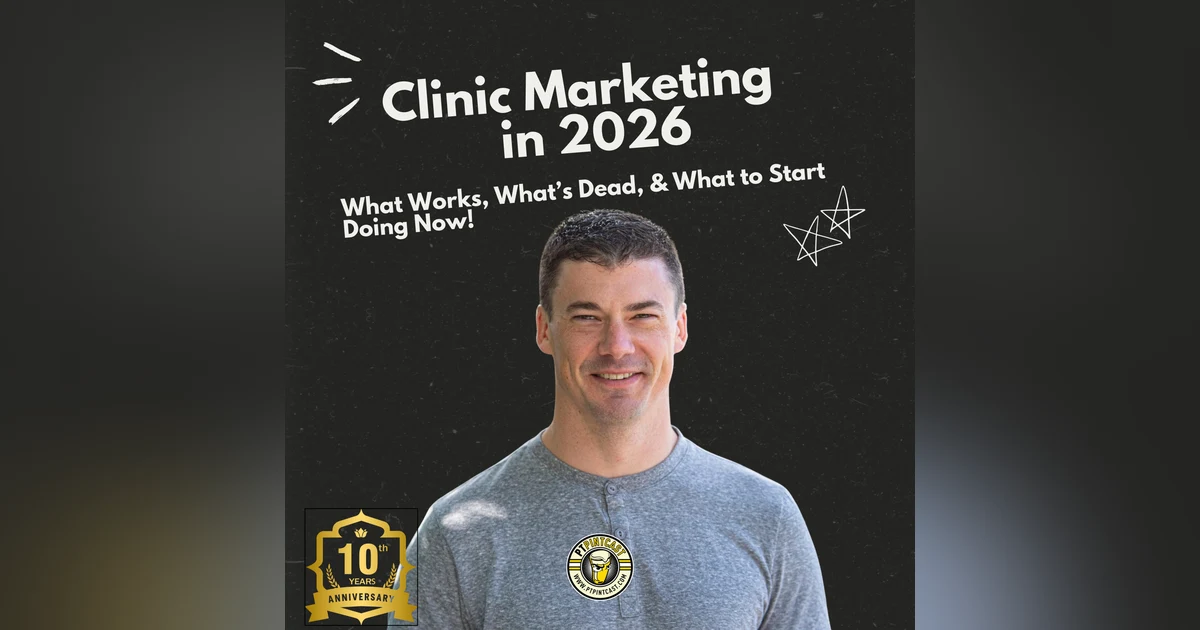


Welcome to the new weekly series Marketing Doesn’t Work! — where marketing myths go to die and healthcare strategies get real. In this kickoff episode, host Jimmy McKay sits down with marketing pro Andrea Cheney to answer the question on every clinic owner’s mind:
What should we start, stop, and continue in 2026?
You’ll hear:
- ???? Why newsletters are usually garbage (and how to fix them)
- ???? Planning your year: proactive vs. reactive
- ❌ The death of Canva-text testimonial dumps
- ✅ The real ROI of Facebook ads for workshops
- ???? “Keep It or Dump It” speed round: clinic blogs, email blasts, exercise reels & more
Plus: A listener question on converting social views to actual appointments.
???? Follow for weekly episodes that make you rethink what “marketing” even means in healthcare.
<p>This episode is part of the <a href="/physical-therapy-business-podcast">Physical Therapy Business Podcast</a>, where physical therapists and clinic owners learn how to get more patients, improve operations, and grow their clinic without relying only on referrals.</p>
<p>Looking for more episodes? Explore the full <a href="/physical-therapy-business-podcast">Physical Therapy Business Podcast</a> for real-world strategies on physical therapy marketing, patient acquisition, and clinic growth.</p>
0:00 Not me. You're listening to the PT Pinecast, where smart people in healthcare come to make noise. Here's your host, Jimmy McKay. I still stand behind the new name of the show, which is Welcome to Marketing Doesn't Work, the show where two healthcare marketing nerds get honest about what actually works, what's BS, and how to keep your sanity while promoting PT, health care, wherever you are. A lot of this is applicable not just within physical therapy, but I'm a physical therapist, so I like to keep one foot on the base so I don't get picked off. If you've ever said, we post all the time, but nothing happens, or marketing doesn't work in my town... This show's for you. I've had people say that. The market doesn't work here.
0:41 I get it, Jimmy. Where you live, it works, but not here. And I've seen those people in the last two to three years. Now they've got regular content going out on what looks like a schedule. And I'm like, ha, man, the world must have changed. Yeah. Uh, it's very, very interesting. All of a sudden it started working or you started doing it regularly. I, and I love using, cause this is where I get to play my, I'm, I have a, I have a PT degree just like you card and I use parallels. So let me do it. Let me do a sponsor thing before I forget. Cause then I'll be in and I'll be like, Oh, I got to redo that. Uh, do you want to thank longtime sponsor? Brooks IHL, they do residencies and fellowships down in Florida, which if you're going to do a residency or a fellowship, I got to be honest, we're both in the Northeast.
1:28 Be smart and go somewhere warm to do it. It is live, Tony. Oh, Tony liked the last one, so he's watching again. Tony's a big live guy. uh brooks ihl world-class residencies fellowships and continuing education designed to turn good clinicians into great ones uh their mentors walk the walk talk the talk the whole thing um check out brooks ihl see how far your career is going to go brooks ihl.org pediatrics uh neuro geriatrics all the things um where was i this is why andrea's here what was i asking before i stopped um marketing doesn't work where i live and then it starts to work so things must have changed Yeah, but of course, that's not the case.
2:09 So I love doing the parallel of there's a principle in healthcare, really like in PT, but in healthcare, it's called the FITVP principle, F-I-T-T-V-P, which is frequency, intensity, time, type, volume, and progression. And this is meant to be like, hey, you want bigger beats? muscles, frequency, intensity, time, type, volume, and progression. And PTs understand this innately. And then I go, they're marketing principles too. And they're like, what do you mean? I'm like, frequency, intensity, time, type, volume, progression. What are you doing? So what I wanted to do was sort of I wanted to play a game called Stop, Start, Continue. Have you ever done one of these before?
2:49 It's like a big consulting thing or like a one-on-one thing, right? So what are some things you think people should stop doing? You don't have to do it in this order either. You just throw it out. Stop doing in twenty twenty six marketing wise. Start doing in twenty twenty six marketing wise or continue. Let's bring sometimes it's good to bring things from twenty twenty five into the fray. So what's something every health care organization should will go with? Start. Where do you want to start? You tell me. Stop, start or continue. You can start with stop. And maybe you saw my post from two hours ago on LinkedIn. And that post is here's what I'm telling clients to stop doing in twenty twenty six. I didn't look.
3:29 I love when things line up. That wasn't on purpose. So so a few things in no particular order. And it's a lot like we've talked about in the past. Stop spraying and praying. So that's kind of like the patchwork stuff. It's like stop doing stuff and hoping it works. Like do stuff for a reason or don't do it. Yeah, I feel like that's a big one. I love to say it like. like when healthcare providers would be like, well, my patient came in. They always like, that was a fake voice too. Well, my patient came in and they're just like, did you do the exercises I gave you? And they're like, eh, not really. And then nothing happened. I want to be like, well, did you spray and pray?
4:10 Did you just randomly do some stuff and then it didn't work? And then you said, oh, I don't know. This whole thing doesn't work and that happens all the time. When you put it in perspective that way, it's very obvious. Yeah. It is. Spraying and praying. What do you see people doing? What does spraying and praying look like with organizations you've worked for? I mean, it could be anything. So it could be, it's really anything you're doing that you don't have like a strategy behind why you're doing it. So spraying and praying, or you're not measuring it. So it's kind of like throwing spaghetti at the wall and seeing what sticks. So you're like, oh, let's post on social. And then you do it for two weeks and then nothing happens.
4:50 Nothing happens, but you don't have a strategy behind it. You don't really have good content. You don't know like what you're posting, who you're posting to that sort of thing. And you're like, well, why didn't it work? Um, I mean, and you could say this across the board for any type of campaign. If you, you know, whatever you're doing, like it could be paid ads. It could be anything across the gamut of marketing. But if you're, if you don't know why you're doing it, you're not measuring it. You're really just spraying and praying. We do that all the time. Like when, especially this, that, um, that phrase comes up when PTs will take students and they'll just be like, well, I'll just ask that student, why are you doing that exercise? And they won't have a good reason. I'll be like, great. Why are you doing that strategy? Well, because I saw someone else doing it. Awesome. Why were they doing it?
5:31 Right. I don't know. So why are you doing it? I don't know. Do you know who the smartest person in marketing, in my experience, has been? Usually the CEO's niece. So my niece looked at our Instagram and said it sucked. So could we make it better? And I love because I'm sort of a jerk and I'll just be like, hey, is your niece anywhere near who we're trying to talk to? Well, no, we're trying to talk to older adults. She's nineteen. So, huh, that's weird. That's weird that she would have deeper insight than the people who get paid to do this. And not saying that you get paid to do it means that you're good at it. But maybe we thought about it deeper than because a nineteen year old could be very good at it.
6:15 Right. But that's typically who I love being introduced to, CEOs, nieces. Yes, or nephews. And I have a few. I had a nickel for every nephew who said we should be on TikTok. And maybe we should be on TikTok. Maybe. But let's figure it out. I'm going to start with a stop. You did a start. No, you said stop. Stop. I'm going to do a stop as well, which is... It's going to sound like I'm biting off of yours, but this is my lead, which is doing it because the other clinic, either in my town or in my vertical, is doing it. That feels weak, I would say, all the time.
6:58 There was a great phrase that says, you don't go to war with what you need, you go to war with what you have. Right. And I remember in radio, when I was back in radio, it would be like, well, we should start doing this. And I'm like, number one, do we need to do that? Well, our competition is doing it. Hang on. Before we react. Knee-jerk reaction. Worst kind of reaction, right? The other thing was, let's say we do need to do it. I would go, okay, we've decided. We moved on from that decision stage. Now we decided we do. This is the thing that we need to start doing. Do we have the people... the process on hand to do that well because in six weeks if you come to me and you're like i saw you doing that thing again of course i'm always talking to my boss i saw you you started doing that thing it sucks i'm like right you didn't give me the tools the training or the time to empower my people to develop a process to do that well so when i start talking like that i sound like a jerk No, well, I mean, marketers always sound like jerks, right?
7:52 When they push back, we always do, but there's so much to unpack there. I mean, it's so, I've worked with so many clients and in-house with so many CEOs, founders, executives across the board, because everyone has an opinion on marketing. We should be doing this because our competition's doing it. I've seen it in direct to consumer. I've seen it in B to B. And this is why like, let's just go to B to B for a minute. When you look at a B to B, like health tech or any tech, um, website you see the same words and it's like crap they're saying and it's like well people hold on people have admitted me to me i'm like hey uh saw you updated the website what walk me through the above the full design meaning what i see this sec first two seconds and i've literally had people say we just copied so and so's and i'm like What?
8:41 Why? What? Why? I had a client not that long ago say, here are three competitors. I want you to pull their websites together. And that's what ours is. And I'm like, well, there's so many things wrong with that. Steve, by the way, is going to forever be this not any real person. This is going to be our person. Hey, Steve, would it be okay if I took the crappiest parts of each of their website and slammed them together? No? No, exactly. Not a good idea? Huh. Just the best parts though, right? Yeah, let's do that. this is like filed under the marketing marketers always need to be educating and they end up being like the bad guy like you said because we're sort of always pushing back because it's like here's why we're not doing that let's think through what makes sense right like but do they have the same and maybe all of the things are are the same we really shouldn't be copying someone else right like i'm always like we should know what competitors are doing we but that's not our top priority I would push back and say, even if you're selling the exact same type of widget, that is a reason to not look like them at all.
9:48 Because if they're looking at you, they're probably looking at your competition also. And if they've bounced from one to the other, they are looking for something different. That's exactly it. And I think this goes to one of my stop doings in twenty twenty six ties in is like stop doing generic AI content at scale. Like there is a time and place. And I I'm a fan of AI and I think it's sort of helped us become more efficient in so many areas. I think if everyone's using the same language and saying the same thing and spitting out this generic stuff, I mean, one of the things that's like big for twenty twenty six is authenticity. And we've been saying it for years. But I think in this age of AI, like brands need to have their own voice and they do need to be authentic.
10:32 I feel like we should do an entire episode on what that could look like. That would be great. That'd be fun. Cause I think, uh, I forget the name of the car. There's some coffee shop that started essentially posting like a real every day, but they turned the people in the coffee shop into essentially characters. And it was above average production value. But they've said, it takes us an hour to shoot this. And we're talking about six or seven figure views. And if you're a coffee shop, you're like, well, that's a lot of effort for views. Does that turn into coffee? It has turned into merch. It has turned into now you're the spot to go to when you're on vacation in that city.
11:14 I'll find it. So it was like, I go back to all the time. I've said this to people. I've said this to people that we've worked together with. If I'm ever using terms that you don't understand, please call me on it. I'll say, is the juice worth a squeeze on this? What does that mean? I'm like, if you don't know what that means, we can't work it. Is the effort and the cost worth the outcome? If it's not, why are we entertaining this? Right. So I feel like we could do an entire episode on especially healthcare brands, man. How do you take some... I mean, I've worked for organizations that had... clinicians in them on their own time had successful Instagram accounts.
11:55 And the organization was, was like, how do we shut this down? How do we, how do we, how do we reel this in? I'm in the room because I'm like a junior member of the more, I'm like a director. I don't even know why I'm in the C-suite meeting and people are looking around and they're looking at me to start nodding with them. Like, yeah, let's reel it in. And I literally was like, Hey, uh, Jimmy here. I don't Wait, work with me here. What if we actually helped them and our success and their success were tied? And they were like, absolutely not. And do you want to know what happened? Those two clinicians who worked together, who had a wildly successful Instagram account, left this massive healthcare organization and now are wildly successful by themselves.
12:46 And the healthcare brand is now like, you know what we should do? We should turn our clinicians into influencers. And I'm like, that's so funny. That's so weird that you would come up with that idea on your own that we had seven years ago. That's so crazy. And this is like in its own episode, like this, like the influencer in healthcare. I mean, this is... like this is talk about authenticity and uh you know when you're thinking about like how do we get out there differentiate ourselves and also show that we are the the clinical experts having your clinicians be front and center but making sure they're supported right so they're not just like putting them out there to like do boring things on video or low quality or whatever it may be like the strategy behind internal influencer marketing is is Now it is.
13:38 But seven years ago, it was Jimmy being, well, that's, no, this is, we're giving away the secret sauce here. I'm like, I gotta be honest. I can buy that sauce in the corner for a dollar a gallon. It ain't a secret, guys. Like, what are we talking about here? Like, what are we talking about? I think it has a lot to do with No one else is doing it. So if it were a good idea, someone else would be doing it. That's it. Right. And it's like that's in in health care, that's in financial services. And it's probably across the board, depending on the founders comfort level. What I found, you're exactly right. Like no one else is doing this. And so we're like, well, this is a great reason to try it if we've thought about it and it makes sense to do.
14:18 And I think that's like, you know, there's in health care, there's like compliance and there's like all these things. But if you have if you have clinicians doing this, they they know better. Right. And I think brands are so I think like established health care brands, especially or brands that look to establish health care brands are like, we've always done it this way and we're very careful. And, you know, in one of my recent posts, I said something about. you know, not like moving quickly and breaking things in healthcare that works in some, but it doesn't work in healthcare. But I think there's two sides of it. Like you need to be nimble and try things, but you don't want to work so quickly that you're, you're reckless and breaking things because healthcare is different. And I think that's maybe like executives in healthcare are sort of feeling like, Oh, whoa, whoa, whoa. This isn't, we don't do influencer stuff.
15:01 Like we have branded images and we do like a corporate video. This is what We do. Do you know how long... I worked for organizations that had full-time graphic designers and they did immaculate work. But once you hire a graphic designer and then your second one and then your third one, you then fill their schedule. Exactly. To justify their existence. And now when something happens that we need to turn around today... I need to fill out a ticket. You're a ticket in a queue. Exactly. Graphic designers want to do the thing. They turn it around quickly because they understand what hitting the pulse and reacting in a good way is. And the funny part is I heard someone say that like, uh, essentially wow people should be running the organization and the how people should be running behind them trying to figure out how to make it happen.
15:52 This is like Richard Branson. It's like, could you imagine if Richard Branson was like fourth in charge at Virgin? You wouldn't know who the fuck Virgin was. Exactly, exactly. If Virgin was just like, you know what we should do? We should buy an airline. They'd be like, all right, sit down, Richard. We're going to run the numbers. And he was like, no, we're going to go buy an airline. We're going to call it Virgin Atlantic and we're going to run a record company. We'll call it Virgin Records. But the funny part is like, we don't. We let how people run around and then are confused why we aren't wowing anybody. When I break it down like that, it becomes real obvious, isn't it? It does. And I think because how people feel safe because they are like working within these guardrails. And I think you need to have the balance. I think it's like the yin and the yang.
16:36 But I think how people get in their own way. And I mean, I'm a how person also, but I feel like I'm a different how person. I'm not like the... Even where you are in the how-wow spectrum, like you're still on the wow end. You're the how end of the wow spectrum. Right. Yeah. And even I know how to make things happen. But I'm like, like, let me give you an example. That party that I threw, I threw a charity party a couple years ago at APT's big conference. And I sat with a bunch of how people who were like, we need to make tickets, fifty dollars. And I'm like, tickets are two hundred and fifty dollars. And they're like, that's insane. No one's going to buy them. And I'm like, wait for it. And then I like took out a dry erase board, but we're going to make companies pay for it. Because here's the thing. If we throw a party where tickets are worth fifty dollars, I don't want to be at that party.
17:19 That's a trash party. That's like how many should we get paper cups or plastic cups? And I want to be like cups should be made of ice. You know what I mean? And they should melt. Like, we need to think outside the box. People are like, do we like when you think outside the box, Jimmy? I go, no, you don't. You like when I paint the box blue. And you're like, look at that. It was never blue. And now it is. That's so crazy. I'm like, no, it's not. No, it's not. You're being boring. So here's my start. Yours was stop spraying and praying? Yes. I'm going to twist it a little bit to sound contrarian, but I'm not. Which is, I do want you to start testing things aggressively. I heard someone, their math was...
18:01 You should be testing out, this is for organic content. And here's how I look at organic and paid. Organic is your proving ground. Costs you effort, right? I like flinging things. I like, we're going to do ten types of content. We're going to do face into the camera. We're going to do day in the life. Whatever you see in the world, good. We're going to do our version on it. Test it, test it, test it, test it, test it. But then if it doesn't work in how long, I don't know. We'll figure that out. We dump it. But if one of the ten things pings, we're going to triple down on it. And now that's over here. Okay, that's a project that's now on the regular roster.
18:41 It now gets replaced with a new thing. You have to have a little R&D. And if something pings and blows up, now that's moved on to the paid roster. Good. Because want to know what? The world is going to change in ten minutes, ten hours, ten days, ten weeks, and we better have some new stuff backing it up. So I agree with don't spray and pray. I also agree with having a lab and R&D and testing what is working for you specifically. A thousand percent. And you are, but you're talking about it in a smart way. That's not spraying and praying. Correct. I think emotionally people like testing things. That sounds scary. Or let's just fling some stuff. And I'm like, no, one is bad.
19:22 One is good. They sound similar. They're not. Right. No, I think so. If you're testing, you are being strategic and maybe you're just going like I have this wild idea, whatever. But like then when you're testing it, it's controlled. And, you know, one of my stop doing is like focusing only on vanity metrics. But I'm just going to like scrap it and go like pay attention to metrics. And the hard thing as a marketer, like I'm constantly preaching like metrics, metrics, metrics. We need to be tying things to outcomes. But like from here to outcome, there's a lot of gray area. And I think marketers need to understand that and know what that is. That doesn't need to get to the CEO, the CFO, the private equity company, the board, whoever it may be. But you need to understand it.
20:02 So if you're testing something, you need to know like it worked or it didn't. Why? Maybe why not? Maybe you'll never understand why not. But like if you can sort of figure out why it's working, what success looks like in advance, then then you're in a good place because you do need to be able to measure things. And we're not going to be able to measure like every single thing every single time. And I say this about direct to consumer health care all the time is. It goes back to the journey. People are doing a lot of things. They're like seeing an ad. They're Googling. Their friend told them they're in this Facebook group. You know, they saw a Google review, whatever it may be. We don't know which one of those things was more powerful than the other. But I think when we're talking about like content, organic content, we can say like, yes, it was a success or no, it flopped.
20:47 Talk about what the difference for you, and it can be different for each type of content, project, any of these things. Like what are vanity metrics to you? I was taught, they were a different term to me in radio. They're the same thing. We talked about it a lot. What did you, beauty pageant metrics. Yeah. Yeah. Same thing. So it's hard, right? Like as a marketer, we want to know how things are performing. So we track views and likes and shares and, you know, all that engagement stuff. And then on the website, we're looking at traffic and, you page views and time spent on site and all that jazz. Um, those are vanity metrics. So as a marketer, you need to know what they are. And I think, you know, there's like lead metrics, there's lag metrics.
21:29 You need to know what those are, but those aren't the things you're reporting to your CEO or your CFO or private equity or within a board meeting, because they are like, whatever, what does that translate to, to revenue? There it is. But what is that? What is that doing? And so I think they're important, but you also have to layer on. We did these things. We got this much attention. Oh, by the way, in that time frame, this is what leads or depending on the kind of company you're working with, like this is what it translated to like patients or revenue or, you know, when I look at like micro conversions or macro conversions, like if someone's conversions or macro conversions. So if I, you know, if we're testing content and someone goes to the website and say they're like watching a video, I'll call that a micro conversion.
22:14 Like we have their attention for one step. They did like a micro thing, but if they are scheduled, filled out a thing, got it. Um, but if they schedule an appointment, that's a macro conversion. If they buy. If they buy, that's the conversion. So like all these things are important along the way, but you don't necessarily just want to be reporting on these. You want to go like this drove this much business. And you know, whatever the timeframe is. For healthcare providers who are maybe a little bit earlier in their journey. If your goal is to run an Ironman triathlon, I think you should lift weights. But if you're just measuring, well, what's your dead... How much are you deadlifting?
22:54 I'm like, that's... I don't know if that's the smartest thing to be measuring. Maybe run it maybe over my last month. What's my mile time look like? See what I mean? We can measure both of those things. But how much I'm deadlifting is cute. That's a beauty pageant metric. Now, deadlifting is probably playing into... My mile time, maybe, right? We had to tease that out. But if I'm just like, well, then deadlift more, the endurance triathlon PT is like, whoa, there's a point when you're deadlifting too much. I'm like, right. So it's like, how come everything you do, Jimmy, doesn't go viral?
23:35 I'm like, well, first of all, because humans are human-y. But also, because I don't want eyeballs, I'm teaching Instagram or YouTube, and I've just gotten, quote, good at this, or at least started looking at it differently in the last year and a half. Thanks a lot to Tony and people I talk to, which is like, what are you teaching? You're teaching the algorithm. Everybody loves to bitch about the algorithm. Like, dude, the algorithm is math, man. That's physics. What are you teaching it? I don't want... my grandma watching my Instagram because that would teach Instagram, oh, like old ladies from Oklahoma who like cats. Grandma doesn't like cats, but I'll just throw it out there. No, no, I don't want that.
24:15 I want this. This is who I want. So a lot of the words I'm using and a lot of the file names, like I'm even looking into... Like when I'm done with this episode and I download the MP three to share it to the podcast, people are now in the background going, what you name the file name is actually telling the internet what this is. So instead of like, you know, January five, nine, thirty two dot MP three, not a good file name. And I'm like, are they measuring that? They go, if they're not, they might be soon. Interesting. Oh, we got to do that. I mean, every marketer's files are like final V five, final, final, final, final.
24:56 Correct. all right let's uh let's do a listener email did you know we have listener emails on my website on my website in the bottom right hand corner you can either send we haven't anybody do this yet you can send a voice memo because i would love to just push play and have the person say it in their own voice or you can send an email let's hit the mailbag it's mailbag time real questions real people no bots allowed All right, Mailbag brought to you by Empower EMR. If your clinic is stuck in an EMR that slows you down, Empower gives you speed, clean workflows and features PTs actually ask for, better notes, faster documentation, smoother operations, all wrapped up in customer support that doesn't ghost you.
25:41 That's who I did there. Upgrade your clinic's brain with EmpowerEMR.com. That is EmpowerEMR.com. This is from Katie. Katie, I'm going to leave where she works out. Uh, Hey, Jimmy and Andrea, I watched your last episode. We've been posting three times a week for a year, but engagement is low and no new evals in parentheses that we, that I can measure. How do I know if I'm doing, and then this is quote, how do I know if I'm doing good marketing that just needs more time or if it's time to change everything? So how do you, what do you, what would you ask her? I mean, like there's not enough information to give a great answer. What are the questions? So she said she's posting, right?
26:21 Posting. What does that mean? Where are you posting? What are you posting? What else are you doing? And this goes back to sort of the like journey within like, what are we seeing? So we're not seeing, we're not seeing new evals or enough new evals. Like what are people doing? Are they engaging somehow? But we would need to know. We need to know. We have a lot of questions for that one. Yeah. So I always tell people this is where I get to act like a petulant six-year-old. Like, who? Where? What? Why? Why? What are you doing? What? Just act dumb. This is actually hard. You have to play completely dumb.
27:02 But you have to erase everything. No assumptions. And you can't jump right to solutioning, which is where I'm like, all right, how do we fix it? And I'm like, wait, no, no, no. We can't figure out how to fix this. I flipped this back to healthcare providers, specifically PTs. I'm like, so, so far you've told me you have a knee. It's not doing knee things. Like what? Like this person might have a four million Instagram, like follower Instagram account. They might have four people. Like, I don't know, like act completely dumb. This is where I get to act like my high school English teacher, Mr. Mooney. And I took, you ever take technical writing? No, but I've done technical writing exercises.
27:42 That's an exam. Like, explain how to write, explain in text only how to make a peanut butter and jelly sandwich. And then he would do exactly what you wrote, which of course is not what you wanted him to do. The exercise was to prove words matter. So you, so, all right. So let's see if we can be helpful here. You're posting three times a week for a year. I got to be honest, if you were doing an exercise or a series of exercises for a year and you were seeing no change, I would say you probably should have asked sooner. Nine months ago. Right, nine months, right. I'm going to make this up. There's no right period, but a quarter feels like no change in a quarter. Come go back, refer back, right? Yep. Engagement is low.
28:23 I would say how low over time. So like no general change. That's cool. And no new evals. Hard red flag. It has no macro conversions is what you're telling me in a year. That's not good. um how do i know if i'm doing good marketing needs more time uh it would lead to because you started with a goal the goal apparently was without you telling me was new evals and you haven't done it so that was that's not good marketing why i don't know because i can't see it yet so if you want to share some links i would that would be fun to do that would be yes like if someone sent us stuff yep i would definitely like oh let's bring this up no judgment like those are the people who typically would get the most out of something like that.
29:07 How do I know if I'm doing new marketing needs more time or if it's time to change everything? I don't know if it's time to change everything, but I don't know what it is. So I would need them to be more specific. But like that's even just saying that to a person like Katie, this is where the brain power goes and the mindset goes. Okay, let's shift a little bit. We did a little bit of stop, start, continue. Maybe we can come back to that. I fell for some marketing. But I'm happy about it. And that's the best, right? I knew I was being marketed to. And did I talk about this guy with you before? Do you know Jeffrey? Sorry, Jesse Itzler? I don't know. You might know his wife. Do you know Sarah Blakely?
29:47 Yes. Spanx. Spanx. She married this man. He's not. He's weird. He's like a runner. They do merit like something. I remember looking into him. I saw him in a LinkedIn post or something. He's got a wild background. He is very much like I am. He got paid like five thousand dollars in nineteen eighty nine to write a rap for the New York Knicks and famously like spent seven thousand dollars producing it because he's like, this is my opportunity. This is my thing. But anyway, he is now like one of these mindset guys. I'm OK with it. I like his vibe. So he sells this thing called the big ass calendar.
30:29 And it's off camera right now. It's on the wall. But it is a large dry erase calendar. But it's every month. And I am very visual. So now it's three hundred and fifty sixty five squares. Jesse did not invent necessarily anything new. Jesse spoke to my pain, which is I use Google Calendar all the time, but I'm looking at one day or one week or not really at one month because you really can't see that. Yep. And he was just like, don't you feel better when you see it and you write it down? And he said that. for a year because i've been looking at these ads for a year like i don't know it's forty bucks for a calendar a lot and then he four hundred times over the last three sixty five days it's like people are forty three percent more likely to complete a goal if they write it down did you know that and i'm like i didn't know that it might not even be true i mean i don't know if it's true but i have heard you feel like huh that is interesting so i i wound up buying the the big ass calendar twenty twenty six It's just a piece of dry erase.
31:28 How many times did you see the ad? More than a year. More than a year. More than a year. In a hundred different formats, ways. Eighty percent of them had Jesse. Twenty percent had other people. Like people, like users or people on his team or testimonials. I saw a billion of them. Here's the best part. Jesse didn't just say, hey, I got a calendar. You should buy it. Because that's how I think a lot of people would have stopped. Look, it's dry erase. It comes with a marker. It comes with stickers. Here's what size it is. Jesse sold Jimmy an outcome. The outcome was this.
32:10 He's like, wouldn't it be great If you walked away with twenty twenty six with a year defining event. And I was like, hang on a second. What's a year defining event? And he's like, well, this is a Japanese theory called Misogi. He's like, it could be like climbing a mountain, opening a business, running a marathon. Like, what is the thing? Everybody's got one or two. Here's the thing. Let's be honest. This is how he said it. Let's be honest. Look deep into my eyes. You know you're not going to get to the starting line of the Ironman triathlon waking up one day in June and being like, you know what I'll do tomorrow? I'm going to do the Ironman. You understand that you've got to backfill.
32:52 So that's really what a Misogi is. So Jesse didn't just sell me the calendar. Jesse sold me a different version of Jimmy, which comes with one Misogi, one Andrea. You got to pick one big BHAG, not lots of BHAGs, one. Right. Okay. And then he goes, you're going to get one Misogi, one, You're going to get six mini adventures. What's a mini adventure? He's like, not as big as a Misogi, but like, I've always wanted to rock climb in the Schwanguk Mountains near me. I drive past them all the time. People hang glide around where I live. A lot of skydiving, a lot of hang gliding and rock like mountain climbing, like not in a gym, like a legit like mountain climbing.
33:36 I'm like, that looks cool, but I could never do that. And people are like, no, there's classes. You just go pay some guy, and they make it real safe, and you can just do that. And I'm like, I could just do that. So what he's saying is, you have one Misogi, You plan for all year, six mini adventures, one every other month. Not crazy. And they don't need to be expensive. It doesn't need to fly to South America, but it could be. It could be whatever you want it to be. You have to plan for it. Because if you don't plan for it, it's probably mathematically not going to happen. And then the third one, the third thing in my three steps to a big-ass year is three...
34:16 winning habits, four winning habits, one new habit every three months, not four habits on January fricking first. That's not going to happen. He's like, pick one winning habit. So I'm not going to bite my fingernails in the first quarter of twenty twenty six. Which for a guy who's, I'm a, I'm a, I just like, I'm a fingernail biter. Why? Because my dad was, I don't know. But he's saying add new, add one new habit every three months, being realistic. So at the end of the year, you would have had one year defining event, six cool mini adventures that maybe one of those mini adventures turns into a Misogi next year. Yeah, I would like to climb fricking Everest. And you've built four, you've stacked four habits.
34:57 And even if twenty five percent of those habits stick, still a pretty good year. Yep. Sold me a calendar, Andrea. But he told me a story. Yeah. And I got to be honest, none of this involves a million dollar ad spend. Right. It just it just didn't. But we don't do that with healthcare, with the thing that apparently is like at the core of everything. We just go, we're open from seven to three and we bought a new MRI machine. We're evidence-based. Literally, someone was like, I want to go to this place to get an MRI. And I go, why? And they go, because you can watch Netflix while you're in there. And I was like, holy shit.
35:38 That we have reached bottom of barrel. That's the differentiating factor. That place was like, we got Netflix. Holy shit. So anyway, I've already started. It's on my table now. And I am picking out my Misogi carefully because I'm going to stick to it. I think I'm going to do another Ironman. I'm going to do an Ironman. And I've got six or seven months to prepare for it, which is more than enough time. But like, what are your thoughts? Have you seen? Well, well, he also like, this is, this is free marketing, right? So you are so excited. You were delighted. You've now become this evangelist maybe.
36:19 And you're telling people about it. Word of mouth. Correct. It's so cool. Yes. This is the thing he didn't say. I didn't need, I didn't have a calendar problem. Right. I had a, I had a becoming a different version of myself problem. He never said that. but he did. He had my thoughts coming out of his mouth or his ads. I want to have a big ass year. Even the words. Danny Matei is a PT who wrote a book a number of years ago called Fuck Insurance. And people were like, you can't title that. And he was like, why? And he's like, because you're going to turn a lot of people off. And he goes, good. They were never...
37:00 Once they signed up for whatever it is that I'm teaching, they were going to freaking hate me because I drop F-bombs left and right. That was one of his qualifying questions without having to ask. This guy, same thing. It's called the big ass calendar. Jesse's like, I don't want prudes. They're not going to like me anyway. Good. Get rid of them on step one. I don't want... Not the brand. Jesse knows his brand. Jesse knew his audience. Jesse read me like a book, even though he's never met me. Yep. It's a masterclass. It is. That's very cool. And I mean, pretty similar. So the few times that I've fallen for advertising on Instagram, it's been like similar. And it's like, I've seen it a bunch of times. They're speaking to me. It doesn't matter what the product is. I'm like, yes, yes, I have that.
37:41 Oh, yeah, I have that problem. Yep. I want to feel that way. Yeah. Yeah. Yes, I want to feel that way. Do you know how many times in your lifetime that you've ever seen someone drink a beer in a commercial in the United States? Ballpark, how many times you ever? Ballpark it. Try to be within ten thousand. This is a trick question. I don't know. Zero. Zero. I was thinking it had to be zero. Can't show someone as far as... I'm going to say in my lifetime, but I'm definitely going to say since I've been eight years old. You can't show it. It's a rule. It's a law. That's what those things are. They're like rules, but they get enforced. Exactly.
38:22 Think about the last... You're holding it and it's like... It looks good and appetizing. It's cool. They talk about cold. Think about that. Coors... Like all their ads are like someone's, like even in the summer, they're like skiing or they're in the snow. And they're like, our beer is brewed cold. Cold. Like it's cold. And I'm like, yeah, but like as soon as it left your brewery, somebody else's, like your truck had to keep it cold. Then it went to my supermarket. They kept it cold. Now I'm keeping it cold. They're literally selling you cold. But they're not. They're selling you the feeling of what it's like when it hits your lips.
39:03 Right, because you know what it feels like for a cult to drink a cold drink. But how do we get that? It's similar to why cologne and perfume ads are so freaking insane. They're like a fever dream. They don't make any sense. Like Leonardo DiCaprio standing there with a shirt unbuttoned and a fan going... coming out of the water and then there's like a weird unicorn and yes it gets weird like why it's like they're trying to different like i don't understand that but like this is what i've been told it's like they're trying to sell image and like sort of weird like how do you market a smell until the tv starts spraying stuff out in our living rooms it's not gonna happen yep very cool about the calendar so i got the calendar i'll let you know if it works doesn't matter Doesn't matter if it works.
39:52 You bought in. But maybe it'll work and you'll do it again next year. Well, that was also one of the ads that I saw after I purchased the calendar. The woman was like going through all her. She's like, I've done doing this for seven years. So she goes, think about that. In seven years, I've had seven year defining events. You could say what happened in twenty twenty. I'd be like, oh, I did this. Right? Smart marketing, right? Because your thought might be like, yeah, that sounds cool, but I'm not going to use it. I'm not going to continue. Like, you know, that's, that's really smart to have, to show someone who's used it year after year. Correct. Show me the future state of me. And that's where it's like, huh, that makes it, that makes sense. All right. We're going to do keep it or dump it. You're ready to do keep it or dump it.
40:32 Let's do it. Hold on. I'm going to do the quick button. Keep it or dump it. This is just personal and it's going to be hard, but I'm going to ask you to do like macro because like you could be for different segments or different businesses. I'm going to throw a tactic at you. So very specific. You say whether we keep it in twenty twenty six, dump it forever and then justify it or just fire off a hot take. Patient testimonial videos on social. Keep it or dump it. Keep it. Yeah. It's just too authentic. It's super authentic. You don't get much better and real than that. But please make them real. Real. Yes. Real patients. I love the ones that look like proof-of-life hostage videos where you're clearly putting words in their mouth.
41:17 I'm like, that does the opposite. That does this. They're just saying your brand messaging. Correct. Or, oh, can we stop this one? Which is patient testimonial texts on Instagram where they literally screenshot it or they take the ninety-three words and put it in a Canva template. I'm like, no one's reading that. Take five words out of that. felt my best ever steve whatever but just do dot dot dot felt my best ever dot dot dot like as long as it's real but please don't give me sixty eight words on instagram in an image not reading it uh seven that's the that's the that's the rule seven words or less keep it or dump it uh clinic blogs for seo Oh, so this is, I have like a little asterisk next to this.
42:03 Um, yes. And so Google and search engines are getting smarter to generic AI stuff, right? They're like, they are AI. They're getting good. So we need SEO. We need things that we need, obviously, keywords that people are going to find us if they're searching for a clinical thing in our area and there are in our audience. But we also now and, you know, this is like Google's latest updates tell us they they're looking for authentic human words. authentic content that's written for humans, whether or not that's written by humans.
42:43 It needs to be written for humans. And so I think we need both. We need SEO, which is pretty boring stuff, but we also need the human stuff. And I think we also need to make sure we're optimizing not only for search engines, but we're optimizing for AI because that is where people are looking for sure. So I think the pendulum has swung back, which is like, I don't know about you spending ten grand on fifty thousand words that is clearly automated. But like, yes, this is where search engine optimization or generative search optimization as well. Yep. Again, depends on who you are. If you're a one location practice, I don't know if that's the thing I would be optimizing for, but if you're a little bit larger, maybe.
43:25 Facebook ads for workshops slash events. Would you run ads to go to it to lead to a workshop or an event? That's a micro conversion sound like the event or the workshop sounds like it'd be a micro conversion in your point of view. Yeah, I think it's fine. I think if you are targeting correctly and appropriately, I also think you shouldn't expect major conversions from the Facebook ad because you're probably advertising it in other places. But no, I think it's good. I think it's good to run Facebook ads because you can target at certain levels and I think it's fine. Yeah.
44:05 In my opinion, if you sell a really great experience... I was talking to a guy in the Pacific Northwest. And I'm like, what makes you great? I love asking questions that sound lazy. But I'm looking for how you answer, not just what you're answering. He's like, when people get in here, we really make them feel like... And he said something like they're a pro athlete. He's like, I want to work with athletes. I work with high school and college athletes. And I'm like, sounds like if you had ten... That would be a ridiculous experience. Like, oh my God. Yeah. I go, then why don't you do a combine? He's like, what's that? I go, go get a volleyball team and pick out ten volleyball specific tests you can do like vertical leap, overhead arm strength. Like, I don't know. You're the clinician who works with volleyball players.
44:45 Can you make me feel an experience? Then is it worth taking the volleyball coach to ten local high schools out to dinner? Yes. And be like, I'll run all your players through each one of these one at a time. This two-hour block is going to be for your fifteen players. And then rank them in a spreadsheet. Show them where they fell in each event. And then do a combined graded score. And then go here. And then when they go, well, how do I get better? I go, right here. Now, is all that effort worth it? It is if that's who you want to, in my opinion, if that's who you want. So I think, yeah, I think Facebook ads for workshop, it's an event. If you're actually good in person.
45:26 Right, right. It needs to be the full experience. Yes. Yeah. Reels with clinicians doing exercises. Uh, fine. Um, but it's fine, but I think real patients and real people doing exercises, if it's engaging, that's a real tough one. For me, this, this begins to be manic flavors ice cream again. So it's like, look, when we do exercise videos, when we put our clinician in tights and Lululemon and we show big muscles, people love watching exercise videos. I go, do they, or is it just a six second video that gets lots of views, but no conversions? Exactly. Is it a beauty pageant metric?
46:07 And if it is, what are you doing? So like, I don't know. I would put my effort elsewhere instead of real. I think maybe showing like a patient outcome video and then like here's like some snippets of how we got there potentially. Yeah. Two more. Clinic email newsletters. You're going to have more experience and a better viewpoint than this from me. I don't really care about newsletters, but that's me. I don't care about doing them, but what are your thoughts? Is the juice worth the squeeze, I guess is what I'm asking, Andrea. So I say this to every client who wants to do an email newsletter, which feel very productive. If you're going to do email, it needs to be segmented and you need to talk about something people care about and they need to be opted in.
46:53 And that is a behavior and that's a technology issue. So you need to make sure you're capturing that they want to do it. You need to give them a reason to want to read this. And I think segmentation is, like, the biggest thing. I've worked with so many people who have just, like, sent everyone the same message. And they're like, well, why aren't our open rates good? Like, well, because you're sending me, you know, or click-through rates. Like, you're sending... a sixteen-year-old and a seventy-year-old the same content and it's just not relevant i think the other thing too is like setting expectations i think it's important to have consistent communication with people but i also think we need to understand what we're getting out of it like we're probably not getting a patient out of a newsletter right now well the funny part is like a lot of a lot of practices i have no problem sending someone an email from your emr But as to what you just said, it better be about them and not you.
47:49 We've worked with organizations together who were like, we're going to send out this email. And I'm like, so can you point to the news in this newsletter? And they're like, we opened a new clinic. And I go, that's news to you. Right. That's not news. That's an ad. That's an ad. And we understand how newspapers used to work. It was a bunch of news with ads between. With ads. Right. Newsletters for health practices are typically ads with ads between them. Right. I found what works better in healthcare has been sending... just very like targeted emails about so if someone like if something this is where you have to just get sophisticated with both your strategy but also the technology that you're using if a sixteen year old is coming in like they're a sixteen year old athlete or they're a twenty whatever it is um they could be any age athlete or they're a runner um you know thirty year old it doesn't matter what it is like sending them information that's targeted to them that will actually help them that's not uh just we need to push this out and so we're going to show you pictures of our team doing something silly.
48:58 Yeah. Like to use my example with Jesse and his big ass calendar, like his newsletter probably wouldn't be like, we've added purple stickers to the package if you buy it. Like that's not news. Right. This is where people like Tim Ferriss or James Clear, their newsletters, Mark Manson, their newsletters take off because they're like... I think it was Tim Ferriss who does like three, two, one or James Clear. It's like three things I'm reading, two things I'm thinking about, one thing I'm doing or whatever. It's like I become different even if I skim his newsletter. But practice owners or providers sending out newsletters, it's like I, I, I, I, I.
49:47 I will defend myself because I just said, James Coy says, here's three things I'm reading. Here's two things I'm doing. But it's about, here's my suggestion to you. I think it could benefit you. Not just what I did. I read a book. It's like great, cool story, bro. Exactly. And I think it goes back to the productivity thing. It feels like we're doing something if we send our newsletter every month. Blast it. Blast it. And I think there's value in newsletters if you have a targeted list who is signing up for your newsletter. I don't necessarily think most practices that I've seen, whether it's in PT or in other kind of clinical healthcare, they're not using newsletters the way newsletters are intended to be used. And then they're like, but why isn't it resulting in anything?
50:28 Well, not to be nitty gritty or overly critical, stop calling it a newsletter. You're not in the news business. What business are you in? We're in the exercise business. All right, but do I need exercises in my... Do I need what you're in in my inbox? No. What are you giving me to give me a reason to spend ten seconds, even ten seconds of my freaking day, to clicking that? Because then I've got to spend brain power trying to decipher what the hell it is, why it's in there. I don't think Jesse sent me one email. He never asked me to send up an email, probably because he's like, I don't have a reason to get your email. I don't have a reason to email you. I mean, I had a very recently healthcare company here in New England that I am a patient of send me a newsletter that was focused on diabetes.
51:16 And I was just like, well, I don't. So I unsubscribed. I was like, I don't have I don't have diabetes. Like, why are you sending this to me? It was it's really like it's the it's a quick way for people to ignore you or get annoyed with you. This is when, you know, someone's following a template blindly. Exactly. Send out an email. Why? Because it's Friday. It's Friday. Yeah. Yeah. How often should you, I was always asked, how long should you, how often should you post? How often should you send out an email? And I would go back to when I was in radio. How often should I turn on the microphone when you have something to say? And if you don't, shut up and play some Pearl Jam. Don't do it if you don't have anything to, I mean, that is like, if listeners take, you know, viewers take nothing away, like don't say anything if you don't have anything to say.
51:59 Cause people will remember that. They'll be like, whenever the guy opens his mouth, whenever they send out an email, it's, it's crap. And you only get so many opportunities where you can't wash that image off anymore. Oh no, I see that name. What do they even do? I don't remember. Just it's crap. Yeah. All right. Um, that's it. That's a keep it or dump it. I will say thanks to, I think I'm going to one of their conferences, US Physical Therapy. That's a big nationwide network of clinics focused on developing clinicians and not burning them out. Leadership tracks, mentorship, career growth, and the stability to build your future in this profession of physical therapy. If you want to find a place that supports how you want to practice, that's USPH.
52:43 USPH.com. That's USPH.com. What... do you want your parting shot to be oh wait i gotta push the button we do have a i don't know how long this is gonna last because it's like i gotta push buttons this is the parting shot one last mic drop moment no pressure just your legacy on the line All right. No pressure. Just your legacy in the line. What's your parting shot for today? A marketing doesn't work. I think I'll just go back to what we were just talking about. Don't say, you know, if you don't have anything meaningful to say, don't say anything. I mean, grandma and mom's advice. That, you know, wear clean underwear, I think is a good one, but I don't know if that's in my scope.
53:26 But yeah, but then this also sounds like we're contradicting when we say, make sure you're consistently frequency, intensity, time, type, volume, progression, creating good paid or organic content. But that should push you back to, oh, why am I actually, what could I be doing with all these email addresses? Right, right. Maybe I could be doing something, dare I say, different. Dare I say different and better? What are the odds different and better? I would say that the bar is not even on the, it's not low, it's on the floor to differentiate yourself from other providers. They're not even listening to this podcast. And I'm not saying that this podcast is a thing that's going to separate you from the next.
54:06 I'm saying the mindset that this podcast might bring you would help you do that. Stop sending newsletters. Why? Because you're not in the news business. You're in the, I don't know, whatever business you're in business. send that via email dot, dot, dot. Right. So, uh, don't, yeah. If you have nothing good to say, shut your damn. That's it for this one. We're just getting warmed up. Smash, follow, send it to a friend or crank up the next episode. Want to go deeper? It is at PG podcast.com or find us on YouTube and socials at PG podcast. And legally, none of this was advice. It's for entertainment purposes only.
54:46 See, Keith? We read the script. Happy now?