Burnout, Better Jobs, and the PT Social Media Game
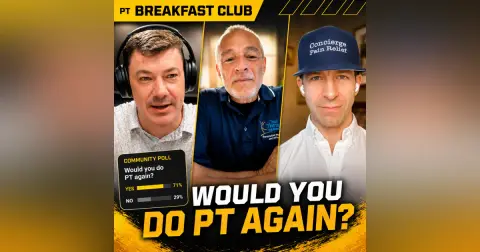


On this episode of PT Breakfast Club, Jimmy McKay, Tony Maritato, and Dave Kittle unpack one of the profession’s loudest conversations: burnout.
But instead of stopping at “PTs are burned out,” they push into the more useful question: what are clinicians actually asking for when they say they want fewer patients?
More time? A buffer between visits? Better systems? Less emotional carryover? A job that matches the version of the profession they thought they were entering?
The crew also asks the dangerous dinner-party question: would you become a PT again? Tony and Dave both say yes, but with caveats. They’d understand market forces sooner, think differently about ownership, and build earlier.
In the second half, the conversation pivots to social media, AI, and clinic growth. Tony shares how he’s using Meta AI, ChatGPT, and Gemini to analyze what is actually working across his content. Dave explains how TikTok is already creating real patient conversations for Concierge Pain Relief. Jimmy ties it together with a lesson from his talk to PT students in Colorado:
Attention leads to trust. Trust leads to action.
And the big takeaway for clinics?
Stop trying to create “social media.”
Create media that is social.
Big Ideas
- Burnout needs a clearer definition before PT can solve it.
- “Fewer patients” may actually mean more time, recovery, documentation space, or emotional reset.
- Better pay might help, but it does not automatically fix workplace dissatisfaction.
- PT students are still fired up about the profession, and that matters.
- Future clinicians need to understand market forces, not just anatomy and interventions.
- Social media is not just marketing fluff. It is attention, trust, and patient behavior.
- Clinics should stop overproducing and start documenting real moments.
- AI can help clinicians and clinic owners understand what their audience is telling them.
- The FITT-VP principle works for exercise, communication, business, and content.
Best Line
“Don’t try to create social media. Try to create media that is social.”
<p>This episode is part of the <a href="/physical-therapy-business-podcast">Physical Therapy Business Podcast</a>, where physical therapists and clinic owners learn how to get more patients, improve operations, and grow their clinic without relying only on referrals.</p>
<p>Looking for more episodes? Explore the full <a href="/physical-therapy-business-podcast">Physical Therapy Business Podcast</a> for real-world strategies on physical therapy marketing, patient acquisition, and clinic growth.</p>
0:02 Broadcasting way too early from three separate Wi-Fi connections. It's PT Breakfast Club with Tony Meritato, Dave Kittle, and Jimmy McKay. all right gentlemen well one gentleman second gentleman coming pretty soon pt breakfast club tony good news we got a sponsor all right this is such a smart idea combine two things one thing that you like and one thing that you hate today's episode is brought to you by the prior authorization escape room can you solve twelve impossible puzzles find the missing facts call the insurance company get transferred four times sit on hold for twenty minutes and track down the physician who retired in twenty nineteen before your patient's shoulder freezes.
0:48 Nobody has escaped yet. Look your next clinic team building event today, prior authorization escape room. It's technically in network. Don't you always feel like that? It's always good. So that's a sponsor. All right. I love it. That's one of the things that APTA is working on, right? Like reducing liability, reducing prior auth, all that stuff. Well, I mean, that was the thing. Somebody asked me the other day. They weren't at the thing I went to Portland two weeks ago. It was the APTA's payment summit forum. Extravaganza, whatever you want to call it. And people were like, what were the big takeaways? And I listed a few. Then I was like, here's the biggest takeaway.
1:29 The fact that they're having this meeting. I mean, putting a meeting on like that is not cheap. You know what I mean? It's not just a webinar. This is an in-person, four hundred and fifty, five hundred people were there renting a ballroom for two days and If you've ever had an event, it's not small. So APTA is paying attention. They've always been paying attention. It's just, what do you do about it? Because I do hear other people going, APTA should, APTA should. And I go, you're APTA CEO tomorrow. Show me exactly what you would do. You can't just say the big picture stuff. You've got to give me the granular stuff. But let's talk about something that you shared from APTA as Dave joins us. I'm going to pull it up. You sort of alluded to that the post that said roughly half the profession feels burned out according to a survey but the thing that caught my eye was like the comments of course right instead of people talking about pay housing cost living they're talking about burnout Larry Benz is talking a lot about this and he's like he's got some thoughts but why did you screenshot this and share it what what jumped out at you or it's got to be a pattern it's either it's either a pattern over time or it's something interesting at once Yeah, so Dave, good morning.
2:41 Good morning. You know, the survey says nearly fifty percent of PT surveyed say they're experiencing burnout. And from my perspective now, maybe we have a different definition of burnout, but I'm like, all right, if I am self-declared burnt out, experiencing burnout, I'm probably not loving my work. I'm probably not coming in today looking for new opportunities to impress my patients, to share my knowledge, to like wow the consumer, to build raving fans, right? I'm probably just scraping by. I'm struggling. There's therapists on TikTok who talk about crying on their way to work every single day.
3:23 like how can that therapist be an amazing therapist in the clinic i openly admit look i am not as good of a therapist at four p.m in the afternoon than i was at nine a.m in the morning i'm just not like we're human beings we have a limited capacity and so I shared that the intent behind my original post was basically to say, look, you want to know why insurance is paying us less? Because half the profession feels burnout. How many people, Dave is in a hiring mode. Does Dave want to hire and pay a premium rate to somebody who comes in and says, man, I'm burnout. I hate what I'm doing. I hate physical therapy. Like, no, nobody wants to pay, including payers.
4:06 So of course there were the clinicians, at least two who came on and they're like, look, I've experienced burnout. I can still deliver a great patient care experience. I can still be a great therapist just because I feel burnout doesn't mean it affects my performance. I call bullshit, but even if I didn't, okay, you're the unicorn. You're the one person in a thousand and ten thousand who can still put their professional face forward, deliver a great service and feel burnout on the back end. but most aren't most are not. And that was the point is we still have a huge percentage of the profession who are just not capable of delivering an exceptional experience.
4:50 Dave, what do you think when somebody says, man, I'm burned out on this, are they going to be the best employee? Are they going to be the best clinician? Is that who you want seeing your mom or dad? Definitely not. Definitely not. Definitely not. They, they would not be able to bring it. They would not be able to, um, provide a excellent or wonderful patient experience. No, they just can't. It doesn't matter what location, what type of setting they're in. Um, I tend to try to hire people that understand, like, hey, I'm a professional. And it doesn't matter what personal stuff that's happening. You might lose a family member, God forbid, or something happens.
5:34 But can you separate that? Can you not bring that into work? Can you not bring that into the hospital or the outpatient clinic or home visits or whatever it is? Um, obviously it's challenging and obviously everyone has, uh, different, different things that happen and occur, especially they could be surprises or we're out of the, uh, out of the ordinary. Um, and those things are, you know, that's life and that's okay. Right. And maybe they need some extra support and all that. But in general, I love this topic because the burnout definition needs to be defined in the challenges. It's, it's like the word it's like personal development. personal development has no definition. There's no way to measure it.
6:15 You know, you pay all this money to go to Tony Robbins and you don't know if it did anything or not. Did you take action or not? What's the ROI of going to Tony Robbins and paying five or ten grand or even more? Some people pay more, which is Crazy, right? So we'll get back to burnout. You also don't know, like, what's the definition? Everyone's got different definitions. And also, it's hard to know, are we all speaking about the same thing? Correct. That's what Larry Benz is talking about. We'll get to that. But I just typed that in and looked that up. So we have two definitions. One is the pop culture definition. this is like in the zeitgeist right just out there in the ether pop culture burnout says i'm exhausted i hate my job i'm over it it's sort of what dave is saying become the catch-all for low pay too much paperwork bad bosses long hours difficult patients student loans work-life balance that's all lumped together basically work sucks The psychological like book definition is more specific.
7:07 The World Health Organization defines burnout as a syndrome caused by chronic workplace stress that hasn't been successfully managed. And it has to have three parts. And you guys touched on all of them. First is exhaustion. You're running on empty. Tony Tony's tired of four p.m. Second is cynicism. You start emotionally distancing yourself from the work. Nobody wants to hire that person. No one really wants to be that person. So patients stop becoming Mrs. Smith and start becoming the ten o'clock. And then third is reduced effectiveness. You feel like you're working incredibly hard. You're just not getting anywhere. So that's the psychological definition. They do specify that it is not a diagnosis, though. Burnout is not a actual almost almost sounds like it, though.
7:49 It is a criteria. Um, but, uh, but Larry Benz has a series on this. I helped produce the podcast. There's his podcast. That's a disclaimer. But if you want a guy with more experience in, I mean, he's wrote a book called called to care and he's doing a pod, uh, a series on his sub stack. where he's saying if technology actually wants to help with this, I full disclaimer, I work for a technology company in health care. It needs to do these five things. And he's got a great series and we can go into depth on those five things. But when I show the pop culture definition, the psych definition, did that line up to what you guys thought it was? I would say my definition, I didn't know the psych definition, but that's what it is.
8:34 Like you're frustrated, you're cynical, you're coming into the clinic to see the same people with a different name and a different body, but the same condition. You know that no matter how hard you try, the person in front of you is never going to get better. That's the feeling you have inside. And so that individual is, there's nothing left in the tank. They're done. They come to the understanding, I'm never going to make more money. I'm never going to help this person truly gain independence. The person doesn't want to be here, the patient. The therapist doesn't want to be here. Nobody in the equation wants to do any of this stuff. That is, in my mind, the definition of burnout.
9:17 And that is the person who is not going to come in and continue to feel inspired and passionate. Right. So the people who are making those comments are not burnout. They're just doing hard stuff, and we all do hard stuff. But everybody wants to label it as burnout. Right, right, right, right. Do you like the hard stuff? So I worked in radio, notoriously were underpaid. I didn't care. I would have crawled over broken glass to stay in that industry if it still survived. I liked the stuff. That stuff â that job still had a downside. There was a boring part of it. I had to go to parades. I had to go to endless parades, parades forever. I never want to go to a parade again.
9:58 But here's the thing. The upside for me outweighed the bad by a factor of something. There was enough pull. Here's that poll I was talking about on LinkedIn. I did this yesterday. I didn't want to make it a burnout poll because I feel like that's the clickbait term. And I could have done that because everybody just wants to pile on. I wanted what you're really looking for. Or I tried to as scientific as a LinkedIn poll could be. And this is what I asked. What do you really want as a clinician? When you say you want fewer patients a day, what are you actually asking for? Because that was the thing everybody says they want, right? Do you want more time with each patient? Do you actually want a little buffer? Do you want to reset? This is what Dave provides. Both of those things, right? More time and a buff.
10:40 Do you want both? Which of course everybody wants, but everyone wants the most. Whatever the most is, I want the most. Or I do like this. Twenty two percent of people were honest. Like, honestly, I just want less. I just want less patience. I read that. Yes. I just wanted to learn. I want to work less. Right. But I like the first three options anyway. So thirty six percent want both. They want that buffer. You want to be able to recharge. You want to be able to actually process mentally what just happened. Maybe you want to go say something. Of course, appropriate to a coworker between patients because you can't always say, you know, inside jokes in front of patients. Or do you want more time with patients? So when you say you want less patients, what do you say? What do you what do you actually want?
11:22 That's that was that's been up for less than twenty four hours. It's got almost one hundred responses on my LinkedIn. Now, I don't I don't think that's too surprising or shocking, and I think sixty four votes is a pretty decent sample size for a LinkedIn poll like that. What do you guys think? Yeah, I think that's great. Yeah. Um, so, and by the way, all, all the structure with concierge pain relief, all the things that I'm putting out on LinkedIn, I like, I didn't know, I wouldn't think, I don't know if I'd be able to guess the percentages of each of those answers, but the signaling, right. Of that, the sentiment of that. I know that a lot more therapists are yearning for everything from that pole, right? They want less patients.
12:02 They want a buffer in between patients. Actually, I didn't even think of that, but that makes sense to not have back-to-back-to-back nonstop. And I remember, I didn't call it burnout, but my first job out of school, we're seeing patients every thirty minutes. And sometimes, as Tony has talked about it before, sometimes you get people that come in early, some people come in late, and all of a sudden it feels like it's like a, like an avalanche of patients coming in. Right. Catch up. Right. Suffocating. But the thing is like, I didn't look for LinkedIn groups and stuff to go on there and like flame employer. I know, I know. I write the bar. Yeah. So, so I never, it never registered for me the word burnout back then, which, and listen guys, it's not even that long ago.
12:49 We're talking. Yeah. Ten, twelve years ago, like thirteen years ago, like not that long ago. So like, I don't, I just don't understand. I know now I'm a business owner, but even when I wasn't a practice owner, i wasn't thinking of of saying burnout and saying like i need a new job and this license was horrible and the and the loan debt and all that like i just was like i just was like i was just looking for more options looking to do more things but i wasn't like the victim that's the thing that like i know this irritates me i think it irritates tony a little bit but i was never like this was you know i got blindsided by the profession and you know then you got the health the health uh reimbursement the payment right so for me it's like when i started practice i'm like i'm gonna just unplug it i'm just gonna do something different and not be in network right but i didn't Even then in twenty eighteen, twenty nineteen, I didn't go on line and say this is all horrible.
13:42 I was like, I'm going to just take action and march this way. Yeah. Dave, does this help you change how you write copy to find answers? new clinicians to work with you. If you're seeing data like this, what they're looking for, and you provide it, like that's copy gold, right? This is the audience telling you what they want. If you have it, say it in fifty different ways, right? Because if that's what you offer, that's who you want to attract. Exactly. But the thing is, is like, I want to attract the ones that are not being inflammatory online, though. There's a there's a kid. Tony's laughing. There's a continuum of clinicians that this post resonates with.
14:24 But I'm still selecting like a certain batch of those folks, the ones that are probably not. writing inflammatory stuff online. Their heads are down and they're doing the grind somewhere else, but they're not flaming their employer or the profession or blaming others. They might say to me privately, yeah, I would love to make more and only treat four to six patients a day. To answer your question, yes, I'm posting organic content on LinkedIn, sometimes Facebook, and it's hitting a lot of those things. I think that poll certainly can help assist with more of the copy. So yeah, totally. Yeah. All right. Teresa had said most clinicians don't burn out because they care too much.
15:07 They burn out because they care without systems, without recovery, without boundaries. People rarely fail alone. They fail inside systems that don't support them. What boundaries, though? You signed up for an eight-hour workday each day. What boundaries? Well, that's someone who wants to stay within whatever system they signed up for. This is a mismatch of expectation and reality, except if you show up... and someone does something oh several times believe them this is how it's going to be right so you have two choices you can complain about it and i don't even know if that feels good or you do something different you go somewhere else you build your own thing those are them's the rules them them's the rules so yeah on linkedin i think the really dangerous thing here and dave's kind of alluding to it it's so easy to play into their anger and frustration and all of that stuff i mean that's what we see politicians doing constantly the politician who offers free this and free that and raises and rent freezes and all that stuff it's so easy to feed that but that's not the person you want working for you.
16:21 You want the person that's innately successful, that's naturally happy, the person who walks in the door with a smile, not somebody who's looking for your job opportunity to fix their problem, to fix their life, to make them happy. So from a communication perspective, it's really easy to fire up that angry disgruntled base but that's not who we're trying to attract. We're trying to attract kind of the opposite of what that is. The person who's happy and satisfied and fulfilled, even making, earning less money, even working harder than everyone else on the team. Go ahead.
17:02 This is Adam Paris. I wanted to make sure it was not Teresa. Okay. So to double click on that, Tony, like the candidates that we want are the ones that don't like treating patients every thirty minutes or having to go home and do fifteen to twenty four notes every day but they're not online complaining about it and they the patients where they current where the the patients where they currently work would not know that they were dissatisfied with the volume of in-network model. Does that make sense? The patients for those therapists that we want to hire, that we're plucking and poaching from the in-network world, that have a following, that have a good reputation, all of their patients are looking at them as like, Yeah, of course they love their job and all that.
17:50 Now, privately, they will say, I would love to make more or just treat four to six patients a day and do some home visits with you guys and do some office visits. That's the sweet spot, Tony. And that's really hard to find. But the ones that are like... probably commenting about, I don't know if there's any comments on that post, Jimmy, with the poll, but if people are commenting like blaming the APTA and blaming United Healthcare and blaming their employer and all that type of stuff, they will get attracted by our post about what we're trying to market and advertise for clinicians and job roles, but they won't make it through our interview process.
18:31 So let me ask an unfair question. Right. So here it is on the board. If PT salaries increase twenty five thousand dollars tomorrow, does burnout suddenly become less common? So, yes, you're asking. Right. So that so it's this one thing. Right. Or for some percentage, it's one thing. What do you think, Tony? Does does the does the the inflammatory posting about burnout drop by fifty percent tomorrow if salaries go up twenty five K? Tony, no, no. No, I don't think it does. I think this, you know, they say it's a systemic problem. I think it's a mental problem. I think in their brains, it does not matter. I've got friends, I've got associates that are in other healthcare professions who are making half a million, seven hundred and fifty thousand a year.
19:17 They're saying the same stuff. They're feeling the same emotions. They're just as unhappy, just as frustrated. it makes no difference how much money they're going to make. This is where you go back to there's a person who's happy and there's a person who's not. The person who's not happy is not happy because of their own choice and decision and the way they perceive the environment compared to the person who is happy. And no amount of money is going to change that. Yeah. Dave says this is the exact same thing. Some amount of money, some amount of money or less of a caseload for, for some people, Jimmy, you, you, you qualified it. And so I initially said, yes, I'm a twenty five K bump, but then you said some, so I think you would get less, you would get maybe, you know, let's say, let's say for every extra thousand dollars in salary, we get one percent less of therapists online complaining about burnout.
20:09 How about that? Can we, maybe it's somewhere in that range. know i don't know uh dave from linkedin says this is the exact subject it's this exact subject which is a reason why many mature pt companies hire their student affiliates more than direct applicants why i want to know what he means but what do you what first of all because they'll accept lower salaries in general my opinion my opinion i don't know if that's what he means though I thought my interpretation of this, like we used to hire our student PTs all the time. It gave us twelve weeks to understand who they are, what they're like. You know, it gives them twelve weeks to understand who we are, what we are like.
20:52 Does the culture fit? We almost hardly ever hired a PT off the street. It was usually always a student. Now that I'm not hiring, I don't take students. There's no reason for me to take a student. Right. Adam is clarifying. He was the comment a few minutes ago. He said clarification on boundaries. He meant clinicians that take ownership of outcomes they don't control, let their emotional part of the job take over. I agree with that and was having a conversation with students in Colorado this weekend about that. I said I so I did a talk on communications, but really I did it about trust. And I said, if you move the goalposts closer, It's not cheating, kind of. I want you to move closer to the goalpost.
21:34 Your goal is to be clear. Your goal is to be understood. That patient is going to decide on their own. We make suggestions. They make decisions. They're going to decide on their own if they're going to do this or not. If you attach... I think this is what Adam is saying. If you attach... outcome to your emotion and that person's not getting better and you feel like crap because of it that's not fair and agreed that is a roller coaster ride you do not want to be on there's no way to win that game so what was the vibe of the student you know what are some of the the inspirations or the positive things you took away from that student engagement Whenever I go with a group of students, it was a hundred APTA, it was a hundred students from Colorado PT schools with APTA.
22:18 First of all, if they had a tail, if they all had tails, they'd be wagging. Like they're pumped. Like that's the thing that kills me is they were ready to Kool-Aid man, run out of the room and just start helping people. And I don't wanna see them in these Facebook comments a year from now six months from now eighteen months from i just i don't want to see them like that because they're all so excited um about doing that it was also sort of unfair i gotta be honest so i'll give a nod to alice barnes alice is a pt in colorado that's where the where the little uh conclave took place She has it dialed in, man. You walk in, no beige paint, Tony.
22:59 No beige paint. Cold plunge, hot plunge, infrared sun. You walk into this gym. It's three stories high. It feels like an NFL training facility. You feel like you're an athlete. It's called the performance shift. Good luck trying to get a job there because there's people probably crawling all over each other in Colorado to work with her. But imagine you're a student and you're like, look at this. I come to work every day in this gym. Not all of them are like that, but you don't have to work at all of them. You can either go find the ones or you could make the one. You could make that thing. Dave is saying that, bingo, Tony, that's what he was saying. Got a lot of interaction today. Let's go, live comments.
23:40 Let's go, live comments. All right, are we done with this topic? I have more. Yeah, go to the next one. All right. Well, before we go to the next one, gentlemen, you know how this works. We got to we got to pay the bills. And this one is apropos. Today's show is also brought to you by Student Loan Stretch. The only yoga program designed specifically for health care professionals featuring popular poses like Income Based Warrior, Downward Facing Debt and the PSLF Maybe. And everybody's favorite positions, child's pose, because that's where you'll be living if tuition keeps going up. Student loan stretch, helping healthcare professionals become more flexible.
24:23 All right. That's a good sponsor. Let me get that off the screen. That's why we need a producer. All right. Next topic. Should have stayed in school. Dave, I don't have the screenshot, but I'll paint the picture. I think I can paint the picture. This was a buddy of yours from high school or college, right? Construction worker? No, a weekend baseball player on another team. And he's in a manhole. It's ninety two degrees. These captions says should have stayed in school. The funny thing, though, again, if you ask enough health care workers, they'll tell you maybe I should have started an HVAC company or climbed in manholes. And I think I responded, man, the grass is always greener when there's some.
25:05 fertilizer on it right so it's green where you water it so every profession thinks the grass is greener construction has physical wear and tear health care has emotional wear and tear neither is free so for both of you and since we have people watching i guess the first question would be would you still become a pt again i i think i could answer for both of you i think yes Yes. Yeah, I think I would. I, you know, the, the information, I would become a PT again for the information, the experience, the connections, but you know, how, the question now is how would you be a different PT?
25:47 Because gotta go back. I became an official PT in two thousand six. That was a different world. That was twenty years ago. How would I become a PT today? That's a good one to think about. For me, I was already, it was before I was engaged, but my wife was right out of the school living back here in Brooklyn. If I could do it over again, I would have come up here in twenty eleven, twenty twelve, and just started concierge pain relief then. Right. But it's like, I didn't, I didn't have all those skills and all the knowledge and the, and the, the fearlessness and the gumption and all the grit. I mean, I had some of the grit cause I did the initial, but I would, I would have done it sooner. Right.
26:27 I mean, who knows how much larger the practice would be right now, but can't change any of that. So yeah, What I think is interesting now that I'm thinking about it. So as you guys know, I became a PT. I already had a physical therapy practice. We already had two locations, opened a third. But I ultimately became a PT to be a personal trainer. I was already a strength coach. I was already a personal trainer in my mind then and now. The reason why going that route was to become a better personal trainer. not to be necessarily a physical therapist. It gave me a license to bill insurance for personal training. That is effectively why I became a PT.
27:09 It gave me a license to bill insurance for personal training, to make people fitter, healthier, stronger. Well, let me ask this question. As Angie says, she would become an SLP, but would definitely start private practice sooner and make the change. Class of two thousand and eight is is Angie. Thanks for chiming in. Most of the time when people give this regret, it's I wish I went bigger sooner. My question. My question to her, why become an SLP? Like you want to be a business owner. I was already a business owner. I already had two to three locations. Then I became a physical therapist because I wanted that next step.
27:52 It was a hobby. It was recreation. If, you know, and I go back, a business owner is a business owner. It is a full-time occupation. It is a job and a title and a profession all in of itself. why even go the SLP route? You can hire SLPs. You can, you know, have ten SLPs, whereas if you become the SLP, you can only have one SLP. So let me ask this question, and this is fitting for both of you. If your son or daughter wanted to become a PT tomorrow, would you encourage them? Tony, you've got kids that are a little older. Dave, you've got one that's a little younger.
28:34 So what would you say? One of your kids, Tony, your kids are high school age, right? If they walked in and said, I want to be a PT, do they have any interest? I think you said they didn't. They were doing other things, right? Yeah, nobody has an interest in it right now. But we are talking all the time about like, what do my kids want to do? What are they appropriate for? I think you have to look at personality is one of them, which, you know, do they want a job? Do they want a W-II? Do they want to clock in, clock out, go home and not thinking about anything during the day? Are they going to work and stay in the profession? Like, I've got all boys. There's not going to be a maternity leave. There's not going to be that time. Even if they want to be there like I was with the kids, it's not the same as being a woman who's going to get pregnant, who's going to leave the profession for a predetermined amount of time.
29:21 So from my perspective, if somebody wants a W-II, work forty hours a week, have benefits, work for a hospital, Okay, go ahead and do it. You know, I would rather you make your money first, you build your nest egg first, then go back and do what I would consider a career that doesn't pay enough to afford the education. But you're doing it for joy. Again, just like I did. That's my bias. I can't break away from what felt comfortable to me. This might be a hard question for David to answer just because your son's so young. I mean, who the hell knows what PT is going to look like in three years, never mind, you know, eighteen years.
30:04 But what are your thoughts? If you had a nephew or something who was five years away from high school graduation, would that be something you'd push? Totally, yeah, but I would want them to know the market forces, which you don't learn about until you become a professional, at least in health care. the market forces, meaning the cap in payment reimbursement and a little bit, you know, in general, a little bit more volume, compared to like the self padded network stuff, which I think every single year now is like becoming more and more acceptable. It's becoming more and more known. Uh, I've, I'm, I'm a, I'm trying to get out of doing the callbacks for concierge pain relief and I'm about to hire some virtual front desk, but doing all these calls for the last eight years, like there's definitely a trend in more people being like, Oh yeah, all right.
30:52 Like out of pocket or, you know, even, Oh, okay. Three fifty, whatever. Like less and less people balking more and more people paying out of pocket. So the nephew or the family member, if we're giving advice, at least for me, I would say, yes, do it. But know that you got to know the game. And it's really hard, I think, to teach or to convey the game of whatever industry it is or whatever sector of health care to someone who is eighteen to twenty four years old. Like they could hear it, but do they get it? And does it does it actually like does it actually get through the noggin? You know what I mean? Yeah. I think what's interesting in that question real quick, too, is when I was younger in my late teens, early twenties, it was like, what's a stable job?
31:37 I'm going to go get a stable job. Like what's job security? And that was part of, you know, some people are always going to get hurt. People are always going to need the services we can deliver, whether it's called physical therapy or not. Now I find myself thinking less about what is the right job and more what are the personality traits of the kid? You know, like, what are they curious? Are they more technical? What are they looking for? What's going to satisfy them? If I understand the kid, the personality, the culture they were raised in, then I feel more comfortable making recommendations about things they can do. All right. So in that vein, this will be the last question I ask on this topic.
32:21 who's selling or who's communicating this because before i said there's a difference between expectation and reality that's where the friction lies so who's actually selling this because if you're in college it's going to be a university a pt program selling they're going to create the brochure if it's a private practitioner they're going to create a different picture because they're looking for something different so does our profession oversell or i should say clearly sell the actual career is that is that the disconnect could that be it gosh i don't i don't know um i i still think there's a message that says you're always going to have a job right maybe it's not paying you enough but you're always going to have a job there's always going to be a demand there's always going to be a need Where is that coming from?
33:13 Probably more the employer than the university. The university, and we see those messages, they're going to sell their time in school. You want to take eight years, twelve years, stay a student for life, don't ever stop learning, you know, and keep paying us our tuition. Like, yeah, so they have their motivations. The APTA messaging, I mean, that's really hard because now you're talking across the entire scope of the profession from pediatric to geriatric to neuro to ortho to employee to independent. I don't know. I don't know where the messaging comes from or what even the messaging should be.
33:58 What do you think, Dave? Does the profession over or mis-sell the career? Is that where the friction starts? It's hard. I mean, I feel like either they undersell it or they just kind of here it is. And like, you've got to kind of figure it out later if it truly was for you. And you don't fully know until you get into it, maybe in terms of like the volume and the demands. But again, just circling back to the whole burnout thing, it's like there's certain people that are going, there's a lot of therapists that are going through the same type of productivity demands and, you know, patient volume and all that. that don't complain right so it's like i think it's it's a hard question because you're asking how to how do all these people respond in the same type of like job environment or the same type of you know work uh and role all right um let's move to another topic tony you shared a or i think you tagged me in a screenshot on facebook You sort of had ChatGPT do an analysis of all of your social channels.
35:07 And I thought this was pretty informative. You sort of uploaded all of your details and all of your views and everything from the last couple of months. And ChatGPT gave you sort of like a consultant level analysis. Why'd you do it? What did it say? And how could someone else use that? Yeah, you would love this stuff. So inside of Meta, I've been using all three. Inside of Meta, on my business page, there's called the Creative Assistant, I think it's called. It's the Meta AI. You can only access it through your cell phone, through the app. And basically, it has access to all of the comments on all of your Facebook posts.
35:50 It's got your analytics. It's got everything. It's the only way I have found to get all of that information. it gives me feedback on what's doing well what the meta algorithm thinks is doing well what's what maybe could be improved then i take some of that stuff i throw it into chat gpt and gemini i'm like hey analyze these analytics tell me you know the messaging and create categories the photos i made a thousand dollars in seven days just posting photos on facebook last week That's crazy. I had eighteen million views in the twenty eight day analytics, but most of those views came last week.
36:32 And so now as I'm learning and understanding a lot of this, the AIs are giving me, you know, obviously post recommendations, has given me wording recommendations, but more than anything, I just, I like to see what the AI says and how the AI interprets it. Just like I asked Dave, I'm like, Dave, what do you think about this situation? I like to hear his perspective because it helps me develop my perspective. But so many of the elements there, I think, are useful for therapists that are trying to get their social media up and running.
37:13 You bounced it off to get my input, but you're the master. I mean, we're here, especially both of you, with social media posting and the amount of views... that you get tony is just i mean i showed my wife the other day i'm like something about what i think was was this post about seven million views or some other post even my mom in new jersey screenshots tony's and jimmy's stuff and she's like oh my god i can't believe how many views this guy these guys are crushing it And my mom's like, you know, obviously my supporter, no matter what, she's like, you're crushing it too, Dave. You know, my mom and I'm like, my YouTube gets and Tony's getting, you know, seven million on a post or whatever. It's just crazy. But it's just it's just hilarious.
37:53 But, you know, huge fan of what you guys doing. Obviously, Tony's just like bonkers with the views. I think if there's a lesson at all is you do stuff and you see what succeeds, you see what fails. This is PT, right? The talk I gave this weekend, to come back to it again, one of the slides had the FIT VP principle, frequency, intensity, time, type, volume, and progression. I said, there's your acronym if you want to write it down. Kids, take a picture of this slide. Those are exercise principles, but they're also communication principles. They're also business principles. They're also parenting principles. Frequency, intensity, time, type, volume, and progression. A year ago, it was all about short form reels, the short, you know, the the fifteen to thirty five.
38:35 And now Facebook says there's too many people doing it. It's swamped. So we are going to show you we're going to move the carrot over here and we're are going to know that images are the thing to do now, or text posts. LinkedIn a year ago was like, we want to be in the short form video game. We'll encourage you with added impressions. And now that thing's a desert, I mean, I don't even bother sharing a short form video. I don't even go image. I go only text on LinkedIn. But I pay attention to that right you got to pay attention to these things or have someone that pays attention, but if I were to say anything would be frequency intensity time type volume of progression. Those are exercise principles and there's those are those are communication principles.
39:16 Yeah, the same exact lessons we learn in the clinic apply to social media, apply to everything in life, really. Even marriage advice, like, it can come out of the physical therapy clinic. We apply those principles. You do the reps. You do the hard things. You face the challenges, you know. But I will say, like, I left... pretty much a hundred percent left LinkedIn. I gave it a solid year, year and a half. I just wasn't getting the return on the investment. And it was cutting my focus away. So that's why I moved. And then when Facebook took off, I was just like, I'm still gaining fourteen, fifteen thousand followers a month on Facebook.
39:58 It's the fastest platform for me right now. It's the most effective. It's paying me the most money. But at some point that'll change. I'm not attached to it. I know that something's going to change. That's not going to be as exciting of an opportunity as it is today. And then I'll move on to the next thing. You know, we're going back to the profession of physical therapy. If you are not changing the profession of physical therapy today is not the profession. It was twenty years ago when I became licensed. It's not the profession. My wife was in twenty five or thirty years ago. Yeah. And I don't think that's a big shock, Tony, because there's more consumers like your content is your you like the consumer experience.
40:47 production, like the consumer content, the biggest tam, like the total addressable market, the biggest, the biggest, you know, mass audience. And LinkedIn is just all of us. It's just all the professionals, you know, it's a smaller pond, right? So that makes sense. Like, that's the same thing why you were doing more of like the like Instagram and Facebook posts are just around total knee replacement as opposed to I think LinkedIn, you were doing some total knee stuff, but then you were also maybe you were kind of doing some like Medicare stuff and clinician stuff over the years. But yeah, that makes sense. What's interesting now is as I move, so I asked chat GPT and Gemini both and meta, I'm like, Hey, do I have, you know, what it takes to be the biggest total knee replacement resource on Facebook?
41:35 And what are you pointing at? I was gonna say, what did it say? Oh, so it said there is no established like resource that everybody goes to with your growth. And the big thing it was telling me about all the growth I had last week was I am getting the majority of non followers seeing my content. And basically what it was saying was like, it was mostly followers seeing your content. That's okay. But that means that Facebook isn't interested in growing your audience and helping more people get exposure. A lot of my, I did a text only post, no image, no video, just text one or two sentences got half a million views in forty eight hours.
42:17 And it was like ninety two percent non followers. So the algorithm said, yes, absolutely. You have the signals from Facebook to say you can build and be the biggest resource on Facebook. for total knee replacement um in my mind i'm like okay but it's still a capped audience maybe i need to start pushing toward just osteoarthritis of the knee because that's a bigger audience than people who have had the knee replacement surgery there you go yeah and when i'm looking at these other pages that are doing a thousand two thousand a day that's where it's gonna come from it's gonna come from the next level of audience we don't have that in pt Unless you go the digital route.
43:04 Right. What should clinics be doing differently because of this? What are people taking away from this? What are businesses or solopreneurs, what should they be doing differently because of this? One thing I would say is stop overthinking or trying to overproduce. You have all the tools you need in your pocket right now. I tell people all the time, don't spend a dollar on anything until you do a hundred repetitions. Don't spend a dollar on a microphone until you've done a hundred episodes of a podcast. Don't do it. What do you think, Dave? What should clinics be doing differently because of what Tony is finding out that you can reach an audience if you pay attention to the signals?
43:44 literally just pull your phone out and just, I just said it last week, but model what Tony is doing. I was, when we were doing, thinking about doing video and I was like, Oh, I want to do like a Gary V type person and hire a videographer and an editor and someone to post the content. And Tony's like, yeah, but you could also just like pull your phone out, record videos and then post them and try to post, you know, two to five a day or at least one a day and string a bunch of days together where you're just posting one a day. But something as simple as anything that you tell a patient, any like HEP guidance, any counseling, any like support type thing, we all overlook it. Tony's like, Hey, just like pull your phone out. And with the patient and client's permission, if you had them sign, hopefully a social media release, if not do that.
44:29 But just just film them in the clinic, like just record them or record you without even seeing the without showing the patient record what you're saying on your end. And do that string a bunch of days together, then like I did, then over time, then I bought the lapel mics, which were like a hundred bucks. And now it's like, now even my therapist know we're doing it. But The the one the videos that are the most like for Tony, the ones that are the most unique or the ones that tend to get a lot of views are the ones that are just so raw and genuine and real. And it's Tony's finger and he's pointing at something or he's explaining something. Or it's his patient or client talking about something. And it feels so real.
45:09 You feel like a fly on the wall. That is the sweet spot right now. Not the overproduced, you know, pay someone thousands of dollars to chop down and make like a thirty second reel or a one or two minute video. You're going to pay way more and then there's not going to be an ROI there. Maybe you sprinkle that in later. You just pull your phone out and record. Yeah, Dave, you think like a New Yorker. It's what Dave Bullock thinks. Well, I live here. I mean, I'm from New Jersey. I'm from New Jersey, from South Jersey, went to school in Philly, lived there for six years. Now I'm in New York for eleven-something years. So I would hope that I think like a New Yorker. Thank you, Dave. Shout out to you. You're overthinking it. It's going to be the same thing that this user said earlier in the show, which is, I wish I started my business sooner.
45:53 I wish I went bigger. you're overthinking this. Like quite literally, Tony, you also shared another account who was just sharing screenshots of tweets or something like that. Were they even their tweets? No, no. I mean, some other people's tweets. He takes the screenshot. He has Claude write the the caption. And I mean, this guy is crushing it now. He's in the financial space. He's not in the health care space, but it's the same thing. So the AI keeps telling me the same thing, which is. The exercise demonstrations are fine.
46:34 They're good. They get views. The thing that blows the engagement out of the water is the stuff that opens the door and invites the viewer to contribute. I've got multiple posts now. The million view posts, they're nice. I've got posts that have thousands of comments. I never in a million years thought I'd get a post with thousands of comments. And it's something as simple as my last one was, when did your total knee replacement feel natural or feel like your natural knee or something like that? And then it just explodes in the comment section. And of course, that is what gives Facebook the information it needs.
47:15 They're not, you know, the typical like, hey, comment link to get a link to this product or whatever. These are all unique comments. They're all completely different comments. The other day, the AI said, what's most interesting about your posts is people are talking to each other in the comments. That's a huge positive signal for the algorithm to say what you're offering, what you're contributing is valuable. Yeah, I'm doing this right now. I took the train into work today and I was thinking about what we're going to talk about. So on my LinkedIn feed, I asked a stunningly simple question. People love to talk about themselves or their babies. I don't get into their babies on LinkedIn.
47:57 So I asked the question this morning. The actual prompt read this. Help me settle curiosity. How long have you been at your current job as a physical therapist? Just drop the number of years in the comments. No explanation needed. I'm wondering what the distribution actually is. People want to be part of something, want to cast their vote. Now, how am I hacking LinkedIn or trying to anyway? When someone responds, when Adam Paris responds, thirty years, I go triple decade club and I put a little trophy, three trophy emojis. And when someone says seven years, I give them a medal for hitting the half a decade mark. Why? LinkedIn is looking at is there interaction?
48:41 Are there comments? I know they look deeper. We don't know what it is, but are they looking for how long the comment, how varied? I don't know. But right now I'm trying to get numbers and LinkedIn might like that for today. But so far, that post that I posted on the train two hours ago has gotten four hundred impressions. And I got to refresh. Fifteen, fifteen people have voted in the last hour. Nice. Yeah. So you're trying to, one of the takeaways from this weekend with the students in Colorado, yes, the fit VP principle, but don't try to create social media. Try to create media that is social.
49:24 Like think about what you would ask someone at a dinner party. you wouldn't ask them hugely dense questions not to start the conversation you'd ask them something about them do that i think some of the life advice i gave him was do you want to sound like the most interesting person at a uh at a dinner party just ask questions never answer them just ask the question then put your hand on your chin and do exactly what dave is doing and just not interesting interesting take how did you get to that conclusion oh it's very interesting The trap here though, and I think this is what anybody watching this episode is going to be thinking right now is, yeah, but how does that put money in my pocket? Why are we spending this time? I got you.
50:04 I got you from my side. All right. So with Tony's inspiration, we have started a TikTok for Concierge Pain Relief. There we go. Now we're getting some leads where people are actually saying, hey, can you help with this nerve in my back, whatever. And I don't know if they've converted to phone calls yet, but we're getting very close. So this particular post with this, um, full knee flexion off the edge of the treatment table, kind of like, um, like a full quad, uh, hip flexor stretch. Someone had commented a woman just a couple of days ago, literally, this is hilarious. You're going to love this. She goes, I was considering coming to you guys for PT for my back, but I got to say, this looks so painful.
50:49 And then I'm like, oh, here we go. This is like a troll. What is this? So I said, we don't push our clients into pain or over-treat them to the point where our clients are experiencing pain. This technique is not for everyone. And this young man, the patient, the client, in the video is not wincing in pain smiley face anyway we'd love to speak with you on the phone to see if it might be the right fit for the for each of us be well and then she replied because i don't know what i mean tiktok is crazy but she replied i was just kidding thanks for responding i will call you this week i will i will call you this week tiktok is crazy so listen i you know, there's certain people to follow, especially Jimmy and Tony for volume, and you guys are doing an incredible job getting views getting engagements.
51:37 Yeah, I want some of that. And I would love to have millions of views like Tony has, but I also want the phone ringing and I want to pull humans out of this internet ecosystem. And engage in the Concierge Pain Relief in-person visits, in-person experiences. That's what it's all about for us. And the fact that now people are following and commenting and asking questions and stuff publicly in the comments and DMs just on TikTok alone in the past two weeks is progress enough for me. Yeah, I would say it is the image I'm going to put on the screen in just a second. This is one of the slides that I had this weekend. The purpose of social media is attention first.
52:19 because attention leads to trust or just knowing, right? So attention leads to trust, trust leads to action. Now this can be said for a clinician in the clinic, right? You have to earn their attention to eventually over time earn their trust so the patient takes action or the person on this weird device world that we live into, they pay attention to you over time, they're like, yeah tony guy sounds like he likes knees and he knows he's talking about he's got fifty different people and eventually if they need your help and you and you're clear about click here for my knee course or click here to subscribe to my youtube channel attention leads to trust trust leads to action so the point of social media in my in my opinion is not stopping at attention a hundred thousand views is cute But if it doesn't lead to trust, if you're just doing it for no good, it can't lead to action.
53:11 So that's how it puts money in your pocket or clients in the door is this. Now, I will say, there's whatever variation that you want. Somebody asked, a student asked this weekend, I kind of want to get into this. I said, that's fantastic. She goes, what platform would you suggest? And I said, what platform do you already consume content on? What do you like? then she said well i guess instagram and i said here's my suggestion in the next week if you're just cruising and you stop and watch ten things screenshot them inside the profession outside the profession i would actually suggest throw them up on a vision board and ask yourself what you liked about them and what you'd want to do because some people like watching talking head videos but would never ever want to put their face on a camera.
53:53 Great, do voiceover videos or share text content. You don't have to do what the next person is doing the way that they're doing it. You just don't have to. Dave, just on the technical side, are you putting the location in your videos? Not in the video part, but in the post part, you can choose a location? tiktok allows me to pin our actual brick and mortar which is where most of the videos are so yes hundred percent yeah like i do that on tiktok instagram facebook they all allow you to pin the location okay awesome yeah i will say this tony there was one time not long ago i shared a screenshot of a post of mine that went off and it had a little bit of an analysis that's instagram edits Have you played with edits?
54:40 What that's doing is it's using their own internal AI. I don't know how many comments you need, but if you hit a certain number, it'll be like, hey, the comments all generally saying it's giving you a summary of the vibe of the audience. that's a pretty powerful tool uh as well i've started to that's my workflow now i'll record the video i might judge it a little bit with that captions.ai app and then to edits then to instagram and i've seen a lot more success doing it that way because i get some insight so i'm i'm using the edits app like crazy what i do is i'll pull my content and like through the edits app it pulls in your your camera images and photos and all that I'll make a video with some captions.
55:24 I'll hit download. So the download, then I will post it on TikTok. And then you hit another button and the reel that I just made, you hit the Instagram button and it puts it right into Instagram. And then I just write a caption and then boom. You can set it up where it goes to both too. It's Instagram and Facebook if you want it to. Yeah, exactly. Yep. That's great. So this is the clinical brain being applied to different business models. I was asking the AIs the other day, I'm like, I can post through Meta Business Suite and it'll post out to both Instagram and Facebook. I can post to Instagram and it'll cross post to Facebook automatically. It'll show me the analytics for both.
56:07 I can post individually to Facebook and Instagram. I'm like, what's better? Why can I do these different things? What are the best options of each? How does this differentiate? And it gave me a list of criteria and I was like, well, If right now for me, my Facebook has ten X the volume of my Instagram. So it's like from a social proof perspective, if you share to Instagram, post organically to Instagram, Instagram cross posts to Facebook, it connects those. And when somebody goes to my Instagram, looks at reels, you can see the number of views. What you see is a hundred thousand, five hundred thousand views.
56:51 But really, ninety percent of that is on Facebook. Oh, just blacked out. Tony blacked out. That's great. At the end of the show, he's got great advice. And we have to say tune in next time for part two. While he's not on the screen, I'll use this as an opportunity to pay some bills. This episode is brought to you by FactsGPT. AI is transforming health care. Unless your referral source still uses a fax machine. FaxGPT takes your PDF, prints it, scans it, refaxes it, waits twelve minutes, and proudly announces transmission failed.
57:31 FaxGPT, only in nineteen eighty seven to twenty twenty six. Sorry, Tony. Tony, great cliffhanger, buddy. Great. Sorry, I got a call coming in. Basically, what I was saying was you get the benefit of the social proof if you cross post from Instagram to Facebook because you see all of the views as if they're Instagram views. But if you want cleaner analytics, you post individually to each one. Don't cross post the same video. You put them on both platforms, but separate posts. You get cleaner analytics. It gives you better information. Gotcha. All right. Just takes a little longer, unfortunately.
58:13 Yeah, yeah, yeah. But that's the thing is they're trying to weed people out who are doing it for the volume. They're looking for, unfortunately, you know, do a little bit of a harder pushup. All right. What do we got for parting shots? Guys, the profession is evolving every single day. If you're staying the same, if you're the same therapist you were twenty years ago, you are left behind. I love this graphic. I mean, I know Jimmy's probably gonna riff on it. But yeah, the reason why we're on this one right here attention to trust to action. Same thing, whether it's like we're trying to put this out there just for our creative outlet, but also to attract the things that we're looking for. Same type of thing that patients are looking for out there.
58:54 So for us, we are trying to get more social media content out there. Now, like I said, Tick Tock, we've been doing Instagram and Facebook for a while and just continuing to get feedback from those analytics, from the data and continue to try to get patients and clients from it, but at the same time, feeding the top of the bucket, which is the attention first. Yeah. Attention leads to trust. Trust leads to action. That was a take-home slide from this conversation with students this weekend in Colorado. Thank you, Colorado. You don't have to twist my arm to go to Colorado for a couple of days. The other I would say is you have the brainpower to do this. Don't overthink it. I gave it to the students in the Fit VP.
59:35 Fit VP, Frequency, Intensity, Time, Type, Volume progression. Do one a week. You don't need to do thirty two things. You don't need to be doing it at the level of what Tony's doing. He didn't start there. You're right. As a PT, you wouldn't tell someone go to Saquon Barkley's Tuesday. You wouldn't do that. That's insane. Of course, that ramp up, ramp up, ramp up. We're back on. We're back on Thursday. Dave, enjoy New York City, man. I'm across. I'm waving at you from across the river in Hoboken. Oh, man. We'll talk soon. That's it. We're out. Boys, what the hell are you doing? Follow Tony Meritato on YouTube at Total Therapy Solution. Find Dave Kittle at conciergepainrelief.com and on YouTube at The Dave Kittle Show.
1:00:19 And follow Jimmy McKay at PT Podcasts on YouTube, the socials, and wherever you binge podcasts you pretend are for CEUs. And hey, just a reminder, none of this was for advice. This was for entertainment only. Our lawyers say that counts. Thanks, Keith.